PUBLISHER: Mordor Intelligence | PRODUCT CODE: 2115256

PUBLISHER: Mordor Intelligence | PRODUCT CODE: 2115256
Learning Analytics - Market Share Analysis, Industry Trends & Statistics, Growth Forecasts (2026 - 2031)
According to Mordor Intelligence, the learning analytics market size is expected to grow from USD 14.05 billion in 2025 to USD 16.99 billion in 2026 and is forecast to reach USD 43.87 billion by 2031 at 20.90% CAGR over 2026-2031.
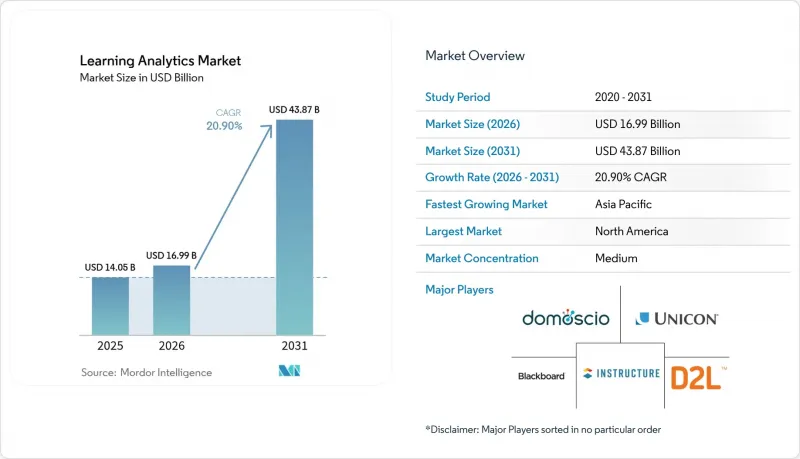
This report is Segmented by Offerings (Software, and Services), Deployment Mode (On-Premise, and Cloud), Analytics Type (Descriptive Analytics, Predictive Analytics, and Prescriptive Analytics), Application (Performance Management and Student Success, Curriculum and Course Development, and More), End User (Academia, and Corporate), and Geography. The Market Forecasts are Provided in Terms of Value (USD).
Global Learning Analytics Market Trends and Insights
Increasing Focus on Improving Student Outcomes and Retention
Institutions now tie financial viability to completion metrics, adopting analytics suites that flag at-risk learners and recommend timely interventions. Post-pandemic enrollment pressures heightened the urgency, and universities using comprehensive platforms have recorded 15-20% gains in first-year retention. Performance-based funding in 28 states links public allocations to student success, turning analytics from optional innovation into operational necessity. The shift also answers accountability demands from accreditors and employers who equate graduate performance with institutional reputation.
Expansion of Cloud-Based Learning Analytics Platforms and MOOCs
Cloud delivery removes infrastructure barriers, letting smaller schools obtain enterprise-grade insights via subscription models. Seamless links with learning management systems shorten deployment cycles, while real-time processing supports personalized feedback loops at scale. Massive Open Online Course providers refine content through continuous cloud analytics, and consortia now share anonymized datasets under stringent encryption standards. The resulting democratization broadens the learning analytics market far beyond early adopters.
Data Privacy and Security Compliance Burden
GDPR and FERPA impose strict consent and data-handling mandates that raise legal and technical costs. Institutions must modernize governance frameworks, encrypt granular learner records, and justify algorithmic decisions to stakeholders, slowing procurement cycles. Vendors, in turn, localize solutions to meet region-specific rules, adding complexity and cost that can delay global rollouts.
Other drivers and restraints analyzed in the detailed report include:
- Government and Institutional EdTech Funding Surge
- Advances in AI/ML Enabling Deeper Analytics Insights
- Shortage of Analytics Talent Within Education Sector
For complete list of drivers and restraints, kindly check the Table Of Contents.
Segment Analysis
Software solutions generated 67.62% of 2025 revenue, forming the backbone of the learning analytics market. Predictive dashboards surface early-warning indicators, while adaptive engines personalize content. Over the forecast horizon, services will outpace software with a 22.52% CAGR, reflecting demand for integration, training, and managed operations. Institutions increasingly rely on partners to bridge technical and pedagogical gaps, underscoring that human expertise remains essential for delivering full value.
Services growth also mirrors rising complexity: multi-source data ingestion, AI model tuning, and evergreen compliance updates require specialized skills. Consulting and managed services firms therefore secure long-term contracts as schools seek outcome guarantees rather than licenses alone. As a result, the learning analytics market size attributable to services is projected to rise steadily through 2031 alongside deepening platform penetration.
On-premise architectures retained 70.35% share of the learning analytics market size in 2025, supported by data-sovereignty policies and entrenched campus infrastructure. Yet cloud solutions are expanding at 22.96% CAGR, driven by elastic capacity and subscription pricing that lower total cost of ownership. Institutions that moved to the cloud during pandemic disruptions seldom revert, citing seamless remote access and quicker feature updates.
Hybrid frameworks now emerge, letting schools keep sensitive datasets on local servers while harnessing cloud compute for intensive analytics. This layered architecture reconciles privacy mandates with scalability, and it encourages incremental migration paths that further enlarge the learning analytics market. Vendors offering flexible deployment options thus appeal to both risk-averse and forward-leaning customers.
Complete Report Scope:
- By Offerings
- Software
- Predictive Analytics Tools
- Descriptive and Diagnostic Dashboards
- Adaptive Learning Platforms
- Services
- Professional Services
- Managed Services
- Software
- By Deployment Mode
- On-Premise
- Cloud
- By Analytics Type
- Descriptive Analytics
- Predictive Analytics
- Prescriptive Analytics
- By Application
- Performance Management and Student Success
- Curriculum and Course Development
- Assessment and Adaptive Learning
- Recruitment, Marketing and Retention
- By End User
- Academia
- K-12 Schools
- Higher Education Institutions
- Corporate
- Large Enterprises
- Small and Medium Enterprises (SMEs)
- Academia
- By Geography
- North America
- United States
- Canada
- Mexico
- Europe
- Germany
- United Kingdom
- France
- Italy
- Spain
- Russia
- Rest of Europe
- Asia-Pacific
- China
- Japan
- India
- South Korea
- Australia and New Zealand
- Rest of Asia-Pacific
- South America
- Brazil
- Argentina
- Rest of South America
- Middle East and Africa
- Middle East
- Saudi Arabia
- United Arab Emirates
- Turkey
- Rest of Middle East
- Africa
- South Africa
- Nigeria
- Rest of Africa
- Middle East
- North America
Geography Analysis
North America kept its leadership with 38.12% share in 2025 owing to mature EdTech ecosystems, clear funding channels, and balanced privacy frameworks that foster trust. Federal initiatives such as the U-GAIN program channel resources into scalable solutions, encouraging institutions to embed analytics in daily operations. Canada's provincial strategies echo this momentum, reinforcing regional dominance.
Asia-Pacific represents the most dynamic arena with a 21.62% CAGR forecast. India's ₹500 crore AI Centre of Excellence and China's modernization policies funnel capital and policy support toward data-driven instruction. Markets such as Japan and South Korea contribute through early 5G adoption and high digital readiness. Despite heterogeneous regulations, the region's demographic scale and government backing fuel sustained expansion of the learning analytics market.
Europe keeps steady growth, propelled by GDPR-compliant solutions that reconcile analytics value with strict privacy mandates. The UK's GBP 4 million (USD 5.43 million) AI teacher-support scheme illustrates policy-level confidence, while Germany and France fund institution-level digital transitions. Vendors able to demonstrate airtight compliance enjoy a clear advantage, reinforcing a specialized yet sizeable subsection of the learning analytics market.
- Instructure Inc. (Canvas)
- Blackboard Inc.
- D2L Corporation (Brightspace)
- Civitas Learning Inc.
- Hobsons Inc. (Naviance)
- Domoscio
- Unicon Inc.
- Watershed Systems
- BrightBytes Inc.
- Certica Solutions Inc.
- IBM Corporation
- Oracle Corporation
- Microsoft Corporation
- SAS Institute Inc.
- Google LLC (Education)
- PowerSchool Holdings Inc.
- Turnitin LLC
- Knewton (Wiley)
- Squirrel AI
- Apereo Foundation (OpenLRS, Sakai)
Additional Benefits:
- The market estimate (ME) sheet in Excel format
- 3 months of analyst support
TABLE OF CONTENTS
1 INTRODUCTION
- 1.1 Study Assumptions and Market Definition
- 1.2 Scope of the Study
2 RESEARCH METHODOLOGY
3 EXECUTIVE SUMMARY
4 MARKET LANDSCAPE
- 4.1 Market Overview
- 4.2 Market Drivers
- 4.2.1 Increasing focus on improving student outcomes and retention
- 4.2.2 Expansion of cloud-based learning analytics platforms and MOOCs
- 4.2.3 Government and institutional EdTech funding surge
- 4.2.4 Advances in AI/ML enabling deeper analytics insights
- 4.2.5 Integration of Learning Record Stores with XR content
- 4.2.6 Outcome-based funding models driving analytics adoption
- 4.3 Market Restraints
- 4.3.1 Data privacy and security compliance burden
- 4.3.2 Shortage of analytics talent within education sector
- 4.3.3 Vendor lock-in and NGDLE interoperability gaps
- 4.3.4 Algorithmic bias scrutiny slowing procurements
- 4.4 Value Chain Analysis
- 4.5 Regulatory Landscape
- 4.6 Technological Outlook
- 4.7 Porter's Five Forces Analysis
- 4.7.1 Bargaining Power of Suppliers
- 4.7.2 Bargaining Power of Buyers
- 4.7.3 Threat of New Entrants
- 4.7.4 Threat of Substitutes
- 4.7.5 Intensity of Competitive Rivalry
- 4.8 Assessment of the Impact of Macroeconomic Trends on the Market
- 4.9 Investment Analysis
5 MARKET SIZE AND GROWTH FORECASTS (VALUE)
- 5.1 By Offerings
- 5.1.1 Software
- 5.1.1.1 Predictive Analytics Tools
- 5.1.1.2 Descriptive and Diagnostic Dashboards
- 5.1.1.3 Adaptive Learning Platforms
- 5.1.2 Services
- 5.1.2.1 Professional Services
- 5.1.2.2 Managed Services
- 5.1.1 Software
- 5.2 By Deployment Mode
- 5.2.1 On-Premise
- 5.2.2 Cloud
- 5.3 By Analytics Type
- 5.3.1 Descriptive Analytics
- 5.3.2 Predictive Analytics
- 5.3.3 Prescriptive Analytics
- 5.4 By Application
- 5.4.1 Performance Management and Student Success
- 5.4.2 Curriculum and Course Development
- 5.4.3 Assessment and Adaptive Learning
- 5.4.4 Recruitment, Marketing and Retention
- 5.5 By End User
- 5.5.1 Academia
- 5.5.1.1 K-12 Schools
- 5.5.1.2 Higher Education Institutions
- 5.5.2 Corporate
- 5.5.2.1 Large Enterprises
- 5.5.2.2 Small and Medium Enterprises (SMEs)
- 5.5.1 Academia
- 5.6 By Geography
- 5.6.1 North America
- 5.6.1.1 United States
- 5.6.1.2 Canada
- 5.6.1.3 Mexico
- 5.6.2 Europe
- 5.6.2.1 Germany
- 5.6.2.2 United Kingdom
- 5.6.2.3 France
- 5.6.2.4 Italy
- 5.6.2.5 Spain
- 5.6.2.6 Russia
- 5.6.2.7 Rest of Europe
- 5.6.3 Asia-Pacific
- 5.6.3.1 China
- 5.6.3.2 Japan
- 5.6.3.3 India
- 5.6.3.4 South Korea
- 5.6.3.5 Australia and New Zealand
- 5.6.3.6 Rest of Asia-Pacific
- 5.6.4 South America
- 5.6.4.1 Brazil
- 5.6.4.2 Argentina
- 5.6.4.3 Rest of South America
- 5.6.5 Middle East and Africa
- 5.6.5.1 Middle East
- 5.6.5.1.1 Saudi Arabia
- 5.6.5.1.2 United Arab Emirates
- 5.6.5.1.3 Turkey
- 5.6.5.1.4 Rest of Middle East
- 5.6.5.2 Africa
- 5.6.5.2.1 South Africa
- 5.6.5.2.2 Nigeria
- 5.6.5.2.3 Rest of Africa
- 5.6.5.1 Middle East
- 5.6.1 North America
6 COMPETITIVE LANDSCAPE
- 6.1 Market Concentration
- 6.2 Strategic Moves
- 6.3 Market Share Analysis
- 6.4 Company Profiles (includes Global level Overview, Market level overview, Core Segments, Financials as available, Strategic Information, Market Rank/Share, Products and Services, Recent Developments)
- 6.4.1 Instructure Inc. (Canvas)
- 6.4.2 Blackboard Inc.
- 6.4.3 D2L Corporation (Brightspace)
- 6.4.4 Civitas Learning Inc.
- 6.4.5 Hobsons Inc. (Naviance)
- 6.4.6 Domoscio
- 6.4.7 Unicon Inc.
- 6.4.8 Watershed Systems
- 6.4.9 BrightBytes Inc.
- 6.4.10 Certica Solutions Inc.
- 6.4.11 IBM Corporation
- 6.4.12 Oracle Corporation
- 6.4.13 Microsoft Corporation
- 6.4.14 SAS Institute Inc.
- 6.4.15 Google LLC (Education)
- 6.4.16 PowerSchool Holdings Inc.
- 6.4.17 Turnitin LLC
- 6.4.18 Knewton (Wiley)
- 6.4.19 Squirrel AI
- 6.4.20 Apereo Foundation (OpenLRS, Sakai)
7 MARKET OPPORTUNITIES AND FUTURE OUTLOOK
- 7.1 White-space and Unmet-Need Assessment

