PUBLISHER: Mordor Intelligence | PRODUCT CODE: 2115785

PUBLISHER: Mordor Intelligence | PRODUCT CODE: 2115785
Task Management Software - Market Share Analysis, Industry Trends & Statistics, Growth Forecasts (2026 - 2031)
According to Mordor Intelligence, the task management software market size was valued at USD 1.27 billion in 2025 and estimated to grow from USD 1.44 billion in 2026 to reach USD 2.66 billion by 2031, at a CAGR of 13.1% during the forecast period (2026-2031).
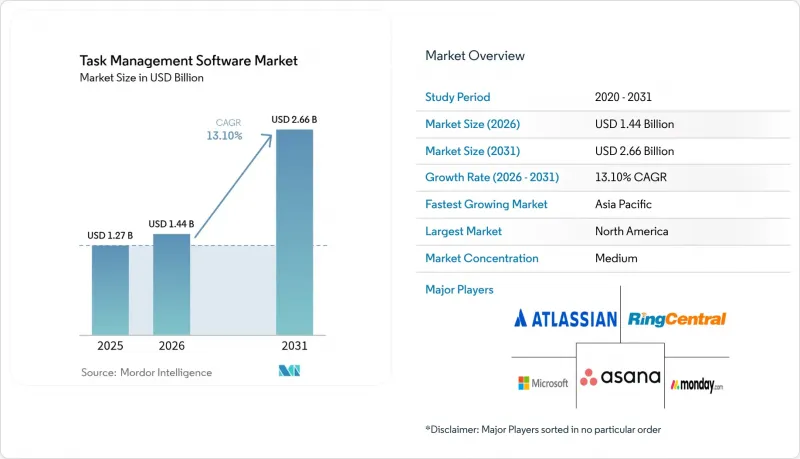
This report is Segmented by Component (Software, and Services), Organization Size (Small and Medium Enterprises, and Large Enterprises), Deployment Mode (Cloud, and On-Premises), End-User Industry (BFSI, Manufacturing, and More), Business Function (Marketing and Creative, HR and Recruiting, and More), and Geography (North America, and More). The Market Forecasts are Provided in Terms of Value (USD).
Global Task Management Software Market Trends and Insights
Rapid Adoption of Cloud by SMEs
Subscription pricing removes capital expense, automatic updates protect feature parity, and bundled modules increase wallet share, encouraging smaller firms to migrate en masse. A 2024 Indian survey showed half of SMEs ranking cloud infrastructure as the top IT priority. Salesforce reports that 52% of small businesses already use AI-enabled tools, paying a median USD 29 per user monthly, evidence that cloud economics have democratized advanced capabilities. Vendors now bundle CRM, HR, and accounting with task orchestration, deepening lock-in. Emerging-market SMEs, unburdened by legacy systems, adopt full-stack cloud suites in greenfield rollouts. Minimal regulatory friction exists, though providers increasingly open regional data centers to meet local privacy rules.
Expansion of Hybrid and Remote Workforces
Global firms now manage employees who collaborate across time zones and device types, which amplifies the need for unified task visibility. Fragmented tool stacks create duplicate work, missed dependencies, and unnecessary meetings that erode productivity gains. Modern platforms consolidate project feeds, chat threads, and status indicators into a single pane of glass that reduces administrative overhead for managers. Real-time dashboards surface workload balance and risk metrics, enabling proactive interventions rather than reactive fire-fighting. Embedded ambient intelligence captures work events automatically, so individual contributors update fewer fields while leadership still obtains complete audit trails. Asynchronous collaboration features such as comment threads and automated reminders further streamline hand-offs.
Persistent SaaS Sprawl and Integration Fatigue
Organizations juggle 50-plus cloud applications on average, and 60% of IT leaders still add new tools each month, creating sprawling ecosystems that drain performance gains. Connecting so many point solutions requires ongoing API maintenance, license governance, and security hardening that consume precious engineering hours. The resulting integration fatigue encourages vendor consolidation toward multi-module suites that promise lower total cost of ownership. Enterprises wasted USD 18 million annually on redundant SaaS spending in 2024, prompting nearly every CIO survey respondent to prioritize rationalization roadmaps over the next fiscal year. Comprehensive task management suites that incorporate chat, document management, and analytics reduce swivel-chair overhead and centralize data lineage.
Other drivers and restraints analyzed in the detailed report include:
- Vertical-Specific Task Suites for Regulated Industries
- Rise of Low-Code and No-Code Platforms
- Data-Residency and Sovereignty Regulations
For complete list of drivers and restraints, kindly check the Table Of Contents.
Segment Analysis
Managed services grew 16.8% annually and are expected to continue outpacing overall task management software market growth as enterprises seek turnkey delivery of AI-driven workflow design and optimization. Software packages still represented 64.10% revenue in 2025 because they provide the digital foundation, yet many buyers lack in-house teams to configure advanced rules, train machine learning models, and integrate legacy applications. Services specialists close this gap by offering playbooks that shorten time to value and outcome-based contracts that align provider incentives with productivity gains. The partnership model often includes continuous improvement programs that calibrate orchestration engines against evolving staffing patterns and compliance mandates.
Providers now bundle change-management training, governance audits, and security remediation into annual engagements, creating recurring revenue streams that rival license subscriptions. This service-led adoption pattern is expected to raise platform stickiness because clients embed vendor resources deep within operational teams. Vendors that can seamlessly convert engagement data into new product features will secure long-term competitive moats in the task management software market.
Large enterprises captured 54.60% 2025 revenue due to complex program portfolios that demand robust reporting, single sign-on, and granular permissions. Nonetheless, SMEs will expand at 14.1% CAGR through 2031 as intuitive onboarding, affordable per-seat pricing, and low-code flexibility level the competitive playing field. Cloud-native architectures eliminate hardware spend and shorten procurement cycles, helping smaller firms deploy enterprise-grade automation within days rather than quarters.
The task management software market size for the SME segment is projected to approach parity with the large-enterprise segment near the end of the decade as growing firms scale usage across newly formed teams. Vendors that nurture freemium or tiered offerings stand to convert initial projects into organization-wide deployments, driving predictable expansion revenue. Community forums, template libraries, and localized language packs further accelerate adoption in emerging economies.
Complete Report Scope:
- By Component
- Software
- Stand-alone Task Management Apps
- Integrated Project and Work-Management Suites
- Services
- Professional (Implementation, Consulting)
- Managed Services
- Software
- By Organization Size
- Small and Medium Enterprises
- Large Enterprises
- By Deployment Mode
- Cloud
- Public Cloud
- Private and Hybrid Cloud
- On-Premise
- Cloud
- By End-User Industry
- BFSI
- IT and Telecommunication
- Retail and eCommerce
- Manufacturing
- Healthcare and Life-Sciences
- Government and Public Sector
- Travel, Tourism and Hospitality
- Other End-User Industrys (Education, Media, etc.)
- By Business Function
- Marketing and Creative
- HR and Recruiting
- Finance and Accounting
- Sales and Customer Success
- By Geography
- North America
- United States
- Canada
- Mexico
- South America
- Brazil
- Argentina
- Chile
- Rest of South America
- Europe
- United Kingdom
- Germany
- France
- Italy
- Spain
- Rest of Europe
- Asia-Pacific
- China
- Japan
- India
- South Korea
- Australia and New Zealand
- Rest of Asia-Pacific
- Middle East and Africa
- Middle East
- United Arab Emirates
- Saudi Arabia
- Turkey
- Rest of Middle East
- Africa
- South Africa
- Kenya
- Nigeria
- Rest of Africa
- Middle East
- North America
Geography Analysis
North America retained 37.10% of 2025 revenue because early adopters rely on AI-augmented orchestration to satisfy Sarbanes-Oxley audit requirements and to mitigate worker shortage pressures. Tight integration between task engines and incumbent productivity suites accelerates rollout because most enterprises are already entrenched in large vendor ecosystems. Robust venture funding and a vibrant startup landscape also feed rapid product innovation cycles that resonate with buyers seeking competitive differentiation.
Asia Pacific is advancing at a 13.8% CAGR as improved mobile broadband coverage, government cloud incentives, and SME digitalization programs combine to create favorable market conditions. Countries such as India and Indonesia champion domestic SaaS champions that localize pricing and language, while China's regulatory environment favors providers with sovereign cloud options. Many regional businesses leapfrog legacy on-premise deployments altogether, adopting cloud or hybrid task engines that support geographically dispersed supply chains across Southeast Asia.
Europe maintains steady growth despite navigating GDPR, DORA, and emerging artificial-intelligence risk guidelines that raise implementation complexity. Vendors that operate within the region respond by offering data-residency controls, customer-managed encryption keys, and continuous compliance reporting that align with stringent privacy norms. Southern Europe is witnessing accelerated uptake among mid-market exporters who seek operational visibility across far-flung subsidiaries. Elsewhere, Latin America, the Middle East, and Africa remain nascent but promising as cloud infrastructure expands and public-sector modernization programs anchor early demand for structured project oversight.
- Microsoft Corporation
- Atlassian Corporation Plc
- Asana, Inc.
- monday.com Ltd.
- Smartsheet Inc.
- Adobe Inc. (Workfront)
- RingCentral, Inc.
- Citrix Systems, Inc. (Wrike)
- Basecamp LLC
- ClickUp Inc.
- Quickbase, Inc.
- Redbooth, Inc.
- Upland Software, Inc.
- SAP SE
- Oracle Corporation (NetSuite)
- ServiceNow Inc.
- Zoho Corporation Pvt Ltd. (Zoho Projects)
- Airtable, Inc.
- Notion Labs, Inc.
- ProofHub LLC
Additional Benefits:
- The market estimate (ME) sheet in Excel format
- 3 months of analyst support
TABLE OF CONTENTS
1 Introduction
- 1.1 Study Assumptions and Market Definition
- 1.2 Scope of the Study
2 Research Methodology
3 Executive Summary
4 Market Landscape
- 4.1 Market Overview
- 4.2 Market Drivers
- 4.2.1 Rapid Adoption of Cloud by SMEs
- 4.2.2 Explosion of Hybrid/Remote Workforces Requiring Unified Task Visibility
- 4.2.3 Vertical-Specific Task Suites for Regulated Industries
- 4.2.4 Rise of Low-Code/No-Code Platforms that Embed Task Engines
- 4.2.5 Bundling of Task Analytics into Employee-Experience (EX) Cloud Stacks
- 4.2.6 ESG Compliance and Audit-Trail Mandates Boosting Traceable Task Workflows
- 4.3 Market Restraints
- 4.3.1 Persistent Saas Sprawl Creating Integration Fatigue
- 4.3.2 Data-Residency and Sovereignty Regulations Slowing Multi-Tenant Adoption
- 4.3.3 Change-Management Inertia In Legacy-Heavy Verticals (Manufacturing, Public Sector)
- 4.3.4 AI-Generated Task Recommendations Facing Explainability Scrutiny
- 4.4 Industry Value / Supply-Chain Analysis
- 4.5 Regulatory Landscape
- 4.6 Technological Outlook
- 4.7 Impact of Macroeconomic Factors on the Market
- 4.8 Porter's Five Forces Analysis
- 4.8.1 Threat of New Entrants
- 4.8.2 Bargaining Power of Buyers
- 4.8.3 Bargaining Power of Suppliers
- 4.8.4 Threat of Substitutes
- 4.8.5 Competitive Rivalry
5 MARKET SIZE AND GROWTH FORECASTS (VALUE)
- 5.1 By Component
- 5.1.1 Software
- 5.1.1.1 Stand-alone Task Management Apps
- 5.1.1.2 Integrated Project and Work-Management Suites
- 5.1.2 Services
- 5.1.2.1 Professional (Implementation, Consulting)
- 5.1.2.2 Managed Services
- 5.1.1 Software
- 5.2 By Organization Size
- 5.2.1 Small and Medium Enterprises
- 5.2.2 Large Enterprises
- 5.3 By Deployment Mode
- 5.3.1 Cloud
- 5.3.1.1 Public Cloud
- 5.3.1.2 Private and Hybrid Cloud
- 5.3.2 On-Premise
- 5.3.1 Cloud
- 5.4 By End-User Industry
- 5.4.1 BFSI
- 5.4.2 IT and Telecommunication
- 5.4.3 Retail and eCommerce
- 5.4.4 Manufacturing
- 5.4.5 Healthcare and Life-Sciences
- 5.4.6 Government and Public Sector
- 5.4.7 Travel, Tourism and Hospitality
- 5.4.8 Other End-User Industrys (Education, Media, etc.)
- 5.5 By Business Function
- 5.5.1 Marketing and Creative
- 5.5.2 HR and Recruiting
- 5.5.3 Finance and Accounting
- 5.5.4 Sales and Customer Success
- 5.6 By Geography
- 5.6.1 North America
- 5.6.1.1 United States
- 5.6.1.2 Canada
- 5.6.1.3 Mexico
- 5.6.2 South America
- 5.6.2.1 Brazil
- 5.6.2.2 Argentina
- 5.6.2.3 Chile
- 5.6.2.4 Rest of South America
- 5.6.3 Europe
- 5.6.3.1 United Kingdom
- 5.6.3.2 Germany
- 5.6.3.3 France
- 5.6.3.4 Italy
- 5.6.3.5 Spain
- 5.6.3.6 Rest of Europe
- 5.6.4 Asia-Pacific
- 5.6.4.1 China
- 5.6.4.2 Japan
- 5.6.4.3 India
- 5.6.4.4 South Korea
- 5.6.4.5 Australia and New Zealand
- 5.6.4.6 Rest of Asia-Pacific
- 5.6.5 Middle East and Africa
- 5.6.5.1 Middle East
- 5.6.5.1.1 United Arab Emirates
- 5.6.5.1.2 Saudi Arabia
- 5.6.5.1.3 Turkey
- 5.6.5.1.4 Rest of Middle East
- 5.6.5.2 Africa
- 5.6.5.2.1 South Africa
- 5.6.5.2.2 Kenya
- 5.6.5.2.3 Nigeria
- 5.6.5.2.4 Rest of Africa
- 5.6.5.1 Middle East
- 5.6.1 North America
6 Competitive Landscape
- 6.1 Market Concentration
- 6.2 Market Share Analysis
- 6.3 Company Profiles (includes Global level Overview, Market level overview, Core Segments, Financials as available, Strategic Information, Market Rank/Share for key companies, Products and Services, and Recent Developments)
- 6.3.1 Microsoft Corporation
- 6.3.2 Atlassian Corporation Plc
- 6.3.3 Asana, Inc.
- 6.3.4 monday.com Ltd.
- 6.3.5 Smartsheet Inc.
- 6.3.6 Adobe Inc. (Workfront)
- 6.3.7 RingCentral, Inc.
- 6.3.8 Citrix Systems, Inc. (Wrike)
- 6.3.9 Basecamp LLC
- 6.3.10 ClickUp Inc.
- 6.3.11 Quickbase, Inc.
- 6.3.12 Redbooth, Inc.
- 6.3.13 Upland Software, Inc.
- 6.3.14 SAP SE
- 6.3.15 Oracle Corporation (NetSuite)
- 6.3.16 ServiceNow Inc.
- 6.3.17 Zoho Corporation Pvt Ltd. (Zoho Projects)
- 6.3.18 Airtable, Inc.
- 6.3.19 Notion Labs, Inc.
- 6.3.20 ProofHub LLC
7 MARKET OPPORTUNITIES AND FUTURE OUTLOOK
- 7.1 White-space and Unmet-Need Assessment

