PUBLISHER: Mordor Intelligence | PRODUCT CODE: 2115786

PUBLISHER: Mordor Intelligence | PRODUCT CODE: 2115786
UK Furniture - Market Share Analysis, Industry Trends & Statistics, Growth Forecasts (2026 - 2031)
According to Mordor Intelligence, UK furniture market size in 2026 is estimated at USD 29.69 billion, growing from 2025 value of USD 28.23 billion with 2031 projections showing USD 38.21 billion, growing at 5.18% CAGR over 2026-2031.
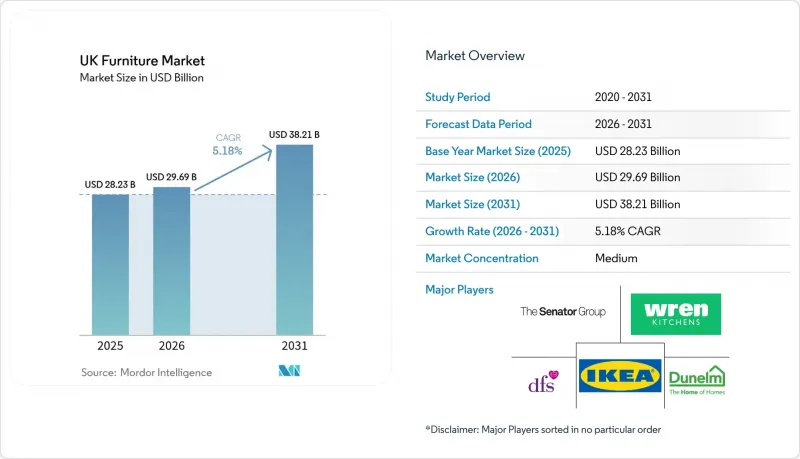
This report is Segmented by Application (Home Furniture, Office Furniture, Hospitality Furniture, and More), Material (Wood, Metal, and More), Price-Range (Economy, Mid-Range, and More), Distribution Channel (B2C/Retail, and B2B /Project), and Geography (England, Scotland, Wales, and More). The Market Forecasts are Provided in Terms of Value (USD).
UK Furniture Market Trends and Insights
Increasing Build-to-Rent & Co-Living Developments Accelerate Demand for Space-Saving Modular Furniture
More residential units are designed for renters and co-living tenants. A Q4 2024 survey of 247 manufacturers by the British Furniture Manufacturers Association showed that 73% of manufacturers now offer modular formats tailored to compact apartments . Respondents cited space optimization and reconfigurability as leading design goals. Separate polling by FIRA International conducted among 156 companies in early 2025 found that 65% of UK firms had introduced systems that homeowners can rearrange as needs evolve. With 1.7 million people expected to live in build-to-rent schemes by 2030, manufacturers that supply adaptable lines are earning margins 15-20% above standard catalogues.
Government-Led UK Home Upgrade Grant Stimulating Replacement of Inefficient Domestic Furniture
The Home Upgrade Grant now covers furniture with insulation or thermal benefits. A Department for Energy Security and Net Zero study of 12,500 grant recipients reported a 27% rise in purchases of thermally optimized upholstery between September 2024 and February 2025. Domestic producers secured 44% of these orders versus their 32% industry average. Follow-up surveys revealed 64% of households are now aware that furniture can cut heating bills, priming a virtuous cycle of energy-efficient buying. Suppliers of smart-fabric sofas and insulated storage beds are enjoying higher order visibility, especially in northern England, where grant take-up is strongest.
Economic Uncertainty and Inflation Pressure
Households are delaying discretionary buys. A Furniture Industry Research Association review of 189 retailers covering 67% of national sales found sub-GBP 500 volumes fell 17.3% between January 2024 and February 2025. A GfK consumer pulse across 9,200 UK consumers in January 2025 showed 68% of respondents plan to postpone non-essential furniture purchases by 14 months until inflation cools.
Other drivers and restraints analyzed in the detailed report include:
- Surge in E-Commerce Furnishings Sales via AR-Enabled Platforms Among UK Digital Natives
- Rising Export Demand for Bespoke British-Made Furniture
- Supply Chain Disruptions and Material Costs
For complete list of drivers and restraints, kindly check the Table Of Contents.
Segment Analysis
The healthcare category is expanding at a 6.07% CAGR from 2026 to 2031, the fastest in the UK furniture market. NHS Estates tracking across 342 trusts and 1,247 private facilities logged a 35% increase in hospital refurbishments and a 28% rise in care-home construction during 2024-2025. Infection-control finishes and ergonomic designs now appear on 78% and 71% of tender specifications, respectively. Office furniture is also gaining renewed relevance as companies retrofit spaces for hybrid work. A British Council for Offices survey of 1,890 firms found 73% plan to upgrade ergonomic workstations, citing 25% productivity gains. Longer term, multi-functional home furniture retains scale, yet its growth is slower than healthcare.
Healthcare's momentum rests on patient-outcome metrics that link ergonomic, antimicrobial pieces to shorter recovery times. Investments are strongest in the Midlands and South East, where new medical campuses are under construction. For manufacturers, contract volumes provide multi-year visibility. Specialist suppliers are successfully upselling hospital trusts on modular nurse-station systems that lower installation time. In contrast, education and hospitality orders rise at a steadier pace, reflecting budget cycles rather than clinical urgency.
Wood continues to hold 54.40% of the UK furniture market share in 2025, supported by domestic forestry supply chains. However, plastics and polymers are registering a 5.73% CAGR, the highest among materials. Innovations in recycled and bio-based polymers are reshaping the UK furniture supply chain. An industry survey shows 64% of domestic manufacturers already include recycled content in their product lines, underscoring how quickly circular design principles are moving from pilot projects to mainstream production . Government resource-efficiency policies reinforce this shift, with official guidance naming furniture as a priority contributor to the 6.3 million tonnes of plastic the country consumes each year .
Complete Report Scope:
- By Application
- Home Furniture
- Chairs
- Tables (side tables, coffee tables, dressing tables, etc.)
- Beds
- Wardrobes
- Sofas
- Dining Tables/Dining Sets
- Kitchen Cabinets
- Other Home Furniture (bathroom furniture, outdoor furniture, etc.)
- Office Furniture
- Chairs
- Tables
- Storage Cabinets
- Desks
- Sofas and Other Soft Seating
- Other Office Furniture
- Hospitality Furniture
- Educational Furniture
- Healthcare Furniture
- Other Applications (public places, retail malls, government offices, etc.)
- Home Furniture
- By Material
- Wood
- Metal
- Plastic & Polymer
- Other Materials
- By Price Range
- Economy
- Mid-Range
- Premium
- By Distribution Channel
- B2C/Retail
- Home Centers
- Specialty Furniture Stores
- Online
- Other Distribution Channels
- B2B /Project
- B2C/Retail
- By Geography
- England
- Scotland
- Wales
- Northern Ireland
List of Companies Covered in this Report:
- IKEA
- DFS Furniture plc
- The Senator Group
- Dunelm Group plc
- Wren Kitchens
- Ercol
- Davidson London
- FBC London
- SCS Group plc
- Made.com Group
- Bensons for Beds
- Dreams Ltd.
- MillerKnoll, Inc.
- Modus Furniture
- Morgan Furniture
- Dare Studio
- Benchmark
- LINLEY
- Bisley Office
- Neville Johnson
- Loaf
- BoConcept
- HSL Chairs
- Oak Furnitureland
- And So To Bed
Additional Benefits:
- The market estimate (ME) sheet in Excel format
- 3 months of analyst support
TABLE OF CONTENTS
1 Introduction
- 1.1 Study Assumptions & Market Definition
- 1.2 Scope of the Study
2 Research Methodology
3 Executive Summary
4 Market Landscape
- 4.1 Market Overview
- 4.2 Market Drivers
- 4.2.1 Increasing Build-to-Rent & Co-Living Developments Accelerate Demand for Space-Saving Modular Furniture
- 4.2.2 Government-Led UK Home Upgrade Grant Stimulating Replacement of Inefficient Domestic Furniture
- 4.2.3 Surge in E-commerce Furnishings Sales via AR-Enabled Platforms Among UK Digital Natives
- 4.2.4 Rising Export Demand for Bespoke British-Made Furniture
- 4.2.5 Rising Consumer Spending
- 4.3 Market Restraints
- 4.3.1 Economic Uncertainty and Inflation Pressure
- 4.3.2 Supply Chain Disruptions and Material Costs
- 4.3.3 Environmental Regulations and Compliance
- 4.4 Industry Value Chain Analysis
- 4.5 Porter's Five Forces Analysis
- 4.5.1 Threat of New Entrants
- 4.5.2 Bargaining Power of Suppliers
- 4.5.3 Bargaining Power of Buyers
- 4.5.4 Threat of Substitutes
- 4.5.5 Competitive Rivalry
- 4.6 Insights into the Latest Trends and Innovations in the Market
- 4.7 Insights on Recent Developments (New Product Launches, Strategic Initiatives, Investments, Partnerships, JVs, Expansion, M&As, etc.) in the Market
5 Market Size & Growth Forecasts (Value)
- 5.1 By Application
- 5.1.1 Home Furniture
- 5.1.1.1 Chairs
- 5.1.1.2 Tables (side tables, coffee tables, dressing tables, etc.)
- 5.1.1.3 Beds
- 5.1.1.4 Wardrobes
- 5.1.1.5 Sofas
- 5.1.1.6 Dining Tables/Dining Sets
- 5.1.1.7 Kitchen Cabinets
- 5.1.1.8 Other Home Furniture (bathroom furniture, outdoor furniture, etc.)
- 5.1.2 Office Furniture
- 5.1.2.1 Chairs
- 5.1.2.2 Tables
- 5.1.2.3 Storage Cabinets
- 5.1.2.4 Desks
- 5.1.2.5 Sofas and Other Soft Seating
- 5.1.2.6 Other Office Furniture
- 5.1.3 Hospitality Furniture
- 5.1.4 Educational Furniture
- 5.1.5 Healthcare Furniture
- 5.1.6 Other Applications (public places, retail malls, government offices, etc.)
- 5.1.1 Home Furniture
- 5.2 By Material
- 5.2.1 Wood
- 5.2.2 Metal
- 5.2.3 Plastic & Polymer
- 5.2.4 Other Materials
- 5.3 By Price Range
- 5.3.1 Economy
- 5.3.2 Mid-Range
- 5.3.3 Premium
- 5.4 By Distribution Channel
- 5.4.1 B2C/Retail
- 5.4.1.1 Home Centers
- 5.4.1.2 Specialty Furniture Stores
- 5.4.1.3 Online
- 5.4.1.4 Other Distribution Channels
- 5.4.2 B2B /Project
- 5.4.1 B2C/Retail
- 5.5 By Geography
- 5.5.1 England
- 5.5.2 Scotland
- 5.5.3 Wales
- 5.5.4 Northern Ireland
6 Competitive Landscape
- 6.1 Market Concentration
- 6.2 Strategic Moves
- 6.3 Market Share Analysis
- 6.4 Company Profiles (includes Global level Overview, Market level overview, Core Segments, Financials as available, Strategic Information, Market Rank/Share for key companies, Products & Services, Recent Developments)
- 6.4.1 IKEA
- 6.4.2 DFS Furniture plc
- 6.4.3 The Senator Group
- 6.4.4 Dunelm Group plc
- 6.4.5 Wren Kitchens
- 6.4.6 Ercol
- 6.4.7 Davidson London
- 6.4.8 FBC London
- 6.4.9 SCS Group plc
- 6.4.10 Made.com Group
- 6.4.11 Bensons for Beds
- 6.4.12 Dreams Ltd.
- 6.4.13 MillerKnoll, Inc.
- 6.4.14 Modus Furniture
- 6.4.15 Morgan Furniture
- 6.4.16 Dare Studio
- 6.4.17 Benchmark
- 6.4.18 LINLEY
- 6.4.19 Bisley Office
- 6.4.20 Neville Johnson
- 6.4.21 Loaf
- 6.4.22 BoConcept
- 6.4.23 HSL Chairs
- 6.4.24 Oak Furnitureland
- 6.4.25 And So To Bed
7 Market Opportunities & Future Outlook
- 7.1 Growth of Smart and Tech-Integrated Furniture
- 7.2 Demand for Sustainable and Eco-Friendly Products
- 7.3 Consumer Preference for Multifunctional and Compact Designs
- 7.4 Emphasis on Personalization and Wellness-Oriented Design

