PUBLISHER: Mordor Intelligence | PRODUCT CODE: 2115789

PUBLISHER: Mordor Intelligence | PRODUCT CODE: 2115789
Global Amyotrophic Lateral Sclerosis Treatment - Market Share Analysis, Industry Trends & Statistics, Growth Forecasts (2026 - 2031)
According to Mordor Intelligence, the amyotrophic lateral sclerosis treatment market size was valued at USD 0.9 billion in 2025 and estimated to grow from USD 952.74 million in 2026 to reach USD 1.27 billion by 2031, at a CAGR of 5.86% during the forecast period (2026-2031).
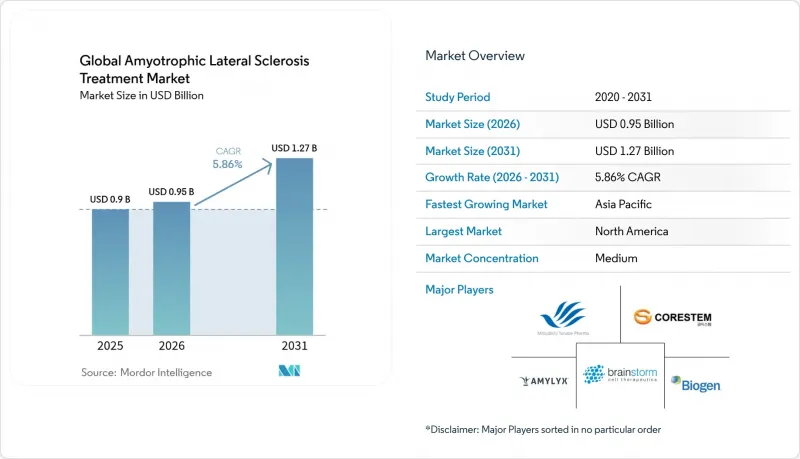
This report is Segmented by Treatment Type (Medication and Others), Distribution Channel (Hospital Pharmacies, Retail Pharmacies, and Others), and Geography (North America, Europe, Asia-Pacific, Middle East and Africa, and South America). The Report Offers the Value (in USD Million) for the Above Segments.
Global Amyotrophic Lateral Sclerosis Treatment Market Trends and Insights
Growing Incidence and Prevalence of ALS
Epidemiologic studies record rising ALS incidence, especially in aging Western populations, where enhanced neurodiagnostic tools have trimmed diagnostic delay from 16 months to under 12 months.Earlier detection widens the therapeutic window for ASOs that show greatest efficacy in presymptomatic carriers, thereby boosting unit demand and supporting premium pricing. Emerging economies post parallel prevalence gains as specialist neurologists and genetic testing become more available. The demographic surge combines with precision medicine momentum to reinforce sustained volume growth in the Amyotrophic lateral sclerosis treatment market.
Regulatory Tailwinds for Orphan / Rare-Disease Drugs
The FDA's accelerated approval of tofersen on biomarker endpoints and the EMA's 2024 endorsement under exceptional-circumstances status underscored a transatlantic realignment toward expedited, evidence-adaptive reviews. Parallel incentives such as fee waivers, priority vouchers, and extended exclusivity, among others, attract venture financing and shorten average development timelines by 3-5 years. Health technology agencies are increasingly receptive to surrogate endpoints, easing reimbursement hurdles for validated biomarker-directed products.
High Treatment Costs and Limited Reimbursement
Annual therapy costs for approved ASOs exceed USD 450,000, and real-world analyses show out-of-pocket spending topping USD 36,000 when supplemental coverage is absent. European payers apply stringent cost-effectiveness thresholds, delaying launches by one to two reimbursement cycles. In middle-income countries, list prices surpass per-capita income, severely curtailing uptake. These affordability gaps temper overall revenue growth despite robust clinical demand.
Other drivers and restraints analyzed in the detailed report include:
- Breakthroughs in Gene and Antisense-Oligonucleotide Therapies
- AI-Driven Drug-Repurposing Accelerating Pipeline Diversity
- Limited Efficacy of Current Disease-Modifying Drugs
For complete list of drivers and restraints, kindly check the Table Of Contents.
Segment Analysis
Medication retained 66.50% revenue leadership in 2025, reflecting entrenched prescribing patterns and widespread availability. Gene & ASO therapies, however, are advancing at a 6.55% CAGR that will narrow the gap through 2031. The Amyotrophic lateral sclerosis treatment market size for gene-based modalities is forecast to rise as hospital formulary committees increasingly endorse intrathecal ASO protocols following consistent biomarker correlation with slowed clinical decline. Capacity bottlenecks in autologous cell manufacturing persist, yet gene-editing platforms avoid many of these constraints, accelerating commercial scale-up.
Stem cell therapy occupies a high-touch niche anchored by South Korea's Neuronata-R approval, while BrainStorm's NurOwn pursues an FDA special protocol. Their progress reinforces sustained investment even as manufacturing scale limitations cap near-term volumes. Oral medications remain the mainstay for symptom control, but payer focus is migrating toward high-value therapies that demonstrably alter disease trajectory, sharpening competitive dynamics across all categories.
Riluzole's 37.40% share benefits from generic penetration and favorable neurologist familiarity, yet ASOs are growing 5.45% annually through 2031 as genetic testing becomes routine at diagnosis. The Amyotrophic lateral sclerosis treatment market share for riluzole is projected to erode once additional mutation-specific ASOs transition from the pipeline to the bedside. Edaravone retains intravenous share but faces safety surveillance over long-term hepatic events, prompting some payers to restrict the duration of therapy. Combination products integrating neuroprotection and anti-inflammatory action are progressing in late-phase trials, signaling a future market composed of multimodal regimens rather than single-agent therapies.
Complete Report Scope:
- By Treatment Type
- Medication
- Stem Cell Therapy
- Gene / ASO Therapy
- Others
- By Drug Class
- Riluzole
- Edaravone
- Antisense Oligonucleotides
- Combination / Multi-target
- Symptomatic Modifiers
- By Route of Administration
- Oral
- Intravenous
- Intrathecal
- Sub-cutaneous
- By End-user
- Hospitals
- Specialty Clinics / ALS Centers
- Home-care Settings
- By Distribution Channel
- Hospital Pharmacies
- Retail Pharmacies
- Online Pharmacies
- By Geography
- North America
- United States
- Canada
- Mexico
- Europe
- Germany
- United Kingdom
- France
- Italy
- Spain
- Rest of Europe
- Asia Pacific
- China
- Japan
- India
- South Korea
- Australia
- Rest of Asia Pacific
- Middle East & Africa
- GCC
- South Africa
- Rest of Middle East & Africa
- South America
- Brazil
- Argentina
- Rest of South America
- North America
Geography Analysis
North America held 42.05% of global revenue in 2025, propelled by immediate Medicare eligibility for ALS patients and early FDA approvals that grant first access to innovative treatments. Legislation such as the ACT for ALS program finances expanded clinical-trial infrastructure, and right-to-try provisions accelerate compassionate-use uptake. Despite comprehensive insurance, coverage caps and variable state supplemental policies expose income-linked disparities in therapy access, especially for ASOs priced beyond USD 400,000.
Europe follows with mature reimbursement networks and the EMA's coordinated authorization pathway that endorsed the first ASO in 2024. Although pan-EU marketing approval is centralized, country-specific health technology appraisals produce launch stagger delays of 6-12 months. Germany's AMNOG framework and the United Kingdom's NICE evaluations often impose early price-volume agreements that shape commercial forecasts. Research consortia anchored in Germany, France, and the United Kingdom underpin a robust clinical-trial ecosystem that draws foreign sponsors.
Asia Pacific posts the highest 6.98% CAGR through 2031 as large unmet need intersects with rapid neurology-center expansion. Japan leads commercial uptake, leveraging prior edaravone familiarity and government funding for neurodegeneration R&D. South Korea's regulatory head start on stem cell therapy positions the country as a manufacturing exporter for regional demand. China's volume opportunity is vast, but provincial reimbursement heterogeneity and lengthy drug-price negotiations delay full monetization. Australia, Singapore, and India are emerging nodes in multinational trial networks, offering enrollment scale and cost efficiencies.
List of Companies Covered in this Report:
- Mitsubishi Tanabe Pharma
- Amylyx Pharmaceuticals
- Sun Pharmaceuticals Industries
- Biogen
- Ionis Pharmaceuticals
- BrainStorm Cell Therapeutics Inc.
- CORESTEM Inc.
- AB Science SA
- Boehringer Ingelheim
- Annexon Biosciences Inc.
- CRISPR Therapeutics AG
- Biohaven Ltd.
- Cytokinetics
- QurAlis Corporation
- MediciNova Inc.
- Takeda Pharmaceuticals
- Neuvivo Inc.
- Acorda Therapeutics
- Cyclerion Therapeutics Inc.
- ALS Biopharma LLC
Additional Benefits:
- The market estimate (ME) sheet in Excel format
- 3 months of analyst support
TABLE OF CONTENTS
1 Introduction
- 1.1 Study Assumptions & Market Definition
- 1.2 Scope of the Study
2 Research Methodology
3 Executive Summary
4 Market Landscape
- 4.1 Market Overview
- 4.2 Market Drivers
- 4.2.1 Growing Incidence And Prevalence Of ALS
- 4.2.2 Regulatory Tailwinds For Orphan / Rare-Disease Drugs
- 4.2.3 Breakthroughs In Gene And Antisense-Oligonucleotide Therapies
- 4.2.4 AI-Driven Drug-Repurposing Accelerating Pipeline Diversity
- 4.2.5 Right-To-Try And Expanded-Access Laws Boosting Early Uptake
- 4.2.6 Adoption Of Digital Biomarkers And Remote Patient Monitoring
- 4.3 Market Restraints
- 4.3.1 High Treatment Costs And Limited Reimbursement
- 4.3.2 Limited Efficacy Of Current Disease-Modifying Drugs
- 4.3.3 Biologics / Autologous-Cell CMC Capacity Bottlenecks
- 4.3.4 Emerging Safety Signals For Long-Term Edaravone Use
- 4.4 Supply Chain Analysis
- 4.5 Regulatory Landscape
- 4.6 Technological Outlook
- 4.7 Porter's Five Forces Analysis
- 4.7.1 Threat of New Entrants
- 4.7.2 Bargaining Power of Buyers
- 4.7.3 Bargaining Power of Suppliers
- 4.7.4 Threat of Substitutes
- 4.7.5 Intensity of Competitive Rivalry
5 Market Size & Growth Forecasts (Value, USD)
- 5.1 By Treatment Type
- 5.1.1 Medication
- 5.1.2 Stem Cell Therapy
- 5.1.3 Gene / ASO Therapy
- 5.1.4 Others
- 5.2 By Drug Class
- 5.2.1 Riluzole
- 5.2.2 Edaravone
- 5.2.3 Antisense Oligonucleotides
- 5.2.4 Combination / Multi-target
- 5.2.5 Symptomatic Modifiers
- 5.3 By Route of Administration
- 5.3.1 Oral
- 5.3.2 Intravenous
- 5.3.3 Intrathecal
- 5.3.4 Sub-cutaneous
- 5.4 By End-user
- 5.4.1 Hospitals
- 5.4.2 Specialty Clinics / ALS Centers
- 5.4.3 Home-care Settings
- 5.5 By Distribution Channel
- 5.5.1 Hospital Pharmacies
- 5.5.2 Retail Pharmacies
- 5.5.3 Online Pharmacies
- 5.6 By Geography
- 5.6.1 North America
- 5.6.1.1 United States
- 5.6.1.2 Canada
- 5.6.1.3 Mexico
- 5.6.2 Europe
- 5.6.2.1 Germany
- 5.6.2.2 United Kingdom
- 5.6.2.3 France
- 5.6.2.4 Italy
- 5.6.2.5 Spain
- 5.6.2.6 Rest of Europe
- 5.6.3 Asia Pacific
- 5.6.3.1 China
- 5.6.3.2 Japan
- 5.6.3.3 India
- 5.6.3.4 South Korea
- 5.6.3.5 Australia
- 5.6.3.6 Rest of Asia Pacific
- 5.6.4 Middle East & Africa
- 5.6.4.1 GCC
- 5.6.4.2 South Africa
- 5.6.4.3 Rest of Middle East & Africa
- 5.6.5 South America
- 5.6.5.1 Brazil
- 5.6.5.2 Argentina
- 5.6.5.3 Rest of South America
- 5.6.1 North America
6 Competitive Landscape
- 6.1 Market Concentration
- 6.2 Market Share Analysis
- 6.3 Company Profiles (includes Global-level Overview, Market-level Overview, Core Segments, Financials, Strategic Info, Market Rank/Share, Products & Services, Recent Developments)
- 6.3.1 Mitsubishi Tanabe Pharma Corporation
- 6.3.2 Amylyx Pharmaceuticals Inc.
- 6.3.3 Sun Pharmaceutical Industries Ltd.
- 6.3.4 Biogen Inc.
- 6.3.5 Ionis Pharmaceuticals Inc.
- 6.3.6 BrainStorm Cell Therapeutics Inc.
- 6.3.7 CORESTEM Inc.
- 6.3.8 AB Science SA
- 6.3.9 Boehringer Ingelheim International GmbH
- 6.3.10 Annexon Biosciences Inc.
- 6.3.11 CRISPR Therapeutics AG
- 6.3.12 Biohaven Ltd.
- 6.3.13 Cytokinetics Inc.
- 6.3.14 QurAlis Corporation
- 6.3.15 MediciNova Inc.
- 6.3.16 Takeda Pharmaceutical Company Ltd.
- 6.3.17 Neuvivo Inc.
- 6.3.18 Acorda Therapeutics Inc.
- 6.3.19 Cyclerion Therapeutics Inc.
- 6.3.20 ALS Biopharma LLC
7 Market Opportunities & Future Outlook
- 7.1 White-space & Unmet-need Assessment

