PUBLISHER: Mordor Intelligence | PRODUCT CODE: 2115795

PUBLISHER: Mordor Intelligence | PRODUCT CODE: 2115795
Fixed Asset Management Software - Market Share Analysis, Industry Trends & Statistics, Growth Forecasts (2026 - 2031)
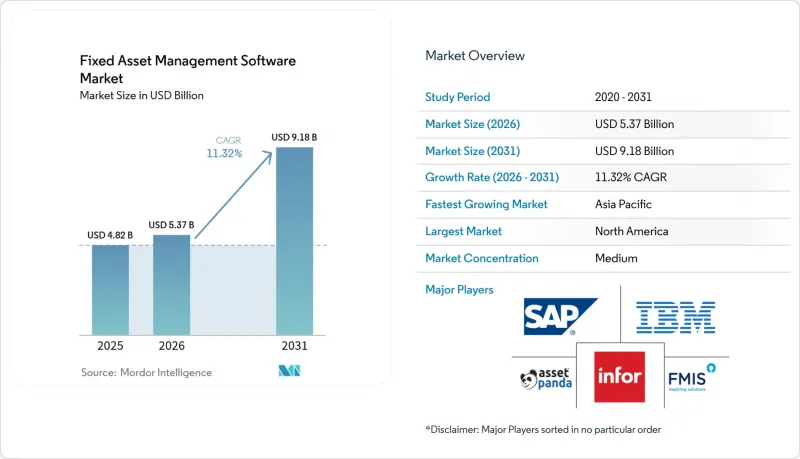
According to Mordor Intelligence, the fixed asset management software market size was valued at USD 4.82 billion in 2025 and estimated to grow from USD 5.37 billion in 2026 to reach USD 9.18 billion by 2031, at a CAGR of 11.32% during the forecast period (2026-2031).
This report is Segmented by Type (Software and Services), Deployment Model (Cloud-Based and On-Premise), Enterprise Size (Large Enterprises and Small and Medium Enterprises), Asset Class (IT and Digital Assets, Plant and Machinery, and More), End-User Industry (Industrial Manufacturing, Transportation and Logistics, and More), and Geography.
Global Fixed Asset Management Software Market Trends and Insights
Increasing Focus on Optimizing Operational Cost
Cost containment tops CIO agendas as inflation and supply chain volatility pressure margins. IFS recorded a 33% surge in software revenue and a 46% jump in cloud revenue during 2024, evidence that buyers prioritize rapid payback and operating-expense models over capital-heavy deployments. AI-enhanced modules identify underutilized equipment, predict part failures, and rebalance maintenance schedules to lower unplanned downtime. Manufacturing SMEs illustrate the benefit: peer-reviewed studies confirm Industrial IoT systems deliver statistically significant cost reductions that exceed installation spend, accelerating adoption beyond large multinationals. Vendors now embed ROI dashboards and savings guarantees in proposals to shorten decision cycles and neutralize budget objections.
Growing Adoption of IoT-enabled Real-time Asset Tracking
Sensor miniaturization and affordable connectivity underpin a dramatic leap in asset visibility. Hospitals deploy RFID and Bluetooth tags to slash equipment search time, curbing rental fees and asset loss. The hospital asset tracking market itself is advancing at 16.8% CAGR, reinforcing healthcare's status as an early adopter. Transportation platforms integrate telematics, route optimization, and condition monitoring, propelling sector software revenue to USD 72 billion at an expected 19.8% CAGR. Real-time datasets also enhance regulatory audits, producing immutable trails that satisfy ISO and safety mandates while feeding predictive models that shift maintenance from reactive to proactive.
High Upfront Cost Barrier for SMEs
Comprehensive platforms can require USD 200,000-250,000 for custom deployments in healthcare, sums that deter smaller firms. Surveys of 4,500 SMEs confirm financial limitations and skills shortages remain the largest drag on digital uptake. OECD analyses underscore that SMEs lag larger rivals in advanced software adoption, widening productivity gaps. Vendors counter with tiered SaaS packages, phased rollouts, and government-backed grants that distribute expenditure over subscription cycles, although budget hesitancy persists in emerging economies.
Other drivers and restraints analyzed in the detailed report include:
- Regulatory and Financial-audit Compliance Pressures
- Rapid Shift Toward Cloud-native SaaS EAM Suites
- Data-security and Privacy Concerns in Multi-tenant Clouds
For complete list of drivers and restraints, kindly check the Table Of Contents.
Segment Analysis
Software modules retained 64.78% of the fixed asset management software market share in 2025 as enterprises demanded integrated tracking, depreciation, and compliance functionality. Growth now centers on services, which are expanding at 13.22% CAGR through 2031 because migrations from legacy databases, data cleansing, and change-management programs require external expertise. Implementation partners design IoT sensor layouts, map maintenance hierarchies, and train users in predictive workflows, activities that internal teams struggle to resource. Managed services appeal to SMEs lacking 24/7 IT support, offering end-to-end monitoring, patching, and reporting under pay-as-you-go terms.
The asset tracking and bar-coding sub-segment benefits directly from the IoT surge, while AI-infused predictive maintenance modules help organizations avoid catastrophic downtime. Accounting teams rely on depreciation calculators to align with evolving tax schedules, especially in jurisdictions rolling out accelerated write-off rules. Compliance modules now embed ESG metrics such as energy intensity and emissions intensity, allowing automated export into sustainability reports. Collectively, the breadth of functionality reinforces the fixed asset management software market as the foundational layer for enterprise performance data.
On-premise systems commanded 62.95% of the fixed asset management software market size in 2025, a legacy function of earlier capital-expense cycles and tight security postures in sectors like defense. Yet cloud platforms are scaling at 13.26% CAGR as CIOs pursue elastic resources that handle sensor streams and AI workloads. Early adopters cite automatic versioning, lower hardware refresh outlays, and anytime mobile access for distributed technicians. Hybrid patterns persist: sensitive process controls remain on-site while analytics dashboards reside in regional clouds for latency-tolerant use cases.
Edge computing augments both models by pre-processing vibration or thermal imagery at gateways before sending summaries to the cloud, reducing bandwidth and cost. Vendors such as IFS indicated cloud revenue rising 46% in 2024 as license customers transition to usage-based contracts. The direction is unequivocal. By 2030, the fixed asset management software market narrative will center on SaaS consumption, AI copilots, and click-configured workflows rather than server counts.
Complete Report Scope:
- By Component
- Software
- Asset Tracking and Bar-coding Module
- Preventive and Predictive Maintenance Module
- Depreciation and Tax Management Module
- Risk and Compliance Module
- Services
- Professional and Implementation
- Managed Services
- Software
- By Deployment Model
- Cloud-based
- On-premise
- By Enterprise Size
- Large Enterprises
- Small and Medium Enterprises
- By Asset Class
- IT and Digital Assets
- Plant and Machinery
- Fleet and Mobile Equipment
- Real-Estate and Infrastructure
- By End-user Industry
- Industrial Manufacturing
- Transportation and Logistics
- Healthcare and Life Sciences
- Energy and Utilities
- Construction and Real Estate
- Government and Public Sector
- IT and Telecom
- Other Industries (Media, Education, BFSI, Retail)
- By Geography
- North America
- United States
- Canada
- Mexico
- Europe
- Germany
- United Kingdom
- France
- Italy
- Spain
- Russia
- Rest of Europe
- Asia-Pacific
- China
- Japan
- India
- South Korea
- ASEAN
- Australia and New Zealand
- Rest of Asia-Pacific
- South America
- Brazil
- Argentina
- Rest of South America
- Middle East and Africa
- Middle East
- Saudi Arabia
- UAE
- Turkey
- Rest of Middle East
- Africa
- South Africa
- Nigeria
- Rest of Africa
- Middle East
- North America
Geography Analysis
North America maintained a 36.88% revenue share in 2025, fueled by early enterprise adoption, federal compliance mandates, and robust partner ecosystems. United States agencies must operate JFMIP-aligned asset systems, embedding stable funding into annual budgets. Canada scales investment in energy and healthcare modernization, while Mexican maquiladora plants adopt SaaS asset suites to support export supply chains. Market maturity does temper growth, yet vendor competition intensifies around AI add-ons and subscription renewals.
Asia-Pacific delivers the fastest trajectory at 12.05% CAGR through 2031, reflecting aggressive manufacturing upgrades, infrastructure build-outs, and SME cloud adoption across China, India, and ASEAN. Beijing's Industry 4.0 incentives, New Delhi's digital-SEZ expansion, and cross-border e-commerce logistics all demand unified asset visibility. Oracle's localized language packs, multi-currency billing, and region-specific compliance templates accelerate rollouts. Japan and South Korea leverage advanced robotics integration, while Indonesia and Vietnam install fleet telematics to manage archipelagic logistics.
Europe combines stable growth with differentiated demand drivers. The EU Corporate Sustainability Reporting Directive obligates more than 50,000 firms to disclose asset performance and climate impact, reinforcing software conversions. Germany's Mittelstand manufacturers deploy AI maintenance to hedge energy costs, the United Kingdom expands NHS equipment tracking, and France integrates asset tools into nuclear and rail modernization. Data-sovereignty laws open space for regional cloud providers to challenge hyperscalers, framing compliance as a competitive advantage.
- IBM Corporation
- SAP SE
- Infor Inc.
- Oracle Corporation
- Hexagon AB (HxGN EAM)
- IFS AB
- AssetWorks LLC
- Asset Panda LLC
- FMIS Ltd.
- Ramco Systems
- UpKeep Technologies
- Sage Group plc
- MRI Software LLC
- Fiix Software
- Wasp Barcode Technologies (AssetCloud)
- Tracet (Adaequare Info Pvt Ltd.)
- RCS Technologies
- Mynd Integrated Solutions
- Osource Global
- EZ Web Enterprises
- InfoFort LLC
Additional Benefits:
- The market estimate (ME) sheet in Excel format
- 3 months of analyst support
TABLE OF CONTENTS
1 INTRODUCTION
- 1.1 Study Assumptions and Market Definition
- 1.2 Scope of the Study
2 RESEARCH METHODOLOGY
3 EXECUTIVE SUMMARY
4 MARKET LANDSCAPE
- 4.1 Market Overview
- 4.2 Market Drivers
- 4.2.1 Increasing focus on optimizing operational cost
- 4.2.2 Growing adoption of IoT-enabled real-time asset tracking
- 4.2.3 Regulatory and financial-audit compliance pressures
- 4.2.4 Rapid shift toward cloud-native SaaS EAM suites
- 4.2.5 ESG-linked asset performance and sustainability reporting
- 4.2.6 Embedded insurtech-driven risk-based maintenance models
- 4.3 Market Restraints
- 4.3.1 High upfront cost barrier for SMEs
- 4.3.2 Data-security and privacy concerns in multi-tenant clouds
- 4.3.3 Legacy-equipment integration complexity
- 4.3.4 Vendor-lock and interoperability limitations
- 4.4 Value Chain Analysis
- 4.5 Regulatory Landscape
- 4.6 Technological Outlook
- 4.7 Porter's Five Forces Analysis
- 4.7.1 Bargaining Power of Suppliers
- 4.7.2 Bargaining Power of Buyers
- 4.7.3 Threat of New Entrants
- 4.7.4 Threat of Substitutes
- 4.7.5 Intensity of Competitive Rivalry
- 4.8 Assessment of the Impact of Macroeconomic Trends on the Market
5 MARKET SIZE AND GROWTH FORECASTS (VALUE)
- 5.1 By Component
- 5.1.1 Software
- 5.1.1.1 Asset Tracking and Bar-coding Module
- 5.1.1.2 Preventive and Predictive Maintenance Module
- 5.1.1.3 Depreciation and Tax Management Module
- 5.1.1.4 Risk and Compliance Module
- 5.1.2 Services
- 5.1.2.1 Professional and Implementation
- 5.1.2.2 Managed Services
- 5.1.1 Software
- 5.2 By Deployment Model
- 5.2.1 Cloud-based
- 5.2.2 On-premise
- 5.3 By Enterprise Size
- 5.3.1 Large Enterprises
- 5.3.2 Small and Medium Enterprises
- 5.4 By Asset Class
- 5.4.1 IT and Digital Assets
- 5.4.2 Plant and Machinery
- 5.4.3 Fleet and Mobile Equipment
- 5.4.4 Real-Estate and Infrastructure
- 5.5 By End-user Industry
- 5.5.1 Industrial Manufacturing
- 5.5.2 Transportation and Logistics
- 5.5.3 Healthcare and Life Sciences
- 5.5.4 Energy and Utilities
- 5.5.5 Construction and Real Estate
- 5.5.6 Government and Public Sector
- 5.5.7 IT and Telecom
- 5.5.8 Other Industries (Media, Education, BFSI, Retail)
- 5.6 By Geography
- 5.6.1 North America
- 5.6.1.1 United States
- 5.6.1.2 Canada
- 5.6.1.3 Mexico
- 5.6.2 Europe
- 5.6.2.1 Germany
- 5.6.2.2 United Kingdom
- 5.6.2.3 France
- 5.6.2.4 Italy
- 5.6.2.5 Spain
- 5.6.2.6 Russia
- 5.6.2.7 Rest of Europe
- 5.6.3 Asia-Pacific
- 5.6.3.1 China
- 5.6.3.2 Japan
- 5.6.3.3 India
- 5.6.3.4 South Korea
- 5.6.3.5 ASEAN
- 5.6.3.6 Australia and New Zealand
- 5.6.3.7 Rest of Asia-Pacific
- 5.6.4 South America
- 5.6.4.1 Brazil
- 5.6.4.2 Argentina
- 5.6.4.3 Rest of South America
- 5.6.5 Middle East and Africa
- 5.6.5.1 Middle East
- 5.6.5.1.1 Saudi Arabia
- 5.6.5.1.2 UAE
- 5.6.5.1.3 Turkey
- 5.6.5.1.4 Rest of Middle East
- 5.6.5.2 Africa
- 5.6.5.2.1 South Africa
- 5.6.5.2.2 Nigeria
- 5.6.5.2.3 Rest of Africa
- 5.6.5.1 Middle East
- 5.6.1 North America
6 COMPETITIVE LANDSCAPE
- 6.1 Market Concentration
- 6.2 Strategic Moves
- 6.3 Market Share Analysis
- 6.4 Company Profiles (includes Global level Overview, Market level overview, Core Segments, Financials as available, Strategic Information, Market Rank/Share, Products and Services, Recent Developments)
- 6.4.1 IBM Corporation
- 6.4.2 SAP SE
- 6.4.3 Infor Inc.
- 6.4.4 Oracle Corporation
- 6.4.5 Hexagon AB (HxGN EAM)
- 6.4.6 IFS AB
- 6.4.7 AssetWorks LLC
- 6.4.8 Asset Panda LLC
- 6.4.9 FMIS Ltd.
- 6.4.10 Ramco Systems
- 6.4.11 UpKeep Technologies
- 6.4.12 Sage Group plc
- 6.4.13 MRI Software LLC
- 6.4.14 Fiix Software
- 6.4.15 Wasp Barcode Technologies (AssetCloud)
- 6.4.16 Tracet (Adaequare Info Pvt Ltd.)
- 6.4.17 RCS Technologies
- 6.4.18 Mynd Integrated Solutions
- 6.4.19 Osource Global
- 6.4.20 EZ Web Enterprises
- 6.4.21 InfoFort LLC
7 MARKET OPPORTUNITIES AND FUTURE OUTLOOK
- 7.1 White-space and Unmet-need Assessment

