PUBLISHER: Mordor Intelligence | PRODUCT CODE: 2115797

PUBLISHER: Mordor Intelligence | PRODUCT CODE: 2115797
Autonomous Agents - Market Share Analysis, Industry Trends & Statistics, Growth Forecasts (2026 - 2031)
According to Mordor Intelligence, autonomous agents market size in 2026 is estimated at USD 5.83 billion, growing from 2025 value of USD 4.42 billion with 2031 projections showing USD 23.32 billion, growing at 31.95% CAGR over 2026-2031.
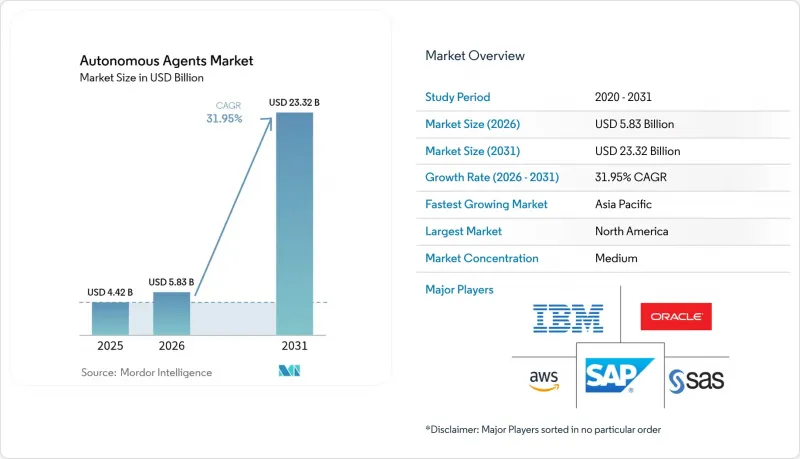
This report is Segmented by Component (Solution and Services), Deployment Type (Cloud and On-Premises), Autonomy Level (Reactive Agents, Deliberative Agents, and More), Organization Site (Small and Medium-Sized Enterprises (SMEs) and Large Enterprises), Industry Vertical (BFSI, Manufacturing, IT and Telecom, and More), and Geogrpahy.
Global Autonomous Agents Market Trends and Insights
Hyper-personalised Customer Engagement Needs in BFSI Driving Agent Adoption
Banks are rolling out autonomous agents to deliver real-time, personalised recommendations across digital channels, with 78% of global institutions scheduling deployments by 2026. JPMorgan's COIN platform now reviews 12,000 complex contracts a year, saving 360,000 human hours and raising accuracy by 30%. Integration with core banking systems lets agents make instant lending and fraud-monitoring decisions, turning reactive service into proactive engagement. Return on investment is strengthened by service-delivery savings of 25-30% and customer-satisfaction gains of 15-20%. Regulatory frameworks in the United States and the European Union are maturing, allowing agents to handle sensitive transactions with clear audit trails. These factors together are adding a 7.4% lift to the autonomous agents market CAGR.
European Automotive OEM Shift to In-Vehicle Software-Defined Architectures
Manufacturers are redesigning vehicles around software platforms that embed agents throughout the driving experience. Mercedes-Benz is integrating agents within MB.OS to adapt to driver habits and road conditions, boosting predictive-maintenance capability and cutting downtime by 20%. The movement from hardware to software differentiation is opening space for secure, scalable agent ecosystems that comply with Europe's strict privacy rules. Increased software R&D, now growing more than 35% each year among leading OEMs, underlies the 5.8% CAGR impact.
Lack of Interoperability Standards Across Heterogeneous Agent Platforms
Enterprises report cross-platform integration delays averaging 8.3 months, limiting multi-agent collaboration benefits. Only 23% of deployments manage to connect agents from more than one vendor, forcing lock-in or expensive custom work. Vendors pursuing common protocols, such as Google's Agent2Agent, have yet to reach critical mass, restraining near-term adoption by 3.2%.
Other drivers and restraints analyzed in the detailed report include:
- Surge in Multi-agent RL for Smart-Factory Optimisation in North Asia
- Regulatory Mandates for Explainable AI in U.S. Federal Agencies
- Talent Scarcity in Multi-Agent Safety and Alignment Engineering
For complete list of drivers and restraints, kindly check the Table Of Contents.
Segment Analysis
Solutions captured 67.20% of the autonomous agents market in 2025, showing enterprise preference for ready-made platforms that integrate security, governance, and workflow orchestration. IBM watsonx Orchestrate links to more than 80 business applications and lists over 150 pre-built agents in its catalog. The segment benefits from quick implementation and unified management consoles, making it the cornerstone of large-scale deployments. Services, however, are expanding quickly as firms seek consulting for complex rollouts. A 33.92% CAGR through 2031 indicates that integration, training, and managed-services partners are central to unlocking solution value.Growing adoption complexity is lifting demand for expert guidance.
Regulated sectors such as finance and healthcare need advisory services to meet compliance, and managed-services providers are stepping in to operate agents for customers lacking in-house talent. The autonomous agents market size allocated to services is predicted to multiply as enterprises migrate pilot projects into production and request ongoing optimization.
Cloud deployments owned 81.10% share in 2025, reflecting preference for elastic compute that supports large language models. Microsoft Azure AI Foundry gives users access to more than 1,900 AI models and auto-scales resources to match workload demand.The cloud's 34.02% forecast CAGR confirms its role as the default environment, helped by growing confidence in virtual-private-cloud security controls. The autonomous agents market size attributed to cloud workloads is expected to widen further as model-size growth outpaces on-premises capacity.
On-premises systems remain important for defense, government, and financial services that demand control over sensitive data. Hybrid approaches are bridging the gap, routing inference to local infrastructure while training runs in the cloud. Edge computing is emerging as a complementary method where agents run latency-sensitive tasks near devices, blending security with scale.
Complete Report Scope:
- By Component
- Solution
- - Platforms
- - Frameworks and Toolkits
- Services
- - Professional Services
- - Managed Services
- By Deployment Type
- Cloud
- On-Premises
- By Autonomy Level
- Reactive Agents
- Deliberative Agents
- Hybrid Agents
- Cognitive Agents
- By Organization Size
- Small and Medium-sized Enterprises (SMEs)
- Large Enterprises
- By Industry Vertical
- BFSI
- IT and Telecom
- Healthcare and Life Sciences
- Manufacturing
- Transportation and Mobility
- Retail and E-commerce
- Energy and Utilities
- Others
- By Geography
- North America
- United States
- Canada
- South America
- Brazil
- Rest of South America
- Europe
- Germany
- United Kingdom
- France
- Nordics
- Rest of Europe
- Middle East
- GCC
- Turkey
- Rest of Middle East
- Africa
- South Africa
- Rest of Africa
- Asia Pacific
- China
- Japan
- South Korea
- India
- Rest of Asia
- North America
Geography Analysis
North America generated 40.30% of the autonomous agents market in 2025 thanks to heavy R&D investment and early corporate adoption. United States enterprises plan to spend more than USD 300 billion on AI research in 2025, with a sizeable portion aligned to agent technologies. Financial institutions and hospitals lead deployments, boosted by supportive federal frameworks that balance innovation with responsible AI. Concentrated venture funding and deep talent pools add further momentum.
Asia Pacific is the fastest-growing region, forecast to record a 35.10% CAGR between 2026 and 2031. China's national AI strategy directs significant subsidies toward autonomous manufacturing agents, while Japan and South Korea back smart-factory pilots to address labor shortages. The Gulf region is attracting bespoke agent solutions, and joint ventures such as CNTXT AI and Beam AI estimate a regional market value of USD 4.2-5.4 billion in 2025. Scalable cloud infrastructure and 5G rollouts make the region conducive to edge-deployed agents, expanding scope in logistics and retail. Europe combines strong ethics oversight with practical deployment in automotive, finance, and industrial settings. The EU AI Act requires transparency and risk management, guiding product design toward trustworthy outcomes. Software-defined architectures in vehicles place Europe at the forefront of in-car agents. The regional AI market could hit USD 235.5 billion by 2031 at a 26.3% CAGR, illustrating robust potential. Data sovereignty rules in healthcare slow adoption but also catalyze advances in privacy-preserving AI that may turn into exportable strengths.
- IBM Corporation
- Google LLC
- Microsoft Corporation
- Amazon Web Services Inc.
- Oracle Corporation
- SAP SE
- Salesforce Inc.
- SAS Institute Inc.
- Intel Corporation
- Aptiv PLC
- Nuance Communications
- Infosys Limited
- Fair Isaac Corporation (FICO)
- Fetch.ai Ltd.
- Affectiva Inc.
- Baidu Inc.
- Huawei Technologies Co. Ltd.
- Bosch Global Software Technologies
- SAPEON Inc.
- DataRobot Inc.
Additional Benefits:
- The market estimate (ME) sheet in Excel format
- 3 months of analyst support
TABLE OF CONTENTS
1 INTRODUCTION
- 1.1 Study Assumptions and Market Definition
- 1.2 Scope of the Study
2 RESEARCH METHODOLOGY
3 EXECUTIVE SUMMARY
4 MARKET LANDSCAPE
- 4.1 Market Overview
- 4.2 Market Drivers
- 4.2.1 Hyper-personalised Customer Engagement Needs in BFSI Driving Agent Adoption
- 4.2.2 Automotive OEM Shift to In-Vehicle Software-Defined Architectures in Europe
- 4.2.3 Surge in Multi-agent RL for Smart-Factory Optimisation in North Asia
- 4.2.4 Regulatory Mandates for Explainable AI in U.S. Federal Agencies
- 4.2.5 Rapid Scaling of Edge-Deployed Agents in 5G Private Networks
- 4.3 Market Restraints
- 4.3.1 Lack of Interoperability Standards Across Heterogeneous Agent Platforms
- 4.3.2 High Training-data Sovereignty Barriers in EU Healthcare
- 4.3.3 Energy-Efficiency Limits on On-device Inference for Mobile Agents
- 4.3.4 Talent Scarcity in Multi-agent Safety and Alignment Engineering
- 4.4 Value Chain Analysis
- 4.5 Regulatory and Standards Outlook
- 4.6 Technological Outlook
- 4.7 Porter's Five Forces
- 4.7.1 Bargaining Power of Suppliers
- 4.7.2 Bargaining Power of Buyers
- 4.7.3 Threat of New Entrants
- 4.7.4 Threat of Substitutes
- 4.7.5 Competitive Rivalry
- 4.8 Investment Analysis
- 4.9 Impact of Macroeconomic Trends on the Market
5 MARKET SIZE AND GROWTH FORECASTS (VALUE)
- 5.1 By Component
- 5.1.1 Solution
- 5.1.2 - Platforms
- 5.1.3 - Frameworks and Toolkits
- 5.1.4 Services
- 5.1.5 - Professional Services
- 5.1.6 - Managed Services
- 5.2 By Deployment Type
- 5.2.1 Cloud
- 5.2.2 On-Premises
- 5.3 By Autonomy Level
- 5.3.1 Reactive Agents
- 5.3.2 Deliberative Agents
- 5.3.3 Hybrid Agents
- 5.3.4 Cognitive Agents
- 5.4 By Organization Size
- 5.4.1 Small and Medium-sized Enterprises (SMEs)
- 5.4.2 Large Enterprises
- 5.5 By Industry Vertical
- 5.5.1 BFSI
- 5.5.2 IT and Telecom
- 5.5.3 Healthcare and Life Sciences
- 5.5.4 Manufacturing
- 5.5.5 Transportation and Mobility
- 5.5.6 Retail and E-commerce
- 5.5.7 Energy and Utilities
- 5.5.8 Others
- 5.6 By Geography
- 5.6.1 North America
- 5.6.1.1 United States
- 5.6.1.2 Canada
- 5.6.2 South America
- 5.6.2.1 Brazil
- 5.6.2.2 Rest of South America
- 5.6.3 Europe
- 5.6.3.1 Germany
- 5.6.3.2 United Kingdom
- 5.6.3.3 France
- 5.6.3.4 Nordics
- 5.6.3.5 Rest of Europe
- 5.6.4 Middle East
- 5.6.4.1 GCC
- 5.6.4.2 Turkey
- 5.6.4.3 Rest of Middle East
- 5.6.5 Africa
- 5.6.5.1 South Africa
- 5.6.5.2 Rest of Africa
- 5.6.6 Asia Pacific
- 5.6.6.1 China
- 5.6.6.2 Japan
- 5.6.6.3 South Korea
- 5.6.6.4 India
- 5.6.6.5 Rest of Asia
- 5.6.1 North America
6 COMPETITIVE LANDSCAPE
- 6.1 Market Concentration
- 6.2 Strategic Moves
- 6.3 Market Share Analysis
- 6.4 Company Profiles (includes Global level Overview, Market level overview, Core Segments, Financials as available, Strategic Information, Market Rank/Share for key companies, Products and Services, and Recent Developments)
- 6.4.1 IBM Corporation
- 6.4.2 Google LLC
- 6.4.3 Microsoft Corporation
- 6.4.4 Amazon Web Services Inc.
- 6.4.5 Oracle Corporation
- 6.4.6 SAP SE
- 6.4.7 Salesforce Inc.
- 6.4.8 SAS Institute Inc.
- 6.4.9 Intel Corporation
- 6.4.10 Aptiv PLC
- 6.4.11 Nuance Communications
- 6.4.12 Infosys Limited
- 6.4.13 Fair Isaac Corporation (FICO)
- 6.4.14 Fetch.ai Ltd.
- 6.4.15 Affectiva Inc.
- 6.4.16 Baidu Inc.
- 6.4.17 Huawei Technologies Co. Ltd.
- 6.4.18 Bosch Global Software Technologies
- 6.4.19 SAPEON Inc.
- 6.4.20 DataRobot Inc.
7 MARKET OPPORTUNITIES AND FUTURE OUTLOOK
- 7.1 White-space and Unmet-need Assessment

