PUBLISHER: Mordor Intelligence | PRODUCT CODE: 2115799

PUBLISHER: Mordor Intelligence | PRODUCT CODE: 2115799
Animal Model - Market Share Analysis, Industry Trends & Statistics, Growth Forecasts (2026 - 2031)
According to Mordor Intelligence, the animal model market size was valued at USD 2.90 billion in 2025 and estimated to grow from USD 3.14 billion in 2026 to reach USD 4.67 billion by 2031, at a CAGR of 8.24% during the forecast period (2026-2031).
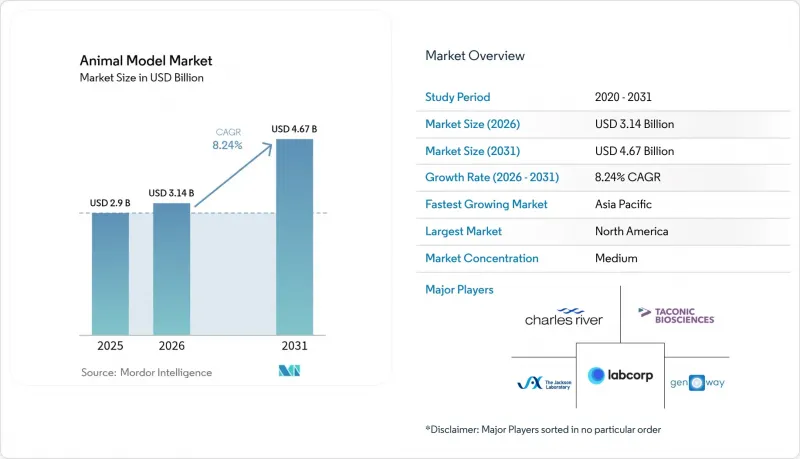
This report Segments the Industry Into by Animal Type (Mice, Birds, and More), Service (Breeding, Cryopreservation, and More), Technology (CRISPR/CAS9 and More), Application (Oncology, Cardiovascular Studies, and More), End-User (Pharmaceutical & Biopharmaceutical Companies and More), and Geography (North America, Europe, Asia-Pacific, and More). The Market Forecasts are Provided in Terms of Value (USD).
Global Animal Model Market Trends and Insights
Increased Adoption of CRISPR & Other Gene-Editing Tools
CRISPR/Cas9 has cut classical model-generation timelines in half and trimmed per-project costs by roughly 40%, making sophisticated knock-ins feasible for smaller research institutes that previously depended on commercial suppliers. Beyond simple indels, base- and prime-editing variants now deliver single-nucleotide precision without double-strand breaks, broadening use in metabolic, immunologic, and neurodegenerative investigations. Vendors such as Cyagen and GenOway have capitalized on the trend with standardized CRISPR pipelines and robust quality controls, allowing pharmaceutical clients to commission multi-gene constructs in parallel rather than sequentially. Demand for compound mutants is therefore scaling faster than classical colony-expansion capacity, prompting breeders to automate embryo handling, genotyping, and cryopreservation. As these efficiencies aggregate, the animal model market gains a durable growth engine that offsets margin pressure from regulatory alternatives.
Rising Use of Animal Models in Virology & Emerging Infectious Diseases
Since 2024, infectious-disease budgets have migrated from crisis response to long-term infrastructure, spurring record orders for humanized mouse strains and non-human primates engineered for viral receptors. The hACE2 mouse, pivotal during COVID-19, has become a template for rapid pathogen-specific line creation through CRISPR knock-ins. National Institutes of Health consortia now fund dedicated high-containment breeding sites, shifting procurement from ad-hoc imports to secure domestic pipelines. The strategic goal is to maintain on-shore capacity to model respiratory viruses, filoviruses, and flaviviruses without relying on global transportation corridors that can be disrupted by bio-security rules. For suppliers, this sustained virology focus means recurring demand for custom immunocompetent and immunodeficient backgrounds, supporting steady CAGR contribution across the forecast window.
Stringent Regulations on Ethical Use of Animals
European Directive 2010/63/EU tightened the ethical bar by requiring systematic replacement reviews, enhanced enrichment, and public disclosure of annual animal-use statistics, all of which raise compliance costs. Laboratories must secure approvals from Institutional Animal Care and Use Committees that track every procedural refinement, adding months to project lead-times in certain jurisdictions. Pharmaceutical sponsors, wary of reputational risk, often mirror EU rules globally, compelling North-American and Asian sites to upgrade housing, analgesia, and endpoint monitoring. Smaller academic centers struggle to finance these upgrades, pushing more demand toward large-scale commercial providers that already meet high-welfare thresholds.
Other drivers and restraints analyzed in the detailed report include:
- Growing Demand for Humanized Models in Precision Medicine
- Government R&D Funding Surge Post-Pandemic
- Rapid Advances in Organ-on-Chip & 3D-Organoid Alternatives
For complete list of drivers and restraints, kindly check the Table Of Contents.
Segment Analysis
Mice retained a 54.62% hold of the animal model market share in 2025, reflecting decades of accumulated genomic resources, standardized husbandry protocols, and well-validated behavioral assays. This dominance anchors predictable baseline demand across oncology, neuroscience, and metabolic disease. Yet the segment's growth rate is now trailing the broader animal model market, signaling maturity in traditional murine workflows.
By contrast, zebrafish and other aquatic species are set to log a 10.04% CAGR to 2031. High-content imaging of transparent larvae, automation-friendly plate formats, and lower compound requirements drive cost efficiencies that resonate with high-throughput screening teams at pharmaceutical firms. As a result, the animal model market size for aquatic species is projected to climb swiftly, supported by institutional investment in automated embryo sorters and micro-CT imaging. Although regulatory familiarity with teleost outcomes is still building, early adopters cite clear toxicity-ranking parallels with mammalian studies, bolstering acceptance.
Breeding services accounted for 44.21% of the animal model market size in 2025, underlining their status as the logistical backbone of the animal model market. Volume demand stems from the sheer number of colonies needed to support oncology xenografts, safety pharmacology, and neurobehavioral pipelines. Nevertheless, growth has shifted toward value-added offerings, with genetic authentication registering an 10.72% CAGR as sponsors adopt mandatory single-nucleotide polymorphism panels to verify strain integrity.
The animal model market size for genetic-testing workflows benefits from the broader rollout of next-generation sequencing benches within vivaria, enabling same-day confirmation of CRISPR edits or genetic drift. Cryopreservation, rederivation, and quarantine services complete a life-cycle loop that reduces vivarium footprint at client sites while guaranteeing health status. These integrated service bundles strengthen stickiness because once embryos or sperm are banked, switching providers becomes operationally risky and time-consuming.
Complete Report Scope:
- By Animal Type
- Mice
- Rats
- Fish
- Birds
- Cattle
- Other Animals
- By Service
- Breeding
- Cryopreservation
- Rederivation & Quarantine
- Genetic Testing
- Other Services
- By Technology
- CRISPR/Cas9
- Embryonic Stem Cell Injection
- Nuclear Transfer
- Microinjection
- Other Technologies
- By Application
- Oncology
- Cardiovascular & Metabolic Disorders
- Neurology & Psychiatry
- Immunology & Infectious Diseases
- Toxicology & Safety Assessment
- Others
- By End-User
- Pharmaceutical & Biopharmaceutical Companies
- Contract Research Organizations (CROs)
- Academic & Research Institutes
- Other End-Users
- By Geography
- North America
- United States
- Canada
- Mexico
- Europe
- Germany
- United Kingdom
- France
- Italy
- Spain
- Rest of Europe
- Asia-Pacific
- China
- India
- Japan
- Australia
- South Korea
- Rest of Asia-Pacific
- Middle East and Africa
- GCC
- South Africa
- Rest of Middle East and Africa
- South America
- Brazil
- Argentina
- Rest of South America
- North America
Geography Analysis
North America retained 46.25% of 2025 revenue, underpinned by a dense cluster of pharmaceutical headquarters, venture-funded biotech start-ups, and academic medical centers. The region's 7.77% CAGR to 2031 rests on technology refresh cycles-automated cage-change robotics, digital colony-management, and AI-driven behavior analytics-rather than volume expansion. The FDA's 2025 signal to sunset monoclonal antibody animal requirements has triggered parallel investment in virtual control-group software, allowing suppliers to diversify while shielding core revenue.
Europe follows with an 8.01% CAGR even under stringent welfare directives. Commercial breeders command premium pricing by offering genetically authenticated, welfare-optimized lines that pass EU inspections without additional client audits. Simultaneously, Europe leads global organ-on-chip validation, granting its suppliers export opportunities for alternative testing platforms; that dual capability positions EU firms at the intersection of current and future regulatory paradigms.
Asia-Pacific stands out as the fastest-growing territory at 8.98% CAGR, driven by China's rapid expansion of laboratory-animal science programs. China now produces more than 19 million research animals annually, supported by a workforce exceeding 100,000 specialists across roughly 2,000 institutes. Regional leaders such as Japan's RIKEN BioResource Center supply over 13,000 defined mouse strains with rigorous health-screening, aligning output with global Good Laboratory Practice standards. These developments raise the animal model market size for the region dramatically and are complemented by emerging spending in the Middle East, Africa, and South America, each logging high-single-digit CAGRs as nascent biotech sectors take hold.
- Aragen Bioscience
- Beijing Vital River Laboratory Animal Technology Co.
- Biocytogen Pharma
- Biomere
- Charles River
- CLEA Japan
- Crown BioScience Intl.
- Cyagen Biosciences.
- GemPharmatech
- GenOway
- Harbour BioMed
- Hera BioLabs
- Ingenious Targeting Laboratory
- Innovative Research
- Inotiv, Inc.
- Janvier Labs
- JSR
- Labcorp UK Ltd
- Melior Inc.
- Ozgene
- PolyGene AG
- Shanghai Model Organisms Center, Inc.
- Taconic Biosciences
- The Jackson Laboratory
- Trans Genic
Additional Benefits:
- The market estimate (ME) sheet in Excel format
- 3 months of analyst support
TABLE OF CONTENTS
1 Introduction
- 1.1 Study Assumptions & Market Definition
- 1.2 Scope of the Study
2 Research Methodology
3 Executive Summary
4 Market Landscape
- 4.1 Market Overview
- 4.2 Market Drivers
- 4.2.1 Increased adoption of CRISPR & other gene-editing tools
- 4.2.2 Rising use of animal models in virology & emerging infectious diseases
- 4.2.3 Growing demand for humanized models in precision medicine
- 4.2.4 Government R&D funding surge post-pandemic
- 4.2.5 AI-enabled high-throughput phenotyping accelerating adoption
- 4.2.6 Micro-gravity disease models from space-biology programs
- 4.3 Market Restraints
- 4.3.1 Rapid advances in organ-on-chip & 3D-organoid alternatives
- 4.3.2 Stringent regulations on ethical use of animals
- 4.3.3 Shareholder ESG pressure to reduce animal testing
- 4.3.4 High cost & long lead-times for complex transgenic lines
- 4.4 Supply Chain Analysis
- 4.5 Regulatory Landscape
- 4.6 Technological Outlook
- 4.7 Porter's Five Forces Analysis
- 4.7.1 Threat of New Entrants
- 4.7.2 Bargaining Power of Buyers
- 4.7.3 Bargaining Power of Suppliers
- 4.7.4 Threat of Substitutes
- 4.7.5 Intensity of Competitive Rivalry
5 Market Size & Growth Forecasts (Value)
- 5.1 By Animal Type
- 5.1.1 Mice
- 5.1.2 Rats
- 5.1.3 Fish
- 5.1.4 Birds
- 5.1.5 Cattle
- 5.1.6 Other Animals
- 5.2 By Service
- 5.2.1 Breeding
- 5.2.2 Cryopreservation
- 5.2.3 Rederivation & Quarantine
- 5.2.4 Genetic Testing
- 5.2.5 Other Services
- 5.3 By Technology
- 5.3.1 CRISPR/Cas9
- 5.3.2 Embryonic Stem Cell Injection
- 5.3.3 Nuclear Transfer
- 5.3.4 Microinjection
- 5.3.5 Other Technologies
- 5.4 By Application
- 5.4.1 Oncology
- 5.4.2 Cardiovascular & Metabolic Disorders
- 5.4.3 Neurology & Psychiatry
- 5.4.4 Immunology & Infectious Diseases
- 5.4.5 Toxicology & Safety Assessment
- 5.4.6 Others
- 5.5 By End-User
- 5.5.1 Pharmaceutical & Biopharmaceutical Companies
- 5.5.2 Contract Research Organizations (CROs)
- 5.5.3 Academic & Research Institutes
- 5.5.4 Other End-Users
- 5.6 By Geography
- 5.6.1 North America
- 5.6.1.1 United States
- 5.6.1.2 Canada
- 5.6.1.3 Mexico
- 5.6.2 Europe
- 5.6.2.1 Germany
- 5.6.2.2 United Kingdom
- 5.6.2.3 France
- 5.6.2.4 Italy
- 5.6.2.5 Spain
- 5.6.2.6 Rest of Europe
- 5.6.3 Asia-Pacific
- 5.6.3.1 China
- 5.6.3.2 India
- 5.6.3.3 Japan
- 5.6.3.4 Australia
- 5.6.3.5 South Korea
- 5.6.3.6 Rest of Asia-Pacific
- 5.6.4 Middle East and Africa
- 5.6.4.1 GCC
- 5.6.4.2 South Africa
- 5.6.4.3 Rest of Middle East and Africa
- 5.6.5 South America
- 5.6.5.1 Brazil
- 5.6.5.2 Argentina
- 5.6.5.3 Rest of South America
- 5.6.1 North America
6 Competitive Landscape
- 6.1 Market Concentration
- 6.2 Competitive Benchmarking
- 6.3 Market Share Analysis
- 6.4 Company Profiles (includes Global level Overview, Market level overview, Core Segments, Financials as available, Strategic Information, Market Rank/Share for key companies, Products & Services, and Recent Developments)
- 6.4.1 Aragen Bioscience
- 6.4.2 Beijing Vital River Laboratory Animal Technology Co.
- 6.4.3 Biocytogen Pharma
- 6.4.4 Biomere
- 6.4.5 Charles River Laboratories International Inc.
- 6.4.6 CLEA Japan
- 6.4.7 Crown BioScience Intl.
- 6.4.8 Cyagen Biosciences
- 6.4.9 GemPharmatech
- 6.4.10 GenOway
- 6.4.11 Harbour BioMed
- 6.4.12 Hera BioLabs
- 6.4.13 Ingenious Targeting Laboratory
- 6.4.14 Innovative Research
- 6.4.15 Inotiv, Inc.
- 6.4.16 Janvier Labs
- 6.4.17 JSR Corporation
- 6.4.18 Labcorp UK Ltd
- 6.4.19 Melior Inc.
- 6.4.20 Ozgene Pty Ltd
- 6.4.21 PolyGene AG
- 6.4.22 Shanghai Model Organisms Center, Inc.
- 6.4.23 Taconic Biosciences, Inc.
- 6.4.24 The Jackson Laboratory
- 6.4.25 Trans Genic Inc.
7 Market Opportunities & Future Outlook
- 7.1 White-space & Unmet-need Assessment

