PUBLISHER: Mordor Intelligence | PRODUCT CODE: 2115804

PUBLISHER: Mordor Intelligence | PRODUCT CODE: 2115804
Gluten-Free Ready Meals - Market Share Analysis, Industry Trends & Statistics, Growth Forecasts (2026 - 2031)
According to Mordor Intelligence, the gluten-free ready meals market size in 2026 is estimated at USD 2.14 billion, growing from 2025 value of USD 2.03 billion with 2031 projections showing USD 2.81 billion, growing at 5.56% CAGR over 2026-2031.
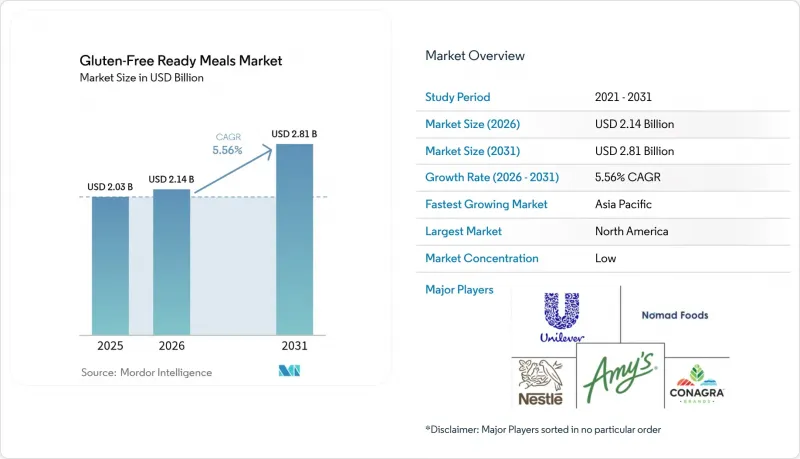
This report is Segmented by Product Type (Frozen Ready Meals, Chilled Ready Meals, and More), Category (Vegetarian and Non-Vegetarian), Distribution Channel (Supermarkets/Hypermarkets, Convenience Stores, and More), and Geography (North America, South America, Europe, and More). The Market Forecasts are Provided in Terms of Value (USD).
Global Gluten-Free Ready Meals Market Trends and Insights
Rising prevalence of celiac disease and gluten sensitivity
The medical demand for gluten-free ready meals primarily stems from celiac disease, which affects approximately 1% of the global population.The United States Food and Drug Administration (FDA) estimates that 3 million Americans have celiac disease, forming a core consumer base that requires strict gluten avoidance. Beyond medical necessity, the market growth is driven by increasing health consciousness among consumers, rising disposable incomes, and growing awareness of gluten sensitivity. The convenience factor of ready-to-eat meals, combined with improved taste and texture of gluten-free products, has expanded the consumer base beyond those with medical requirements. Additionally, endorsements from healthcare professionals and nutritionists have contributed to the mainstream adoption of gluten-free products.
Growing health and wellness awareness
There is a significant consumer base across the globe following gluten-free diets, including individuals without celiac disease diagnoses. This dietary preference stems from self-reported gluten sensitivity, lifestyle choices, and health objectives. Gluten-free products appeal particularly to millennials seeking clean-label and allergen-free options, as these products are commonly associated with digestive health benefits, weight control, and wellness. The COVID-19 pandemic intensified health-conscious food choices, with factors such as healthy living practices, age, and income levels influencing gluten-free purchasing decisions. This consumer behavior has expanded the demand for gluten-free options across food categories, including bread, pasta, snacks, and desserts.
High production costs
Manufacturing costs for gluten-free ready meals are 2-2.5 times higher than conventional products, creating significant affordability barriers that restrict market expansion. Gluten-free products maintain substantial price premiums, with staple foods experiencing the highest cost differentials. The elevated costs result from multiple factors: specialized ingredient sourcing requiring strict quality controls, investment in dedicated production lines and equipment to prevent cross-contamination, smaller batch sizes reducing economies of scale, and comprehensive testing protocols to meet the FDA's 20 ppm gluten threshold. Additional cost factors include specialized storage facilities, enhanced quality control measures, and increased labor costs for trained personnel. In rural areas, distribution costs compound these manufacturing premiums due to lower population density and longer transportation routes, limiting market growth potential in underserved regions. These combined cost pressures make it challenging for manufacturers to maintain competitive pricing while ensuring product quality and safety, ultimately impacting market penetration and consumer adoption rates.
Other drivers and restraints analyzed in the detailed report include:
- Innovation in plant-based and alternative proteins
- Cultural and ethnic diversity
- Taste and quality perception
For complete list of drivers and restraints, kindly check the Table Of Contents.
Segment Analysis
Frozen ready meals are expected to command a 50.62% market share in 2025, reflecting the established supply chain infrastructure and consumer familiarity with frozen convenience foods. The frozen segment benefits from extended shelf life and lower cold chain complexity, making it accessible across diverse retail formats, including convenience stores and rural markets. However, chilled ready meals emerge as the fastest-growing segment with 5.79% CAGR through 2031, driven by premiumization trends and perceived freshness advantages. Chilled products target health-conscious consumers willing to pay premiums for perceived quality, though they face shelf-life constraints that limit distribution reach.
Shelf-stable ready meals occupy a middle position, offering convenience without refrigeration requirements. Freeze-dried ready meals represent the smallest segment but show potential for outdoor recreation and emergency preparedness applications, with innovations in rehydration technology improving palatability. Advanced preservation technologies, including high-pressure processing and cold plasma treatments, are addressing shelf-life limitations across all segments, with research demonstrating significant microbial reduction while maintaining nutritional quality.
Complete Report Scope:
- By Product Type
- Frozen Ready Meals
- Chilled Ready Meals
- Shelf Stable
- Freeze-Dried Ready Meals
- By Category
- Vegetarian
- Non-vegetarian
- By Distribution Channel
- Supermarkets/Hypermarkets
- Convenience/Grocery Stores
- Online Retail Stores
- Other Distribution Channels
- By Geography
- North America
- United States
- Canada
- Mexico
- Rest of North America
- Europe
- Germany
- United Kingdom
- Italy
- France
- Spain
- Netherlands
- Poland
- Belgium
- Sweden
- Rest of Europe
- Asia-Pacific
- China
- India
- Japan
- Australia
- Indonesia
- South Korea
- Thailand
- Singapore
- Rest of Asia-Pacific
- South America
- Brazil
- Argentina
- Colombia
- Chile
- Peru
- Rest of South America
- Middle East & Africa
- South Africa
- Saudi Arabia
- United Arab Emirates
- Nigeria
- Egypt
- Morocco
- Turkey
- Rest of Middle East and Africa
- North America
Geography Analysis
North America commands 39.92% market share in 2025, reflecting mature regulatory frameworks, established consumer awareness, and higher celiac disease prevalence among key demographic groups. The region benefits from FDA gluten-free labeling standards implemented since 2013 and widespread retail acceptance of specialty dietary products. However, Asia-Pacific emerges as the fastest-growing region with 6.71% CAGR through 2031, driven by urbanization, rising disposable incomes, and increasing health consciousness among expanding middle-class populations. North America demonstrates mature market characteristics, including widespread retail acceptance, established supply chains, and consumer willingness to pay premiums for specialty dietary products.
Asia-Pacific's growth potential is particularly strong in developed markets like Japan, Australia, and Singapore, where regulatory frameworks support gluten-free labeling and retail infrastructure can accommodate specialty products. The region's growth trajectory depends on continued urbanization, rising disposable incomes, and gradual dietary westernization that creates receptivity to convenience foods. Companies targeting Asia-Pacific must navigate diverse regulatory environments, taste preferences, and price sensitivity while building distribution networks capable of supporting cold chain requirements for premium chilled and frozen products. Europe maintains steady growth supported by EU Regulation 828/2014 establishing harmonized gluten-free labeling requirements across member states, with products labeled 'gluten-free' containing no more than 20 mg/kg gluten. The region demonstrates strong consumer acceptance of premium food products and willingness to pay for quality, creating favorable conditions for chilled and organic gluten-free ready meals. Research across European markets confirms persistent cost premiums for gluten-free products, with staple foods showing the highest price differentials, yet consumer studies indicate growing satisfaction with product quality and availability. Emerging markets in South America, and the Middle East and Africa represent long-term opportunities as modern retail infrastructure expands and health awareness increases, though current penetration remains limited by distribution challenges, regulatory gaps, and price sensitivity that constrains premium product adoption.
- Amy's Kitchen
- Conagra Brands
- Nestle SA
- Unilever PLC
- Kerry Group PLC
- Dr. Schar AG/SPA
- Kirsty's
- Nomad Foods Ltd.
- Tyson Foods Inc.
- General Mills Inc.
- Maple Leaf Foods Inc.
- Hain Celestial Group
- Kraft Heinz Co.
- Caulipower LLC
- Saffron Road (American Halal)
- Feel Good Foods
- Boulder Brands
- BFree Foods
- Kellanova
- Green Chef
Additional Benefits:
- The market estimate (ME) sheet in Excel format
- 3 months of analyst support
TABLE OF CONTENTS
1 INTRODUCTION
- 1.1 Study Assumptions and Market Definition
- 1.2 Scope of the Study
2 RESEARCH METHODOLOGY
3 EXECUTIVE SUMMARY
4 MARKET LANDSCAPE
- 4.1 Market Overview
- 4.2 Market Drivers
- 4.2.1 Rising prevalence of celiac disease and gluten sensitivity
- 4.2.2 Growing health and wellness awareness
- 4.2.3 Innovation in plant-based and alternative proteins
- 4.2.4 Cultural and ethnic diversity
- 4.2.5 Flavor and culinary trends
- 4.2.6 Government regulations and labeling
- 4.3 Market Restraints
- 4.3.1 High production costs
- 4.3.2 Short shelf life for premium products
- 4.3.3 Taste and quality perception
- 4.3.4 Limited appeal in rural areas
- 4.4 Consumer Behaviour Analysis
- 4.5 Regulatory Outlook
- 4.6 Porter's Five Forces Analysis
- 4.6.1 Bargaining Power of Suppliers
- 4.6.2 Bargaining Power of Buyers
- 4.6.3 Threat of New Entrants
- 4.6.4 Threat of Substitutes
- 4.6.5 Degree of Competition
5 MARKET SIZE & GROWTH FORECASTS (VALUE)
- 5.1 By Product Type
- 5.1.1 Frozen Ready Meals
- 5.1.2 Chilled Ready Meals
- 5.1.3 Shelf Stable
- 5.1.4 Freeze-Dried Ready Meals
- 5.2 By Category
- 5.2.1 Vegetarian
- 5.2.2 Non-vegetarian
- 5.3 By Distribution Channel
- 5.3.1 Supermarkets/Hypermarkets
- 5.3.2 Convenience/Grocery Stores
- 5.3.3 Online Retail Stores
- 5.3.4 Other Distribution Channels
- 5.4 By Geography
- 5.4.1 North America
- 5.4.1.1 United States
- 5.4.1.2 Canada
- 5.4.1.3 Mexico
- 5.4.1.4 Rest of North America
- 5.4.2 Europe
- 5.4.2.1 Germany
- 5.4.2.2 United Kingdom
- 5.4.2.3 Italy
- 5.4.2.4 France
- 5.4.2.5 Spain
- 5.4.2.6 Netherlands
- 5.4.2.7 Poland
- 5.4.2.8 Belgium
- 5.4.2.9 Sweden
- 5.4.2.10 Rest of Europe
- 5.4.3 Asia-Pacific
- 5.4.3.1 China
- 5.4.3.2 India
- 5.4.3.3 Japan
- 5.4.3.4 Australia
- 5.4.3.5 Indonesia
- 5.4.3.6 South Korea
- 5.4.3.7 Thailand
- 5.4.3.8 Singapore
- 5.4.3.9 Rest of Asia-Pacific
- 5.4.4 South America
- 5.4.4.1 Brazil
- 5.4.4.2 Argentina
- 5.4.4.3 Colombia
- 5.4.4.4 Chile
- 5.4.4.5 Peru
- 5.4.4.6 Rest of South America
- 5.4.5 Middle East & Africa
- 5.4.5.1 South Africa
- 5.4.5.2 Saudi Arabia
- 5.4.5.3 United Arab Emirates
- 5.4.5.4 Nigeria
- 5.4.5.5 Egypt
- 5.4.5.6 Morocco
- 5.4.5.7 Turkey
- 5.4.5.8 Rest of Middle East and Africa
- 5.4.1 North America
6 COMPETITIVE LANDSCAPE
- 6.1 Market Concentration
- 6.2 Strategic Moves
- 6.3 Market Share Analysis
- 6.4 Company Profiles (Includes Global-level Overview, Market-level Overview, Core Segments, Financials, Strategic Info, Market Rank/Share, Products & Services, Recent Developments)
- 6.4.1 Amy's Kitchen
- 6.4.2 Conagra Brands
- 6.4.3 Nestle SA
- 6.4.4 Unilever PLC
- 6.4.5 Kerry Group PLC
- 6.4.6 Dr. Schar AG/SPA
- 6.4.7 Kirsty's
- 6.4.8 Nomad Foods Ltd.
- 6.4.9 Tyson Foods Inc.
- 6.4.10 General Mills Inc.
- 6.4.11 Maple Leaf Foods Inc.
- 6.4.12 Hain Celestial Group
- 6.4.13 Kraft Heinz Co.
- 6.4.14 Caulipower LLC
- 6.4.15 Saffron Road (American Halal)
- 6.4.16 Feel Good Foods
- 6.4.17 Boulder Brands
- 6.4.18 BFree Foods
- 6.4.19 Kellanova
- 6.4.20 Green Chef
7 MARKET OPPORTUNITIES & FUTURE OUTLOOK

