PUBLISHER: Mordor Intelligence | PRODUCT CODE: 2115808

PUBLISHER: Mordor Intelligence | PRODUCT CODE: 2115808
Esoteric Testing - Market Share Analysis, Industry Trends & Statistics, Growth Forecasts (2026 - 2031)
According to Mordor Intelligence, the esoteric testing market size was valued at USD 27.21 billion in 2025 and estimated to grow from USD 30.35 billion in 2026 to reach USD 52.34 billion by 2031, at a CAGR of 11.52% during the forecast period (2026-2031).
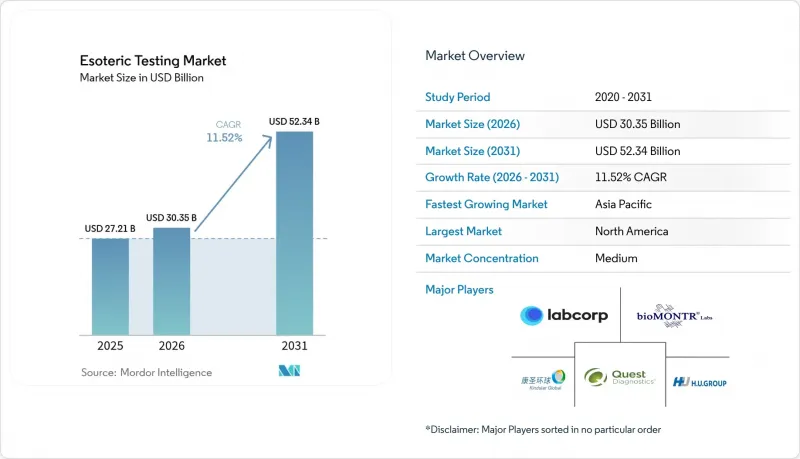
This report is Segmented by Test Specialty (Endocrinology, Infectious Disease, Oncology, Neurology, and More), Technology (Flow Cytometry, Chemiluminescence Immunoassay, Mass Spectrometry, Radio Immunoassay, and More), Sample Type (Blood and More), End User (Hospitals and Clinics and More), and Geography (North America, Europe, Asia Pacific, and More). The Market and Forecasts are Provided in Terms of Value (USD).
Global Esoteric Testing Market Trends and Insights
Rising Burden of Chronic & Complex Diseases
Long-term growth is tied to diabetes, autoimmune disorders, and cancer, all of which require multi-analyte panels that routine labs cannot handle. Medicare's MolDX program links payment to clinical utility, encouraging physicians to order advanced assays . As populations age, clinicians face overlapping comorbidities; definitive esoteric testing offers clarity, reduces misdiagnosis costs, and supports value-based care.
Growing Demand for Rare-Disease Diagnostics
Improved physician awareness and over 54,000 available genetic tests have boosted orders for ultra-low-volume assays. The FDA breakthrough device pathway accelerates approval timelines, while orphan-drug sponsors fund companion diagnostics that identify niche patient cohorts, enabling laboratories with deep genomic capability to command premium pricing.
Stringent Regulatory & Compliance Requirements
The FDA now demands that laboratory-developed tests meet medical-device rules, adding up to USD 3.56 billion in cumulative costs across U.S. labs and causing smaller facilities to reconsider new-test launches. Ongoing legal appeals create uncertainty that may defer capital spending.
Other drivers and restraints analyzed in the detailed report include:
- Advances in Molecular & Multi-Omics Platforms
- Increased R&D Funding and Lab Automation
- High Per-Test Cost in Price-Sensitive Economies
For complete list of drivers and restraints, kindly check the Table Of Contents.
Segment Analysis
Oncology's 12.18% CAGR makes it the fastest-moving specialty because liquid biopsy and comprehensive genomic profiling guide targeted treatments. FoundationOne CDx and Guardant Shield approvals show regulators view broad tumor panels as clinically essential. Endocrinology remains the revenue anchor, capturing 26.78% of the esoteric testing market size in 2025 through insulin, HbA1c, and thyroid assays.
Clinical focus continues to shift from high-volume thyroid testing to sophisticated biomarker suites that stratify cancer risk. Infectious-disease, neurology, and immunology segments benefit from AI-driven interpretation, but oncology captures the spotlight as payers reimburse for tests that match therapy to mutation, shortening hospital stays and improving outcomes.
Sequencing costs have fallen below USD 200 per genome, and regulatory green lights for multi-gene panels propel NGS to a 12.05% CAGR. Illumina's kit-based oncology panel gained FDA clearance, giving smaller labs plug-and-play capability. Chemiluminescence immunoassay remains dominant with a 26.45% esoteric testing market share due to its scalable menu across endocrinology and infectious disease.
Flow cytometry broadens from hematology into immune profiling, while mass spectrometry moves from research to routine through automated sample prep. Although real-time PCR sustains infectious-disease demand, ELISA and radio-immunoassay fade as labs consolidate around faster, multiplexed options.
Complete Report Scope:
- By Test Specialty
- Endocrinology
- Infectious Disease
- Oncology
- Neurology
- Immunology
- Genetics
- Others
- By Technology
- Flow Cytometry
- Chemiluminescence Immunoassay
- Mass Spectrometry
- Real-time PCR
- Next-Generation Sequencing (NGS)
- ELISA
- Radio Immunoassay
- Others
- By Sample Type
- Blood
- Urine
- Saliva
- Cerebrospinal Fluid (CSF)
- Others
- By End User
- Hospitals and Clinics
- Diagnostics Laboratories
- Academic and Research Institutes
- Others
- By Geography
- North America
- United States
- Canada
- Mexico
- Europe
- Germany
- United Kingdom
- France
- Italy
- Spain
- Rest of Europe
- Asia-Pacific
- China
- Japan
- India
- Australia
- South Korea
- Rest of Asia-Pacific
- Middle East and Africa
- GCC
- South Africa
- Rest of Middle East and Africa
- South America
- Brazil
- Argentina
- Rest of South America
- North America
Geography Analysis
North America commanded 41.35% revenue in 2025. Medicare's MolDX pathway speeds coverage for molecular tests, and the region's payer mix supports premium pricing. Ongoing mergers-including Quest Diagnostics' takeover of LifeLabs-bundle logistics networks with AI-enabled result portals, reinforcing regional dominance.
Asia-Pacific is the fastest-growing region at a 12.07% CAGR. China's regulator cleared 228 new drugs in 2024, 92 with companion diagnostics, sparking hospital demand for multi-gene tests. Indian chains such as Dr. Lal PathLabs push into tier-3 cities while Molbio Diagnostics readies a USD 265 million IPO to fund molecular expansion. Mobile health platforms link rural clinics to reference labs, shortening sample-to-result cycles.
Europe posts stable single-digit gains. Cross-border lab alliances streamline sample routing, and sustainability mandates spur demand for environmental toxicology panels. Eurofins reported EUR 6.951 billion revenue in 2024 after 31 acquisitions, highlighting a buy-and-build model that keeps menu breadth ahead of regional peers. Latin America and Middle East & Africa advance steadily as private insurers widen coverage, though infrastructure gaps and import duties temper immediate scale.
- LabCorp
- Quest Diagnostics
- Sonic Healthcare
- Eurofins
- Mayo Clinic Laboratories
- ARUP Laboratories
- Kindstar Global Gene Technology
- Fulgent Genetics
- Grifols
- H.U. Group Holdings
- Nordic Laboratories
- OPKO Health (BioReference)
- SYNLAB AG
- Sonic Reference Labs (USA)
- ACM Global Laboratories
- Charles River
- Exact Sciences
- Invitae
- Beijing Genomics Institute
- Neuberg Diagnostics
Additional Benefits:
- The market estimate (ME) sheet in Excel format
- 3 months of analyst support
TABLE OF CONTENTS
1 Introduction
- 1.1 Study Assumptions & Market Definition
- 1.2 Scope of the Study
2 Research Methodology
3 Executive Summary
4 Market Landscape
- 4.1 Market Overview
- 4.2 Market Drivers
- 4.2.1 Rising Burden of Chronic & Complex Diseases
- 4.2.2 Growing Demand for Rare-Disease Diagnostics
- 4.2.3 Advances In Molecular & Multi-Omics Platforms
- 4.2.4 Increased R&D Funding and Lab Automation
- 4.2.5 Value-Based Reimbursement Favouring High-Impact Esoteric Panels
- 4.2.6 Digital E-Ordering Portals Expanding Test Accessibility
- 4.3 Market Restraints
- 4.3.1 Stringent Regulatory & Compliance Requirements
- 4.3.2 High Per-Test Cost in Price-Sensitive Economies
- 4.3.3 Shortage Of Highly Skilled Laboratory Personnel
- 4.3.4 Data-Integration Hurdles for Multi-Omics Reports
- 4.4 Regulatory Landscape
- 4.5 Technological Outlook
- 4.6 Porters Five Forces Analysis
- 4.6.1 Threat of New Entrants
- 4.6.2 Bargaining Power of Buyers
- 4.6.3 Bargaining Power of Suppliers
- 4.6.4 Threat of Substitutes
- 4.6.5 Competitive Rivalry
5 Market Size & Growth Forecasts (Value, USD)
- 5.1 By Test Specialty
- 5.1.1 Endocrinology
- 5.1.2 Infectious Disease
- 5.1.3 Oncology
- 5.1.4 Neurology
- 5.1.5 Immunology
- 5.1.6 Genetics
- 5.1.7 Others
- 5.2 By Technology
- 5.2.1 Flow Cytometry
- 5.2.2 Chemiluminescence Immunoassay
- 5.2.3 Mass Spectrometry
- 5.2.4 Real-time PCR
- 5.2.5 Next-Generation Sequencing (NGS)
- 5.2.6 ELISA
- 5.2.7 Radio Immunoassay
- 5.2.8 Others
- 5.3 By Sample Type
- 5.3.1 Blood
- 5.3.2 Urine
- 5.3.3 Saliva
- 5.3.4 Cerebrospinal Fluid (CSF)
- 5.3.5 Others
- 5.4 By End User
- 5.4.1 Hospitals and Clinics
- 5.4.2 Diagnostics Laboratories
- 5.4.3 Academic and Research Institutes
- 5.4.4 Others
- 5.5 By Geography
- 5.5.1 North America
- 5.5.1.1 United States
- 5.5.1.2 Canada
- 5.5.1.3 Mexico
- 5.5.2 Europe
- 5.5.2.1 Germany
- 5.5.2.2 United Kingdom
- 5.5.2.3 France
- 5.5.2.4 Italy
- 5.5.2.5 Spain
- 5.5.2.6 Rest of Europe
- 5.5.3 Asia-Pacific
- 5.5.3.1 China
- 5.5.3.2 Japan
- 5.5.3.3 India
- 5.5.3.4 Australia
- 5.5.3.5 South Korea
- 5.5.3.6 Rest of Asia-Pacific
- 5.5.4 Middle East and Africa
- 5.5.4.1 GCC
- 5.5.4.2 South Africa
- 5.5.4.3 Rest of Middle East and Africa
- 5.5.5 South America
- 5.5.5.1 Brazil
- 5.5.5.2 Argentina
- 5.5.5.3 Rest of South America
- 5.5.1 North America
6 Competitive Landscape
- 6.1 Market Concentration
- 6.2 Market Share Analysis
- 6.3 Company Profiles (includes Global level Overview, Market level overview, Core Segments, Financials as available, Strategic Information, Market Rank/Share for key companies, Products & Services, and Recent Developments)
- 6.3.1 Laboratory Corporation of America Holdings
- 6.3.2 Quest Diagnostics Incorporated
- 6.3.3 Sonic Healthcare Limited
- 6.3.4 Eurofins Scientific SE
- 6.3.5 Mayo Clinic Laboratories
- 6.3.6 ARUP Laboratories
- 6.3.7 Kindstar Global Gene Technology
- 6.3.8 Fulgent Genetics
- 6.3.9 Grifols, S.A.
- 6.3.10 H.U. Group Holdings, Inc.
- 6.3.11 Nordic Laboratories
- 6.3.12 OPKO Health (BioReference)
- 6.3.13 SYNLAB AG
- 6.3.14 Sonic Reference Labs (USA)
- 6.3.15 ACM Global Laboratories
- 6.3.16 Charles River Laboratories
- 6.3.17 Exact Sciences Corporation
- 6.3.18 Invitae Corporation
- 6.3.19 Beijing Genomics Institute (BGI)
- 6.3.20 Neuberg Diagnostics
7 Market Opportunities & Future Outlook
- 7.1 White-space & Unmet-need Assessment

