PUBLISHER: Mordor Intelligence | PRODUCT CODE: 2115811

PUBLISHER: Mordor Intelligence | PRODUCT CODE: 2115811
Pharmaceutical Analytical Testing - Market Share Analysis, Industry Trends & Statistics, Growth Forecasts (2026 - 2031)
According to Mordor Intelligence, the pharmaceutical analytical testing market size in 2026 is estimated at USD 10.55 billion, growing from 2025 value of USD 9.74 billion with 2031 projections showing USD 15.67 billion, growing at 8.30% CAGR over 2026-2031.
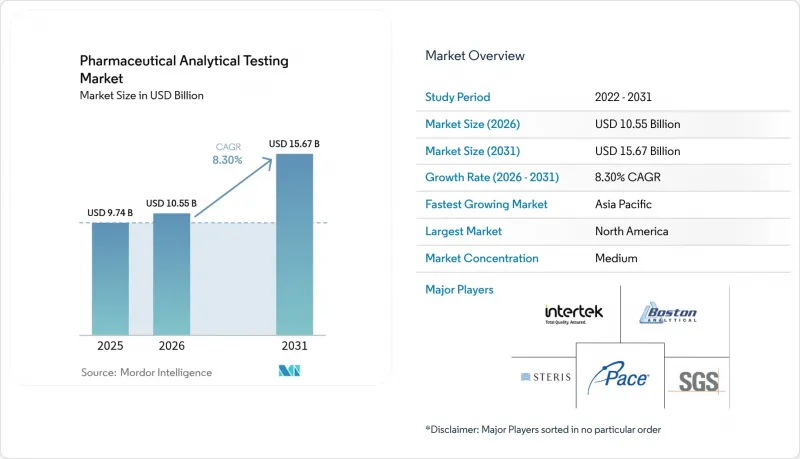
This report is Segmented by Service Type (Bioanalytical Testing, and More), Product Type (Raw Materials, and More), End User (Pharmaceutical Companies, Biopharmaceutical Companies, Cros and CMOs, Academic & Research Institutions), and Geography (North America, Europe, Asia-Pacific, Middle East & Africa, South America). The Market Forecasts are Provided in Terms of Value (USD).
Global Pharmaceutical Analytical Testing Market Trends and Insights
Increasing Regulatory Stringency and Compliance Requirements
Heightened supervisory rigor now governs the entire analytical lifecycle, spanning design, maintenance, and extending to product discontinuation. FDA Q14 obliges continuous verification, compelling manufacturers to validate method robustness under real-world manufacturing variability that many internal labs are not equipped to monitor. The EMA's adoption of analogous provisions creates a similar compliance ceiling across Europe, while the finalized LDT rule extends regulatory reach to in-house diagnostics, thereby broadening outsourced assay demand. In parallel, the ICH Q2(R2) framework deepens statistical scrutiny on precision, linearity, and robustness, driving a migration toward CROs with bio-informatics and chemometrics expertise. Regulatory convergence,, therefore,, cements outsourced analytical testing as a permanent fixture rather than a discretionary expense.
Rising Complexity of Drug Development and Formulations
Combination products, nanocarriers, and personalized therapeutics are pushing analytical science beyond legacy chromatographic fingerprints. Cell and gene therapies require high-parameter flow cytometry, digital PCR, and viral vector potency assays that few sponsor labs have fully qualified. Antibody-drug conjugates necessitate orthogonal MS workflows to confirm drug-to-antibody ratios, while mRNA assets depend on capillary electrophoresis to demonstrate structural integrity. Targeted protein degraders further complicate pharmacodynamic readouts, as standard micromolar potency curves fail to capture catalytic degradation kinetics. Given such heterogeneity, the pharmaceutical analytical testing market continues to recruit outsourcing to fill in expertise gaps and shorten method development timelines.
Data Security and Intellectual Property Concerns
Fierce therapeutic rivalry raises the perceived risk of data leakage when proprietary chromatograms, degradation pathways, or bioassay algorithms leave a sponsor's firewall. Recent cyber intrusions at life-science vendors have underscored vulnerabilities, prompting some companies to retain ultra-sensitive assays in house and slow outsourcing uptake in high-value oncology and rare-disease programs. Compliance with FDA 21 CFR Part 11 and EU Annex 11 electronic record controls adds further contractual complexity, demanding CRO investments in segregated data centers, multi-factor authentication, and immutable audit trails. Though mitigatable, these risks moderately temper the pharmaceutical analytical testing market expansion curve.
Other drivers and restraints analyzed in the detailed report include:
- Growth in Biologics and Biosimilars Development
- Outsourcing Trend for Cost Optimization and Specialized Expertise
- High Costs of Advanced Analytical Equipment and Expertise
For complete list of drivers and restraints, kindly check the Table Of Contents.
Segment Analysis
Bioanalytical workflows captured 34.78% of overall revenue in 2025, underscoring their indispensability to exposure-response modeling and companion diagnostic codevelopment. In regulatory submissions, the pharmaceutical analytical testing market size for bioanalytical assays is projected to widen further as adaptive trial designs demand interim PK/PD data reviews at granular patient-cohort levels. Sponsors also commission large-scale immunogenicity panels to contextualize biologic safety signals, extending sample queue lengths across phase II and III timelines. Concurrently, raw-material testing is registering a 9.71% CAGR-the fastest of any service-reflecting new supplier-verification clauses and global incidents involving excipient contamination. GMP-qualified laboratories now perform nitrosamine screening, identity confirmation, and USP <232> elemental impurity quantitation on every incoming lot, a requirement propelling sustained double-digit growth. From an operational standpoint, the pharmaceutical analytical testing market deploys high-throughput ICP-MS, automated FTIR dispensers, and barcode-driven chain-of-custody systems to satisfy rising demand without diluting turnaround commitments.
Method development and validation continues as a core offering, representing consistent mid-single-digit growth, because every new modality-from lipid nanoparticles to bifunctional degraders-requires novel chromatographic and bioassay protocols. Stability testing, especially for parallel global registrations, remains a reliable annuity segment because real-time and accelerated conditions run for multiple years. Extractables and leachables studies are likewise becoming mandatory for complex injectables and implantables, generating additional mid-term momentum. Collectively, these vectors ensure that the pharmaceutical analytical testing market remains indispensable across product-lifecycle checkpoints, with bioanalytical testing anchoring immediate revenue and raw-material verification setting the sprint pace through 2031.
Complete Report Scope:
- By Service Type
- Bioanalytical Testing
- Method Development & Validation
- Stability Testing
- Raw Material Testing
- Other Service Types
- By Product Type
- Raw Materials
- Active Pharmaceutical Ingredients (APIs)
- Finished Products
- By End User
- Pharmaceutical Companies
- Biopharmaceutical Companies
- CROs and CMOs
- Academic & Research Institutions
- Geography
- North America
- United States
- Canada
- Mexico
- Europe
- Germany
- United Kingdom
- France
- Italy
- Spain
- Rest of Europe
- Asia-Pacific
- China
- Japan
- India
- Australia
- South Korea
- Rest of Asia-Pacific
- Middle East & Africa
- GCC
- South Africa
- Rest of Middle East & Africa
- South America
- Brazil
- Argentina
- Rest of South America
- North America
Geography Analysis
North America remains the epicenter, accounting for 40.78% of 2025 revenue. The U.S. regulatory environment, spearheaded by the FDA's Q14 deployment, cements the region's leadership in method lifecycle management, compelling local CROs to scale scientific talent pools and digital validation platforms. Canada supports growth through incentives for biologics manufacturing, while niche laboratories in Mexico absorb cost-sensitive routine assays and container-closure evaluations. Collectively, these dynamics maintain North America's dominant contribution to the pharmaceutical analytical testing market, even as pricing competition intensifies.
Europe anchors its stature through EMA-aligned guidance and sustained biosimilar activity. Germany, France, and the United Kingdom drive demand for orthogonal biologic characterizations, while Scandinavia supplies innovation in real-time release methodologies. Post-Brexit, U.K. CROs have repositioned to provide dual-release testing under both MHRA and EMA oversight, creating cross-border analytical demand corridors. Central and Eastern European nations offer capacity relief for stability chambers and routine batch-release assays, encapsulating Europe's balanced mix of premium and cost-optimized services in the pharmaceutical analytical testing market.
Asia-Pacific posts the steepest ascent, registering a 9.12% CAGR and progressively expanding its pharmaceutical analytical testing market size as multinational sponsors localize manufacturing and late-phase development in the region. China's 14th Five-Year Plan earmarks funding for GMP laboratory infrastructure, while India capitalizes on deep organic chemistry expertise and English-speaking technical workforces. Singapore's biotech incentives attract regional headquarters for advanced biologics characterization, and South Korea drives innovation through government-subsidized cell-therapy test beds. Harmonization with ICH guidelines across ASEAN members streamlines cross-border submissions, further lifting analytical demand. As capacity matures, Asia-Pacific's share of the pharmaceutical analytical testing market is expected to approach North America's by the early 2030s.
- Almac Group
- Boston Analytical
- Cambrex
- Catalent
- Charles River
- Element Materials Technology (Exova)
- Eurofins
- Frontage Laboratories
- ICON
- Intertek Group
- LabCorp
- MedPace
- Merck
- Pace Analytical Services
- PPD (Thermo Fisher Scientific)
- SGS
- Syneos Health
- STERIS
- Toxikon, Inc.
- West Pharmaceutical Services
- WuXi App Tec
Additional Benefits:
- The market estimate (ME) sheet in Excel format
- 3 months of analyst support
TABLE OF CONTENTS
1 Introduction
2 Research Methodology
3 Executive Summary
4 Market Landscape
- 4.1 Market Overview
- 4.2 Market Drivers
- 4.2.1 Increasing Regulatory Stringency and Compliance Requirements
- 4.2.2 Rising Complexity of Drug Development and Formulations
- 4.2.3 Growth in Biologics and Biosimilars Development
- 4.2.4 Outsourcing Trend for Cost Optimization and Specialized Expertise
- 4.2.5 Technological Advancements in Analytical Techniques
- 4.2.6 Rising Demand for Stability and Bioanalytical Testing
- 4.3 Market Restraints
- 4.3.1 Data Security and Intellectual Property Concerns
- 4.3.2 High Costs of Advanced Analytical Equipment and Expertise
- 4.3.3 Shortage of Skilled Analytical Professionals
- 4.3.4 Complex Method Transfer and Validation Requirements
- 4.4 Value Chain Analysis
- 4.5 Regulatory Landscape
- 4.6 Technological Outlook
- 4.7 Porter's Five Forces Analysis
- 4.7.1 Threat of New Entrants
- 4.7.2 Bargaining Power of Buyers
- 4.7.3 Bargaining Power of Suppliers
- 4.7.4 Threat of Substitute Products
- 4.7.5 Intensity of Competitive Rivalry
5 Market Size & Growth Forecasts (Value, USD)
- 5.1 By Service Type
- 5.1.1 Bioanalytical Testing
- 5.1.2 Method Development & Validation
- 5.1.3 Stability Testing
- 5.1.4 Raw Material Testing
- 5.1.5 Other Service Types
- 5.2 By Product Type
- 5.2.1 Raw Materials
- 5.2.2 Active Pharmaceutical Ingredients (APIs)
- 5.2.3 Finished Products
- 5.3 By End User
- 5.3.1 Pharmaceutical Companies
- 5.3.2 Biopharmaceutical Companies
- 5.3.3 CROs and CMOs
- 5.3.4 Academic & Research Institutions
- 5.4 Geography
- 5.4.1 North America
- 5.4.1.1 United States
- 5.4.1.2 Canada
- 5.4.1.3 Mexico
- 5.4.2 Europe
- 5.4.2.1 Germany
- 5.4.2.2 United Kingdom
- 5.4.2.3 France
- 5.4.2.4 Italy
- 5.4.2.5 Spain
- 5.4.2.6 Rest of Europe
- 5.4.3 Asia-Pacific
- 5.4.3.1 China
- 5.4.3.2 Japan
- 5.4.3.3 India
- 5.4.3.4 Australia
- 5.4.3.5 South Korea
- 5.4.3.6 Rest of Asia-Pacific
- 5.4.4 Middle East & Africa
- 5.4.4.1 GCC
- 5.4.4.2 South Africa
- 5.4.4.3 Rest of Middle East & Africa
- 5.4.5 South America
- 5.4.5.1 Brazil
- 5.4.5.2 Argentina
- 5.4.5.3 Rest of South America
- 5.4.1 North America
6 Competitive Landscape
- 6.1 Market Concentration
- 6.2 Market Share Analysis
- 6.3 Company Profiles (includes Global level Overview, Market level overview, Core Segments, Financials as available, Strategic Information, Market Rank/Share, Products & Services, Recent Developments)
- 6.3.1 Almac Group
- 6.3.2 Boston Analytical
- 6.3.3 Cambrex Corporation
- 6.3.4 Catalent, Inc.
- 6.3.5 Charles River Laboratories
- 6.3.6 Element Materials Technology (Exova)
- 6.3.7 Eurofins Scientific
- 6.3.8 Frontage Laboratories
- 6.3.9 ICON plc
- 6.3.10 Intertek Group plc
- 6.3.11 Laboratory Corporation of America Holdings
- 6.3.12 Medpace
- 6.3.13 Merck KGaA
- 6.3.14 Pace Analytical Services
- 6.3.15 PPD (Thermo Fisher Scientific)
- 6.3.16 SGS SA
- 6.3.17 Syneos Health
- 6.3.18 STERIS
- 6.3.19 Toxikon, Inc.
- 6.3.20 West Pharmaceutical Services, Inc.
- 6.3.21 WuXi AppTec
7 Market Opportunities & Future Outlook
- 7.1 White-space & unmet-need assessment

