PUBLISHER: Mordor Intelligence | PRODUCT CODE: 2115820

PUBLISHER: Mordor Intelligence | PRODUCT CODE: 2115820
Ceramic Textile - Market Share Analysis, Industry Trends & Statistics, Growth Forecasts (2026 - 2031)
According to Mordor Intelligence, the ceramic textile market size in 2026 is estimated at USD 193.27 million, growing from 2025 value of USD 183.56 million with 2031 projections showing USD 250.14 million, growing at 5.29% CAGR over 2026-2031.
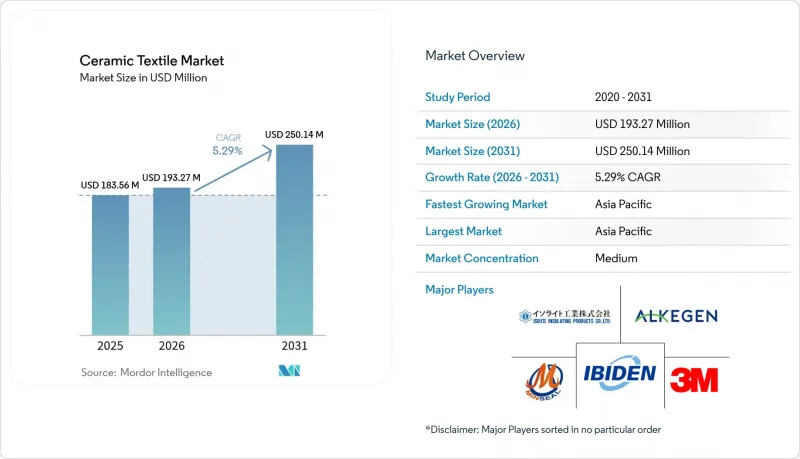
This report Segments the Industry by Fiber (Refractory Ceramic, Low Bio-Persistent, and More), Type (Cloth, Tape, and More), End-User Industry (Industrial, Transportation, and More), and Geography (Asia-Pacific, North America, Europe, South America, and Middle East and Africa). The Market Forecasts are Provided in Terms of Value (USD).
Global Ceramic Textile Market Trends and Insights
Growing Demand for High-Temperature Industrial Insulation
Continuous-run steel, glass and petrochemical kilns now reach operating temperatures above 1,200 °C, creating structural and energy losses that conventional mineral wool cannot handle. Ceramic textiles cut heat loss by as much as 30% compared with legacy refractory bricks, delivering measurable fuel savings while extending maintenance cycles. Higher throughput targets in Asian plants intensify this push, so the ceramic textile market is becoming a critical enabler of furnace upgrades worldwide.
Energy-Efficiency Regulations in Process Industries
Revised greenhouse-gas disclosure rules compel industrial sites to document thermal efficiency improvements, making ceramic fabrics an easy pathway to regulatory compliance without large process overhauls. North American refineries and European ceramics lines already rely on ceramic insulation modules to stay within reporting thresholds, and similar legislation is appearing in China and India. These trends reinforce long-run demand and give the ceramic textile market a policy tail-wind.
Carcinogenic Classification of Refractory Ceramic Fibre
Occupational-exposure limits of 0.2 fibres/cm3 increase monitoring, personal-protective-equipment and disposal costs across plants that handle legacy refractory grades. Europe already mandates substitution assessments, accelerating the pivot to low bio-persistent fibres. This safety-driven switch trims short-term demand yet also stimulates innovation that ultimately widens the ceramic textile market.
Other drivers and restraints analyzed in the detailed report include:
- Superior Weight-to-Performance Characteristics
- Adoption in Battery-Gigafactory Thermal Management
- High Production Costs versus Conventional Insulators
For complete list of drivers and restraints, kindly check the Table Of Contents.
Segment Analysis
Refractory ceramic fiber retained 55.62% of the ceramic textile market in 2025, valued near USD 102.08 million, yet its growth rate trails emerging low bio-persistent grades that post a 6.25% CAGR. Regulators and plant managers prefer fibres that dissolve in body fluids within 30 days, easing exposure compliance. The ceramic textile market size attributed to bio-persistent products could reach USD 67.4 million by 2031, confirming that health issues are no longer a niche concern.
Low-toxicity alumino-silicate fibers, polycrystalline mullite and engineered alkaline-earth silicate variants now match refractories on thermal shock resistance. Pilot lines in Japan and Germany already run fully on bio-persistent feedstock, while Chinese producers expand output for export. Strategic R&D partnerships with universities accelerate property improvements, ensuring the ceramic textile market remains technologically dynamic even as safer chemistries take hold.
Complete Report Scope:
- By Fiber
- Refractory Ceramic
- Low Bio-Persistent
- Other Fibers (Polycrystalline Mullite Fiber, etc.)
- By Type
- Cloth
- Tape
- Rope
- Yarn
- Other Types (Sleeving / Braided Sleeve, etc.)
- By End-User Industry
- Industrial
- Transportation
- Other End-User Industries (Electrical and Electronics, etc.)
- By Geography
- Asia-Pacific
- China
- India
- Japan
- South Korea
- Rest of Asia-Pacific
- North America
- United States
- Canada
- Mexico
- Europe
- Germany
- United Kingdom
- Italy
- France
- Rest of Europe
- South America
- Brazil
- Argentina
- Rest of South America
- Middle East and Africa
- Saudi Arabia
- South Africa
- Rest of Middle East and Africa
- Asia-Pacific
Geography Analysis
Asia-Pacific held a 41.84% share of the ceramic textile market in 2025 and is on pace for a 6.04% regional CAGR. China leads kiln refurbishment projects, Japan focuses on fibre chemistry patents, and South Korea drives electronics-grade consumption. Access to aluminosilicate mines in Shandong and Guangxi further stabilises local supply chains, giving Asian producers a freight advantage into neighbouring refineries and battery plants.
North America remains strong in aerospace and is the fastest adopter of urban air mobility prototypes. Federal efficiency credit programmes reward facility upgrades, so US refineries replace old brick linings with folding ceramic modules despite higher upfront costs. Canadian nickel-cobalt projects, essential for EV supply chains, also deploy ceramic blankets in rotary calciners, broadening the ceramic textile market's base in the region.
Europe balances high labour costs with world-class materials research. Germany's composites clusters refine ceramic matrix processes, France leverages its civil-aviation footprint, and Scandinavian steelmakers retrofit blast-furnace tapholes with ceramic rope seals to curb CO2 intensity. Tighter worker-safety directives accelerate migration to bio-persistent fibres, so European demand tilts towards premium grades that lift the regional average selling price. Together these factors make the ceramic textile market outlook resilient across all three major economic blocs.
- 3M
- 3 Tex Fabrics
- Alkegen
- CeraMaterials
- Double Egret Thermal Insulation Co., Ltd.
- EAS
- FibreCast Inc.
- Great Lakes Textiles
- IBIDEN
- Isolite Insulating Products Co., Ltd.
- JA Harrison & Company Limited
- Luyang Energy-saving Materials Co., Ltd.
- Mineral Seal Corporation
- NUTEC Incorporated
- Rath-Group
Additional Benefits:
- The market estimate (ME) sheet in Excel format
- 3 months of analyst support
TABLE OF CONTENTS
1 Introduction
- 1.1 Study Assumptions & Market Definition
- 1.2 Scope of the Study
2 Research Methodology
3 Executive Summary
4 Market Landscape
- 4.1 Market Overview
- 4.2 Market Drivers
- 4.2.1 Growing demand for high-temperature industrial insulation
- 4.2.2 Energy-efficiency regulations in process industries
- 4.2.3 Superior weight-to-performance characteristics
- 4.2.4 Adoption in battery-gigafactory thermal management
- 4.2.5 Fire-resistant materials requirements for urban air mobility
- 4.3 Market Restraints
- 4.3.1 Carcinogenic classification of refractory ceramic fiber
- 4.3.2 High production costs vs. conventional insulators
- 4.3.3 Supply crunch of high-purity aluminosilicate feedstock
- 4.4 Value Chain Analysis
- 4.5 Porter's Five Forces
- 4.5.1 Bargaining Power of Suppliers
- 4.5.2 Bargaining Power of Buyers
- 4.5.3 Threat of New Entrants
- 4.5.4 Threat of Substitutes
- 4.5.5 Degree of Competition
5 Market Size & Growth Forecasts (Value)
- 5.1 By Fiber
- 5.1.1 Refractory Ceramic
- 5.1.2 Low Bio-Persistent
- 5.1.3 Other Fibers (Polycrystalline Mullite Fiber, etc.)
- 5.2 By Type
- 5.2.1 Cloth
- 5.2.2 Tape
- 5.2.3 Rope
- 5.2.4 Yarn
- 5.2.5 Other Types (Sleeving / Braided Sleeve, etc.)
- 5.3 By End-User Industry
- 5.3.1 Industrial
- 5.3.2 Transportation
- 5.3.3 Other End-User Industries (Electrical and Electronics, etc.)
- 5.4 By Geography
- 5.4.1 Asia-Pacific
- 5.4.1.1 China
- 5.4.1.2 India
- 5.4.1.3 Japan
- 5.4.1.4 South Korea
- 5.4.1.5 Rest of Asia-Pacific
- 5.4.2 North America
- 5.4.2.1 United States
- 5.4.2.2 Canada
- 5.4.2.3 Mexico
- 5.4.3 Europe
- 5.4.3.1 Germany
- 5.4.3.2 United Kingdom
- 5.4.3.3 Italy
- 5.4.3.4 France
- 5.4.3.5 Rest of Europe
- 5.4.4 South America
- 5.4.4.1 Brazil
- 5.4.4.2 Argentina
- 5.4.4.3 Rest of South America
- 5.4.5 Middle East and Africa
- 5.4.5.1 Saudi Arabia
- 5.4.5.2 South Africa
- 5.4.5.3 Rest of Middle East and Africa
- 5.4.1 Asia-Pacific
6 Competitive Landscape
- 6.1 Market Concentration
- 6.2 Strategic Moves
- 6.3 Market Share(%)/Ranking Analysis
- 6.4 Company Profiles (includes Global level Overview, Market level overview, Core Segments, Financials as available, Strategic Information, Market Rank/Share, Products & Services, Recent Developments)
- 6.4.1 3M
- 6.4.2 3 Tex Fabrics
- 6.4.3 Alkegen
- 6.4.4 CeraMaterials
- 6.4.5 Double Egret Thermal Insulation Co., Ltd.
- 6.4.6 EAS
- 6.4.7 FibreCast Inc.
- 6.4.8 Great Lakes Textiles
- 6.4.9 IBIDEN
- 6.4.10 Isolite Insulating Products Co., Ltd.
- 6.4.11 JA Harrison & Company Limited
- 6.4.12 Luyang Energy-saving Materials Co., Ltd.
- 6.4.13 Mineral Seal Corporation
- 6.4.14 NUTEC Incorporated
- 6.4.15 Rath-Group
7 Market Opportunities & Future Outlook
- 7.1 White-space & Unmet-Need Assessment

