PUBLISHER: Mordor Intelligence | PRODUCT CODE: 2115827

PUBLISHER: Mordor Intelligence | PRODUCT CODE: 2115827
Cognitive Media - Market Share Analysis, Industry Trends & Statistics, Growth Forecasts (2026 - 2031)
According to Mordor Intelligence, the cognitive media market size is expected to grow from USD 15.70 billion in 2025 to USD 18.74 billion in 2026 and is forecast to reach USD 45.48 billion by 2031 at 19.4% CAGR over 2026-2031.
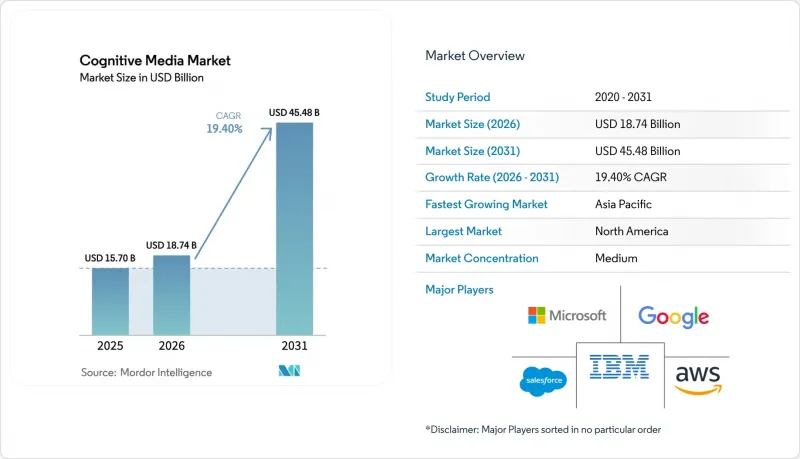
This report is Segmented by Component (Solutions and Services), Deployment (Cloud and On-Premise), Application (Content Management, Recommendation and Personalization, Predictive Analysis, and Network Optimization), and Geography. The Market Forecasts are Provided in Terms of Value (USD).
Global Cognitive Media Market Trends and Insights
Workflow Automation Across Multi-Platform Content Supply Chains
Media groups now automate up to 100% of ingest, edit, and caption tasks, pushing 4.2 percentage points of additional CAGR. Warner Bros. Discovery cut localization costs by 60% after integrating Google's generative captioning suite. Broadcast schedulers such as Mediagenix simultaneously optimize linear and streaming grids, freeing staff to focus on premium content. Prime Focus Technologies reported a 30% fall in manual metadata work when AI agents preview, tag, and archive assets.
Hyper-Personalized Content as an ARPU Lever
Hyper-personalization adds 3.8 percentage points to growth by lifting engagement and subscriber spend. A healthcare retailer deploying AI recommenders logged a 33.49% ARPU jump and a 32.79% rise in average order value. The Financial Times uses an AI paywall that calibrates article access without depressing conversions, underscoring the delicate balance between personalization and revenue. Netflix analyzes more than 200 billion daily user events to steer script development toward segments most likely to binge entire seasons. Publishers collecting zero-party preference signals recorded 60% higher content clicks among self-declared interest cohorts.
Scarcity of Licensed, Culture-Specific Training Data
Court rulings in 2024-2025 confirmed that unlicensed copyrighted inputs fall outside fair-use protections, trimming 2.8 percentage points off market expansion. Disney and NBCUniversal's suit against Midjourney signaled aggressive enforcement by rights holders. News Corp's USD 250 million licensing pact with OpenAI shows how compliant datasets now command premium fees. Smaller language markets face higher entry costs because culturally nuanced corpora remain scarce.
Other drivers and restraints analyzed in the detailed report include:
- Cloud GPU Cost Curves Falling Faster Than Moore's Law
- AI-Native Advertising Formats Boosting CPM Yields
- Escalating GPU Power-Consumption Penalties
For complete list of drivers and restraints, kindly check the Table Of Contents.
Segment Analysis
Solutions contributed 67.20% of the cognitive media market in 2025 as studios prioritized turnkey AI systems over consulting-led roll-outs. IBM's Watsonx alone booked contracts worth USD 5 billion by scaling language-model toolkits into existing broadcast asset management suites. Veritone's Digital Media Hub and Ateliere Connect AI help rights-holders automatically surface long-tail clips for syndication, reducing dormant asset ratios by 45%. As a result, the solutions slice is forecast to maintain clear leadership through 2031.
The services sub-segment is expanding at a 23.30% CAGR because integration across legacy control rooms, playout chains, and OTT apps requires scarce engineering talent. Consulting practices now market rapid-deployment "factory models" to plug skills gaps within weeks. Where custom pipelines still prevail, newsrooms and multi-regional sports networks, specialists tune prompt-engineering, guardrails, and workflow orchestration on retainer models, adding annuity revenue to vendors.
Complete Report Scope:
- By Component
- Solutions
- Services
- By Deployment
- Cloud
- On-premises
- By Application
- Content Management
- Recommendation and Personalization
- Predictive Analysis
- Network Optimization
- Geography
- North America
- South America
- Europe
- Asia-Pacific
- Middle East and Africa
Geography Analysis
North America accounted for 42.40% of 2025 revenue as platform majors assembled end-to-end AI stacks that blend proprietary data, silicon, and distribution. The region's policy regime remains comparatively permissive; yet, a wave of copyright suits, with 25 active as of June 2025, has injected caution into generative deployment news.bloomberglaw.com. Nevertheless, combined USD 320 billion in 2025 AI capex from Meta, Amazon, Alphabet, and Microsoft keeps the cognitive media market primed for near-term innovations.
The Asia-Pacific region posts the fastest 23.10% CAGR through 2031, led by Japan's Society 5.0 programs and SoftBank's USD 960 million backbone expansion, which anchors local model training capacity. China's conversational-AI revenue is projected to quintuple from USD 1.05 billion in 2023 to USD 5.19 billion by 2030, driven by policy incentives that leverage domestic datasets to fuel industry clouds. The first full-length AI-generated feature, "Pirate Queen: Zheng Yi Sao," premiered in Malaysia in 2025, underscoring regional creative momentum.
Europe advances steadily, striking a balance between innovation and consumer protection under the 2025 AI Act, which mandates content watermarking by August 2025. Spain's draft deepfake fines underscore rising enforcement appetite, but the bloc's single digital market still offers scale advantages for vendors clearing compliance hurdles. Emerging Latin American and African markets, largely mobile-first, present white-space opportunities as telcos bundle AI-enabled streaming tiers with prepaid data packs, leapfrogging legacy pay-TV ecosystems.
- IBM Corporation
- Google LLC
- Amazon Web Services
- Microsoft Corporation
- Salesforce Inc.
- Adobe Inc.
- Nvidia Corporation
- Veritone Inc.
- Albert.ai
- Brandwatch
- Valossa Labs Ltd.
- Video Intelligence AG
Additional Benefits:
- The market estimate (ME) sheet in Excel format
- 3 months of analyst support
TABLE OF CONTENTS
1 INTRODUCTION
- 1.1 Study Assumptions and Market Definition
- 1.2 Scope of the Study
2 RESEARCH METHODOLOGY
3 EXECUTIVE SUMMARY
4 MARKET LANDSCAPE
- 4.1 Market Overview
- 4.2 Market Drivers
- 4.2.1 Workflow automation across multi-platform content supply chains
- 4.2.2 Hyper-personalized content as an ARPU lever
- 4.2.3 Cloud GPU cost curves falling faster than Moore's Law
- 4.2.4 AI-native advertising formats boosting CPM yields
- 4.2.5 Generative-AI-ready creator tools democratizing production
- 4.2.6 Zero-party data strategies enhancing recommendation accuracy
- 4.3 Market Restraints
- 4.3.1 Scarcity of licensed, culture-specific training data
- 4.3.2 Escalating GPU power-consumption penalties
- 4.3.3 Regulatory uncertainty on synthetic-content labelling
- 4.3.4 Talent war for applied AI engineers in media firms
- 4.4 Industry Value Chain Analysis
- 4.5 Regulatory Landscape
- 4.6 Technological Outlook
- 4.7 Porter's Five Forces Analysis
- 4.7.1 Threat of New Entrants
- 4.7.2 Bargaining Power of Buyers
- 4.7.3 Bargaining Power of Suppliers
- 4.7.4 Threat of Substitutes
- 4.7.5 Intensity of Rivalry
5 MARKET SIZE AND GROWTH FORECASTS (VALUE)
- 5.1 By Component
- 5.1.1 Solutions
- 5.1.2 Services
- 5.2 By Deployment
- 5.2.1 Cloud
- 5.2.2 On-premises
- 5.3 By Application
- 5.3.1 Content Management
- 5.3.2 Recommendation and Personalization
- 5.3.3 Predictive Analysis
- 5.3.4 Network Optimization
- 5.4 Geography
- 5.4.1 North America
- 5.4.2 South America
- 5.4.3 Europe
- 5.4.4 Asia-Pacific
- 5.4.5 Middle East and Africa
6 COMPETITIVE LANDSCAPE
- 6.1 Market Concentration
- 6.2 Strategic Moves
- 6.3 Market Share Analysis
- 6.4 Company Profiles (includes Global level Overview, Market level overview, Core Segments, Financials as available, Strategic Information, Market Rank/Share for key companies, Products and Services, and Recent Developments)
- 6.4.1 IBM Corporation
- 6.4.2 Google LLC
- 6.4.3 Amazon Web Services
- 6.4.4 Microsoft Corporation
- 6.4.5 Salesforce Inc.
- 6.4.6 Adobe Inc.
- 6.4.7 Nvidia Corporation
- 6.4.8 Veritone Inc.
- 6.4.9 Albert.ai
- 6.4.10 Brandwatch
- 6.4.11 Valossa Labs Ltd.
- 6.4.12 Video Intelligence AG
7 MARKET OPPORTUNITIES AND FUTURE OUTLOOK
- 7.1 White-space and Unmet-need Assessment

