PUBLISHER: Mordor Intelligence | PRODUCT CODE: 2115835

PUBLISHER: Mordor Intelligence | PRODUCT CODE: 2115835
Africa Electric Bus - Market Share Analysis, Industry Trends & Statistics, Growth Forecasts (2026 - 2031)
According to Mordor Intelligence, the Africa electric bus market size is expected to grow from USD 99.41 million in 2025 to USD 116.74 million in 2026 and is forecast to reach USD 260.69 million by 2031 at 17.45% CAGR over 2026-2031.
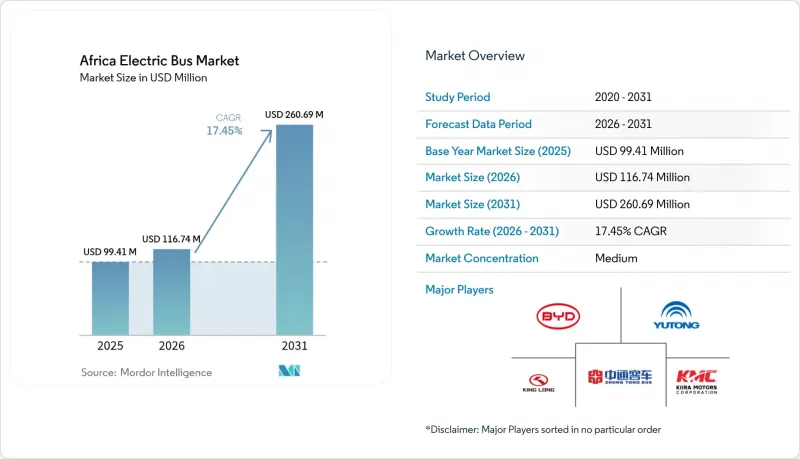
This report is Segmented by Propulsion Type (Battery Electric, Plug-In Hybrid Electric), Consumer Type (Government, Fleet Operators), Bus Length (Mini (Below 9m), Standard (9-14m), and More), Charging Mode (Depot/Overnight Charging, Opportunity/In-Route Charging), Battery Capacity (<=200 KWh, 201-400 KWh, and More), and Country. The Market Forecasts are Provided in Terms of Value (USD).
Africa Electric Bus Market Trends and Insights
Falling Battery Prices and TCO Parity By 2027
Global average Li-ion battery pack prices fell to USD 139/kWh in 2023 and further to ~USD 115/kWh in 2024 and are forecast to reduce further by 2026, pushing the Africa electric bus market toward operating-cost parity with diesel buses . Roam's Nairobi pilots show maintenance costs falling and fuel savings rising versus diesel fleets. Morocco's Renault- and Stellantis-anchored supply chain positions the country to localize battery module assembly, while Egypt's 1 GW Obelisk solar park with 200 MWh of storage signals continent-wide familiarity with stationary battery systems.
Government E-Bus Procurement Programs and Subsidies
Kenya's 2024 Electric Mobility Draft Policy introduces green number plates, duty exemptions, and estimates that dormant renewable capacity could power 7,000 buses daily . Nigeria's October 2024 roadmap prefers Gross-Cost-Contract structures that shift capex risk to private consortia. Rwanda waived VAT on locally built buses, enabling IZI's Impala E30 roll-out, while Ghana grants eight-year import-duty holidays for assembled EVs.
Limited Grid Capacity and Unreliable Power Supply
Load-shedding in South Africa and frequent blackouts in Nigeria force operators to install backup diesel gensets or delay expansion, raising opex. The World Bank's USD 1.6 billion West Africa Regional Electricity Market Program will add cross-border transmission by 2028, yet most depots still require islanded microgrids to guarantee service.
Other drivers and restraints analyzed in the detailed report include:
- Rapid Expansion of Chinese OEM CKD Assembly Plants in Africa
- Emergence of Solar-Powered Depot Charging Using Off-Grid Microgrids
- High Upfront Cost and Constrained Municipal Budgets Post-COVID
For complete list of drivers and restraints, kindly check the Table Of Contents.
Segment Analysis
Battery electric buses held 82.48% market share in 2025, and the segment is forecast to grow at a 20.98% CAGR. This dominance is rooted in lower drivetrain complexity and the accelerating decline in lithium-ion pack prices. BYD's Cape Town fleet has already cut operating costs significantly compared with equivalent diesel routes, underscoring the economic pull.
Plug-in hybrids account for the residual share, mainly in long-distance or grid-constrained corridors, yet their relevance is expected to wane as energy-density improves and solar-charged depots proliferate. Municipalities gravitate toward pure battery platforms to maximize air-quality gains and simplify maintenance. Policy support-such as Kenya's excise duty exemptions-further tilts new tenders toward zero-emission fleets.
Government agencies commanded 61.55% of 2025 demand as public procurement frameworks kickstarted network electrification. Abuja's 100-unit pilot and Addis Ababa's 4,800-bus import plan showcase scale benefits. Private fleet operators are quickly closing the gap; the segment is projected to grow 17.84% annually through 2031 as asset financiers bundle vehicles, chargers, and carbon-credit revenues into pay-per-kilometer contracts.
Early adopters such as Roam demonstrate that optimized duty cycles, dynamic pricing, and outsourcing of depot energy management can yield positive cash flow from year one. As a result, the Africa electric bus market share attributable to private operators is expected to climb significantly by 2030.
Complete Report Scope:
- By Propulsion Type
- Battery Electric
- Plug-In Hybrid Electric
- By Consumer Type
- Government
- Fleet Operators
- By Bus Length
- Mini (Below 9 m)
- Standard (9-14 m)
- Articulated (Above 14 m)
- By Charging Mode
- Depot / Overnight Charging
- Opportunity / In-Route Charging
- By Battery Capacity
- <=200 kWh
- 201-400 kWh
- Above 400 kWh
- By Country
- South Africa
- Morocco
- Egypt
- Rest of Africa
List of Companies Covered in this Report:
- Kiira Motors Corporation
- Zhongtong Bus Holding Co., Ltd
- Zhengzhou Yutong Bus Co., Ltd.
- King Long United Automotive Industry Co., Ltd
- BYD Auto Co., Ltd.
- Volvo Group
- Scania AB
- Tata Motors Limited
- Ashok Leyland Ltd (Switch Mobility)
- Ankai Automobile Co., Ltd.
- Higer Bus Company Limited
- Foton Motor Group
- Roam Electric Ltd.
- IZI Electric
Additional Benefits:
- The market estimate (ME) sheet in Excel format
- 3 months of analyst support
TABLE OF CONTENTS
1 Introduction
- 1.1 Study Assumptions & Market Definition
- 1.2 Scope of the Study
2 Research Methodology
3 Executive Summary
4 Market Landscape
- 4.1 Market Overview
- 4.2 Market Drivers
- 4.2.1 Falling Battery Prices and TCO Parity By 2027
- 4.2.2 Government E-Bus Procurement Programs and Subsidies
- 4.2.3 Rapid Expansion of Chinese OEM CKD Assembly Plants in Africa
- 4.2.4 Emergence of Solar-Powered Depot Charging Using Off-Grid Microgrids
- 4.2.5 Rising Demand for Clean Urban Transport Amid Deteriorating Air Quality
- 4.2.6 Carbon-Credit Monetization for Fleet Operators Under Article 6 Markets
- 4.3 Market Restraints
- 4.3.1 Limited Grid Capacity and Unreliable Power Supply
- 4.3.2 High Upfront Cost and Constrained Municipal Budgets Post-COVID
- 4.3.3 Lack of Regional Battery Recycling Infrastructure
- 4.3.4 Scarcity of Skilled EV Maintenance Workforce
- 4.4 Value / Supply-Chain Analysis
- 4.5 Regulatory Landscape
- 4.6 Technological Outlook
- 4.7 Porter's Five Forces
- 4.7.1 Threat of New Entrants
- 4.7.2 Bargaining Power of Buyers/Consumers
- 4.7.3 Bargaining Power of Suppliers
- 4.7.4 Threat of Substitute Products
- 4.7.5 Intensity of Competitive Rivalry
5 Market Size & Growth Forecasts (Value, USD)
- 5.1 By Propulsion Type
- 5.1.1 Battery Electric
- 5.1.2 Plug-In Hybrid Electric
- 5.2 By Consumer Type
- 5.2.1 Government
- 5.2.2 Fleet Operators
- 5.3 By Bus Length
- 5.3.1 Mini (Below 9 m)
- 5.3.2 Standard (9-14 m)
- 5.3.3 Articulated (Above 14 m)
- 5.4 By Charging Mode
- 5.4.1 Depot / Overnight Charging
- 5.4.2 Opportunity / In-Route Charging
- 5.5 By Battery Capacity
- 5.5.1 <=200 kWh
- 5.5.2 201-400 kWh
- 5.5.3 Above 400 kWh
- 5.6 By Country
- 5.6.1 South Africa
- 5.6.2 Morocco
- 5.6.3 Egypt
- 5.6.4 Rest of Africa
6 Competitive Landscape
- 6.1 Market Concentration
- 6.2 Strategic Moves
- 6.3 Market Share Analysis
- 6.4 Company Profiles (includes Global Level Overview, Market Level Overview, Core Segments, Financials as Available, Strategic Information, Market Rank/Share for Key Companies, Products and Services, SWOT Analysis, and Recent Developments)
- 6.4.1 Kiira Motors Corporation
- 6.4.2 Zhongtong Bus Holding Co., Ltd
- 6.4.3 Zhengzhou Yutong Bus Co., Ltd.
- 6.4.4 King Long United Automotive Industry Co., Ltd
- 6.4.5 BYD Auto Co., Ltd.
- 6.4.6 Volvo Group
- 6.4.7 Scania AB
- 6.4.8 Tata Motors Limited
- 6.4.9 Ashok Leyland Ltd (Switch Mobility)
- 6.4.10 Ankai Automobile Co., Ltd.
- 6.4.11 Higer Bus Company Limited
- 6.4.12 Foton Motor Group
- 6.4.13 Roam Electric Ltd.
- 6.4.14 IZI Electric
7 Market Opportunities & Future Trends

