PUBLISHER: Mordor Intelligence | PRODUCT CODE: 2115836

PUBLISHER: Mordor Intelligence | PRODUCT CODE: 2115836
Yacht Charter - Market Share Analysis, Industry Trends & Statistics, Growth Forecasts (2026 - 2031)
According to Mordor Intelligence, the yacht charter market size is expected to grow from USD 9.30 billion in 2025 to USD 9.80 billion in 2026 and is forecast to reach USD 12.69 billion by 2031 at 5.32% CAGR over 2026-2031.
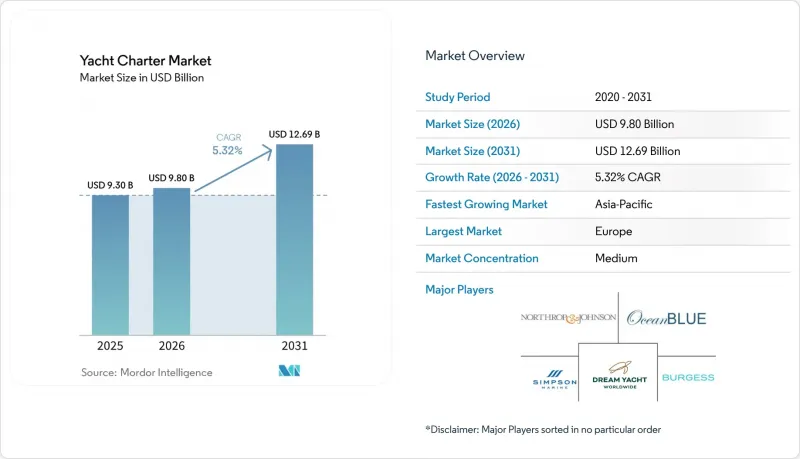
This report is Segmented by Charter Type (Bareboat, Cabin, and More), Yacht Type (Sailing Yacht, Motor Yacht, and More), Yacht Size (Less Than 24 Meters, 24 To 40 Meters, and More), Booking Channel (Broker-Assisted Offline and Online Marketplace), Charter Duration (Daily, Weekly, and More), End-User (Private and Leisure, and More), and Geography. The Market Forecasts are Provided in Terms of Value (USD).
Global Yacht Charter Market Trends and Insights
Surge in UHNWIs in Asia and Middle East catalyzing First-time Charters
The expanding UHNWI population in Asia and the Middle East is fundamentally reshaping the yacht charter market, with approximately 44% of family offices looking to increase allocations to luxury assets, including yacht investments, in 2025. This wealth surge creates a new class of first-time charterers who view yachting as a status symbol and an exclusive retreat from increasingly dense urban centers. The trend is particularly pronounced in China, where the number of individuals with investable assets exceeding USD 30 million grew by 15% in 2024, creating ripple effects across the global charter market. Knight Frank's Wealth Report 2025 reveals that these new entrants are not merely passive consumers but actively influence yacht design and amenities, demanding culturally specific experiences that charter companies must adapt to. The impact extends beyond Asia's waters, with Mediterranean charter operators reporting a 22% increase in Asian clientele in 2024, driving innovation in service offerings and cultural accommodations aboard luxury vessels.
Expansion of Online Platforms Boosting Utilization in Europe
Digital marketplace platforms are revolutionizing the European yacht charter landscape by dramatically reducing idle vessel time and expanding the customer base beyond traditional wealthy demographics. Click&Boat, Europe's leading yacht charter platform, has achieved a 28.13% traffic share, primarily from France and Italy, while emerging platforms like Boataround are gaining significant traction in Central Europe. These platforms have transformed the booking process, with users spending an average of 11 minutes per session exploring listings, resulting in a 30% increase in overall fleet utilization rates compared to traditional broker-only models. The democratization effect is particularly evident in Croatia, where PlainSailing.com reports that digital bookings have contributed to a 7% increase in UK-originated charters in 2024, with Lefkas in Greece emerging as a particularly popular destination due to its affordability and favorable sailing conditions. This digital transformation is not merely changing how yachts are booked but is fundamentally altering who books them, with millennials now representing 35% of all online yacht charter customers in Europe.
Peak-season Crew Shortages Inflating Mediterranean Charter Costs
The Mediterranean yacht charter market is grappling with a critical crew shortage during peak seasons, driving operational costs up by 15-20% in 2024 and forcing operators to make difficult trade-offs between service quality and profitability. This shortage is particularly acute for specialized roles such as engineers and chefs, with some owners opting for minimum crewing standards to reduce costs despite the potential impact on service quality. Charter operators report that crew salaries have increased by up to 25% for the 2025 season as companies compete for qualified personnel, with these costs inevitably passed on to clients through higher charter rates. The shortage has strategic implications for fleet deployment, with some operators redirecting vessels to regions with more stable labor markets or investing in crew retention programs that include year-round employment guarantees and professional development opportunities to secure talent in an increasingly competitive labor market.
Other drivers and restraints analyzed in the detailed report include:
- Experiential Tourism Demand Driving Catamaran Charters in the Caribbean
- Relaxed Mediterranean Charter Regulations Unlocking Capacity
- IMO Tier III Compliance Refits Pressuring Margins
For complete list of drivers and restraints, kindly check the Table Of Contents.
Segment Analysis
Crewed Charters had a 61.58% of the yacht charter market share in 2025, due to a fully staffed service that appeals to newcomers and time-pressed travelers. Vessels in this class often assign one crew member per guest pair, reinforcing value through personalized care. While modest in revenue, Cabin charters are scaling quickly at a 9.31% CAGR, broadening the yacht charter market to middle-income groups who pay per cabin rather than per vessel. In Southeast Asia, cabin offers now represent one in five bookings, underscoring their role in market expansion.
Digital booking hubs report that 70% of 2025 cabin and crewed reservations came via online channels, indicating transparency and convenience outweigh the historical reliance on personal brokers. Bareboat charters, roughly 40-60% cheaper than crewed trips, remain the choice for licensed sailors and contribute steady off-season income in tradewind regions. Enhanced navigation software and remote support deepen bareboat safety, enlarging the qualified client pool. Operators combining flexible staffing, add-on chef packages, and easy online checkout stand to capture the next wave of demand in the yacht charter industry.
Motor yachts accounted for 57.52% of the 2025 revenue pool, favored for expansive saloons and faster repositioning between hotspots. Yet rising eco-awareness is steering an 8.20% CAGR for sailing yachts, especially on Mediterranean island loops where wind availability suits carbon-light cruising. Meanwhile, the yacht charter market size for catamarans has surged, as two-hull designs match the stability of generous deck plans prized by families.
Hybrid propulsion, once a niche, saw more than 300 yachts added to global fleets in 2024, meeting both regulatory obligations and tenant preference for quiet anchorage stays. Operators blending sail and hybrid tech market fuel-savings of 20-30%, resonating with budget-sensitive renters as fuel prices fluctuate. Choice is now less about pure speed and more about aligning trip ethos with traveler values. Motor-yacht builders answer by integrating solar arrays and battery banks, signaling that sustainability has moved from optional to baseline expectation within the yacht charter market.
Complete Report Scope:
- By Charter Type
- Bareboat
- Cabin
- Crewed
- By Yacht Type
- Sailing Yacht
- Motor Yacht
- Catamaran and Others
- By Yacht Size
- Less than 24 meters
- 24 to 40 meters
- 40 to 60 meters
- More than 60 meters
- By Booking Channel
- Broker-Assisted Offline
- Online Marketplace
- By Charter Duration
- Daily
- Weekly
- Monthly/Seasonal
- By End-user
- Private and Leisure
- Corporate and MICE
- Government and Institutional
- By Geography
- North America
- United States
- Canada
- Mexico
- Rest of North America
- South America
- Brazil
- Argentina
- Rest of South America
- Europe
- United Kingdom
- Germany
- France
- Italy
- Spain
- Greece
- Croatia
- Rest of Europe
- Middle East and Africa
- Saudi Arabia
- United Arab Emirates
- Egypt
- Turkey
- South Africa
- Rest of Middle East and Africa
- Asia-Pacific
- China
- Japan
- India
- South Korea
- Thailand
- Rest of Asia Pacific
- North America
Geography Analysis
Europe retained a 45.05% share of global revenue in 2025, underpinned by dense marina networks and standardized charter rules. Greece's new e-Charter Permission drew a wave of non-EU superyachts, while Croatia's Dalmatian Coast captured price-sensitive bookings. Crew wage inflation of up to 25% and limited peak-season berths raise costs; online portals make secondary ports visible, smoothing demand over the entire year.
Asia is the fastest-rising market, predicted to expand at an 8.35% CAGR from 2026 to 2031. China's pool of individuals with more than USD 30 million in liquid assets jumped 15% in 2024, and marinas in Hainan, Phuket, and Bali are scaling to meet larger hull drafts. Digital discovery replaces broker gatekeeping, helping first-time charterers arrange corporate sail-aways and family reunions. Regional governments offer tax breaks on new marinas, spurring private investment.
The Caribbean holds winter appeal as yachts migrate from Europe for dual-season revenue. Catamaran charters climbed 15% year-on-year in 2024 thanks to spacious designs suited to island hopping. Growth is capped by berth shortages in the British Virgin Islands and Bahamas, while tightened U.S. environmental rules, such as California's Commercial Harbor Craft Regulation, raise compliance stakes for operators repositioning to Pacific ports. North America benefits from a strong domestic base and rising corporate incentives afloat, opening chances for themed charters that merge meetings with leisure.
- Dream Yacht Worldwide
- The Moorings
- Sunsail
- Burgess
- Ocean Independence
- Northrop and Johnson (MarineMax, Inc.)
- Y.CO (THE YACHT COMPANY)
- Fraser Yachts (MarineMax, Inc.)
- Imperial Yachts
- Camper and Nicholsons
- Edmiston
- Bluewater Yachting
- CharterWorld
- Boatsetter
- GetMyBoat
- Zizoo
- Navtours
- Asta Yachting
- Yachtico
- OceanBLUE Yachts Ltd.
Additional Benefits:
- The market estimate (ME) sheet in Excel format
- 3 months of analyst support
TABLE OF CONTENTS
1 Introduction
- 1.1 Study Assumptions and Market Definition
- 1.2 Scope of the Study
2 Research Methodology
3 Executive Summary
4 Market Landscape
- 4.1 Market Overview
- 4.2 Market Drivers
- 4.2.1 Surge in UHNWIs in Asia and Middle East Catalysing First-time Charters
- 4.2.2 Expansion of Online Platforms Boosting Utilisation in Europe
- 4.2.3 Experiential Tourism Demand Driving Catamaran Charters in Caribbean
- 4.2.4 Relaxed Mediterranean Charter Regulations Unlocking Capacity
- 4.2.5 Corporate Incentive Travel Adoption in North America
- 4.2.6 Eco-friendly Hybrid-Propulsion Yachts Attracting Scandinavian and Oceania Clientele
- 4.3 Market Restraints
- 4.3.1 Peak-season Crew Shortages Inflating Mediterranean Charter Costs
- 4.3.2 IMO Tier III Compliance Refits Pressuring Margins
- 4.3.3 Limited Marina Berths on Caribbean Islands Constraining Fleet Growth
- 4.3.4 High Discretionary-Spend Sensitivity in European Market
- 4.4 Value/Supply-Chain Analysis
- 4.5 Regulatory and Technological Outlook
- 4.6 Porter's Five Forces Analysis
- 4.6.1 Threat of New Entrants
- 4.6.2 Bargaining Power of Buyers
- 4.6.3 Bargaining Power of Suppliers
- 4.6.4 Threat of Substitutes
- 4.6.5 Intensity of Competitive Rivalry
5 Market Size and Growth Forecasts (Value (USD))
- 5.1 By Charter Type
- 5.1.1 Bareboat
- 5.1.2 Cabin
- 5.1.3 Crewed
- 5.2 By Yacht Type
- 5.2.1 Sailing Yacht
- 5.2.2 Motor Yacht
- 5.2.3 Catamaran and Others
- 5.3 By Yacht Size
- 5.3.1 Less than 24 meters
- 5.3.2 24 to 40 meters
- 5.3.3 40 to 60 meters
- 5.3.4 More than 60 meters
- 5.4 By Booking Channel
- 5.4.1 Broker-Assisted Offline
- 5.4.2 Online Marketplace
- 5.5 By Charter Duration
- 5.5.1 Daily
- 5.5.2 Weekly
- 5.5.3 Monthly/Seasonal
- 5.6 By End-user
- 5.6.1 Private and Leisure
- 5.6.2 Corporate and MICE
- 5.6.3 Government and Institutional
- 5.7 By Geography
- 5.7.1 North America
- 5.7.1.1 United States
- 5.7.1.2 Canada
- 5.7.1.3 Mexico
- 5.7.1.4 Rest of North America
- 5.7.2 South America
- 5.7.2.1 Brazil
- 5.7.2.2 Argentina
- 5.7.2.3 Rest of South America
- 5.7.3 Europe
- 5.7.3.1 United Kingdom
- 5.7.3.2 Germany
- 5.7.3.3 France
- 5.7.3.4 Italy
- 5.7.3.5 Spain
- 5.7.3.6 Greece
- 5.7.3.7 Croatia
- 5.7.3.8 Rest of Europe
- 5.7.4 Middle East and Africa
- 5.7.4.1 Saudi Arabia
- 5.7.4.2 United Arab Emirates
- 5.7.4.3 Egypt
- 5.7.4.4 Turkey
- 5.7.4.5 South Africa
- 5.7.4.6 Rest of Middle East and Africa
- 5.7.5 Asia-Pacific
- 5.7.5.1 China
- 5.7.5.2 Japan
- 5.7.5.3 India
- 5.7.5.4 South Korea
- 5.7.5.5 Thailand
- 5.7.5.6 Rest of Asia Pacific
- 5.7.1 North America
6 Competitive Landscape
- 6.1 Market Concentration
- 6.2 Strategic Moves
- 6.3 Market Share Analysis
- 6.4 Company Profiles (Includes Global Level Overview, Market Level Overview, Core Segments, Financials as Available, Strategic Information, Market Rank/Share for Key Companies, Products and Services, SWOT Analysis, and Recent Developments)
- 6.4.1 Dream Yacht Worldwide
- 6.4.2 The Moorings
- 6.4.3 Sunsail
- 6.4.4 Burgess
- 6.4.5 Ocean Independence
- 6.4.6 Northrop and Johnson (MarineMax, Inc.)
- 6.4.7 Y.CO (THE YACHT COMPANY)
- 6.4.8 Fraser Yachts (MarineMax, Inc.)
- 6.4.9 Imperial Yachts
- 6.4.10 Camper and Nicholsons
- 6.4.11 Edmiston
- 6.4.12 Bluewater Yachting
- 6.4.13 CharterWorld
- 6.4.14 Boatsetter
- 6.4.15 GetMyBoat
- 6.4.16 Zizoo
- 6.4.17 Navtours
- 6.4.18 Asta Yachting
- 6.4.19 Yachtico
- 6.4.20 OceanBLUE Yachts Ltd.
7 Market Opportunities and Future Outlook
- 7.1 White-space and Unmet-need Assessment

