PUBLISHER: Mordor Intelligence | PRODUCT CODE: 2115840

PUBLISHER: Mordor Intelligence | PRODUCT CODE: 2115840
Europe Bike Sharing - Market Share Analysis, Industry Trends & Statistics, Growth Forecasts (2026 - 2031)
According to Mordor Intelligence, Europe bike sharing market size in 2026 is estimated at USD 690 million, growing from 2025 value of USD 630 million with 2031 projections showing USD 1.06 billion, growing at 9.06% CAGR over 2026-2031.
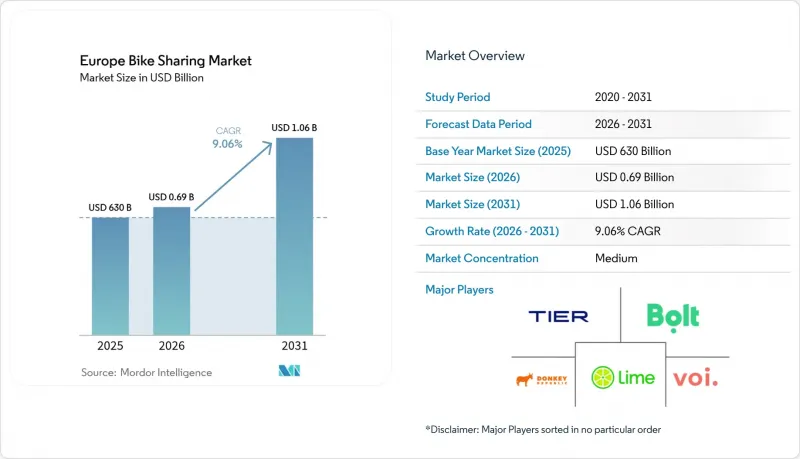
This report is Segmented by Bike Type (Conventional/Traditional Bicycles and Electric Bicycles), Sharing System (Docked and More), Booking Type (App-Based/Online and Kiosk/Walk-Up), User Profile (Commuters and More), Payment Model (Pay-As-You-Go and More), Fleet Ownership Model (Municipal-Owned and More), and Country (Germany, and More). The Market Forecasts are Provided in Terms of Value (USD).
Europe Bike Sharing Market Trends and Insights
Accelerating adoption of e-bikes in shared fleets
Operators cite 2-3 times more rides per vehicle, longer average trip length and stronger demand from older or less-fit riders, which jointly lift revenue per asset. Lime invested USD 55 million in 2024 to add 30,000 new e-bikes, prioritising European hubs where terrain or commuting distances limit classic cycling.Municipal incentive schemes in Belgium and France are reinforcing uptake by normalising electric cycling and improving residual battery-charging coverage. As battery prices fall and range improves, operators secure better procurement terms, widening margins in the Europe bike sharing market.
Emergence of ultra-low-emission urban zones
Amsterdam's January 2025 ban on combustion scooters and vans inside city cores exemplifies how climate policy channels demand toward compliant micro-mobility. Similar regulations in Paris and London expand the captive user pool for bike sharing services and nudge logistics companies into bicycle-based last-mile deliveries. Transport for London's fine regime of GBP 50-100 for misplaced e-bikes shows local authorities balancing accessibility with public-space order. First movers that can scale fleets quickly inside restricted areas gain defensible shares, anchoring their presence in the Europe bike sharing market.
Intense competition from e-scooters & other micro-mobility
Profit-positive e-scooter firms such as Voi Technology are injecting fresh capital to deploy bicycles, crowding curb space and putting price pressure on incumbents. Voi's plan to release thousands of e-bikes in London in 2025 will intensify mode-choice friction and may drive down per-ride revenue if price wars erupt. Multi-vehicle fleets demand sophisticated demand-allocation algorithms and raise capex needs, testing financial resilience in the Europe bike sharing market. Municipal caps on total vehicles often safeguard incumbents but risk dampening innovation.
Other drivers and restraints analyzed in the detailed report include:
- Corporate mobility-budget programmes boosting subscriptions
- AI-driven dynamic rebalancing improving unit economics
- Vandalism & theft driving up operating costs
For complete list of drivers and restraints, kindly check the Table Of Contents.
Segment Analysis
Electric bicycles accounted for 55.88% of Europe bike sharing market share in 2025 and are set to widen dominance via a 9.49% CAGR through 2031. Urban riders appreciate longer range and easier hill climbing, while operators earn more rides per asset and benefit from falling battery costs. The Europe bike sharing market size for e-bikes is projected to grow rapidly by 2031, mirroring policy support and city preference for low-sweat commuting. Conventional bicycles remain cost-efficient for very short trips, flatter geographies and tourist hotspots, maintaining a stabilising role in mixed fleets.
Local topography influences fleet mix: hilly Lisbon has already electrified 80% of its public bicycle stock, whereas flat Amsterdam still prefers classic bikes for last-mile hops. The widening procurement pipeline favours mid-drive motor suppliers in Germany and Japan who can deliver modular battery systems. Survey data show 47% of e-bike riders cite fuel-cost avoidance as a buying reason, underscoring macro drivers that translate into higher trip volumes for sharing schemes. Operators continue to pilot cargo e-bikes for delivery workers, opening niche revenue streams inside the Europe bike sharing market.
Dockless formats captured 68.10% revenue in 2025 on the promise of user flexibility and rapid rollouts without station hardware. Despite complaints about sidewalk clutter, European municipalities are leaning on designation-zone mandates rather than blanket bans, allowing the Europe bike sharing market to retain the convenience of station-free rentals. The segment shows positive outlook as operators refine geo-fenced parking and AI-guided rebalancing.
Hybrid networks-free-floating bikes that lock to painted bays-are emerging in Paris, Copenhagen and London, winning regulatory goodwill while preserving pick-up spontaneity, and expected to grow at 8.43% CAGR by 2031. Docked schemes such as Velib' still thrive in high-density cores, proving that well-funded station models can scale beyond 1,000 hubs when tethered to public-transport passes. The Europe bike sharing market therefore supports a spectrum of infrastructure configurations that align with varying curb-management objectives.
Complete Report Scope:
- By Bike Type
- Conventional/Traditional Bicycles
- Electric Bicycles (Pedelec, Speed-Pedelec)
- By Sharing System
- Docked
- Dockless
- Hybrid (Station-plus-Free-Floating)
- By Booking Type
- App-Based/Online
- Kiosk/Walk-Up
- By User Profile
- Commuters
- Tourists & Leisure Users
- Delivery/Gig Workers
- By Payment Model
- Pay-As-You-Go
- Subscription / Membership
- By Fleet Ownership Model
- Municipal-Owned
- Private-Operator-Owned
- Public-Private Partnership
- By Country
- Germany
- United Kingdom
- France
- Italy
- Spain
- Netherlands
- Belgium
- Rest of Europe
List of Companies Covered in this Report:
- Lime (Neutron Holdings Inc.)
- Tier Mobility SE
- nextbike GmbH (Tier)
- Donkey Republic ApS
- Voi Technology AB
- Dott B.V.
- Bolt Technology OU
- Bird Global Inc.
- PONY SAS
- Bleeper Active Ltd.
- JCDecaux SA (Cyclocity)
- Fifteen SAS
- Uber Technologies Inc. (Jump legacy)
- JOYRIDE Technologies Inc.
- PBSC Urban Solutions Inc.
- Swapfiets B.V.
- Fluctuo SAS
- Donkey Republic
- Beryl UK Ltd.
- Nextbike Polska S.A.
Additional Benefits:
- The market estimate (ME) sheet in Excel format
- 3 months of analyst support
TABLE OF CONTENTS
1 Introduction
- 1.1 Study Assumptions & Market Definition
- 1.2 Scope of the Study
2 Research Methodology
3 Executive Summary
4 Market Landscape
- 4.1 Market Overview
- 4.2 Market Drivers
- 4.2.1 Accelerating adoption of e-bikes in shared fleets
- 4.2.2 Emergence of ultra-low-emission urban zones
- 4.2.3 Corporate mobility-budget programmes boosting subscriptions
- 4.2.4 AI-driven dynamic rebalancing improving unit economics
- 4.2.5 EU NextGen cycling-infrastructure stimulus
- 4.2.6 Post-pandemic tourism rebound raising leisure usage
- 4.3 Market Restraints
- 4.3.1 Intense competition from e-scooters & other micro-mobility
- 4.3.2 Vandalism & theft driving up operating costs
- 4.3.3 Capital-market tightening curbing operator funding
- 4.3.4 Municipal tender volatility & policy reversals
- 4.4 Value/Supply-Chain Analysis
- 4.5 Regulatory Landscape
- 4.6 Technological Outlook
- 4.7 Porter's Five Forces
- 4.7.1 Bargaining Power of Suppliers
- 4.7.2 Bargaining Power of Buyers/Consumers
- 4.7.3 Threat of New Entrants
- 4.7.4 Threat of Substitute Products
- 4.7.5 Intensity of Competitive Rivalry
- 4.8 Investment & Funding Trends
5 Market Size & Growth Forecasts (Value (USD))
- 5.1 By Bike Type
- 5.1.1 Conventional/Traditional Bicycles
- 5.1.2 Electric Bicycles (Pedelec, Speed-Pedelec)
- 5.2 By Sharing System
- 5.2.1 Docked
- 5.2.2 Dockless
- 5.2.3 Hybrid (Station-plus-Free-Floating)
- 5.3 By Booking Type
- 5.3.1 App-Based/Online
- 5.3.2 Kiosk/Walk-Up
- 5.4 By User Profile
- 5.4.1 Commuters
- 5.4.2 Tourists & Leisure Users
- 5.4.3 Delivery/Gig Workers
- 5.5 By Payment Model
- 5.5.1 Pay-As-You-Go
- 5.5.2 Subscription / Membership
- 5.6 By Fleet Ownership Model
- 5.6.1 Municipal-Owned
- 5.6.2 Private-Operator-Owned
- 5.6.3 Public-Private Partnership
- 5.7 By Country
- 5.7.1 Germany
- 5.7.2 United Kingdom
- 5.7.3 France
- 5.7.4 Italy
- 5.7.5 Spain
- 5.7.6 Netherlands
- 5.7.7 Belgium
- 5.7.8 Rest of Europe
6 Competitive Landscape
- 6.1 Market Concentration
- 6.2 Strategic Moves
- 6.3 Market Share Analysis
- 6.4 Company Profiles (Includes Global Level Overview, Market Level Overview, Core Segments, Financials as Available, Strategic Information, Market Rank/Share for Key Companies, Products and Services, SWOT Analysis, and Recent Developments)
- 6.4.1 Lime (Neutron Holdings Inc.)
- 6.4.2 Tier Mobility SE
- 6.4.3 nextbike GmbH (Tier)
- 6.4.4 Donkey Republic ApS
- 6.4.5 Voi Technology AB
- 6.4.6 Dott B.V.
- 6.4.7 Bolt Technology OU
- 6.4.8 Bird Global Inc.
- 6.4.9 PONY SAS
- 6.4.10 Bleeper Active Ltd.
- 6.4.11 JCDecaux SA (Cyclocity)
- 6.4.12 Fifteen SAS
- 6.4.13 Uber Technologies Inc. (Jump legacy)
- 6.4.14 JOYRIDE Technologies Inc.
- 6.4.15 PBSC Urban Solutions Inc.
- 6.4.16 Swapfiets B.V.
- 6.4.17 Fluctuo SAS
- 6.4.18 Donkey Republic
- 6.4.19 Beryl UK Ltd.
- 6.4.20 Nextbike Polska S.A.
7 Market Opportunities & Future Outlook
- 7.1 White-Space & Unmet-Need Assessment

