PUBLISHER: Mordor Intelligence | PRODUCT CODE: 2115851

PUBLISHER: Mordor Intelligence | PRODUCT CODE: 2115851
5-Hydroxytryptophan (5-HTP) - Market Share Analysis, Industry Trends & Statistics, Growth Forecasts (2026 - 2031)
According to Mordor Intelligence, the 5-hydroxytryptophan market size in 2026 is estimated at USD 1.11 billion, growing from 2025 value of USD 1.04 billion with 2031 projections showing USD 1.55 billion, growing at 6.85% CAGR over 2026-2031.
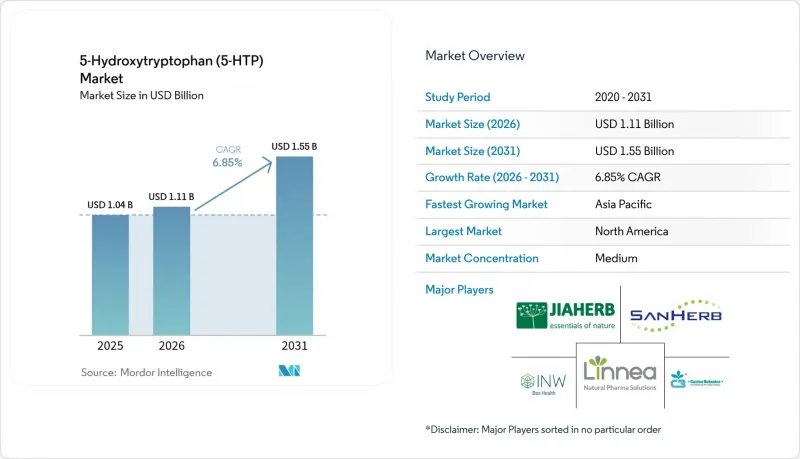
This report Segments the Industry by Source Type (Plant-Derived (Griffonia Simplicifolia), Synthetic Chemical, and More), Form (Liquid Extracts, Capsules/Tablets, and More), Application (Dietary Supplements, Medical/Pharmaceutical, and More), and Geography (Asia-Pacific, North America, Europe, South America, and Middle East and Africa). The Market Forecasts are Provided in Terms of Value (USD).
Global 5-Hydroxytryptophan (5-HTP) Market Trends and Insights
Rising Consumption of Mood-Support Supplements
Clinical recognition of 5-HTP as a serotonin precursor underpins robust demand in the 5-hydroxytryptophan market. Trials show 56% of participants experience marked relief from depressive symptoms, establishing a natural alternative to selective serotonin reuptake inhibitors. Post-pandemic self-care culture reinforces preventive mental-wellness spending, particularly where nutraceutical claims are permissible. Premium brands bundle 5-HTP with adaptogens to deliver multi-pathway mood balance, and subscription e-commerce channels foster routine consumption. Collective momentum adds an estimated 1.8 percentage points to overall CAGR, sustaining mid-term revenue visibility for suppliers.
Expansion of Sports-Nutrition Formulations
Endurance athletes recognize serotonin depletion as a performance bottleneck, and 5-HTP's role in restoring neurotransmitter balance positions the compound for crossover into sports nutrition. Research shows supplementation diminishes exercise-induced oxidative damage while stimulating acute growth-hormone release after 200 mg oral dosing. Brands now integrate 5-HTP with electrolytes and branched-chain amino acids in pre-workout blends, expanding household penetration beyond mood-centric shoppers. Athletic endorsements and clean-label claims reinforce premium pricing, elevating regional growth across established fitness markets.
Volatile Griffonia Seed Supply & Pricing
Ghana exports about 2,000 tonnes of Griffonia simplicifolia seed annually, yet destructive harvesting and habitat loss imperil future yields. Fluctuating farm-gate prices translate into margin pressure for extractors, especially smaller brands with limited inventory buffers. Logistics complexity heightens risk as raw seeds traverse multiple customs regimes en route to Asian processors. Supply anxiety trims 1.5 percentage points from projected CAGR, intensifying interest in fermentation alternatives across the 5-hydroxytryptophan market.
Other drivers and restraints analyzed in the detailed report include:
- Growing Preference for Plant-Based Nootropics
- Microbial-Fermentation Cost Breakthroughs
- Regulatory Uncertainty for Fortified Foods
For complete list of drivers and restraints, kindly check the Table Of Contents.
Segment Analysis
Plant-derived material held 70.22% of 2025 volume as long-standing extraction know-how delivered reliable potency to finished-product formulators. The segment benefits from consumer familiarity with botanical origins and a perception of "naturalness" that bolsters brand storytelling, especially within premium sleep and mood portfolios. Nonetheless, the sustainability crisis surrounding West African seed stocks weakens long-run dependence as habitat degradation erodes collection yields and elevates raw-material costs. Processors report lengthening procurement cycles and more stringent quality screening to manage aflatoxin risk, driving operating-expense creep that narrows margins across the 5-hydroxytryptophan market.
Microbial fermentation, expanding at a 9.02% CAGR, advances through iterative metabolic-engineering breakthroughs that trim media costs and raise product recovery yields. The approach decouples production from agronomic variability and curtails deforestation pressure, creating a compelling sustainability narrative for retailers piloting science-backed carbon labels. Early commercial adopters negotiate long-term offtake agreements to lock in fixed-price supply, thereby safeguarding gross margins when botanical prices spike. This structural shift may pare the plant segment's command to just over half of the 5-hydroxytryptophan market by decade-end, although consumer education remains pivotal in normalizing "fermentation-sourced" label language. Synthetic chemical production persists within tightly regulated pharmaceutical niches, contributing negligible bulk volume but supporting specialty APIs where defined stereochemistry is essential.
Complete Report Scope:
- By Source Type
- Plant-derived (Griffonia simplicifolia)
- Synthetic Chemical
- Microbial Fermentation
- By Form
- Powder (>95 % potency)
- Capsules/Tablets
- Liquid Extracts
- Gummies and Functional Foods
- By Application
- Dietary Supplements
- Medical/Pharmaceutical
- Food and Beverage Fortification
- Cosmetics and Personal Care
- Other Applications
- By Geography
- Asia-Pacific
- China
- India
- Japan
- South Korea
- Rest of Asia-Pacific
- North America
- United States
- Canada
- Mexico
- Europe
- Germany
- United Kingdom
- France
- Italy
- Rest of Europe
- South America
- Brazil
- Argentina
- Rest of South America
- Middle East and Africa
- Saudi Arabia
- South Africa
- Rest of Middle East and Africa
- Asia-Pacific
Geography Analysis
North America generated 39.88% of 2025 revenue on the strength of mature dietary supplement frameworks and superior consumer purchasing power. High internet-adoption rates facilitate direct-to-consumer subscription growth, and expanding telehealth practices integrate nutraceutical recommendations into digital therapy protocols. The United States sees insurers pilot mental-wellness reimbursement bundles that include 5-HTP vouchers, while Canada's recent fortification denial underscores federal caution toward mass-market exposure. Slower incremental consumption among legacy user cohorts moderates the region's forward CAGR compared with emerging territories, yet base-year size preserves absolute dollar leadership within the 5-hydroxytryptophan market.
Asia-Pacific posts the fastest trajectory at 7.95% through 2031 as aging societies in Japan, South Korea, and China prioritize proactive cognitive health measures. Japan's USD 9.4 billion supplement sector validates deep wallet share for natural mood aids, and cross-border e-commerce makes premium United States brands visible to Chinese consumers despite domestic formulary expansion. ASEAN regulatory convergence lowers dossier duplication costs, enabling multinational firms to synchronize multilingual pack artwork and accelerate retail entry. Rural distribution infrastructure upgrades across Indonesia and Vietnam further unlock untapped volume potential.
Europe maintains steady expansion anchored by pragmatic ingredient policy that classifies up to 30%-concentration extracts as non-novel, streamlining routes to shelf for baked goods, ready-to-drink coffees, and ambient snacks. Inflationary pressures on energy and transportation raise cost-of-goods sold, yet premium positioning shields recommended retail prices. Scandinavian pharmacy chains pilot mental-wellness end-caps bundling 5-HTP with magnesium and vitamin B6, offering cross-promotional elasticity. South America and the Middle East & Africa still represent nascent demand clusters, handicapped by fragmented channel infrastructure and sporadic regulatory enforcement. Nonetheless, social-media wellness influencers spark initial brand recognition, setting the stage for multiyear education-led seeding.
- Adooq Bioscience LLC.
- Alpspure Lifesciences Pvt. Ltd.
- Bee Health Limited
- BIOGENA
- Cactus Botanics
- Chengdu SanHerb Bioscience Co.
- Linnea SA
- Natrol
- Pure Encapsulations, LLC.
- Shaanxi Jiahe Phytochem Co., Ltd.
- Shaanxi Shineherb Biotech Co., Ltd.
Additional Benefits:
- The market estimate (ME) sheet in Excel format
- 3 months of analyst support
TABLE OF CONTENTS
1 Introduction
- 1.1 Study Assumptions & Market Definition
- 1.2 Scope of the Study
2 Research Methodology
3 Executive Summary
4 Market Landscape
- 4.1 Market Overview
- 4.2 Market Drivers
- 4.2.1 Rising consumption of mood-support supplements
- 4.2.2 Expansion of sports-nutrition formulations
- 4.2.3 Growing preference for plant-based nootropics
- 4.2.4 Microbial-fermentation cost breakthroughs
- 4.2.5 Emerging cardioprotective pharma research
- 4.3 Market Restraints
- 4.3.1 Volatile Griffonia seed supply & pricing
- 4.3.2 Regulatory uncertainty for fortified foods
- 4.3.3 Serotonin-syndrome safety concerns
- 4.4 Value Chain Analysis
- 4.5 Porter's Five Forces
- 4.5.1 Threat of New Entrants
- 4.5.2 Bargaining Power of Buyers
- 4.5.3 Bargaining Power of Suppliers
- 4.5.4 Threat of Substitute Products
- 4.5.5 Degree of Competition
5 Market Size & Growth Forecasts (Value)
- 5.1 By Source Type
- 5.1.1 Plant-derived (Griffonia simplicifolia)
- 5.1.2 Synthetic Chemical
- 5.1.3 Microbial Fermentation
- 5.2 By Form
- 5.2.1 Powder (>95 % potency)
- 5.2.2 Capsules/Tablets
- 5.2.3 Liquid Extracts
- 5.2.4 Gummies and Functional Foods
- 5.3 By Application
- 5.3.1 Dietary Supplements
- 5.3.2 Medical/Pharmaceutical
- 5.3.3 Food and Beverage Fortification
- 5.3.4 Cosmetics and Personal Care
- 5.3.5 Other Applications
- 5.4 By Geography
- 5.4.1 Asia-Pacific
- 5.4.1.1 China
- 5.4.1.2 India
- 5.4.1.3 Japan
- 5.4.1.4 South Korea
- 5.4.1.5 Rest of Asia-Pacific
- 5.4.2 North America
- 5.4.2.1 United States
- 5.4.2.2 Canada
- 5.4.2.3 Mexico
- 5.4.3 Europe
- 5.4.3.1 Germany
- 5.4.3.2 United Kingdom
- 5.4.3.3 France
- 5.4.3.4 Italy
- 5.4.3.5 Rest of Europe
- 5.4.4 South America
- 5.4.4.1 Brazil
- 5.4.4.2 Argentina
- 5.4.4.3 Rest of South America
- 5.4.5 Middle East and Africa
- 5.4.5.1 Saudi Arabia
- 5.4.5.2 South Africa
- 5.4.5.3 Rest of Middle East and Africa
- 5.4.1 Asia-Pacific
6 Competitive Landscape
- 6.1 Market Concentration
- 6.2 Strategic Moves
- 6.3 Market Share(%)/Ranking Analysis
- 6.4 Company Profiles (includes Global level Overview, Market level overview, Core Segments, Financials as available, Strategic Information, Market Rank/Share for key companies, Products & Services, and Recent Developments)
- 6.4.1 Adooq Bioscience LLC.
- 6.4.2 Alpspure Lifesciences Pvt. Ltd.
- 6.4.3 Bee Health Limited
- 6.4.4 BIOGENA
- 6.4.5 Cactus Botanics
- 6.4.6 Chengdu SanHerb Bioscience Co.
- 6.4.7 Linnea SA
- 6.4.8 Natrol
- 6.4.9 Pure Encapsulations, LLC.
- 6.4.10 Shaanxi Jiahe Phytochem Co., Ltd.
- 6.4.11 Shaanxi Shineherb Biotech Co., Ltd.
7 Market Opportunities & Future Outlook
- 7.1 White-space & unmet-need assessment
- 7.2 Growing Trend for Bio Medications and Increasing Stress Issues Among People

