PUBLISHER: Mordor Intelligence | PRODUCT CODE: 2115858

PUBLISHER: Mordor Intelligence | PRODUCT CODE: 2115858
Phase Transfer Catalyst - Market Share Analysis, Industry Trends & Statistics, Growth Forecasts (2026 - 2031)
According to Mordor Intelligence, the phase transfer catalyst market size is expected to grow from USD 1.13 billion in 2025 to USD 1.19 billion in 2026 and is forecast to reach USD 1.58 billion by 2031 at 5.71% CAGR over 2026-2031.
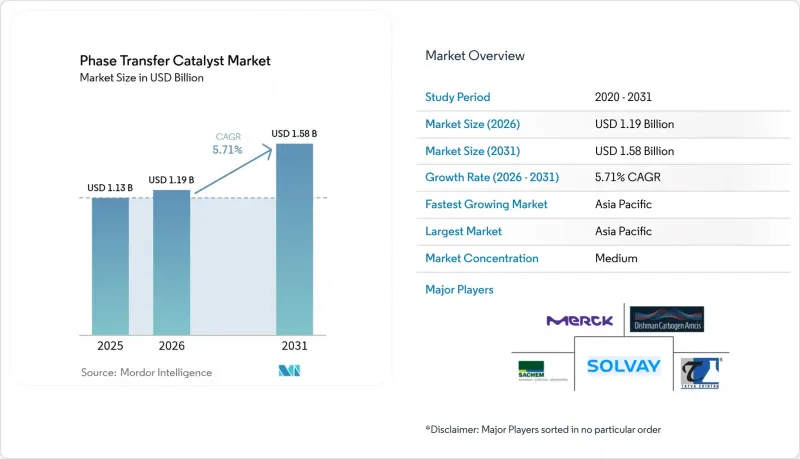
This report is Segmented by Type (Quaternary Ammonium Salts, Quaternary Phosphonium Salts, Others), Form (Liquid PTC, Solid PTC, Supported/Immobilised PTC), End-User Industry (Pharmaceuticals, Chemicals, Agrochemicals, Personal-Care and Cosmetics, and More), and Geography (Asia-Pacific, North America, Europe, and More). The Market Forecasts are Provided in Terms of Value (USD).
Global Phase Transfer Catalyst Market Trends and Insights
Growing Application in Pharmaceutical APIs
Pharmaceutical manufacturers rely on phase transfer catalysis to meet green-chemistry mandates while controlling costs, highlighting trends in the phase transfer catalyst industry. Mild reaction conditions lower energy input, and catalyst recyclability reduces waste disposal. Evonik's reorganization around lipid specialties for mRNA therapies illustrates how large suppliers are refocusing on higher-value drug intermediates. Continuous-manufacturing adoption in the United States and Europe increases demand for supported systems that simplify catalyst recovery. Reshoring programs in both regions add extra pull for local, sustainable PTC solutions that compete with historic Asian low-cost supply.
Demand-side Pull from Green Chemistry Compliance
Environmental regulation underpins the steady uptake of PTC in the phase transfer catalyst industry. The EPA now targets a 65% reduction in hazardous-air-pollutant use, steering chemical plants toward aqueous or solvent-free routes that PTC enables. California's consumer-products rule imposes stringent VOC caps, encouraging waterborne reactions. The EU Chemicals Strategy further rewards circular-economy catalysts with low emissions. Compliance-driven buying supports PTC volumes even during macro-slowdowns, giving early adopters a competitive edge in eco-sensitive markets.
Price Volatility of Quaternary Ammonium Feedstocks
Bromine prices surged more than 40% in early 2025 amid logistics disruptions on Chinese and Jordanian routes, impacting the phase transfer catalyst market. Concurrent caustic-soda tightness, fueled by construction-sector rebound, threatens supply stability. European chlor-alkali plants grapple with energy inflation, passing higher costs to PTC buyers. Producers with captive chlorine and bromine resources or long-term contracts mitigate these shocks and maintain competitive pricing.
Other drivers and restraints analyzed in the detailed report include:
- Expansion of Agrochemical Actives Production
- Process-cost Advantage over Homogeneous Catalysts
- Competition from Ionic-liquid/Enzymatic Catalysts
For complete list of drivers and restraints, kindly check the Table Of Contents.
Segment Analysis
Quaternary Ammonium Salts hold a commanding 47.79% share. Wide deployment in drug and agrochemical synthesis, supported supply chains, and well-documented reaction mechanisms keep them at the forefront. The segment is forecast to grow at 5.89% CAGR to 2031 as demand rises for efficient, environmentally compliant processes. Quaternary Phosphonium Salts occupy the next tier, appealing to battery electrolyte formulators seeking higher thermal durability. The niche "Others" category, spanning chiral and multi-site catalysts, addresses asymmetric synthesis for specialty APIs where single-enantiomer purity commands premium pricing.
Complete Report Scope:
- By Type
- Quaternary Ammonium Salts
- Quaternary Phosphonium Salts
- Others
- By Form
- Liquid PTC
- Solid PTC
- Supported / Immobilised PTC
- By End-user Industry
- Pharmaceuticals
- Chemicals (Bulk and Fine)
- Agrochemicals
- Personal-care and Cosmetics
- Batteries and Energy Storage
- Others
- By Geography
- Asia-Pacific
- China
- India
- Japan
- South Korea
- Rest of Asia-Pacific
- North America
- United States
- Canada
- Mexico
- Europe
- Germany
- United Kingdom
- France
- Italy
- Rest of Europe
- South America
- Brazil
- Argentina
- Rest of South America
- Middle-East and Africa
- Saudi Arabia
- South Africa
- Rest of Middle-East and Africa
- Asia-Pacific
Geography Analysis
Asia Pacific holds a 37.55% share in the phase transfer catalyst market and is projected to post a 6.18% CAGR to 2031. China's pivot toward complex APIs and India's specialty-chemical capacity build-out underpin regional dominance. Multinational expansions, such as Evonik's specialty amine capacity in Nanjing, further consolidate the supply base. Regional lithium-ion gigafactories add demand for electrolyte additives, reinforcing a self-sustaining PTC ecosystem.
North America remains a pivotal buyer in the phase transfer catalyst market, supported by reshoring incentives and heightened environmental scrutiny. The EPA's 2025 hazardous-pollutant thresholds push chemical firms toward PTC routes with lower solvent loads, locking in resilient baseline demand. Europe prioritizes sustainability and circular-economy alignment, driving uptake of recyclable catalysts and hybrid ionic-liquid systems. The EU Chemicals Strategy stipulates safe-and-sustainable-by-design criteria, positioning supported PTC as a favored alternative over legacy homogeneous halide processes.
- Cayman Chemical
- Central Drug House
- Dishman Carbogen Amcis Ltd
- Evonik Industries AG
- Kente Catalysts Inc.
- Merck KGaA
- Nippon Chemical Industrial Co. Ltd
- Pacific Organics Pvt Ltd
- PAT Impex
- SACHEM Inc.
- Solvay
- Tatva Chintan Pharma Chem Ltd
Additional Benefits:
- The market estimate (ME) sheet in Excel format
- 3 months of analyst support
TABLE OF CONTENTS
1 Introduction
- 1.1 Study Assumptions and Market Definition
- 1.2 Scope of the Study
2 Research Methodology
3 Executive Summary
4 Market Landscape
- 4.1 Market Overview
- 4.2 Market Drivers
- 4.2.1 Growing Application in Pharmaceutical APIs
- 4.2.2 Demand-Side Pull from Green Chemistry Compliance
- 4.2.3 Expansion of Agrochemical Active Production
- 4.2.4 Process-Cost Advantage over Homogeneous Catalysts
- 4.2.5 Use In Li-ion Battery Electrolyte Additives
- 4.3 Market Restraints
- 4.3.1 Price Volatility of Quaternary Ammonium Feedstocks
- 4.3.2 Competition From Ionic-Liquid/Enzymatic Catalysts
- 4.3.3 Aquatic?Toxicity Scrutiny of Phosphonium Salts
- 4.4 Value Chain Analysis
- 4.5 Porter's Five Forces Analysis
- 4.5.1 Threat of New Entrants
- 4.5.2 Bargaining Power of Buyers
- 4.5.3 Bargaining Power of Suppliers
- 4.5.4 Threat of Substitutes
- 4.5.5 Degree of Competition
5 Market Size and Growth Forecasts (Value)
- 5.1 By Type
- 5.1.1 Quaternary Ammonium Salts
- 5.1.2 Quaternary Phosphonium Salts
- 5.1.3 Others
- 5.2 By Form
- 5.2.1 Liquid PTC
- 5.2.2 Solid PTC
- 5.2.3 Supported / Immobilised PTC
- 5.3 By End-user Industry
- 5.3.1 Pharmaceuticals
- 5.3.2 Chemicals (Bulk and Fine)
- 5.3.3 Agrochemicals
- 5.3.4 Personal-care and Cosmetics
- 5.3.5 Batteries and Energy Storage
- 5.3.6 Others
- 5.4 By Geography
- 5.4.1 Asia-Pacific
- 5.4.1.1 China
- 5.4.1.2 India
- 5.4.1.3 Japan
- 5.4.1.4 South Korea
- 5.4.1.5 Rest of Asia-Pacific
- 5.4.2 North America
- 5.4.2.1 United States
- 5.4.2.2 Canada
- 5.4.2.3 Mexico
- 5.4.3 Europe
- 5.4.3.1 Germany
- 5.4.3.2 United Kingdom
- 5.4.3.3 France
- 5.4.3.4 Italy
- 5.4.3.5 Rest of Europe
- 5.4.4 South America
- 5.4.4.1 Brazil
- 5.4.4.2 Argentina
- 5.4.4.3 Rest of South America
- 5.4.5 Middle-East and Africa
- 5.4.5.1 Saudi Arabia
- 5.4.5.2 South Africa
- 5.4.5.3 Rest of Middle-East and Africa
- 5.4.1 Asia-Pacific
6 Competitive Landscape
- 6.1 Market Concentration
- 6.2 Strategic Moves
- 6.3 Market Share Analysis
- 6.4 Company Profiles (includes Global level Overview, Market level overview, Core Segments, Financials as available, Strategic Information, Market Rank/Share for key companies, Products and Services, and Recent Developments)
- 6.4.1 Cayman Chemical
- 6.4.2 Central Drug House
- 6.4.3 Dishman Carbogen Amcis Ltd
- 6.4.4 Evonik Industries AG
- 6.4.5 Kente Catalysts Inc.
- 6.4.6 Merck KGaA
- 6.4.7 Nippon Chemical Industrial Co. Ltd
- 6.4.8 Pacific Organics Pvt Ltd
- 6.4.9 PAT Impex
- 6.4.10 SACHEM Inc.
- 6.4.11 Solvay
- 6.4.12 Tatva Chintan Pharma Chem Ltd
7 Market Opportunities and Future Outlook
- 7.1 White-space and Unmet-Need Assessment
- 7.2 Growing Use in Fine-chemicals and Organic Intermediates

