PUBLISHER: Mordor Intelligence | PRODUCT CODE: 2115860

PUBLISHER: Mordor Intelligence | PRODUCT CODE: 2115860
United States Industrial Gas - Market Share Analysis, Industry Trends & Statistics, Growth Forecasts (2026 - 2031)
According to Mordor Intelligence, the United States industrial gas market size is expected to grow from 377.20 Million tons in 2025 to 391.84 Million tons in 2026 and is forecast to reach 473.99 Million tons by 2031 at 3.88% CAGR over 2026-2031.
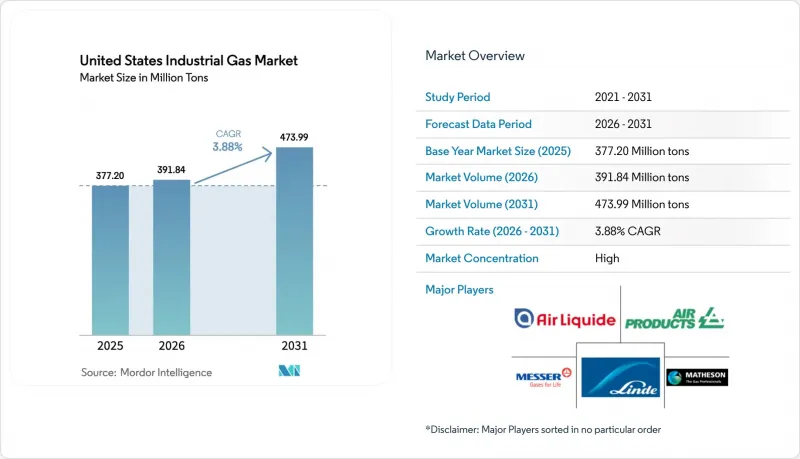
This report is Segmented by Product Type (Nitrogen, Oxygen, Carbon Dioxide, Hydrogen, Helium, Argon, Ammonia, Methane, and More), End-User Industry (Chemical Processing and Refining, Electronics, Food and Beverage, Oil and Gas, Metal Manufacturing and Fabrication, Medical and Pharmaceutical, Automotive and Transportation, and More). The Market Forecasts are Provided in Terms of Volume (Tons).
United States Industrial Gas Market Trends and Insights
Increasing Demand from the Healthcare Sector
Medical oxygen volumes surged during the pandemic and have remained structurally higher as hospitals sustained expanded intensive-care capacity and home-oxygen programs. The FDA's current good manufacturing practice rules under 21 CFR Part 211 impose batch-record documentation, purity testing, and validated filling procedures, adding to production cost compared with industrial-grade oxygen. Pharmaceutical manufacturers are boosting ultra-high-purity nitrogen use for biologics cleanrooms, where oxygen levels must stay below 1 ppm to prevent oxidative degradation. Telehealth expansion in rural regions is lifting demand for portable concentrators, a niche that regional distributors such as Holston Gases and nexAir serve through subscription models. These dynamics combine to keep the United States industrial gas market firmly oriented toward medical-grade reliability and traceability.
Rising Demand for Frozen and Packaged Food Applications
Liquid-nitrogen tunnels reaching -196 °C are displacing mechanical blast freezers because they lock in product moisture within seconds, cutting drip loss and preserving texture. Modified-atmosphere packaging that replaces oxygen with nitrogen or carbon dioxide slows microbial growth, enabling fresh-cut produce to travel up to 10 days without preservatives. USDA cold-chain modernization grants issued in 2024 subsidized nitrogen-injection systems for regional meat-packing and dairy plants, accelerating adoption by mid-size processors. Carbon-dioxide demand is climbing in parallel for beverage carbonation and dry-ice logistics; Air Liquide's 2024 Tennessee air-separation investment pairs a CO2 liquefaction train with regional food processing supply. These factors underpin the fast-growing food segment within the United States industrial gas market.
Persistent Helium Supply Volatility and Price Spikes
In 2024, the closure of the Cliffside Field reserve removed a crucial buffer that had ensured the stability of the domestic helium supply for half a century. While Messer's acquisition of the Federal Helium System introduced a layer of private oversight, helium spot prices experienced notable fluctuations compared to the previous year. To mitigate helium consumption, hospitals operating MRI scanners are investing in closed-loop helium recovery systems. Meanwhile, while aerospace and fiber-optic manufacturers have explored hydrogen and neon as potential substitutes, technical trade-offs have hindered widespread adoption. This price volatility is dampening the growth momentum of the United States industrial gas market.
Other drivers and restraints analyzed in the detailed report include:
- Growing Need for Low-Carbon Hydrogen in Energy Transition
- Expansion of Semiconductor Fabs Requiring Ultra-High-Purity Specialty Gases
- Stringent Environmental and Safety Regulations Raising Compliance Costs
For complete list of drivers and restraints, kindly check the Table Of Contents.
Segment Analysis
Nitrogen is forecast to grow at 4.68% annually, the quickest pace among product types, while oxygen retained 31.94% of the United States industrial gas market share in 2025. Rising semiconductor demand for nitrogen per fab and food processors' adoption of cryogenic freezing underpin nitrogen's trajectory.
The United States industrial gas market size for carbon dioxide is expanding as beverage carbonation and CCUS projects scale, illustrated by Messer's 2025 investment with LSB Industries in Alabama. Hydrogen volumes are climbing as Gulf Coast refiners pivot to low-carbon pathways qualified for 45V and 45Q incentives. Helium remains constrained, supporting premium pricing. Argon's outlook is tied to welding demand in lightweight-vehicle manufacturing, while ammonia, methane, propane, and butane retain specialized roles in refrigeration, feedstocks, and metal-fabrication heating.
Complete Report Scope:
- By Product Type
- Nitrogen
- Oxygen
- Carbon Dioxide
- Hydrogen
- Helium
- Argon
- Ammonia
- Methane
- Propane
- Butane
- Other Product Types
- By End-User Industry
- Chemical Processing and Refining
- Electronics
- Food and Beverage
- Oil and Gas
- Metal Manufacturing and Fabrication
- Medical and Pharmaceutical
- Automotive and Transportation
- Energy and Power
- Other End-user Industries
List of Companies Covered in this Report:
- Air Liquide
- Air Products and Chemicals Inc.
- AIR WATER INC.
- American Gas Products
- Atlas Copco North America LLC.
- BASF
- Cryoin Engineering Ltd.
- GENERON
- Holston Gases.
- Iwatani Corporation
- Linde PLC
- Matheson Tri-Gas Inc.
- Messer North America, Inc.
- nexAir LLC
- Norco Inc.
- Peak Scientific Instruments
- UIG
- Western International Gas and Cylinders, Inc. (WIGC)
Additional Benefits:
- The market estimate (ME) sheet in Excel format
- 3 months of analyst support
TABLE OF CONTENTS
1 Introduction
- 1.1 Study Assumptions and Market Definition
- 1.2 Scope of the Study
2 Research Methodology
3 Executive Summary
4 Market Landscape
- 4.1 Market Overview
- 4.2 Market Drivers
- 4.2.1 Increasing demand from the healthcare sector
- 4.2.2 Rising demand for frozen and packaged food applications
- 4.2.3 Growing need for low-carbon hydrogen in energy transition
- 4.2.4 Expansion of semiconductor fabs requiring ultra-high-purity specialty gases
- 4.2.5 Growth in low-carbon ammonia and sustainable aviation-fuel production
- 4.3 Market Restraints
- 4.3.1 Stringent environmental and safety regulations raising compliance costs
- 4.3.2 Persistent helium supply volatility and price spikes
- 4.3.3 Energy-intensive ASUs exposed to electricity price inflation
- 4.4 Value Chain Analysis
- 4.5 Porter's Five Forces
- 4.5.1 Bargaining Power of Suppliers
- 4.5.2 Bargaining Power of Consumers
- 4.5.3 Threat of New Entrants
- 4.5.4 Threat of Substitute Products and Services
- 4.5.5 Degree of Competition
5 Market Size and Growth Forecasts (Volume)
- 5.1 By Product Type
- 5.1.1 Nitrogen
- 5.1.2 Oxygen
- 5.1.3 Carbon Dioxide
- 5.1.4 Hydrogen
- 5.1.5 Helium
- 5.1.6 Argon
- 5.1.7 Ammonia
- 5.1.8 Methane
- 5.1.9 Propane
- 5.1.10 Butane
- 5.1.11 Other Product Types
- 5.2 By End-User Industry
- 5.2.1 Chemical Processing and Refining
- 5.2.2 Electronics
- 5.2.3 Food and Beverage
- 5.2.4 Oil and Gas
- 5.2.5 Metal Manufacturing and Fabrication
- 5.2.6 Medical and Pharmaceutical
- 5.2.7 Automotive and Transportation
- 5.2.8 Energy and Power
- 5.2.9 Other End-user Industries
6 Competitive Landscape
- 6.1 Market Concentration
- 6.2 Strategic Moves
- 6.3 Market Share/Ranking Analysis
- 6.4 Company Profiles (includes Global level Overview, Market level overview, Core Segments, Financials as available, Strategic Information, Market Rank/Share for key companies, Products and Services, and Recent Developments)
- 6.4.1 Air Liquide
- 6.4.2 Air Products and Chemicals Inc.
- 6.4.3 AIR WATER INC.
- 6.4.4 American Gas Products
- 6.4.5 Atlas Copco North America LLC.
- 6.4.6 BASF
- 6.4.7 Cryoin Engineering Ltd.
- 6.4.8 GENERON
- 6.4.9 Holston Gases.
- 6.4.10 Iwatani Corporation
- 6.4.11 Linde PLC
- 6.4.12 Matheson Tri-Gas Inc.
- 6.4.13 Messer North America, Inc.
- 6.4.14 nexAir LLC
- 6.4.15 Norco Inc.
- 6.4.16 Peak Scientific Instruments
- 6.4.17 UIG
- 6.4.18 Western International Gas and Cylinders, Inc. (WIGC)
7 Market Opportunities and Future Outlook
- 7.1 White-space and Unmet-Need Assessment

