PUBLISHER: Mordor Intelligence | PRODUCT CODE: 2115868

PUBLISHER: Mordor Intelligence | PRODUCT CODE: 2115868
North America Home Furniture - Market Share Analysis, Industry Trends & Statistics, Growth Forecasts (2026 - 2031)
According to Mordor Intelligence, the North America home furniture market size was valued at USD 202.25 billion in 2025 and estimated to grow from USD 211.88 billion in 2026 to reach USD 267.29 billion by 2031, at a CAGR of 4.76% during the forecast period (2026-2031).
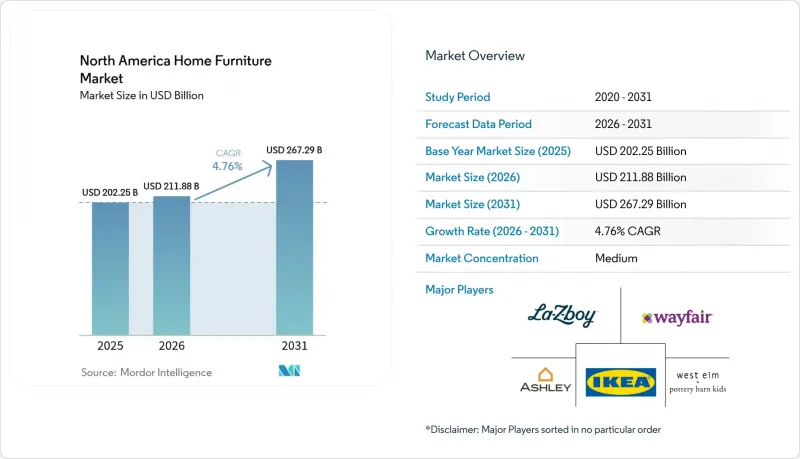
This report is Segmented by Product (Living Room & Dining Room Furniture, Bedroom Furniture, Kitchen Furniture, and Other), Material (Wood, Metal, Plastic & Polymer, Others), Price Range (Economy, Mid-Range, Premium), Distribution Channel (Home Centers, and Other), and Geography (Canada, United States, Mexico). The Market Forecasts are Provided in Terms of Value (USD).
North America Home Furniture Market Trends and Insights
Rising Residential Construction Fuels Demand
Housing starts reached 1.50 million annualized units in February 2025, an 11% monthly jump that signals a solid construction recovery. Single-family starts alone totaled 1.11 million units, underpinning steady demand for full-home furnishing packages. Remodeling outlays are forecast to climb 1.2% to USD 509 billion in 2025, further broadening the addressable base for replacement and upgrade purchases. Each housing completion typically triggers a burst of furniture spend, and historical data show an 80% correlation between existing-home transactions and large furniture purchases. Regional codes that promote energy-efficient buildings intensify interest in sustainably sourced materials, aligning with consumer eco-preferences. Taken together, the construction and remodeling cycle offers durable support to the North America home furniture market.
E-commerce and Omnichannel Expansion
Online sales are rising at a 9.18% CAGR, making digital the fastest-growing distribution route. IKEA's USD 2.2 billion omnichannel outlay elevated its U.S. e-commerce revenue to USD 1.9 billion and lifted total share by 13.6% over five years. Wayfair reports that 64.5% of 2024 orders came from mobile devices, with average ticket size improving to USD 290. Hybrid shopping now guides 45% of total furniture purchases and 62% of millennial transactions as shoppers research online and validate in stores. Augmented-reality tools grew sixfold since 2020, delivering 150% higher conversion rates and cutting returns by 25% when customers preview 3-D models at scale. Retailers that blend robust websites with experiential showrooms are best placed to capture this channel shift and reinforce the North America home furniture market.
Raw-Material Price Instability
Lumber prices averaged USD 577 per thousand board-feet in March 2025, 22% higher year-over-year as tariffs threaten to climb to 39.5% on Canadian imports . Foam, a petroleum derivative essential for upholstered goods, remains exposed to energy-market swings that ripple through the North America home furniture market. Manufacturers such as Flexsteel pass surcharges through to buyers to protect margins, yet extended cost spikes can temper volume growth. Tight supply also nudges producers toward engineered composites and recycled polymers, though these substitutes introduce their own cost curves. Input volatility, therefore, chips away at potential CAGR gains until pricing normalizes.
Other drivers and restraints analyzed in the detailed report include:
- Multifunctional Furniture Meets Space Optimization
- Post-COVID Investment in the Home
- Supply-Chain Bottlenecks
For complete list of drivers and restraints, kindly check the Table Of Contents.
Segment Analysis
Living room & dining room products controlled 38.21% of 2025 revenue, underscoring their central role in household furnishing cycles. The segment's breadth from sofas to sideboards allows brands to craft design stories that encourage multiple-piece purchases, supporting basket size in the North America home furniture market. Meanwhile, home-office pieces top the growth chart with a 7.29% CAGR as hybrid employment cements lasting workspace needs at home. Steelcase and other office specialists continue to translate ergonomic corporate know-how into residential solutions, spurring product cross-pollination. Bedroom sets maintain a 28.74% share, propelled by mattress replacement schedules and growing consumer focus on sleep wellness. Outdoor categories show healthy momentum as homeowners extend living space with weather-resistant collections that withstand year-round use. Modular and accent pieces further blur traditional product boundaries, reflecting lifestyle demands for flexibility. As consumers prioritize fewer, multifunctional pieces that offer high design impact, product development pipelines reorient around adaptability.
A widening range of price points keeps room-based categories vibrant. Mid-range collections leverage time-tested materials and cost-efficient mass production, sustaining broad appeal. Higher-end sub-lines add upscale finishes and artisan detailing to capture discretionary spending. Varying aesthetic trends Scandinavian minimalism, industrial chic, and maximalist color palettes, rotate through bestseller lists, encouraging frequent style refreshes that feed repeat purchases. The result is a dynamic product matrix where staple categories still lead, but faster-moving niches lift the aggregate North America home furniture market.
Wood's 62.21% share proved resilient in 2025 as buyers favored organic textures and timeless craftsmanship. Advanced finishing technologies such as water-based lacquers and UV-cured stains enhance durability and appeal to eco-conscious shoppers. Yet plastics and polymers are projected to progress at a 6.55% CAGR, buoyed by innovations that lower weight and enable intricate designs not feasible in solid timber. Recycled and bio-based resins reduce environmental impact, expanding acceptance among sustainability-minded households. Metal frames gain visibility in mixed-media pieces that deliver industrial aesthetics and structural rigidity. Composite boards that combine wood fibers with synthetic binders offer moisture resistance, tackling common pain points such as warping in humid climates. FSC-certified sourcing policies adopted by 48 leading retailers underscore rising accountability across the North America home furniture industry . As regulation tightens around volatile organic compounds and product stewardship, material innovation will remain pivotal to competitive positioning.
Composite adoption also diversifies supply chains, reducing over-reliance on lumber markets vulnerable to tariff shocks. Manufacturers that invest early in recyclable polymers and closed-loop processes may enjoy cost advantages once extended-producer-responsibility programs become mainstream. Consumers, in turn, gain more lightweight, flat-pack options that simplify delivery and assembly, reinforcing e-commerce growth. This shifting material landscape ultimately blends tradition with technology, widening the palette of design possibilities for the North America home furniture market.
Complete Report Scope:
- By Product
- Living Room and Dining Room Furniture
- Bedroom Furniture
- Kitchen Furniture
- Home Office Furniture
- Bathroom Furniture
- Outdoor Furniture
- Other Furniture
- By Material
- Wood
- Metal
- Plastic and Polymer
- Others
- By Price Range
- Economy
- Mid-Range
- Premium
- By Distribution Channel
- Home Centers
- Specialty Furniture Stores (incl. exclusive brand outlets and local unorganized stores)
- Online
- Other Distribution Channels (hypermarkets, supermarkets, teleshopping, departmental stores, etc.)
- By Geography
- Canada
- United States
- Mexico
List of Companies Covered in this Report:
- Ikea (Ingka Holding B.V.)
- Ashley Furniture Industries Inc.
- Williams-Sonoma Inc. (Pottery Barn, West Elm)
- La-Z-Boy Inc.
- Wayfair Inc.
- RH (Restoration Hardware Holdings)
- Ethan Allen Interiors Inc.
- Bassett Furniture Industries Inc.
- Herman Miller (MillerKnoll Inc.)
- Steelcase Inc.
- Rooms To Go
- Haverty Furniture Companies Inc.
- Sleep Number Corp.
- American Signature Furniture (Value City)
- Crate and Barrel (Euromarket Design Inc.)
- Sauder Woodworking Co.
- Knoll Inc.
- Bob's Discount Furniture LLC
- Leon's Furniture Ltd.
- The Brick Ltd.
- Costco Wholesale Corp. (Kirkland Signature furniture)
Additional Benefits:
- The market estimate (ME) sheet in Excel format
- 3 months of analyst support
TABLE OF CONTENTS
1 Introduction
2 Research Methodology
3 Executive Summary
4 Market Landscape
- 4.1 Market Overview
- 4.2 Market Drivers
- 4.2.1 Rising residential construction and home remodeling
- 4.2.2 E-commerce penetration and omni-channel retailing
- 4.2.3 Growing demand for multifunctional and modular furniture
- 4.2.4 Rising consumer spending on home decor post-COVID
- 4.2.5 Rapid adoption of AR room-visualization tools
- 4.2.6 Surge in sustainable, FSC-certified timber procurement
- 4.3 Market Restraints
- 4.3.1 Volatility in raw-material (lumber and foam) prices
- 4.3.2 Supply-chain disruptions and high freight costs
- 4.3.3 Tightening flammability and formaldehyde regulations
- 4.3.4 Skilled-labor shortages in upholstery manufacturing
- 4.4 Value / Supply-Chain Analysis
- 4.5 Regulatory Landscape
- 4.6 Technological Outlook
- 4.7 Porter's Five Forces
- 4.7.1 Bargaining Power of Suppliers
- 4.7.2 Bargaining Power of Buyers
- 4.7.3 Threat of Substitutes
- 4.7.4 Threat of New Entrants
- 4.7.5 Competitive Rivalry
5 Market Size and Growth Forecasts
- 5.1 By Product
- 5.1.1 Living Room and Dining Room Furniture
- 5.1.2 Bedroom Furniture
- 5.1.3 Kitchen Furniture
- 5.1.4 Home Office Furniture
- 5.1.5 Bathroom Furniture
- 5.1.6 Outdoor Furniture
- 5.1.7 Other Furniture
- 5.2 By Material
- 5.2.1 Wood
- 5.2.2 Metal
- 5.2.3 Plastic and Polymer
- 5.2.4 Others
- 5.3 By Price Range
- 5.3.1 Economy
- 5.3.2 Mid-Range
- 5.3.3 Premium
- 5.4 By Distribution Channel
- 5.4.1 Home Centers
- 5.4.2 Specialty Furniture Stores (incl. exclusive brand outlets and local unorganized stores)
- 5.4.3 Online
- 5.4.4 Other Distribution Channels (hypermarkets, supermarkets, teleshopping, departmental stores, etc.)
- 5.5 By Geography
- 5.5.1 Canada
- 5.5.2 United States
- 5.5.3 Mexico
6 Competitive Landscape
- 6.1 Market Concentration
- 6.2 Strategic Moves
- 6.3 Market Share Analysis
- 6.4 Company Profiles {(includes Global level Overview, Market level overview, Core Segments, Financials as available, Strategic Information, Market Rank/Share for key companies, Products and Services, and Recent Developments)}
- 6.4.1 Ikea (Ingka Holding B.V.)
- 6.4.2 Ashley Furniture Industries Inc.
- 6.4.3 Williams-Sonoma Inc. (Pottery Barn, West Elm)
- 6.4.4 La-Z-Boy Inc.
- 6.4.5 Wayfair Inc.
- 6.4.6 RH (Restoration Hardware Holdings)
- 6.4.7 Ethan Allen Interiors Inc.
- 6.4.8 Bassett Furniture Industries Inc.
- 6.4.9 Herman Miller (MillerKnoll Inc.)
- 6.4.10 Steelcase Inc.
- 6.4.11 Rooms To Go
- 6.4.12 Haverty Furniture Companies Inc.
- 6.4.13 Sleep Number Corp.
- 6.4.14 American Signature Furniture (Value City)
- 6.4.15 Crate and Barrel (Euromarket Design Inc.)
- 6.4.16 Sauder Woodworking Co.
- 6.4.17 Knoll Inc.
- 6.4.18 Bob's Discount Furniture LLC
- 6.4.19 Leon's Furniture Ltd.
- 6.4.20 The Brick Ltd.
- 6.4.21 Costco Wholesale Corp. (Kirkland Signature furniture)
7 Market Opportunities and Future Outlook
- 7.1 Furniture-as-a-Service subscription models
- 7.2 Smart-connected (IoT) furniture solutions

