PUBLISHER: Mordor Intelligence | PRODUCT CODE: 2115870

PUBLISHER: Mordor Intelligence | PRODUCT CODE: 2115870
Concrete Repair Mortar - Market Share Analysis, Industry Trends & Statistics, Growth Forecasts (2026 - 2031)
According to Mordor Intelligence, the concrete repair mortar market size was valued at USD 2.52 billion in 2025 and is estimated to grow from USD 2.65 billion in 2026 to reach USD 3.5 billion by 2031, at a CAGR of 5.66% during the forecast period (2026-2031).
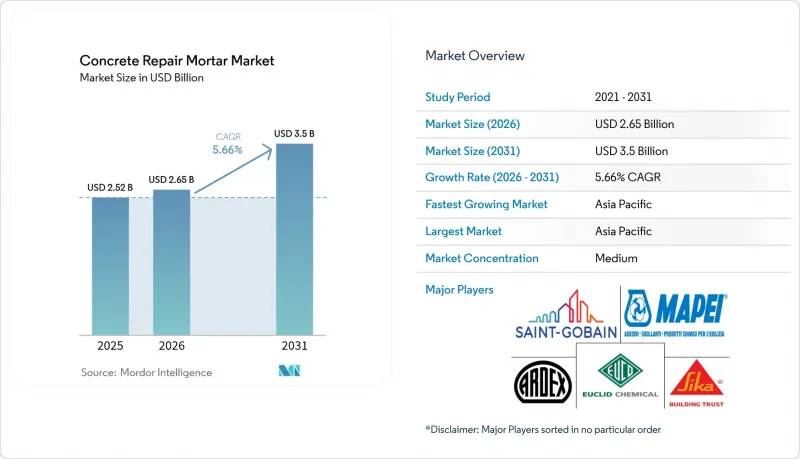
This report is Segmented by Type (Cementitious, Epoxy, and Other Types), Application Method (Spraying, Pouring, and Manual), End-User Industry (Infrastructure, Residential, Commercial, Industrial, and Other End-User Industries), and Geography (Asia-Pacific, North America, Europe, South America, and Middle-East and Africa). The Market Forecasts are Provided in Terms of Value (USD).
Global Concrete Repair Mortar Market Trends and Insights
Aging Transport Infrastructure Stock in Europe and North America
Over 42,000 U.S. bridges now carry a structurally deficient rating, pushing owners toward high-performance overlays that add 15-25 years of service life without full replacement. Germany faces a similar backlog on 25,000 autobahn bridges erected before 1985, and EUR 2 billion a year is earmarked for polymer-modified rehabilitation. Condition-based inspection, enabled by ground-penetrating radar and half-cell mapping, lets owners intervene early, creating a steadier demand curve for suppliers. This diagnostic-driven model is widening the concrete repair mortar market because interventions occur before ratings slip below closure thresholds. Contractors consequently schedule work more predictably, smoothing labor deployment across seasons.
Expanding Rehabilitation Budgets for Bridges and Tunnels
The Infrastructure Investment and Jobs Act alone directs USD 40 billion to the Bridge Formula Program, and early grants favor rapid-setting polymer-modified mortars that keep traffic flowing overnight. New York State supplemented federal dollars with USD 450 million green bonds that specify low-carbon repair mixes for thruway structures to meet climate mandates. Europe's Connecting Europe Facility dedicates EUR 33.7 billion through 2027, with tunnel upgrades consuming a rising share as fire-resistant linings become mandatory. Multi-year public budgets are underwriting long visibility for materials suppliers, though execution risk persists because labor shortages lengthen lead times.
Volatile Prices of Cement, Epoxy Resins, and Specialty Admixtures
Concrete-block prices jumped 5.8% quarter-over-quarter in Q2 2024 as kiln fuel costs and freight tariffs rose. Epoxy resins tracked crude oil, swinging 15-20% in Asia when cracker turnarounds tightened supply, forcing North American formulators to hold larger inventories. A 2024 fire that sidelined 12% of European capacity for calcium-nitrite inhibitors led to allocation regimes favoring long contracts, squeezing small buyers. Public owners on fixed multi-year budgets sometimes downgrade specifications when bids spike, risking long-term durability.
Other drivers and restraints analyzed in the detailed report include:
- Rapid Adoption of Polymer-Modified and Fiber-Reinforced Repair Mortars
- Stringent Building-Safety Codes Mandating Periodic Maintenance
- Stringent VOC and Dust-Emission Regulations on Job Sites
For complete list of drivers and restraints, kindly check the Table Of Contents.
Segment Analysis
Cementitious captured 70.65% revenue in 2025, demonstrating the highest concrete repair mortar market share because they bond seamlessly with Portland-cement substrates and meet installer familiarity thresholds. Within this category, latex additives slash permeability and enable 5 mm thin reinstatement layers on bridge decks. In contrast, epoxy systems, though smaller, command premiums above USD 15/kg in chloride-rich or chemical-spill settings where impermeability matters. Moisture-insensitive epoxies have recently widened their application window to damp substrates, a breakthrough that could lift epoxy's portion of the concrete repair mortar market size by 2031.
Other chemistries remain niche. Methyl-methacrylate mortars reach 3,000 psi in two hours and suit overnight highway patches in dense corridors like the Washington Beltway. Magnesium-phosphate mixes cure below -10 °C, crucial for Canadian winter repairs. Regulatory filters are tightening: the EU's REACH limits certain amines while California Proposition 65 spurs silica-free blends. Suppliers prepared with compliant formulations are better placed to defend or grow their concrete repair mortar market share across regulated geographies.
Complete Report Scope:
- By Type
- Cementitious
- Epoxy
- Other Types
- By Application Method
- Spraying
- Pouring
- Manual
- By End-user Industry
- Infrastructure
- Residential
- Commercial
- Industrial
- Other End-user Industries (Marine, etc.)
- By Geography
- Asia-Pacific
- China
- India
- Japan
- South Korea
- Indonesia
- Malaysia
- Thailand
- Vietnam
- Rest of Asia-Pacific
- North America
- United States
- Canada
- Mexico
- Europe
- Germany
- United Kingdom
- France
- Italy
- Spain
- NORDIC Countries
- Russia
- Turkey
- Rest of Europe
- South America
- Brazil
- Argentina
- Colombia
- Rest of South America
- Middle-East and Africa
- Saudi Arabia
- United Arab Emirates
- Qatar
- Egypt
- South Africa
- Rest of Middle-East and Africa
- Asia-Pacific
Geography Analysis
Asia-Pacific commanded 37.65% of 2025 revenue, with a 6.32% CAGR forecast, making it the fastest contributor to the concrete repair mortar market. China's highway network exceeds 177,000 km and many expressway bridges built before 2010 now reach first major rehab windows; provincial owners prefer polymer-modified mortars that extend cycles by 20 years and reduce lifecycle cost 30%. India's National Infrastructure Pipeline allocates USD 1.4 trillion, 19% for urban rail that specifies fiber-shotcrete linings rated for 100-year durability. Indonesia's 3,200-km Trans-Java tollway and Malaysia's MRT spur Southeast Asian growth. Japan's seismic mandates drive shrinkage-compensated mortars for 72% of bridges soon crossing 50-year age.
North America offers steady expansion anchored by the Infrastructure Investment and Jobs Act. The U.S. National Bridge Inventory lists 42,000 deficient bridges, and layer-funding with toll revenues secures a multiyear concrete repair mortar market. Canada channels CAD 33.5 billion through the Investing in Canada plan, emphasizing cold-weather mixes that hydrate at below 5 °C. Mexico's near-shoring industrial corridor upgrades will add incremental demand once assets enter maintenance.
Europe shows regulatory-led divergence. The Energy Performance of Buildings Directive compels 3% annual renovation of public stock, steering specifications toward alkali-activated binders with 80% lower emissions. Germany pours EUR 2 billion yearly into autobahn bridge overlays, while the UK's carbon tool penalizes high-emission mortars on the Lower Thames Crossing. Southern Europe struggles with fiscal constraints, yet private owners in Spain and Italy comply with balcony-safety rules that favor epoxy injections.
South America's concrete repair mortar market is tied to Brazilian and Chilean highway concessions that impose strict International Roughness Index limits and require six-hour reopening mixes. Argentina's lithium brine plants demand sulfate-resistant mortars for ponds cycling -10 °C to 40 °C. Colombia's 4G infrastructure program enters its first rehab phase, signaling fresh demand as tropical humidity accelerates joint wear.
Middle-East and Africa add lumpy yet high-margin opportunities. Saudi Arabia's NEOM and Red Sea mega-projects need UV-resistant mortars tolerating 50 °C swings, while UAE rail extensions specify epoxy track-bed repairs for 200-ton freight loads. Qatar's performance contracts penalize premature failures, incentivizing fiber blends with 20-year warranties. South Africa's ZAR 198 billion road-rehab backlog is price sensitive, nudging the use of locally blended cementitious mixes.
- Adhesives Technology Corporation (ATC)
- ARDEX GmbH
- ChemCo Systems
- Flexcrete Technologies Ltd
- Heidelberg Materials (Hanson Repair)
- Kryton International Inc.
- MAPEI S.p.A.
- MC-Bauchemie
- Pidilite Industries Ltd
- Polycote
- Remmers GmbH
- Saint-Gobain
- Sika AG
- Tarmac
- The Euclid Chemical Company
- W. R. Meadows Inc.
Additional Benefits:
- The market estimate (ME) sheet in Excel format
- 3 months of analyst support
TABLE OF CONTENTS
1 Introduction
- 1.1 Study Assumptions and Market Definition
- 1.2 Scope of the Study
2 Research Methodology
3 Executive Summary
4 Market Landscape
- 4.1 Market Overview
- 4.2 Market Drivers
- 4.2.1 Aging transport infrastructure stock in Europe and North America
- 4.2.2 Expanding rehabilitation budgets for bridges and tunnels
- 4.2.3 Rapid adoption of polymer-modified and fiber-reinforced repair mortars
- 4.2.4 Stringent building-safety codes mandating periodic maintenance
- 4.2.5 Demand for ultra-low-carbon alkali-activated repair mortars in net-zero projects
- 4.3 Market Restraints
- 4.3.1 Volatile prices of cement, epoxy resins and specialty admixtures
- 4.3.2 Stringent VOC and dust-emission regulations on job sites
- 4.3.3 Shortage of certified concrete-repair applicators and high labor costs
- 4.4 Value Chain Analysis
- 4.5 Porter's Five Forces
- 4.5.1 Bargaining Power of Suppliers
- 4.5.2 Bargaining Power of Buyers
- 4.5.3 Threat of New Entrants
- 4.5.4 Threat of Substitutes
- 4.5.5 Degree of Competition
5 Market Size and Growth Forecasts (Value)
- 5.1 By Type
- 5.1.1 Cementitious
- 5.1.2 Epoxy
- 5.1.3 Other Types
- 5.2 By Application Method
- 5.2.1 Spraying
- 5.2.2 Pouring
- 5.2.3 Manual
- 5.3 By End-user Industry
- 5.3.1 Infrastructure
- 5.3.2 Residential
- 5.3.3 Commercial
- 5.3.4 Industrial
- 5.3.5 Other End-user Industries (Marine, etc.)
- 5.4 By Geography
- 5.4.1 Asia-Pacific
- 5.4.1.1 China
- 5.4.1.2 India
- 5.4.1.3 Japan
- 5.4.1.4 South Korea
- 5.4.1.5 Indonesia
- 5.4.1.6 Malaysia
- 5.4.1.7 Thailand
- 5.4.1.8 Vietnam
- 5.4.1.9 Rest of Asia-Pacific
- 5.4.2 North America
- 5.4.2.1 United States
- 5.4.2.2 Canada
- 5.4.2.3 Mexico
- 5.4.3 Europe
- 5.4.3.1 Germany
- 5.4.3.2 United Kingdom
- 5.4.3.3 France
- 5.4.3.4 Italy
- 5.4.3.5 Spain
- 5.4.3.6 NORDIC Countries
- 5.4.3.7 Russia
- 5.4.3.8 Turkey
- 5.4.3.9 Rest of Europe
- 5.4.4 South America
- 5.4.4.1 Brazil
- 5.4.4.2 Argentina
- 5.4.4.3 Colombia
- 5.4.4.4 Rest of South America
- 5.4.5 Middle-East and Africa
- 5.4.5.1 Saudi Arabia
- 5.4.5.2 United Arab Emirates
- 5.4.5.3 Qatar
- 5.4.5.4 Egypt
- 5.4.5.5 South Africa
- 5.4.5.6 Rest of Middle-East and Africa
- 5.4.1 Asia-Pacific
6 Competitive Landscape
- 6.1 Market Concentration
- 6.2 Strategic Moves
- 6.3 Market Share(%)/Ranking Analysis
- 6.4 Company Profiles (includes Global level Overview, Market level overview, Core Segments, Financials as available, Strategic Information, Products and Services, and Recent Developments)
- 6.4.1 Adhesives Technology Corporation (ATC)
- 6.4.2 ARDEX GmbH
- 6.4.3 ChemCo Systems
- 6.4.4 Flexcrete Technologies Ltd
- 6.4.5 Heidelberg Materials (Hanson Repair)
- 6.4.6 Kryton International Inc.
- 6.4.7 MAPEI S.p.A.
- 6.4.8 MC-Bauchemie
- 6.4.9 Pidilite Industries Ltd
- 6.4.10 Polycote
- 6.4.11 Remmers GmbH
- 6.4.12 Saint-Gobain
- 6.4.13 Sika AG
- 6.4.14 Tarmac
- 6.4.15 The Euclid Chemical Company
- 6.4.16 W. R. Meadows Inc.
7 Market Opportunities and Future Outlook
- 7.1 White-space and Unmet-Need Assessment

