PUBLISHER: Mordor Intelligence | PRODUCT CODE: 2115888

PUBLISHER: Mordor Intelligence | PRODUCT CODE: 2115888
Air Starter - Market Share Analysis, Industry Trends & Statistics, Growth Forecasts (2026 - 2031)
According to Mordor Intelligence, the air starter market size was valued at USD 416.18 million in 2025 and estimated to grow from USD 435.69 million in 2026 to reach USD 547.83 million by 2031, at a CAGR of 4.69% during the forecast period (2026-2031).
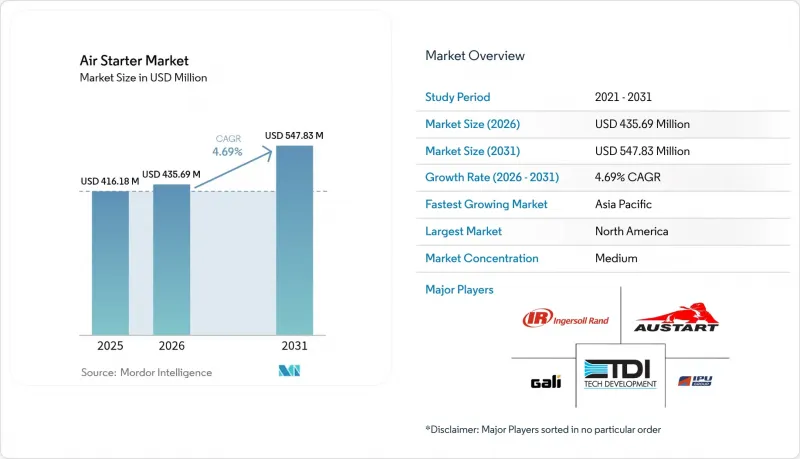
This report is Segmented by Starter Type (Vane Air Starter, Turbine Air Starter, and Gear-Reduced Air Starter), Engine Capacity (Up To 100 HP, 100 To 300 HP, and Above 300 HP), End-User (Oil and Gas, Power Generation, Mining, Marine, Aviation, and Transportation), and Geography (North America, Europe, Asia-Pacific, South America, and More). The Market Sizes and Forecasts are Provided in Terms of Value (USD).
Global Air Starter Market Trends and Insights
Rising replacement of electric starters with pneumatic starters in hazardous zones
Industrial operators are standardizing ATEX- and IECEx-certified pneumatic solutions to mitigate ignition risks in Class I, Division 1 areas. Insurers are increasingly flagging non-certified electric units, which accelerates retrofit cycles across refineries, grain silos, and chemical plants. The safety-driven transition prioritizes operational continuity over upfront cost, especially in upstream drilling and gas compressio,n where unscheduled outages carry hefty penalties. Resulting demand is buoyed by turnkey retrofit kits that minimize downtime and align with tightening regional safety audits.
Growth of LNG carrier fleet requiring ATEX-rated turbine starters
Global LNG shipping backlogs support persistent orders for explosion-proof turbine starters, a must for dual-fuel propulsion and cargo handling in volatile atmospheres. Danish, Korean, and Chinese yards embed these systems at the design stage, while owners increase budgets-Maersk raised its annual vessel capex to USD 10-11 billion-to future-proof their fleets for synthetic and bio-LNG operations. Floating production, storage, and offloading units echo this trend, emphasizing compact, corrosion-resistant designs to minimize offshore maintenance.
Shift toward electric-drive frac pumps eliminating start-stop duty cycles
North American shale operators are transitioning to grid-powered or gas-turbine-generated electric frac spreads, which curbs the frequent engine restarts that historically drove air starter use. ProPetro's three-year ExxonMobil deal exemplifies the shift, with dual-fuel or electric units already accounting for 65% of its fleet. Continuous pump operation reshapes starter demand patterns, forcing suppliers to diversify beyond legacy diesel applications.
Other drivers and restraints analyzed in the detailed report include:
- IOCs' brownfield life-extension programs boosting retrofit demand
- Recovery in mining equipment capex post-2024 commodity super-cycle
- OEM consolidation reducing multi-vendor starter specifications
For complete list of drivers and restraints, kindly check the Table Of Contents.
Segment Analysis
Vane starters dominated the air starter market with a 53.45% share in 2025, reflecting a long track record of field reliability and straightforward servicing protocols. Oil and gas operators value these traits for remote sites where tooling and power may be constrained. Turbine models serve marine and aerospace equipment needing rapid spin-up. Hybrid gear-reduced designs are accelerating at a 6.58% CAGR, combining pneumatic drive with mechanical reduction to boost torque density for autonomous machinery and hydrogen-ready turbines. Additive manufacturing is now unlocking lightweight superalloy rotors that enhance thermal tolerance in extreme-duty turbine variants, positioning hybrids as a future growth driver in the broader air starter market.
Ongoing R&D focuses on sealing improvements, dry-lube coatings, and tighter tolerances achievable through metal additive processes. These innovations aim to widen maintenance intervals, a key selling point for unmanned mines or unmanned offshore installations. Progressive standards bodies are also updating certification schemes to streamline cross-acceptance between ATEX and regional codes, potentially lowering homologation costs for hybrid entrants.
Complete Report Scope:
- By Starter Type
- Vane Air Starter
- Turbine Air Starter
- Gear-Reduced (Hybrid) Air Starter
- By Horsepower Rating
- Up to 100 HP
- 100 to 300 HP
- Above 300 HP
- By End-User Industry
- Oil and Gas
- Power Generation
- Mining
- Marine (LNG, FPSO, Naval)
- Aviation
- Transportation (Heavy-Duty Trucks, Rail)
- By Geography
- North America
- United States
- Canada
- Mexico
- Europe
- Germany
- United Kingdom
- France
- Italy
- NORDIC Countries
- Russia
- Rest of Europe
- Asia-Pacific
- China
- India
- Japan
- South Korea
- ASEAN Countries
- Rest of Asia-Pacific
- South America
- Brazil
- Argentina
- Rest of South America
- Middle East and Africa
- Saudi Arabia
- United Arab Emirates
- South Africa
- Egypt
- Rest of Middle East and Africa
- North America
Geography Analysis
North America led the way in 2025, accounting for 39.45% of revenue, driven by shale gas, offshore Gulf assets, and a robust pipeline of petrochemical upgrades. Harsh winters and desert heat test equipment to extremes, validating pneumatic resilience over a wide temperature range. The region's aftermarket ecosystem is mature, offering rapid turnaround on rebuilds and certified spares, which reinforces loyalty to established brands.
The Asia-Pacific region is the growth pacesetter, with a 6.72% CAGR projected to 2031. China's industrial hubs and India's grid expansion fuel demand, while Korean and Chinese shipyards pack LNG carriers with turbine starters destined for export routes. Rising H2 pilot projects in Japan and Australia further diversify orders toward high-torque designs suited for blended fuels. Local component suppliers are stepping up to shorten lead times, although ATEX compliance still favors European and U.S. firms in securing premium contracts.
Europe maintains a balanced outlook as legacy industries adapt to meet stringent worker safety directives. Hydrogen clusters in Germany and the Nordics create pockets of specialized demand for certified high-torque systems. The Middle East leverages brownfield gas infrastructure spending, and Africa's copper and gold corridors drive mining-centric sales, both contributing to a steady flow of projects that keep regional service depots active within the global air starter market.
- Ingersoll Rand plc
- Tech Development Inc. (TDI)
- Gali International
- Austart (Air Starter Sales & Service)
- IPU Group
- KH Equipment Pty Ltd
- Air Starter Components (ASC)
- Multi Torque Industries
- Maradyne Corporation
- The Rowland Company
- Hilliard Corporation
- Atlas Copco (Air Power div.)
- Caterpillar Inc. (Starting Motors)
- Chicago Pneumatic
- Cummins Inc. (Starter Solutions)
- Powerstart Pty Ltd
- Turbine Kinetics Inc.
- DAB Industries
- Sullair LLC
- Parker Hannifin (Starter Systems)
Additional Benefits:
- The market estimate (ME) sheet in Excel format
- 3 months of analyst support
TABLE OF CONTENTS
1 Introduction
- 1.1 Study Assumptions & Market Definition
- 1.2 Scope of the Study
2 Research Methodology
3 Executive Summary
4 Market Landscape
- 4.1 Market Overview
- 4.2 Market Drivers
- 4.2.1 Rising replacement of electric starters with pneumatic starters in hazardous (Class I, Div 1) zones
- 4.2.2 Growth of LNG carrier fleet requiring ATEX-rated turbine starters
- 4.2.3 IOCs' brown-field life-extension programs boosting demand for retrofit vane starters
- 4.2.4 Recovery in capex for underground hard-rock mining equipment post-2024 commodity super-cycle
- 4.2.5 Surging interest in hydrogen-ready gas turbines that mandate high-torque air starters
- 4.2.6 Emergence of autonomous haul trucks needing ultra-low-maintenance air start systems
- 4.3 Market Restraints
- 4.3.1 Shift toward electric-drive frac pumps eliminating start-stop duty cycles
- 4.3.2 OEM consolidation reducing multi-vendor starter specifications
- 4.3.3 Persistent air leakage losses in legacy compressor skids raising TCO
- 4.3.4 Scarcity of dry-lube vane materials inflating BOM costs
- 4.4 Supply-Chain Analysis
- 4.5 Regulatory Landscape (ATEX, IECEx, UL)
- 4.6 Technological Outlook (3-D printed turbine blades, IoT-enabled start count logs)
- 4.7 Porter's Five Forces
- 4.7.1 Bargaining Power of Suppliers
- 4.7.2 Bargaining Power of Buyers
- 4.7.3 Threat of New Entrants
- 4.7.4 Threat of Substitutes
- 4.7.5 Intensity of Rivalry
5 Market Size & Growth Forecasts
- 5.1 By Starter Type
- 5.1.1 Vane Air Starter
- 5.1.2 Turbine Air Starter
- 5.1.3 Gear-Reduced (Hybrid) Air Starter
- 5.2 By Horsepower Rating
- 5.2.1 Up to 100 HP
- 5.2.2 100 to 300 HP
- 5.2.3 Above 300 HP
- 5.3 By End-User Industry
- 5.3.1 Oil and Gas
- 5.3.2 Power Generation
- 5.3.3 Mining
- 5.3.4 Marine (LNG, FPSO, Naval)
- 5.3.5 Aviation
- 5.3.6 Transportation (Heavy-Duty Trucks, Rail)
- 5.4 By Geography
- 5.4.1 North America
- 5.4.1.1 United States
- 5.4.1.2 Canada
- 5.4.1.3 Mexico
- 5.4.2 Europe
- 5.4.2.1 Germany
- 5.4.2.2 United Kingdom
- 5.4.2.3 France
- 5.4.2.4 Italy
- 5.4.2.5 NORDIC Countries
- 5.4.2.6 Russia
- 5.4.2.7 Rest of Europe
- 5.4.3 Asia-Pacific
- 5.4.3.1 China
- 5.4.3.2 India
- 5.4.3.3 Japan
- 5.4.3.4 South Korea
- 5.4.3.5 ASEAN Countries
- 5.4.3.6 Rest of Asia-Pacific
- 5.4.4 South America
- 5.4.4.1 Brazil
- 5.4.4.2 Argentina
- 5.4.4.3 Rest of South America
- 5.4.5 Middle East and Africa
- 5.4.5.1 Saudi Arabia
- 5.4.5.2 United Arab Emirates
- 5.4.5.3 South Africa
- 5.4.5.4 Egypt
- 5.4.5.5 Rest of Middle East and Africa
- 5.4.1 North America
6 Competitive Landscape
- 6.1 Market Concentration
- 6.2 Strategic Moves (M&A, Partnerships, PPAs)
- 6.3 Market Share Analysis (Market Rank/Share for key companies)
- 6.4 Company Profiles (includes Global level Overview, Market level overview, Core Segments, Financials as available, Strategic Information, Products & Services, and Recent Developments)
- 6.4.1 Ingersoll Rand plc
- 6.4.2 Tech Development Inc. (TDI)
- 6.4.3 Gali International
- 6.4.4 Austart (Air Starter Sales & Service)
- 6.4.5 IPU Group
- 6.4.6 KH Equipment Pty Ltd
- 6.4.7 Air Starter Components (ASC)
- 6.4.8 Multi Torque Industries
- 6.4.9 Maradyne Corporation
- 6.4.10 The Rowland Company
- 6.4.11 Hilliard Corporation
- 6.4.12 Atlas Copco (Air Power div.)
- 6.4.13 Caterpillar Inc. (Starting Motors)
- 6.4.14 Chicago Pneumatic
- 6.4.15 Cummins Inc. (Starter Solutions)
- 6.4.16 Powerstart Pty Ltd
- 6.4.17 Turbine Kinetics Inc.
- 6.4.18 DAB Industries
- 6.4.19 Sullair LLC
- 6.4.20 Parker Hannifin (Starter Systems)
7 Market Opportunities & Future Outlook
- 7.1 White-space & Unmet-Need Assessment

