PUBLISHER: Mordor Intelligence | PRODUCT CODE: 2115899

PUBLISHER: Mordor Intelligence | PRODUCT CODE: 2115899
Dolomite - Market Share Analysis, Industry Trends & Statistics, Growth Forecasts (2026 - 2031)
According to Mordor Intelligence, dolomite market size in 2026 is estimated at 198.63 Million tons, growing from 2025 value of 191.38 Million tons with 2031 projections showing 239.24 Million tons, growing at 3.79% CAGR over 2026-2031.
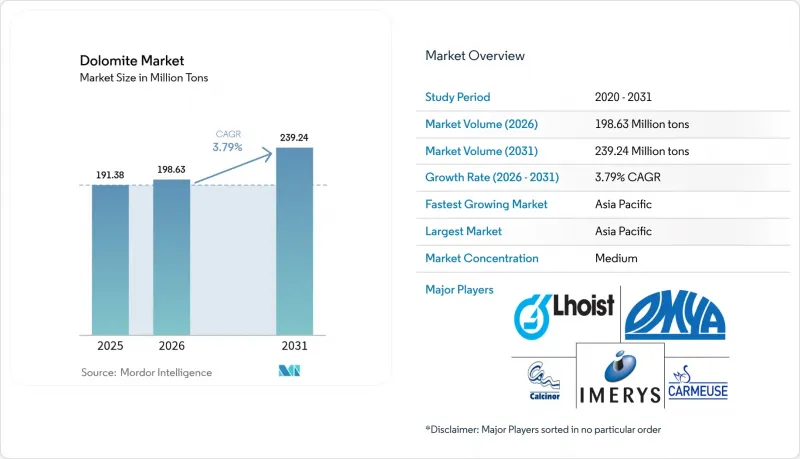
This report is Segmented by Mineral Type (Calcined, Agglomerated, and Sintered), End-User Industry (Mining and Metallurgy, Agriculture, Cement, Ceramics and Glass, Water Treatment, Pharmaceuticals, and Other End-User Industries), and Geography (Asia-Pacific, North America, Europe, South America, and Middle East and Africa). The Market Forecasts are Provided in Terms of Volume (Tons).
Global Dolomite Market Trends and Insights
Growing Construction Spending in Asia-Pacific
Asia-Pacific's infrastructure investment pipeline requires USD 26 trillion through 2030, driving sustained consumption of dolomite-derived cement additives and construction aggregates. China's urban redevelopment programs and India's National Infrastructure Pipeline widen the market for flux-grade dolomite in clinker production, where magnesium oxide improves concrete durability. Logistics advantages encourage contractors in ASEAN's archipelagic settings to substitute locally quarried dolomite for imported limestone, tightening regional supply and lifting prices. Producers with quarry proximity to coastal megacities gain higher margins thanks to shorter hauling distances. Sustainability certification programs that promote low-carbon, locally sourced inputs further entrench regional suppliers.
Expanding Global Steel and Iron Production
Electric arc furnace investments in India and Southeast Asia continue to raise demand for calcined dolomite, which combines with silica to form low-viscosity slag. The growth path is reinforced by hydrogen-based steel trials that run at higher operating temperatures and need refractory linings enriched with sintered dolomite grains. Dual-oxide composition trims raw-material inventories because a single feedstock supplies both CaO and MgO. As mini-mills proliferate near scrap sources, their operators prefer fluxes that arrive pre-calcined and quality-certified, creating premium niches for integrated miners that also own rotary kilns.
Substitution With Cheaper Igneous Rock Fillers
Price-sensitive users in aggregate and low-spec refractory markets often switch to olivine or basalt when dolomite premiums widen. Olivine's higher magnesium content and its availability from coastal Norway and Turkey add competitive tension in Europe. Growth of recycled concrete aggregates in public works further caps virgin dolomite demand. Suppliers respond by differentiating on chemical consistency and by bundling technical support that documents slag-forming efficiency.
Other drivers and restraints analyzed in the detailed report include:
- Environmental Regulations Boosting Soil Conditioning Demand
- Rising Glass and Ceramics Capacity Expansions
- Agricultural Liming Scrutiny Over Micro-Plastic Contamination
For complete list of drivers and restraints, kindly check the Table Of Contents.
Segment Analysis
Calcined variants captured 46.21% of dolomite market share in 2025 as steelmakers demanded reactive oxides to bind silica and alumina at 1,700 °C furnace temperatures. The dolomite market size for calcined grades is forecast to expand in step with EAF capacity additions and decarbonization retrofits that rely on slag-forming efficiency. Sintered forms are set to outpace other products at a 4.53% CAGR because hydrogen-ready furnaces require bricks that endure higher heat fluxes. In that context, the dolomite market creates pricing tiers linked to bulk density and residual CO2 levels.
Technological strides such as vertical shaft kilns with oxygen-enriched combustion improve calcination yield while trimming fuel intensity. Producers also accelerate roll-outs of automated optical sorters to guarantee low-silica feed. Agglomerated pellets remain niche yet strategic in water treatment where controlled dissolution prevents overdosing. As municipalities standardize on PFAS remediation systems, pellet suppliers can quote higher prices than for raw fines, enhancing margin profiles.
Complete Report Scope:
- By Mineral Type
- Calcined
- Agglomerated
- Sintered
- By End-user Industry
- Mining and Metallurgy
- Agriculture
- Cement
- Ceramics and Glass
- Water Treatment
- Pharmaceuticals
- Other End-user Industries
- By Geography
- Asia-Pacific
- China
- India
- Japan
- South Korea
- ASEAN Countries
- Rest of Asia-Pacific
- North America
- United States
- Canada
- Mexico
- Europe
- Germany
- United Kingdom
- France
- Italy
- Russia
- NORDIC Countries
- Rest of Europe
- South America
- Brazil
- Argentina
- Rest of South America
- Middle East and Africa
- Saudi Arabia
- South Africa
- Rest of Middle East and Africa
- Asia-Pacific
Geography Analysis
Asia-Pacific commanded 53.39% of global volume in 2025 and will add capacity at a 4.62% CAGR as mega-projects such as India's high-speed rail corridors and Indonesia's new capital city consume flux-grade aggregates. Chinese consolidation across upstream magnesite and dolomite mines stabilizes supply quality, enabling refractory firms to meet hydrogen furnace specifications without importing European feedstock. Japan's leading steelmakers test higher-purity dolomite bricks in pilot hydrogen direct-reduction modules, reinforcing the region's technological gravity.
North America shows balanced dynamics: legacy demand from integrated steelworks in the Great Lakes coexists with new opportunities in PFAS removal systems mandated by the U.S. EPA. Canadian miners leverage rail links to ship premium sintered material to U.S. Midwest mini-mills, while Mexico's automotive growth spurs ceramic substrate production that requires finely milled dolomite.
Europe maintains steady pull from glass decarbonization and organic farming regulations. German furnace rebuilds favor low-CO2 dolomite flux, whereas France and Italy continue to value soil conditioners that release magnesium slowly. Nordic smelters turn to high-density sintered bricks sourced from domestic quarries, reducing import reliance and shortening lead times.
- Calcinor
- Carmeuse
- Dillon
- Graymont
- Imerys
- JFE Mineral & Alloy Company, Ltd.
- Lhoist
- Nordkalk
- Omya AG
- Raw Edge
- RHI Magnesita
- Sibelco
- Tata Ferro Alloys and Minerals Division
- United States Lime & Minerals, Inc.
Additional Benefits:
- The market estimate (ME) sheet in Excel format
- 3 months of analyst support
TABLE OF CONTENTS
1 Introduction
- 1.1 Study Assumptions and Market Definition
- 1.2 Scope of the Study
2 Research Methodology
3 Executive Summary
4 Market Landscape
- 4.1 Market Overview
- 4.2 Market Drivers
- 4.2.1 Growing Construction Spending in Asia-Pacific
- 4.2.2 Expanding Global Steel and Iron Production
- 4.2.3 Environmental Regulations Boosting Soil Conditioning Demand
- 4.2.4 Rising Glass and Ceramics Capacity Expansions
- 4.2.5 Waste-Water PFAS Removal Pilots Using Dolomite Adsorbents
- 4.3 Market Restraints
- 4.3.1 Substitution With Cheaper Igneous Rock Fillers
- 4.3.2 Stricter Land-Use and Mining Permitting Hurdles
- 4.3.3 Agricultural Liming Scrutiny Over Micro-Plastic Contamination
- 4.4 Value Chain Analysis
- 4.5 Porter's Five Forces
- 4.5.1 Bargaining Power of Suppliers
- 4.5.2 Bargaining Power of Buyers
- 4.5.3 Threat of New Entrants
- 4.5.4 Threat of Substitutes
- 4.5.5 Degree of Competition
5 Market Size and Growth Forecasts (Volume)
- 5.1 By Mineral Type
- 5.1.1 Calcined
- 5.1.2 Agglomerated
- 5.1.3 Sintered
- 5.2 By End-user Industry
- 5.2.1 Mining and Metallurgy
- 5.2.2 Agriculture
- 5.2.3 Cement
- 5.2.4 Ceramics and Glass
- 5.2.5 Water Treatment
- 5.2.6 Pharmaceuticals
- 5.2.7 Other End-user Industries
- 5.3 By Geography
- 5.3.1 Asia-Pacific
- 5.3.1.1 China
- 5.3.1.2 India
- 5.3.1.3 Japan
- 5.3.1.4 South Korea
- 5.3.1.5 ASEAN Countries
- 5.3.1.6 Rest of Asia-Pacific
- 5.3.2 North America
- 5.3.2.1 United States
- 5.3.2.2 Canada
- 5.3.2.3 Mexico
- 5.3.3 Europe
- 5.3.3.1 Germany
- 5.3.3.2 United Kingdom
- 5.3.3.3 France
- 5.3.3.4 Italy
- 5.3.3.5 Russia
- 5.3.3.6 NORDIC Countries
- 5.3.3.7 Rest of Europe
- 5.3.4 South America
- 5.3.4.1 Brazil
- 5.3.4.2 Argentina
- 5.3.4.3 Rest of South America
- 5.3.5 Middle East and Africa
- 5.3.5.1 Saudi Arabia
- 5.3.5.2 South Africa
- 5.3.5.3 Rest of Middle East and Africa
- 5.3.1 Asia-Pacific
6 Competitive Landscape
- 6.1 Market Concentration
- 6.2 Strategic Moves
- 6.3 Market Share (%)/Ranking Analysis
- 6.4 Company Profiles (includes Global level Overview, Market level overview, Core Segments, Financials, Strategic Info, Market Rank/Share, Products and Services, Recent Developments)
- 6.4.1 Calcinor
- 6.4.2 Carmeuse
- 6.4.3 Dillon
- 6.4.4 Graymont
- 6.4.5 Imerys
- 6.4.6 JFE Mineral & Alloy Company, Ltd.
- 6.4.7 Lhoist
- 6.4.8 Nordkalk
- 6.4.9 Omya AG
- 6.4.10 Raw Edge
- 6.4.11 RHI Magnesita
- 6.4.12 Sibelco
- 6.4.13 Tata Ferro Alloys and Minerals Division
- 6.4.14 United States Lime & Minerals, Inc.
7 Market Opportunities and Future Outlook
- 7.1 White-space and Unmet-need Assessment

