PUBLISHER: Mordor Intelligence | PRODUCT CODE: 2115918

PUBLISHER: Mordor Intelligence | PRODUCT CODE: 2115918
Asia-Pacific Enteral Feeding Devices - Market Share Analysis, Industry Trends & Statistics, Growth Forecasts (2026 - 2031)
According to Mordor Intelligence, Asia Pacific enteral feeding devices market size in 2026 is estimated at USD 1.14 billion, growing from 2025 value of USD 1.07 billion with 2031 projections showing USD 1.57 billion, growing at 6.61% CAGR over 2026-2031.
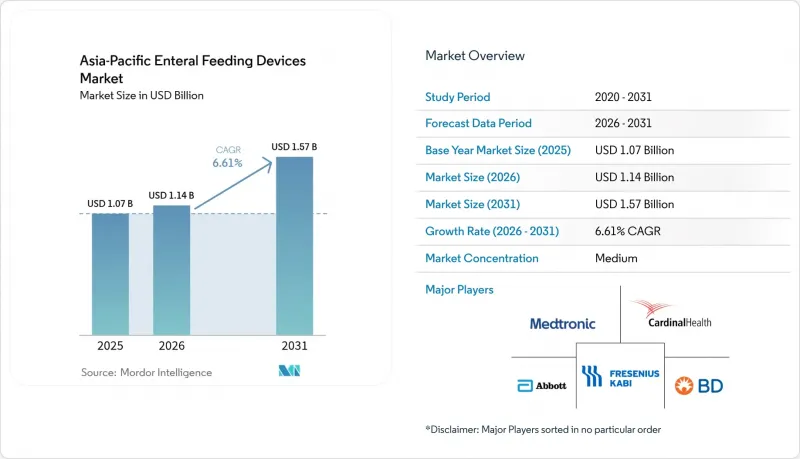
This report is Segmented by Product Type (Feeding Pumps, Feeding Tubes, and More), Age Group (Adults, Pediatric & Neonatal), Distribution Channel (Offline, Online), Application (Oncology and More), End-User (Hospitals, Ambulatory Surgical Centers, Home Care Settings, Other End-Users), and Geography (China, Japan, and More). The Market Forecasts are Provided in Terms of Value (USD).
Asia-Pacific Enteral Feeding Devices Market Trends and Insights
Rapid Ageing Across East Asia Drives Post-Acute Nutrition Demand
East Asian health systems already treat malnutrition in 25% of older adults, and absolute caseloads will rise alongside demographic ageing, reinforcing long-term reliance on enteral feeding solutions. Dysphagia after stroke is a common trigger for device placement, and clinical guidelines from the VA/DoD now recommend enteral nutrition as a standard stroke-recovery intervention. Community screening programs increasingly flag undernutrition, which correlates with 41% higher emergency-department visits and 52% greater inpatient admissions among seniors, intensifying payer focus on early nutritional therapy. As primary-care settings assume greater accountability for geriatric outcomes, demand shifts from hospital-only devices to portable pumps suitable for step-down and home environments. Manufacturers are responding with low-volume precision pumps that minimize aspiration risk while maintaining flow stability over extended use cycles.
Neonatal ICU Capacity Expansion Boosts Premature-Birth Feeding Volumes
Surging NICU bed counts in China, India, and much of Southeast Asia have improved survival for preterm infants, who require highly regulated enteral nutrition to mitigate growth impairment. Hospitals deploying standardized feeding-intolerance scoring systems can initiate enteral feeds within 7 days post-surgery, cutting complication rates in necrotizing enterocolitis cases by 17%. Clinical variability among 336 Asian hospitals-especially differences in ventilation and humidity protocols-creates headroom for advanced pumps offering adaptive flow control and real-time gastric-residual monitoring. Suppliers that bundle neonatal-specific tubes with micro-bore connectors stand to gain as care guidelines tighten around tube size, placement accuracy, and cleaning protocols. With governments funding NICU upgrades, procurement budgets increasingly include connected pumps that feed data back to centralized dashboards for audit and quality improvement.
Tube-Induced Mucosal Injuries & Infection Risks
Extended nasogastric placement can distort the epiglottis' shape and narrow the pharynx, particularly when paired with tracheostomy, leading to higher aspiration rates and prolonged hospitalization. HACCP-style monitoring programs reduce total microbial load in formula delivery, yet compliance remains uneven, and no cleaning technique fully eliminates bacterial colonization after 28 days. ISO 80369-3 connectors solve misconnections but not tube degradation or biofilm build-up. In resource-constrained wards, re-use of single-use components persists, elevating infection risk and dampening uptake of premium systems. Manufacturers must demonstrate measurable reductions in adverse events to overcome clinician hesitancy.
Other drivers and restraints analyzed in the detailed report include:
- Home-Based Long-Term Care Reimbursement Reforms in China & Japan
- Telerehabilitation Protocols Mandate Pump Connectivity
- Reimbursement Caps for Disposable Sets in ASEAN
For complete list of drivers and restraints, kindly check the Table Of Contents.
Segment Analysis
Feeding pumps generated 40.25% of the Asia Pacific enteral feeding devices market share in 2025, underscoring the central role of precision delivery technology in acute and chronic care. Volumetric models dominate because their peristaltic rollers maintain consistent flow irrespective of viscosity, a critical need in oncology and ICU settings. The Asia Pacific enteral feeding devices market size for feeding pumps is forecast to grow at a 5.18% CAGR that reflects pump-replacement cycles more than first-time installations. Wireless telemetry, dose-error-reduction software, and automated flush protocols differentiate premium units, while entry-level devices emphasize ruggedness for emerging-market hospitals.
Feeding tubes, in contrast, are expanding at 7.62% CAGR as basic access becomes universal across secondary hospitals. Innovations such as Cardinal Health's IRIS camera-guided tube replace blind placement, cutting malposition rates by 87% and reducing radiographic confirmation cost. ENFit connectors gained regulatory mandates across Japan and Australia, compelling large-scale legacy stock conversions. Administration sets and syringes post mid-single-digit growth, primarily volume-driven, as each pump requires multiple disposables daily. Environmental scrutiny is rising, so suppliers explore bio-based PVC alternatives that maintain flexibility without leaching plasticizers, balancing cost and compliance with single-use plastic bans in Australia and some Japanese prefectures.
Adults accounted for 72.94% of the Asia Pacific enteral feeding devices market size in 2025, a ratio reflecting high prevalence of stroke, cancer, and neurologic dysphagia in older cohorts. Adult products emphasize easy programmability for nursing staff and compatibility with thickened formulas used for dysphagia management. The Asia Pacific enteral feeding devices market share held by adults is expected to remain above 70% through 2031, albeit with incremental volume gains mainly in home-care settings.
Pediatric and neonatal segments, though smaller, are growing 7.86% annually. Very-low-birth-weight infants require micro-bore tubes and fortified breast-milk formulations; pump suppliers add ultralow-flow modes capable of 0.5 mL/h resolution to meet these needs. Portable warmers keep milk at physiologic temperature en route from milk bank to incubator, decreasing lipid adherence to syringe walls. Pediatric home-care programs in Australia trial connected pumps with gamified caregiver apps that flag occlusions and allow asynchronous dietitian consults, further accelerating uptake beyond hospital walls.
Complete Report Scope:
- By Product Type
- Feeding Pumps
- Volumetric Pumps
- Ambulatory Pumps
- Syringe Pumps
- Feeding Tubes
- Nasogastric Tubes
- Gastrostomy Tubes
- Others
- Enteral Feeding Bags
- Administration Sets & Accessories
- Enteral Syringes
- Feeding Pumps
- By Age Group
- Adults
- Pediatric & Neonatal
- By Distribution Channel
- Offline
- Online
- By Application
- Oncology
- Gastroenterology
- Critical Care & Trauma
- Other Applications
- By End-User
- Hospitals
- Ambulatory Surgical Centers
- Home Care Settings
- Other End-Users
- By Geography
- China
- Japan
- India
- Australia
- South Korea
- Rest of Asia-Pacific
List of Companies Covered in this Report:
- Abbott Laboratories
- ALCOR Scientific
- Amsino International
- Applied Medical Resources
- Avanos Medical
- B. Braun
- Beckton Dickinson
- Boston Scientific
- Cardinal Health
- Conmed
- Cook Group
- Fisher & Paykel Healthcare
- Fresenius
- ICU Medical
- Medtronic
- Moog
- Nestle S.A.
- Owens & Minor (Halyard Health)
- Poly Medicure Ltd.
- Shandong Weigao Group Medical Polymer Co., Ltd.
- Terumo
- Vygon S.A.
Additional Benefits:
- The market estimate (ME) sheet in Excel format
- 3 months of analyst support
TABLE OF CONTENTS
1 Introduction
- 1.1 Study Assumptions & Market Definition
- 1.2 Scope of the Study
2 Research Methodology
3 Executive Summary
4 Market Landscape
- 4.1 Market Overview
- 4.2 Market Drivers
- 4.2.1 Rapid Ageing Across East Asia Drives Post-Acute Nutrition Demand
- 4.2.2 Neonatal ICU Capacity Expansion Boosts Premature-Birth Feeding Volumes
- 4.2.3 Home-Based Long-Term Care Reimbursement Reforms in China & Japan
- 4.2.4 Telerehabilitation Protocols Mandate Pump Connectivity
- 4.2.5 Surge in Gastrointestinal Cancer Surgeries Elevating Post-Operative Tube-Feeding Adoption
- 4.2.6 Military Field-Hospital Procurement in Indo-Pacific
- 4.3 Market Restraints
- 4.3.1 Tube-Induced Mucosal Injuries & Infection Risks
- 4.3.2 Reimbursement Caps for Disposable Sets in Asean
- 4.3.3 Single-Use Plastic Regulations for Medical Tubing
- 4.3.4 Local OEM Price Wars in India Lower Profitability
- 4.4 Supply Chain Analysis
- 4.5 Porter's Five Forces Analysis
- 4.5.1 Threat of New Entrants
- 4.5.2 Bargaining Power of Buyers/Consumers
- 4.5.3 Bargaining Power of Suppliers
- 4.5.4 Threat of Substitute Products
- 4.5.5 Intensity of Competitive Rivalry
5 Market Size & Growth Forecasts (Value, 2021-2030)
- 5.1 By Product Type
- 5.1.1 Feeding Pumps
- 5.1.1.1 Volumetric Pumps
- 5.1.1.2 Ambulatory Pumps
- 5.1.1.3 Syringe Pumps
- 5.1.2 Feeding Tubes
- 5.1.2.1 Nasogastric Tubes
- 5.1.2.2 Gastrostomy Tubes
- 5.1.2.3 Others
- 5.1.3 Enteral Feeding Bags
- 5.1.4 Administration Sets & Accessories
- 5.1.5 Enteral Syringes
- 5.1.1 Feeding Pumps
- 5.2 By Age Group
- 5.2.1 Adults
- 5.2.2 Pediatric & Neonatal
- 5.3 By Distribution Channel
- 5.3.1 Offline
- 5.3.2 Online
- 5.4 By Application
- 5.4.1 Oncology
- 5.4.2 Gastroenterology
- 5.4.3 Critical Care & Trauma
- 5.4.4 Other Applications
- 5.5 By End-User
- 5.5.1 Hospitals
- 5.5.2 Ambulatory Surgical Centers
- 5.5.3 Home Care Settings
- 5.5.4 Other End-Users
- 5.6 By Geography
- 5.6.1 China
- 5.6.2 Japan
- 5.6.3 India
- 5.6.4 Australia
- 5.6.5 South Korea
- 5.6.6 Rest of Asia-Pacific
6 Competitive Landscape
- 6.1 Market Concentration
- 6.2 Competitive Benchmarking
- 6.3 Market Share Analysis
- 6.4 Company Profiles (includes Global level Overview, Market level overview, Core Segments, Financials as available, Strategic Information, Market Rank/Share for key companies, Products & Services, and Recent Developments)
- 6.4.1 Abbott Laboratories
- 6.4.2 ALCOR Scientific Inc.
- 6.4.3 Amsino International Inc.
- 6.4.4 Applied Medical Technology Inc.
- 6.4.5 Avanos Medical Inc.
- 6.4.6 B. Braun Melsungen AG
- 6.4.7 Becton, Dickinson and Company
- 6.4.8 Boston Scientific Corp.
- 6.4.9 Cardinal Health Inc.
- 6.4.10 ConMed Corporation
- 6.4.11 Cook Medical Inc.
- 6.4.12 Fisher & Paykel Healthcare
- 6.4.13 Fresenius Kabi
- 6.4.14 ICU Medical, Inc.
- 6.4.15 Medtronic plc
- 6.4.16 Moog Inc.
- 6.4.17 Nestle S.A.
- 6.4.18 Owens & Minor (Halyard Health)
- 6.4.19 Poly Medicure Ltd.
- 6.4.20 Shandong Weigao Group Medical Polymer Co., Ltd.
- 6.4.21 Terumo Corporation
- 6.4.22 Vygon S.A.
7 Market Opportunities & Future Outlook
- 7.1 White-space & Unmet-Need Assessment

