PUBLISHER: Mordor Intelligence | PRODUCT CODE: 2115919

PUBLISHER: Mordor Intelligence | PRODUCT CODE: 2115919
Americas Polypropylene (PP) Films - Market Share Analysis, Industry Trends & Statistics, Growth Forecasts (2026 - 2031)
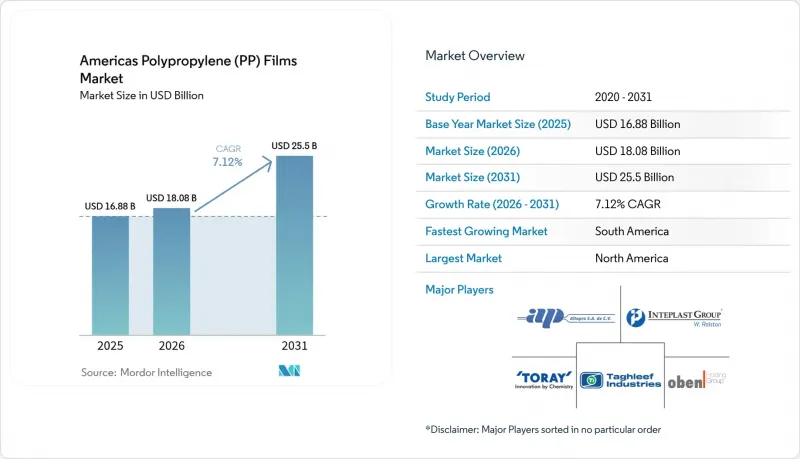
According to Mordor Intelligence, the Americas polypropylene films market size is expected to grow from USD 16.88 billion in 2025 to USD 18.08 billion in 2026 and is forecast to reach USD 25.5 billion by 2031 at 7.12% CAGR over 2026-2031.
This report is Segmented by Type (BOPP, CPP, SPP, and More), Thickness (Below 20 Microns, 20-40 Microns, Above 40 Microns), End-User Industry (Food, Beverage, Pharmaceuticals and Medical, Industrial, and More), Application (Packaging, Labelling and Tapes, Laminations, Graphics and Overlays, and More), and Geography. The Market Forecasts are Provided in Terms of Value (USD).
Americas Polypropylene (PP) Films Market Trends and Insights
Rapid Shift Toward Mono-Material Flexible Packaging Solutions
Brand owners are collapsing multilayer laminates into single-polymer formats to meet design-for-recycling targets and avoid extended producer responsibility fees. Coveris and Borealis commercialized a mono-polypropylene pet-food pouch in 2024 that eliminates polyethylene tie layers and still passes drop-test protocols. Borouge and Siegwerk have released a compatible ink-adhesive system that delivers peel strengths of above 2 N per 15 mm while preserving the purity of the recycling stream. Fraunhofer research shows that laminates retain 85% of their tensile strength after three mechanical cycles, compared to 60% for polyethylene terephthalate blends. California regulations, effective in 2024, require 25% post-consumer content in single-use packaging by 2032, accelerating the adoption of these mono-structures. Together, these advances make the Americas polypropylene films market a preferred platform for closed-loop packaging programs.
Expansion of E-commerce Fresh Food Delivery Networks
Meal-kit and online grocery services are scaling cold-chain hubs that favor lightweight, puncture-resistant pouches. Metallized cast polypropylene delivers moisture barriers below 1 g m-2 day-1, crucial for condensation control in refrigerated cross-docks. Flexible packs reduce shipping weight by 40% and cube utilization by 25%, trimming courier costs in dense cities. UFlex brought an 18,000 tpa line online in Mexico in H2 FY 2025 to supply U.S. fulfillment centers with rapid-turnaround custom prints. Reclosable zippers and fitment spouts laminated onto mono-material webs add consumer convenience without compromising recyclability. As subscription grocery penetration climbs, that functionality propels incremental square-meter demand in the Americas polypropylene films market.
Volatile Propylene Feedstock Prices Linked to Shale Gas Dynamics
Henry Hub spot prices fell to USD 2.27 per MMBtu in 2024 but spiked 15% during unplanned Gulf Coast outages, sending propylene references higher and squeezing converters locked into fixed-price film contracts. INEOS declared force majeure in early 2024 after a compressor failure, while Winter Storm Enzo temporarily idled steam crackers in January 2025. Latin American extruders reliant on U.S. chemical exports paid import premiums that compressed spreads. Because resin accounts for 55-65% of finished-film cost, volatility discourages capital-intensive barrier-coating upgrades and can slow the Americas polypropylene films market in the short term.
Other drivers and restraints analyzed in the detailed report include:
- Increased Demand for High-Barrier Films in Sustainable Packaging
- Replacement of PVC and PET with Polypropylene Films in Pharmaceutical Blister Packs
- Stringent Single-Use Plastic Regulations in Major U.S. States
For complete list of drivers and restraints, kindly check the Table Of Contents.
Segment Analysis
Biaxially oriented grades retained 64.78% of 2025 volume, anchoring the Americas polypropylene films market with strong tensile strength and high gloss that suit snack, label, and tape applications. Producers stretch molten sheet in both machine and transverse directions, boosting modulus above 3 GPa and enabling 15 micron downgauging without puncture compromise. Converters overlay silicon-oxide to meet sub-1 cc m-2 day-1 oxygen targets for roasted coffee, displacing polyethylene terephthalate structures. Cast polypropylene is projected to grow at an 8.18% CAGR as pharmaceutical blister lines transition from polyvinyl chloride to comply with extractables rules and as aseptic pouches demand stronger seal integrity. Brazilian converters ordered wide-cast lines in 2024 to serve Mercosur drug makers, underscoring CPP's rising strategic weight in the Americas polypropylene films market.
Rapid output additions in Mexico, Argentina, and the United States ease historic CPP shortfalls, yet BOPP remains the scale workhorse for labels, overwraps, and transparent snacks. Vitopel's metallized BOPP capacity jump in 2024 lowered lead times for moisture-sensitive coffee bags, while North American converters qualified 30% recycled-content BOPP to meet brand sustainability targets. Niche oriented grades, such as capacitor films and holographic overlays, enjoy premium margins thanks to tight thickness tolerance and dielectric purity, but they combined represent less than 2% of Americas polypropylene films market share.
Films under 20 microns post a 9.05% CAGR because high-stiffness biaxial orientation enables brand owners to reduce resin mass while maintaining puncture resistance. Barrier-coated 12-micron webs deliver the same oxygen protection as 40-micron uncoated films, unlocking 40% material savings. The 20-40 micron slot held 52.05% share in 2025, favored for pharmaceutical blister thermoforming, heavy-duty industrial wraps, and form-fill-seal pouches that need caliper for seal integrity. Many blister lines are calibrated for 25-micron webs, and retrofitting for thinner gauges requires new heater plates and cooling racks that converters often defer.
Above 40 microns, polypropylene competes with oriented polyethylene for stiff freezer bags and with polyethylene terephthalate for transparent retort lids. Growth here is muted, yet the Americas polypropylene films market size for thick gauges holds steady because construction wraps and synthetic paper labels value tear and moisture resistance over weight. The anticipated migration of coffee and snack packs to 15-micron coated webs will continue to put pressure on mid-gauge output, prompting producers to invest in ultra-thin tenter frames and high-output winding systems.
Complete Report Scope:
- By Type
- Biaxially Oriented Polypropylene (BOPP) Films
- Cast Polypropylene (CPP) Films
- Shrink Polypropylene (SPP) Films
- Other Types
- By Thickness
- Below 20 Microns
- 20 - 40 Microns
- Above 40 Microns
- By End-User Industry
- Food
- Beverage
- Pharmaceuticals and Medical
- Industrial
- Personal Care and Cosmetics
- Other End-User Industries
- By Application
- Packaging
- Labelling and Tapes
- Laminations
- Graphics and Overlays
- Other Applications
- By Geography
- North America
- United States
- Canada
- Mexico
- South America
- Brazil
- Argentina
- Chile
- Rest of South America
- North America
List of Companies Covered in this Report:
- Taghleef Industries LLC
- Toray Plastics (America), Inc.
- Jindal Films Americas LLC
- Oben Holding Group S.A.
- Cosmo Films Ltd.
- Inteplast Group Corporation
- Amcor plc
- CCL Industries Inc. (Innovia Films)
- Uflex Limited
- Sigma Plastics Group
- Vitopel Group
- Profol Inc.
- Treofan Americas
- Altopro S.A. de C.V.
- Copol International Ltd.
- Poligal S.A.
- Cheever Specialty Paper and Film
- Polibak Plastic Film Industry Inc.
Additional Benefits:
- The market estimate (ME) sheet in Excel format
- 3 months of analyst support
TABLE OF CONTENTS
1 INTRODUCTION
- 1.1 Study Assumptions and Market Definition
- 1.2 Scope of the Study
2 RESEARCH METHODOLOGY
3 EXECUTIVE SUMMARY
4 MARKET LANDSCAPE
- 4.1 Market Overview
- 4.2 Market Drivers
- 4.2.1 Rapid Shift Toward Mono-Material Flexible Packaging Solutions
- 4.2.2 Expansion of E-commerce Fresh Food Delivery Networks
- 4.2.3 Increased Demand for High-Barrier Films in Sustainable Packaging
- 4.2.4 Replacement of PVC and PET with Polypropylene Films in Pharmaceutical Blister Packs
- 4.2.5 Investment in Advanced Biaxially Oriented Lines by Latin American Converters
- 4.2.6 Rising Adoption of Recyclable Transparent Wraps by Quick-Service Restaurants
- 4.3 Market Restraints
- 4.3.1 Volatile Propylene Feedstock Prices Linked to Shale Gas Dynamics
- 4.3.2 Stringent Single-Use Plastic Regulations in Major U.S. States
- 4.3.3 Supply Chain Disruptions from Regional Plant Outages
- 4.3.4 Competition from Emerging Bio-Based and Biodegradable Film Alternatives
- 4.4 Industry Value Chain Analysis
- 4.5 Regulatory Landscape
- 4.6 Impact of Macroeconomic Factors on the Market
- 4.7 Technological Outlook
- 4.8 Porter's Five Forces Analysis
- 4.8.1 Bargaining Power of Suppliers
- 4.8.2 Bargaining Power of Buyers
- 4.8.3 Threat of New Entrants
- 4.8.4 Threat of Substitute Products
- 4.8.5 Intensity of Competitive Rivalry
- 4.9 Investment Analysis
5 MARKET SIZE AND GROWTH FORECASTS (VALUE)
- 5.1 By Type
- 5.1.1 Biaxially Oriented Polypropylene (BOPP) Films
- 5.1.2 Cast Polypropylene (CPP) Films
- 5.1.3 Shrink Polypropylene (SPP) Films
- 5.1.4 Other Types
- 5.2 By Thickness
- 5.2.1 Below 20 Microns
- 5.2.2 20 - 40 Microns
- 5.2.3 Above 40 Microns
- 5.3 By End-User Industry
- 5.3.1 Food
- 5.3.2 Beverage
- 5.3.3 Pharmaceuticals and Medical
- 5.3.4 Industrial
- 5.3.5 Personal Care and Cosmetics
- 5.3.6 Other End-User Industries
- 5.4 By Application
- 5.4.1 Packaging
- 5.4.2 Labelling and Tapes
- 5.4.3 Laminations
- 5.4.4 Graphics and Overlays
- 5.4.5 Other Applications
- 5.5 By Geography
- 5.5.1 North America
- 5.5.1.1 United States
- 5.5.1.2 Canada
- 5.5.1.3 Mexico
- 5.5.2 South America
- 5.5.2.1 Brazil
- 5.5.2.2 Argentina
- 5.5.2.3 Chile
- 5.5.2.4 Rest of South America
- 5.5.1 North America
6 COMPETITIVE LANDSCAPE
- 6.1 Market Concentration
- 6.2 Strategic Moves
- 6.3 Market Share Analysis
- 6.4 Company Profiles (includes Global level Overview, Market level overview, Core Segments, Financials as available, Strategic Information, Market Rank/Share for key companies, Products and Services, and Recent Developments)
- 6.4.1 Taghleef Industries LLC
- 6.4.2 Toray Plastics (America), Inc.
- 6.4.3 Jindal Films Americas LLC
- 6.4.4 Oben Holding Group S.A.
- 6.4.5 Cosmo Films Ltd.
- 6.4.6 Inteplast Group Corporation
- 6.4.7 Amcor plc
- 6.4.8 CCL Industries Inc. (Innovia Films)
- 6.4.9 Uflex Limited
- 6.4.10 Sigma Plastics Group
- 6.4.11 Vitopel Group
- 6.4.12 Profol Inc.
- 6.4.13 Treofan Americas
- 6.4.14 Altopro S.A. de C.V.
- 6.4.15 Copol International Ltd.
- 6.4.16 Poligal S.A.
- 6.4.17 Cheever Specialty Paper and Film
- 6.4.18 Polibak Plastic Film Industry Inc.
7 MARKET OPPORTUNITIES AND FUTURE OUTLOOK
- 7.1 White-space and Unmet-Need Assessment

