PUBLISHER: Mordor Intelligence | PRODUCT CODE: 2115924

PUBLISHER: Mordor Intelligence | PRODUCT CODE: 2115924
Digital Fault Recorder - Market Share Analysis, Industry Trends & Statistics, Growth Forecasts (2026 - 2031)
According to Mordor Intelligence, the digital fault recorder market size is expected to grow from USD 2.06 billion in 2025 to USD 2.21 billion in 2026 and is forecast to reach USD 3.11 billion by 2031 at 7.12% CAGR over 2026-2031.
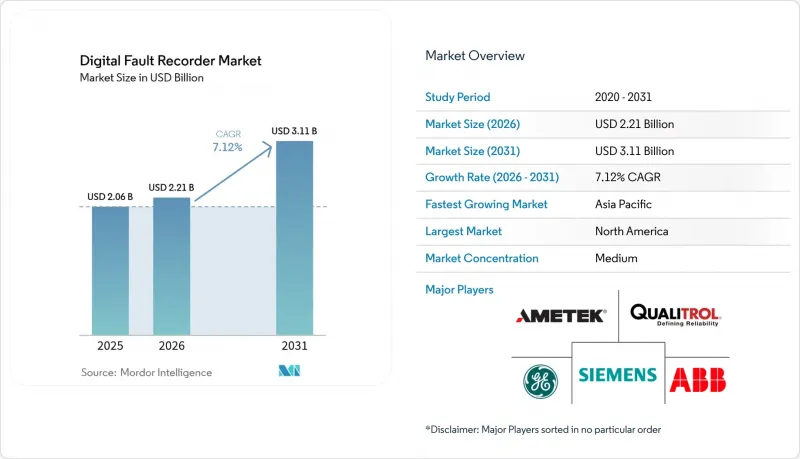
This report is Segmented by Type (Dedicated and Multifunctional), Installation (Generation, Transmission, and Distribution), Voltage Class (<110 KV, 110-220 KV, and More), Communication Protocol (IEC 61850-Compliant and Legacy/Proprietary), End-User (Utilities, Industrial and Manufacturing, and More), and Geography. The Market Forecasts are Provided in Terms of Value (USD).
Global Digital Fault Recorder Market Trends and Insights
Grid-Modernization Capex Surge
Record utility capital programs underpin sustained ordering cycles for the digital fault recorder market. The European Union has earmarked EUR 584 billion for network upgrades by 2030, while North America channels USD 10.5 billion in federal funds toward grid resilience. Suppliers such as Hitachi Energy are investing heavily-USD 4.5 billion through 2027-to scale production and digital capabilities, signalling confidence that modernization spending will survive macroeconomic slowdowns. Utilities increasingly bundle fault recorders with power-quality meters and disturbance analytics, treating them as foundational elements of next-generation grid control architectures. National security framing around grid reliability further shields budgets from cyclical cuts.
Mandatory NERC PRC-002-2 Disturbance-Monitoring Compliance
North American utilities face immovable timelines to demonstrate disturbance-recording coverage across bulk power assets. Penalties for non-compliance can reach multimillion-dollar levels, driving an accelerated procurement cycle for IEC 61850-ready digital fault recorders that satisfy PRC-002-2 event-capture windows while also delivering power-quality insights. The compliance model is resonating abroad: European and Asian regulators reference NERC's framework as they craft equivalent monitoring rules, laying the groundwork for export growth. Utilities favor multifunction units to meet multiple standards in one footprint, supporting the consolidation of relay and recorder hardware.
High Upfront Cost of Multifunction DFRs
Advanced multifunction units priced between USD 50,000 and USD 200,000 test smaller utilities' budgets at a time when they must also fund cybersecurity hardening and distribution automation. Integration, training, and licensing expenses can double the life-cycle cost, prompting tiered deployment strategies that limit installations to critical nodes. Suppliers counter by offering subscription pricing and modular firmware unlocks, yet capital constraints remain the chief adoption brake in price-sensitive regions.
Other drivers and restraints analyzed in the detailed report include:
- Renewable and Inverter-Based Generation Penetration
- IEC 61850 Process-Bus Roll-Out
- OT-Network Cyber-Security Concerns
For complete list of drivers and restraints, kindly check the Table Of Contents.
Segment Analysis
Dedicated units dominated the digital fault recorder market with a 57.90% revenue share in 2025. Transmission operators value their proven reliability, deterministic response, and straightforward relay-scheme integration. However, multifunction devices record a 8.90% CAGR to 2031 as buyers seek to collapse disturbance recording, power-quality metering, and analytics gateways into a single enclosure. Multifunction adoption is strongest in greenfield substations where space and wiring reduction justify premium pricing. Utilities running pilot projects report engineering-hour savings of up to 20% when relying on virtualized protection software. The digital fault recorder market size captured by multifunction devices is forecast to reach USD 1.42 billion by 2031, underpinned by declining per-channel costs and firmware-driven feature expansion. Vendor roadmaps converge toward cloud-update capability, enabling remote addition of synchrophasor streaming and IEC 61850 Edition 2 features without hardware swaps. The competitive narrative shifts as relay incumbents integrate high-resolution capture cards, while traditional recorder specialists develop modular I/O options to protect their share.
Transmission grids held 47.90% of the digital fault recorder market share in 2025 because bulk-power nodes remain mandatory monitoring points across most reliability regimes. Yet distribution networks, historically under-instrumented, post the fastest 8.65% CAGR through 2031. Distributed energy resource connections, voltage-regulating inverters, and vehicle-to-grid pilots create complex fault signatures at medium-voltage levels. Utilities now specify recorders for feeder head-ends and critical distribution transformers to resolve power-quality complaints and minimize outage investigation times. The digital fault recorder market size attributable to distribution is projected to pass USD 980 million in 2031 as unit costs fall and compact form factors become mainstream. Meanwhile, generation-site deployments concentrate on renewable plants where grid-code compliance requires oscillography for every fault trip; these projects favour devices with embedded disturbance analysis that ease certification.
Complete Report Scope:
- By Type
- Dedicated
- Multifunctional
- By Installation
- Generation
- Transmission
- Distribution
- By Voltage Class
- <110 kV
- 110-220 kV
- 220-500 kV
- >500 kV
- By Communication Protocol
- IEC 61850-compliant
- Legacy/Proprietary
- By End-user
- Utilities
- Industrial and Manufacturing
- Railways and Metros
- Data Centers
- Oil and Gas
- Other End-users
- By Geography
- North America
- United States
- Canada
- Mexico
- South America
- Brazil
- Argentina
- Chile
- Rest of South America
- Europe
- Germany
- United Kingdom
- France
- Italy
- Spain
- Russia
- Rest of Europe
- Asia-Pacific
- China
- India
- Japan
- South Korea
- Singapore
- Malaysia
- Australia
- Rest of Asia-Pacific
- Middle East and Africa
- Middle East
- United Arab Emirates
- Saudi Arabia
- Turkey
- Rest of Middle East
- Africa
- South Africa
- Nigeria
- Rest of Africa
- Middle East
- North America
Geography Analysis
North America, holding 35.35% revenue share in 2025, benefits from robust federal funding and stringent NERC standards that oblige disturbance monitoring on all bulk-electric-system elements. Programs under the Bipartisan Infrastructure Law drive rapid retrofit cycles that favour multifunction recorders packaged with power-quality features. United States utilities expand disturbance-monitoring scope to inverter-based resources, while Canada aligns standards to smooth cross-border power flows. Mexico presents emerging opportunities as interconnection upgrades and renewable integration mandates demand improved event visibility.
Asia-Pacific posts the fastest 8.45% CAGR, powered by China's State Grid investment of more than CNY 600 billion (USD 84.5 billion) in ultra-high-voltage construction and comprehensive digital upgrades. India's grid modernization surges on strong demand growth, with recent HVDC awards lifting record installations in renewable corridors. Japan, South Korea, and Australia roll out smart-grid pilots that require IEC 61850 process-bus compatibility, creating openings for multinational suppliers. Southeast Asian distribution utilities embrace compact recorders for feeder automation as electrification rates climb.
Europe sustains steady growth under the European Commission's EUR 584 billion network plan, focusing on offshore wind integration and cross-border trading. Germany and the Netherlands adopt innovative grid-technology packages that expand capacity without new lines, relying on high-resolution data for dynamic rating algorithms. Nordic operators invest in synchronous condensers and STATCOM upgrades, bundling recorders to validate performance. Eastern European networks catch up on substation digitalization, supported by cohesion funds that lower capital hurdles. The Middle East and Africa, while smaller in volume, display rising interest as industrialization and renewable build-outs advance, prompting the adoption of scalable monitoring solutions.
- Qualitrol Company LLC
- GE Grid Solutions (GE Vernova)
- Siemens AG
- AMETEK Power Instruments
- ABB Ltd. (Hitachi Energy DFR line)
- ERLPhase Power Technologies Ltd.
- KoCoS Messtechnik AG
- Elspec Ltd.
- Kinkei System Corp.
- Prosoft Systems Ltd.
- Ducati Energia SpA
- Schweitzer Engineering Laboratories (SEL)
- Novatech Automation (Bitronics)
- Arbiter Systems, Inc.
- NR Electric Co., Ltd.
- Yokogawa Electric Corporation
- Arteche Group
- BHEL (Bharat Heavy Electricals Ltd.)
- Beijing Sifang Automation Co., Ltd.
- Shenzhen Shuanghui Electric Co., Ltd.
- CG Power & Industrial Solutions Ltd.
- Izumi Electric Co., Ltd.
- Zhejiang Yongteng Electric Co., Ltd.
- Supco Systems, Inc.
- Hitachi Energy Ltd.
Additional Benefits:
- The market estimate (ME) sheet in Excel format
- 3 months of analyst support
TABLE OF CONTENTS
1 INTRODUCTION
- 1.1 Study Assumptions and Market Definition
- 1.2 Scope of the Study
2 EXECUTIVE SUMMARY
3 RESEARCH METHODOLOGY
4 MARKET LANDSCAPE
- 4.1 Market Overview
- 4.2 Market Drivers
- 4.2.1 Grid-modernization capex surge
- 4.2.2 Mandatory NERC PRC-002-2 disturbance-monitoring compliance
- 4.2.3 Renewable and inverter-based generation penetration
- 4.2.4 IEC 61850 process-bus roll-out
- 4.2.5 AI-driven predictive maintenance demand
- 4.2.6 Data-center substation reliability push
- 4.3 Market Restraints
- 4.3.1 High upfront cost of multifunction DFRs
- 4.3.2 OT-network cyber-security concerns
- 4.3.3 Shortage of waveform-analysis expertise
- 4.3.4 Memory-chip thermal-cycle reliability
- 4.4 Industry Value Chain Analysis
- 4.5 Regulatory Landscape
- 4.6 Technological Outlook
- 4.7 Industry Attractiveness - Porter's Five Forces Analysis
- 4.7.1 Bargaining Power of Suppliers
- 4.7.2 Bargaining Power of Buyers
- 4.7.3 Threat of New Entrants
- 4.7.4 Threat of Substitutes
- 4.7.5 Intensity of Competitive Rivalry
- 4.8 Impact of Macroeconomic Factors on the Market
5 MARKET SIZE AND GROWTH FORECASTS (VALUES)
- 5.1 By Type
- 5.1.1 Dedicated
- 5.1.2 Multifunctional
- 5.2 By Installation
- 5.2.1 Generation
- 5.2.2 Transmission
- 5.2.3 Distribution
- 5.3 By Voltage Class
- 5.3.1 <110 kV
- 5.3.2 110-220 kV
- 5.3.3 220-500 kV
- 5.3.4 >500 kV
- 5.4 By Communication Protocol
- 5.4.1 IEC 61850-compliant
- 5.4.2 Legacy/Proprietary
- 5.5 By End-user
- 5.5.1 Utilities
- 5.5.2 Industrial and Manufacturing
- 5.5.3 Railways and Metros
- 5.5.4 Data Centers
- 5.5.5 Oil and Gas
- 5.5.6 Other End-users
- 5.6 By Geography
- 5.6.1 North America
- 5.6.1.1 United States
- 5.6.1.2 Canada
- 5.6.1.3 Mexico
- 5.6.2 South America
- 5.6.2.1 Brazil
- 5.6.2.2 Argentina
- 5.6.2.3 Chile
- 5.6.2.4 Rest of South America
- 5.6.3 Europe
- 5.6.3.1 Germany
- 5.6.3.2 United Kingdom
- 5.6.3.3 France
- 5.6.3.4 Italy
- 5.6.3.5 Spain
- 5.6.3.6 Russia
- 5.6.3.7 Rest of Europe
- 5.6.4 Asia-Pacific
- 5.6.4.1 China
- 5.6.4.2 India
- 5.6.4.3 Japan
- 5.6.4.4 South Korea
- 5.6.4.5 Singapore
- 5.6.4.6 Malaysia
- 5.6.4.7 Australia
- 5.6.4.8 Rest of Asia-Pacific
- 5.6.5 Middle East and Africa
- 5.6.5.1 Middle East
- 5.6.5.1.1 United Arab Emirates
- 5.6.5.1.2 Saudi Arabia
- 5.6.5.1.3 Turkey
- 5.6.5.1.4 Rest of Middle East
- 5.6.5.2 Africa
- 5.6.5.2.1 South Africa
- 5.6.5.2.2 Nigeria
- 5.6.5.2.3 Rest of Africa
- 5.6.5.1 Middle East
- 5.6.1 North America
6 COMPETITIVE LANDSCAPE
- 6.1 Market Concentration
- 6.2 Strategic Moves
- 6.3 Market Share Analysis
- 6.4 Company Profiles (includes Global level Overview, Market level overview, Core Segments, Financials as available, Strategic Information, Market Rank/Share for key companies, Products and Services, and Recent Developments)
- 6.4.1 Qualitrol Company LLC
- 6.4.2 GE Grid Solutions (GE Vernova)
- 6.4.3 Siemens AG
- 6.4.4 AMETEK Power Instruments
- 6.4.5 ABB Ltd. (Hitachi Energy DFR line)
- 6.4.6 ERLPhase Power Technologies Ltd.
- 6.4.7 KoCoS Messtechnik AG
- 6.4.8 Elspec Ltd.
- 6.4.9 Kinkei System Corp.
- 6.4.10 Prosoft Systems Ltd.
- 6.4.11 Ducati Energia SpA
- 6.4.12 Schweitzer Engineering Laboratories (SEL)
- 6.4.13 Novatech Automation (Bitronics)
- 6.4.14 Arbiter Systems, Inc.
- 6.4.15 NR Electric Co., Ltd.
- 6.4.16 Yokogawa Electric Corporation
- 6.4.17 Arteche Group
- 6.4.18 BHEL (Bharat Heavy Electricals Ltd.)
- 6.4.19 Beijing Sifang Automation Co., Ltd.
- 6.4.20 Shenzhen Shuanghui Electric Co., Ltd.
- 6.4.21 CG Power & Industrial Solutions Ltd.
- 6.4.22 Izumi Electric Co., Ltd.
- 6.4.23 Zhejiang Yongteng Electric Co., Ltd.
- 6.4.24 Supco Systems, Inc.
- 6.4.25 Hitachi Energy Ltd.
7 MARKET OPPORTUNITIES AND FUTURE TRENDS
- 7.1 White-Space and Unmet-Need Assessment

