PUBLISHER: Mordor Intelligence | PRODUCT CODE: 2115928

PUBLISHER: Mordor Intelligence | PRODUCT CODE: 2115928
Cataract Surgery Devices - Market Share Analysis, Industry Trends & Statistics, Growth Forecasts (2026 - 2031)
According to Mordor Intelligence, the cataract surgery devices market size is expected to grow from USD 8.90 billion in 2025 to USD 9.28 billion in 2026 and is forecast to reach USD 11.41 billion by 2031 at 4.22% CAGR over 2026-2031.
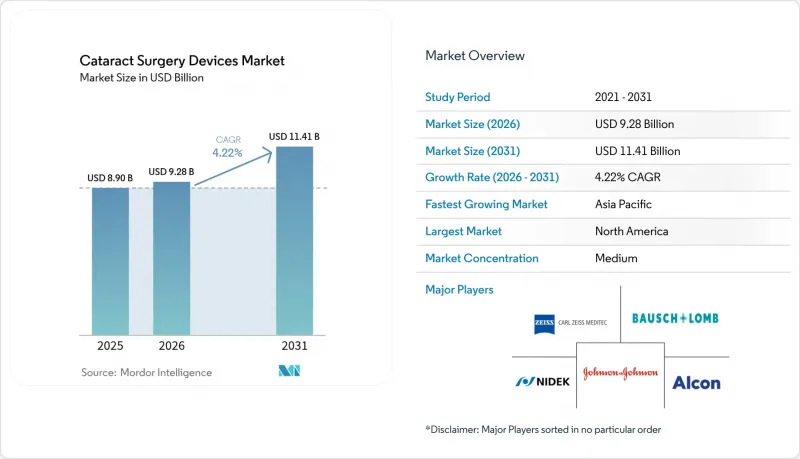
This report Segments the Industry Into by Product Type (Intraocular Lenses, Femtosecond Laser Systems, and More), by Surgery Technique (Phaco-Based Standard Surgery and More), by End User (Hospitals, Ambulatory Surgery Centers, and More), and Geography (North America, Europe, Asia-Pacific, Middle East and Africa, South America). The Market Sizes and Forecasts are Provided in Terms of Value (USD).
Global Cataract Surgery Devices Market Trends and Insights
Rise in Cataract Prevalence and Ageing Population
Cataracts affect approximately 100 million people worldwide and are responsible for almost 45% of global blindness. The number of individuals aged 65 and above is forecast to double by 2050, intensifying surgical demand, particularly in countries still building ophthalmic infrastructure. Vision impairment tied to cataracts causes annual productivity losses estimated at USD 411 billion, creating a strong economic case for governments to clear surgical backlogs. Older patients also tend to present with co-morbidities and higher expectations, spurring adoption of aspheric and toric IOLs that tackle complex aberrations. Together, these factors keep procedure volumes rising even in mature markets, sustaining growth for replacement consumables and capital equipment alike
Technological Leaps in Premium IOLs and FLACS
Recent lens launches redefine patient expectations by reducing halos, enhancing contrast, and enabling post-operative fine-tuning. Johnson & Johnson's TECNIS Odyssey (launched in September 2024) minimizes dysphotopsia, while Bausch + Lomb's enVista Envy (FDA approval October 2024) employs wavefront-optimized optics for broad-range clarity. RxSight's light-adjustable lens allows on-demand refractive refinement, and Rayner's AI-designed Galaxy lens, now in pivotal trials, uses continuous-spiral optics for a near-continuous depth of focus. Parallel advances in femtosecond platforms-such as Lensar's ALLY dual-pulsed laser with robotic patient interface-shorten procedure times and standardize capsulotomies, helping surgeons justify premium tariffs in select patient cohorts.
High Capital Cost of Femtosecond Laser Systems
Purchase prices above USD 400,000, annual service contracts, and the need for disposables make return-on-investment challenging when reimbursement rates remain flat. Smaller facilities often outsource to mobile providers that position lasers on a per-diem basis, a model pioneered by firms offering "precision without the investment." While this broadens access, utilization variability still limits widespread uptake in price-sensitive markets, keeping phaco-only rooms predominant outside major urban hubs.
Other drivers and restraints analyzed in the detailed report include:
- Burgeoning Demand for Day-Care / ASC Cataract Procedures
- Emerging Reimbursement in Middle-Income APAC Markets
- Shortage of Trained Cataract Surgeons in Developing Countries
For complete list of drivers and restraints, kindly check the Table Of Contents.
Segment Analysis
In 2025, intra-ocular lenses captured 41.02% of the cataract surgery devices market share, reflecting their indispensable role in every procedure. Penetration of multifocal, toric, and extended-depth-of-focus models pushes average selling prices upward, creating an attractive profit pool for integrated manufacturers. Continuous improvements, such as glistening-free hydrophobic materials and blue-light-filtering chromophores, drive repeat interest among surgeons seeking post-operative satisfaction gains. Femtosecond laser systems, although representing a smaller revenue base, are projected to grow at a 6.12% CAGR to 2031 as evidence mounts that consistent capsulotomies translate into fewer lens dislocations and faster refractive recovery.
Cost-optimized phaco consoles continue to sell well in emerging economies where maintenance support can be inconsistent. Vendors often pair these with reusable handpieces and multi-country training caravans. On the premium end, next-generation phaco pumps with venturi fluidics and real-time occlusion sensing deliver sub-10-second effective phaco time, reducing corneal edema risk in dense nuclei cases.
Complete Report Scope:
- By Product Type
- Intra-ocular Lenses (IOL)
- Phacoemulsification Systems
- Standard Phaco Machines
- Advanced Phaco Machines
- Ophthalmic Viscoelastic Devices
- Femtosecond Laser Systems
- Others (Knives and Low-Cost Consumables)
- By Surgery Technique
- Manual Small-Incision Cataract Surgery
- Phaco-based Standard Surgery
- Femtosecond-Laser-Assisted Cataract Surgery (FLACS)
- Others (Extracapsular Cataract Extraction, Intracapsular Cataract Extraction, and Micro-Incision Cataract Surgery)
- By End User
- Hospitals
- Ophthalmology Clinics
- Ambulatory Surgery Centers
- Academic and Research Institutes
- Geography
- North America
- United States
- Canada
- Mexico
- Europe
- Germany
- United Kingdom
- France
- Italy
- Spain
- Rest of Europe
- Asia-Pacific
- China
- Japan
- India
- South Korea
- Australia
- Rest of Asia-Pacific
- Middle East and Africa
- GCC
- South Africa
- Rest of Middle East and Africa
- South America
- Brazil
- Argentina
- Rest of South America
- North America
Geography Analysis
North America remained the largest regional buyer, contributing 38.20% of global revenue in 2025 as advanced reimbursement mechanisms and strong ASC penetration sustain high procedural volumes. The United States tightens its focus on quality metrics; beginning in 2025, updated Medicare rules link facility payment to unplanned return-to-OR rates for "Cataract removal with intraocular lens implantation," nudging providers to adopt digital planning platforms for error reduction . Canada's single-payer model, in contrast, emphasizes queue management, reinforcing demand for high-throughput phaco systems coupled with reusable packs.
Asia-Pacific is the fastest-growing region, forecast at 6.04% CAGR through 2031 as demographic pressure meets expanding insurance coverage. China and India are playing a major role in driving growth, due to their huge populations and steadily improving healthcare systems. These countries offer big opportunities, especially as demand rises across different segments. In urban areas and among wealthier groups, there's a growing appetite for premium healthcare services. At the same time, more affordable, value-based solutions are helping meet the needs of the wider population. Japan stands out as a leader in adopting advanced medical technologies, while India is making waves with innovative, cost-effective models that boost surgical efficiency and access..
Europe maintains steady growth, anchored by Germany, France, and the United Kingdom. Day-case surgery overtook inpatient cataract procedures in most EU-27 members by 2024. Eastern Europe shows catch-up potential as EU structural funds subsidize diagnostic and surgical equipment upgrades. South America and the Middle East and Africa deliver smaller volumes but above-average growth as public-private partnerships build new eye hospitals.
- Alcon
- Johnson & Johnson
- Carl Zeiss
- Bausch + Lomb
- Nidek
- STAAR SURGICAL COMPANY
- HOYA
- EssilorLuxottica
- Ziemer Group
- HAAG-Streit
- TOPCON CORPORATION
- Glaukos
- HumanOptics Holding AG
- Coburn Technologies, Inc.
- Iridex Corporation
- BVI Medical
- Rayner Group
- RxSight, Inc.
- LensGen, Inc.
Additional Benefits:
- The market estimate (ME) sheet in Excel format
- 3 months of analyst support
TABLE OF CONTENTS
1 Introduction
- 1.1 Study Assumptions & Market Definition
- 1.2 Scope of the Study
2 Research Methodology
3 Executive Summary
4 Market Landscape
- 4.1 Market Overview
- 4.2 Market Drivers
- 4.2.1 Rise in Cataract Prevalence & Ageing Population
- 4.2.2 Technological Leaps in Premium IOLs and FLACS
- 4.2.3 Burgeoning Demand for Day-Care / ASC Cataract Procedures
- 4.2.4 Emerging Reimbursement in Middle-Income APAC Markets
- 4.2.5 Increase in Government Efforts to Address Visual Impairment
- 4.3 Market Restraints
- 4.3.1 High Capital Cost of Femtosecond Laser Systems
- 4.3.2 Shortage of Trained Cataract Surgeons in Developing Countries
- 4.3.3 Increasing Competition From Low-Cost IOL Manufacturers
- 4.4 Supply-Chain Analysis
- 4.5 Regulatory Landscape
- 4.6 Technological Outlook
- 4.7 Porter's Five Forces Analysis
- 4.7.1 Threat of New Entrants
- 4.7.2 Bargaining Power of Buyers
- 4.7.3 Bargaining Power of Suppliers
- 4.7.4 Threat of Substitutes
- 4.7.5 Intensity of Competitive Rivalry
5 Market Size & Growth Forecasts (Value)
- 5.1 By Product Type
- 5.1.1 Intra-ocular Lenses (IOL)
- 5.1.2 Phacoemulsification Systems
- 5.1.2.1 Standard Phaco Machines
- 5.1.2.2 Advanced Phaco Machines
- 5.1.3 Ophthalmic Viscoelastic Devices
- 5.1.4 Femtosecond Laser Systems
- 5.1.5 Others (Knives and Low-Cost Consumables)
- 5.2 By Surgery Technique
- 5.2.1 Manual Small-Incision Cataract Surgery
- 5.2.2 Phaco-based Standard Surgery
- 5.2.3 Femtosecond-Laser-Assisted Cataract Surgery (FLACS)
- 5.2.4 Others (Extracapsular Cataract Extraction, Intracapsular Cataract Extraction, and Micro-Incision Cataract Surgery)
- 5.3 By End User
- 5.3.1 Hospitals
- 5.3.2 Ophthalmology Clinics
- 5.3.3 Ambulatory Surgery Centers
- 5.3.4 Academic and Research Institutes
- 5.4 Geography
- 5.4.1 North America
- 5.4.1.1 United States
- 5.4.1.2 Canada
- 5.4.1.3 Mexico
- 5.4.2 Europe
- 5.4.2.1 Germany
- 5.4.2.2 United Kingdom
- 5.4.2.3 France
- 5.4.2.4 Italy
- 5.4.2.5 Spain
- 5.4.2.6 Rest of Europe
- 5.4.3 Asia-Pacific
- 5.4.3.1 China
- 5.4.3.2 Japan
- 5.4.3.3 India
- 5.4.3.4 South Korea
- 5.4.3.5 Australia
- 5.4.3.6 Rest of Asia-Pacific
- 5.4.4 Middle East and Africa
- 5.4.4.1 GCC
- 5.4.4.2 South Africa
- 5.4.4.3 Rest of Middle East and Africa
- 5.4.5 South America
- 5.4.5.1 Brazil
- 5.4.5.2 Argentina
- 5.4.5.3 Rest of South America
- 5.4.1 North America
6 Competitive Landscape
- 6.1 Market Concentration
- 6.2 Market Share Analysis
- 6.3 Company Profiles (includes Global level Overview, Market level overview, Core Segments, Financials as available, Strategic Information, Market Rank/Share for key companies, Products & Services, and Recent Developments)
- 6.3.1 Alcon Inc.
- 6.3.2 Johnson & Johnson Services, Inc.
- 6.3.3 Carl Zeiss Meditec AG
- 6.3.4 Bausch + Lomb
- 6.3.5 NIDEK CO., LTD.
- 6.3.6 STAAR SURGICAL COMPANY
- 6.3.7 HOYA Corporation
- 6.3.8 EssilorLuxottica
- 6.3.9 Ziemer Ophthalmic Systems AG
- 6.3.10 Haag-Streit Group
- 6.3.11 TOPCON CORPORATION
- 6.3.12 Glaukos Corporation
- 6.3.13 HumanOptics Holding AG
- 6.3.14 Coburn Technologies, Inc.
- 6.3.15 Iridex Corporation
- 6.3.16 BVI Medical
- 6.3.17 Rayner Group
- 6.3.18 RxSight, Inc.
- 6.3.19 LensGen, Inc.
7 Market Opportunities & Future Outlook
- 7.1 White-space & Unmet-Need Assessment

