PUBLISHER: Mordor Intelligence | PRODUCT CODE: 2116007

PUBLISHER: Mordor Intelligence | PRODUCT CODE: 2116007
North America Pet Food Packaging - Market Share Analysis, Industry Trends & Statistics, Growth Forecasts (2026 - 2031)
According to Mordor Intelligence, the North America PET food packaging market size in 2026 is estimated at USD 12.07 billion, growing from 2025 value of USD 11.67 billion with 2031 projections showing USD 14.29 billion, growing at 3.43% CAGR over 2026-2031.
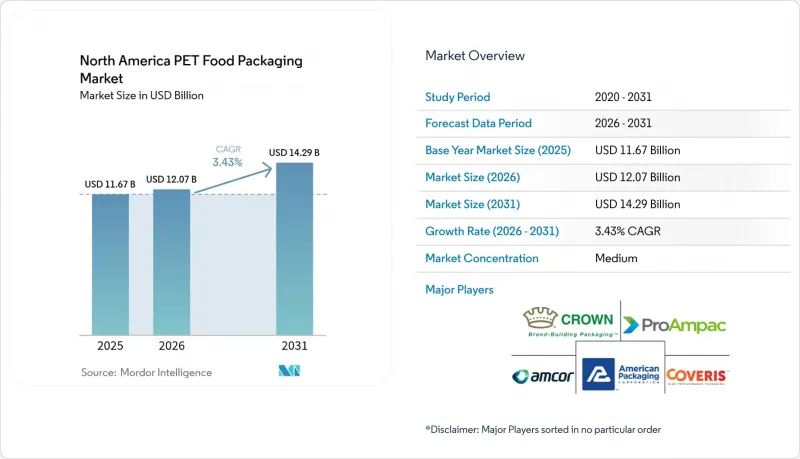
This report is Segmented by Material (Plastic, Paper and Paperboard, and Metal), Product Type (Bags, Pouches, Plastic Bottles and Containers, Metal Cans, Folding Cartons, and Other Product Types), Food Type (Dry Food, Wet Food, and Other Food Type), Pet Animal Type (Canine (Dog), and More), and Geography (United States, and More). The Market Forecasts are Provided in Terms of Value (USD).
North America PET Food Packaging Market Trends and Insights
Premiumisation of Grain-Free and High-Protein Formulae
Manufacturers marketing grain-free and protein-dense diets require ultra-low oxygen transmission rates to curb lipid oxidation, pushing demand for metallized polyethylene terephthalate and aluminum-oxide coated films that cost up to 20% more than standard laminations. Ingredient transparency surveys show 73% of pet parents under 35 read labels before purchase, encouraging clear windows, matte varnishes, and tactile elements that reinforce premium narratives. Resealable sliders and portion-control cups reduce feeding errors, supporting veterinary recommendations and minimizing waste. These enhancements lift average pack price but also elevate brand loyalty in a market where 42% of consumers switched labels after noticing packaging damage. The premiumisation driver therefore ties material science to lifestyle storytelling, boosting the North America pet food packaging market even in mature categories.
Surge in E-Commerce Led Direct-to-Consumer Packaging Fulfilment
Online penetration hit 23% of regional pet food sales in 2024, and parcel carriers now dictate drop-test and dimensional-weight thresholds that converge on sturdy, space-efficient designs. Brands qualifying for Amazon's Frustration-Free program remove outer cartons and shave 15-25% of total material, creating immediate cost-of-goods savings while slashing freight surcharges. Optimal cases of 12 x 9 x 6 inches for dry diets boost pallet fill to 88%, cutting transportation emissions and supporting corporate ESG targets. Subscription bundles embed tamper-evident pull tabs and scannable batch codes so automated inventory platforms can predict reorder cycles. These logistics-centric tweaks are central to the North America pet food packaging market, especially as last-mile economics shape pack geometry more than shelf presence.
Volatility in Virgin Resin Prices
Polyethylene and polypropylene quotes swung 25-40% during 2023-2024, compressing converter margins locked into fixed brand contracts. To hedge, large suppliers carry 60-90 days of inventory, tying up working capital and crowding out R&D budgets. Food-grade recycled pellets trade at 15-20% above virgin when supply is tight, limiting substitution that could cushion volatility. Small and mid-sized plants without multi-year resin agreements face spot-price exposure that erodes competitiveness, nudging them toward consolidation. The resulting supply-base shake-up tempers the otherwise steady expansion of the North America pet food packaging market.
Other drivers and restraints analyzed in the detailed report include:
- Lightweight Barrier Films Replacing Multilayer Metal Cans
- Rising Disposable Incomes among Millennial Pet Parents
- High Capital Outlay for Retort-Ready Pouch Lines
For complete list of drivers and restraints, kindly check the Table Of Contents.
Segment Analysis
Plastic accounted for 55.62% of North America pet food packaging market share in 2025, but its dominance is edging down as paper and paperboard climb at a 4.44% CAGR to 2031. The transition is driven by state-level recycled-content bills and producer-responsibility fees that penalize multi-material laminates. Despite cost advantages, conventional polyethylene structures struggle to reach the 30% post-consumer resin threshold without compromising seal integrity, pushing converters toward engineered mono-material films. EPR schemes in California, Oregon, and New Jersey already levy variable tariffs based on recyclability, steering brand owners to substrate redesign.
Developers of water-based dispersion coatings are piloting paper packs that withstand 50 drop cycles and sustain moisture barrier ratings suited for dry kibble. For wet formulas, bio-based coatings blended with polyvinyl alcohol extend shelf life up to 12 months, creating credible alternatives to metallized film. The continuous ebb and flow between barrier performance and recyclability will redefine material value pools, yet plastic remains indispensable for retort closures and high-stiffness zipper profiles. As a result, hybrid solutions such as "recycle-ready" PE-PE laminates will anchor near-term volume, while fiber innovations chip away at longer-term share in the North America pet food packaging market.
Bags held 33.78% North America pet food packaging market share in 2025 thanks to cost-efficient rollstock and high-speed form-fill-seal lines. However, stand-up pouches are accelerating at a 5.59% CAGR, reflecting their ship-ready geometry, billboard branding area, and portion-friendly reclosability. Barrier enhancements have raised oxygen protection to rival that of thick-wall bags, enabling smaller SKU sizes without sacrificing shelf life. For wet entrees, spouted retort pouches support "tear-pour-serve" rituals that resonate with busy pet parents and cut aluminum inputs by half.
Rigid bottles cater to niche liquid treats and probiotic toppers, leveraging HDPE's compatibility with high-viscosity fills. Folding cartons primarily aggregate single-serve packs for club-store channels, adding gift-worthy cues. Though cans remain synonymous with traditional wet food, 76% of surveyed millennials indicated a preference for lighter packs that they can reseal after partial feeding. In this context, pouches are poised to surpass bags in perceived value, cementing their position as the innovation epicenter of the North America pet food packaging market.
Complete Report Scope:
- By Material
- Plastic
- Paper and Paperboard
- Metal
- By Product Type
- Bags
- Pouches
- Plastic Bottles and Containers
- Metal Cans
- Folding Cartons
- Other Product Types
- By Food Type
- Dry Food
- Wet Food
- Other Food Type
- By Pet Animal Type
- Canine (Dog)
- Feline (Cat)
- Other Pet Animal Types
- By Geography
- United States
- Canada
- Mexico
List of Companies Covered in this Report:
- Amcor PLC
- American Packaging Corporation
- ProAmpac Intermediate Inc.
- Coveris Holdings SA
- Crown Holdings Inc.
- Eagle Flexible Packaging LLC
- Excel Packaging Corporation
- Graphic Packaging International LLC
- Mondi PLC
- Silgan Holdings Inc.
- Sonoco Products Company
- Trivium Packaging BV
- Winpak Ltd.
- Bryce Corporation
- Printpack Inc.
- AptarGroup Inc.
- Huhtamaki Oyj
- Sealed Air Corporation
- Constantia Flexibles Group GmbH
Additional Benefits:
- The market estimate (ME) sheet in Excel format
- 3 months of analyst support
TABLE OF CONTENTS
1 INTRODUCTION
- 1.1 Study Assumptions and Market Definition
- 1.2 Scope of the Study
2 RESEARCH METHODOLOGY
3 EXECUTIVE SUMMARY
4 MARKET LANDSCAPE
- 4.1 Market Overview
- 4.2 Industry Value Chain Analysis
- 4.3 Regulatory Landscape
- 4.4 Technological Outlook
- 4.5 Porter's Five Forces Analysis
- 4.5.1 Bargaining Power of Suppliers
- 4.5.2 Bargaining Power of Consumers
- 4.5.3 Threat of New Entrants
- 4.5.4 Threat of Substitute Products
- 4.5.5 Intensity of Competitive Rivalry
- 4.6 Market Drivers
- 4.6.1 Premiumisation of Grain-Free and High-Protein Formulae
- 4.6.2 Surge in E-Commerce Led Direct-to-Consumer Packaging Fulfilment
- 4.6.3 Lightweight Barrier Films Replacing Multilayer Metal Cans
- 4.6.4 Rising Disposable Incomes among Millennial Pet Parents
- 4.6.5 Deployment of Smart RFID-Enabled Freshness Sensors
- 4.6.6 Local Legislative Mandates on Post-Consumer Recycled Resin Content
- 4.7 Market Restraints
- 4.7.1 Volatility in Virgin Resin Prices
- 4.7.2 High Capital Outlay for Retort-Ready Pouch Lines
- 4.7.3 Limited Curb-Side Recycling Infrastructure for Multi-Material Pouches
- 4.7.4 Growing Anti-Plastics Activism Targeting Pet Food Brands
5 MARKET SIZE AND GROWTH FORECASTS (VALUE)
- 5.1 By Material
- 5.1.1 Plastic
- 5.1.2 Paper and Paperboard
- 5.1.3 Metal
- 5.2 By Product Type
- 5.2.1 Bags
- 5.2.2 Pouches
- 5.2.3 Plastic Bottles and Containers
- 5.2.4 Metal Cans
- 5.2.5 Folding Cartons
- 5.2.6 Other Product Types
- 5.3 By Food Type
- 5.3.1 Dry Food
- 5.3.2 Wet Food
- 5.3.3 Other Food Type
- 5.4 By Pet Animal Type
- 5.4.1 Canine (Dog)
- 5.4.2 Feline (Cat)
- 5.4.3 Other Pet Animal Types
- 5.5 By Geography
- 5.5.1 United States
- 5.5.2 Canada
- 5.5.3 Mexico
6 COMPETITIVE LANDSCAPE
- 6.1 Market Concentration
- 6.2 Strategic Moves
- 6.3 Market Share Analysis
- 6.4 Company Profiles (includes Global level Overview, Market level overview, Core Segments, Financials as available, Strategic Information, Market Rank/Share for key companies, Products and Services, and Recent Developments)
- 6.4.1 Amcor PLC
- 6.4.2 American Packaging Corporation
- 6.4.3 ProAmpac Intermediate Inc.
- 6.4.4 Coveris Holdings SA
- 6.4.5 Crown Holdings Inc.
- 6.4.6 Eagle Flexible Packaging LLC
- 6.4.7 Excel Packaging Corporation
- 6.4.8 Graphic Packaging International LLC
- 6.4.9 Mondi PLC
- 6.4.10 Silgan Holdings Inc.
- 6.4.11 Sonoco Products Company
- 6.4.12 Trivium Packaging BV
- 6.4.13 Winpak Ltd.
- 6.4.14 Bryce Corporation
- 6.4.15 Printpack Inc.
- 6.4.16 AptarGroup Inc.
- 6.4.17 Huhtamaki Oyj
- 6.4.18 Sealed Air Corporation
- 6.4.19 Constantia Flexibles Group GmbH
7 MARKET OPPORTUNITIES AND FUTURE OUTLOOK

