PUBLISHER: Mordor Intelligence | PRODUCT CODE: 2116008

PUBLISHER: Mordor Intelligence | PRODUCT CODE: 2116008
United States Facial Recognition - Market Share Analysis, Industry Trends & Statistics, Growth Forecasts (2026 - 2031)
According to Mordor Intelligence, the US facial recognition market size is expected to grow from USD 1.75 billion in 2025 to USD 2.05 billion in 2026 and is forecast to reach USD 4.51 billion by 2031 at 17.12% CAGR over 2026-2031.
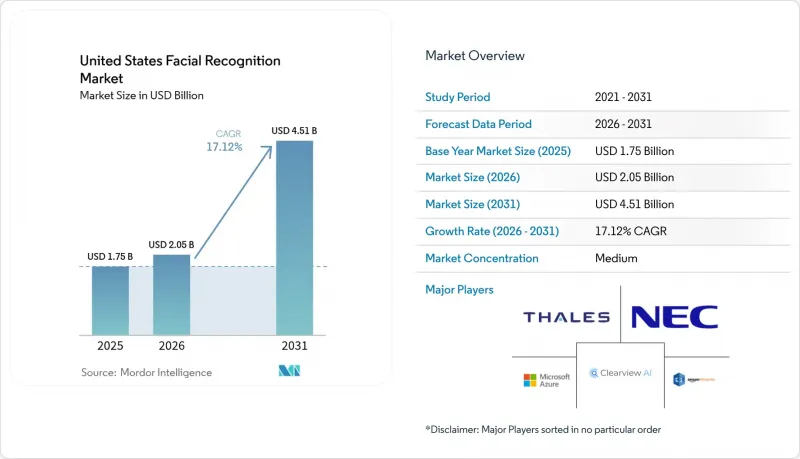
This report is Segmented by Technology (3D Facial Recognition, 2D Facial Recognition, and More), Component (Hardware, Software/Algorithms, and More), Application (Access Control and Authentication, Security and Surveillance, and More), End-User Industry (Government and Law Enforcement, Transportation, and More). The Market Forecasts are Provided in Terms of Value (USD).
United States Facial Recognition Market Trends and Insights
Homeland Security modernization funds fueling AI-based border surveillance
Fresh federal allocations are expanding autonomous surveillance towers and the Traveler Verification Service, which has already processed more than 300 million travelers and identified 1,800 impostors.Integration with airline and cruise line systems is reshaping traveler journeys, creating a contiguous identity layer from curb to boarding gate. Vendors able to deliver cloud-native, high-accuracy platforms are positioned to win long-term service contracts as coverage extends to 79 airports and 12 seaports.
REAL-ID deadline driving state DMV facial capture upgrades
The May 2025 enforcement date is accelerating DMV investments, with only 61-66% of credentials expected to be compliant at the deadline. Mobile driver's licenses tied to liveness-verified face biometrics, already piloted by 625,000 Californians, indicate a longer-range pivot toward digital wallets. System integrators linking enrollment, credential issuance, and mobile verification stand to capture a multi-year replacement cycle.
FinTech fraud surge & deepfake risk boosting e-KYC face verification
Deepfakes caused USD 158 billion in financial losses in 2023, with 40% of attacks aimed at banks. Liveness-assured facial verification, combined with voice or behavioral biometrics, is fast becoming the default e-KYC standard. Vendors embedding spoof-resistant AI in low-latency APIs are gaining wallet share as traditional video-ID workflows phase out.
Other drivers and restraints analyzed in the detailed report include:
- Retail shrink & organized retail crime pushing loss-prevention deployments
- TSA 2026 road-map for touch-less airport checkpoints
- State-backed digital ID pilots requiring liveness detection
For complete list of drivers and restraints, kindly check the Table Of Contents.
Segment Analysis
3D recognition accounted for 37.15% of the US facial recognition market share in 2025, underscoring its superiority in accuracy and spoof resistance. The segment's depth mapping allows consistent matches across lighting variables and partial occlusions, making it the benchmark in border, airport, and high-security enterprise use cases. Texture-rich deep-learning algorithms are further raising accuracy; NIST tracked 1,149 algorithms from 378 developers in its latest evaluation.At the same time, facial analytics and emotion detection are the fastest-growing niche, projected at a 19.95% CAGR, as retailers and clinicians mine sentiment for merchandising and diagnostics. Thermal imaging maintains relevance for low-light installations such as critical infrastructure, while 2D remains in budget-constrained deployments.
Developers are iterating on transformer architectures that process multi-spectral inputs, shortening inference latency at edge nodes. This technical evolution reinforces a tiered pricing model that packages premium 3D or thermal hardware with subscription analytics services. Over the forecast horizon, vendors able to combine on-device privacy with cloud retraining will capture outsized cross-sell in analytics-driven verticals of the US facial recognition market.
Hardware secured 41.60% of the US facial recognition market size in 2025, driven by camera modules and edge AI chipsets. Yet services, covering integration, cloud APIs, and managed monitoring, are advancing at an 18.15% CAGR as buyers shift to operating-expense models. US-China trade controls are inflating chip prices and prompting buyers to evaluate domestic silicon, creating openings for fabless startups specializing in low-power vision neural processors.
Service providers are differentiating through rapid deployment toolkits, zero-trust data governance, and outcome-based service-level guarantees. Their recurring revenue stabilizes margins, offsetting hardware cyclicality. This blended delivery strategy underscores a broader movement toward end-to-end stacks that lock in lifetime value across the US facial recognition market.
Complete Report Scope:
- By Technology
- 2D Facial Recognition
- 3D Facial Recognition
- Thermal/Infra-red Facial Recognition
- Facial Analytics and Emotion Detection
- By Component
- Hardware (Cameras, Edge AI Chipsets)
- Software/Algorithms
- Services (Integration, Managed, Cloud API)
- By Application
- Access Control and Authentication
- Security and Surveillance
- Identity Verification / e-KYC
- Attendance and Workforce Management
- Emotion Recognition and Customer Insights
- By End-user Industry
- Government and Law Enforcement
- Transportation (Airports, Ports, Public Transit)
- BFSI
- Healthcare and Life Sciences
- Retail and E-commerce
- Travel and Hospitality
- Automotive and Smart Mobility
- Education
- Energy and Utilities
List of Companies Covered in this Report:
- Amazon Web Services (Rekognition)
- Microsoft Corp. (Azure Face)
- NEC Corporation
- Thales Group (Idemia)
- Clearview AI Inc.
- Cognitec Systems GmbH
- Aware Inc.
- FaceFirst Inc.
- Panasonic Connect North America
- Google Cloud Vision
- Apple Inc. (FaceID Ecosystem)
- Meta Platforms (DeepFace Research)
- Veritone Inc.
- Daon Inc.
- BioID GmbH
- AnyVision (Oosto)
- Intel (RealSense)
- Snap Inc. (Cameos and AR Lenses)
- Rank One Computing
- Onfido
Additional Benefits:
- The market estimate (ME) sheet in Excel format
- 3 months of analyst support
TABLE OF CONTENTS
1 INTRODUCTION
- 1.1 Study Assumptions and Market Definition
- 1.2 Scope of the Study
2 RESEARCH METHODOLOGY
3 EXECUTIVE SUMMARY
4 MARKET LANDSCAPE
- 4.1 Market Overview
- 4.2 Market Drivers
- 4.2.1 Homeland Security Modernization Funds Fueling AI-based Border Surveillance
- 4.2.2 REAL-ID Deadline Driving State DMV Facial Capture Upgrades
- 4.2.3 Retail Shrink and Organized Retail Crime Pushing Loss-Prevention Deployments
- 4.2.4 TSA 2026 Road-map for Touch-less Airport Check-points
- 4.2.5 FinTech Fraud Surge and Deepfake Risk Boosting e-KYC Face Verification
- 4.2.6 State-backed Digital ID/Wallet Pilots (e.g., Apple Wallet) Requiring Liveness Detection
- 4.3 Market Restraints
- 4.3.1 Patchwork of State Biometric Privacy Laws Escalating Litigation Risk
- 4.3.2 Municipal Moratoriums on Police Use Reducing Public-sector Demand
- 4.3.3 Algorithmic Bias Scrutiny Triggering Federal Procurement Delays
- 4.3.4 Edge-AI Chip Cost Inflation from US-China Trade Controls
- 4.4 Value / Supply-Chain Analysis
- 4.5 Regulatory Outlook
- 4.6 Technological Outlook and Patent Analysis
- 4.7 Porter's Five Forces
- 4.7.1 Bargaining Power of Suppliers
- 4.7.2 Bargaining Power of Buyers
- 4.7.3 Threat of New Entrants
- 4.7.4 Threat of Substitutes
- 4.7.5 Intensity of Competitive Rivalry
5 MARKET SIZE AND GROWTH FORECASTS (VALUE)
- 5.1 By Technology
- 5.1.1 2D Facial Recognition
- 5.1.2 3D Facial Recognition
- 5.1.3 Thermal/Infra-red Facial Recognition
- 5.1.4 Facial Analytics and Emotion Detection
- 5.2 By Component
- 5.2.1 Hardware (Cameras, Edge AI Chipsets)
- 5.2.2 Software/Algorithms
- 5.2.3 Services (Integration, Managed, Cloud API)
- 5.3 By Application
- 5.3.1 Access Control and Authentication
- 5.3.2 Security and Surveillance
- 5.3.3 Identity Verification / e-KYC
- 5.3.4 Attendance and Workforce Management
- 5.3.5 Emotion Recognition and Customer Insights
- 5.4 By End-user Industry
- 5.4.1 Government and Law Enforcement
- 5.4.2 Transportation (Airports, Ports, Public Transit)
- 5.4.3 BFSI
- 5.4.4 Healthcare and Life Sciences
- 5.4.5 Retail and E-commerce
- 5.4.6 Travel and Hospitality
- 5.4.7 Automotive and Smart Mobility
- 5.4.8 Education
- 5.4.9 Energy and Utilities
6 COMPETITIVE LANDSCAPE
- 6.1 Market Concentration
- 6.2 Strategic Moves (MandA, Funding, Contracts)
- 6.3 Market Share Analysis
- 6.4 Company Profiles {(includes Global level Overview, Market level overview, Core Segments, Financials as available, Strategic Information, Market Rank/Share for key companies, Products and Services, and Recent Developments)}
- 6.4.1 Amazon Web Services (Rekognition)
- 6.4.2 Microsoft Corp. (Azure Face)
- 6.4.3 NEC Corporation
- 6.4.4 Thales Group (Idemia)
- 6.4.5 Clearview AI Inc.
- 6.4.6 Cognitec Systems GmbH
- 6.4.7 Aware Inc.
- 6.4.8 FaceFirst Inc.
- 6.4.9 Panasonic Connect North America
- 6.4.10 Google Cloud Vision
- 6.4.11 Apple Inc. (FaceID Ecosystem)
- 6.4.12 Meta Platforms (DeepFace Research)
- 6.4.13 Veritone Inc.
- 6.4.14 Daon Inc.
- 6.4.15 BioID GmbH
- 6.4.16 AnyVision (Oosto)
- 6.4.17 Intel (RealSense)
- 6.4.18 Snap Inc. (Cameos and AR Lenses)
- 6.4.19 Rank One Computing
- 6.4.20 Onfido
7 MARKET OPPORTUNITIES AND FUTURE OUTLOOK
- 7.1 White-space and Unmet-Need Assessment

