PUBLISHER: Mordor Intelligence | PRODUCT CODE: 2116015

PUBLISHER: Mordor Intelligence | PRODUCT CODE: 2116015
Recovered Paper - Market Share Analysis, Industry Trends & Statistics, Growth Forecasts (2026 - 2031)
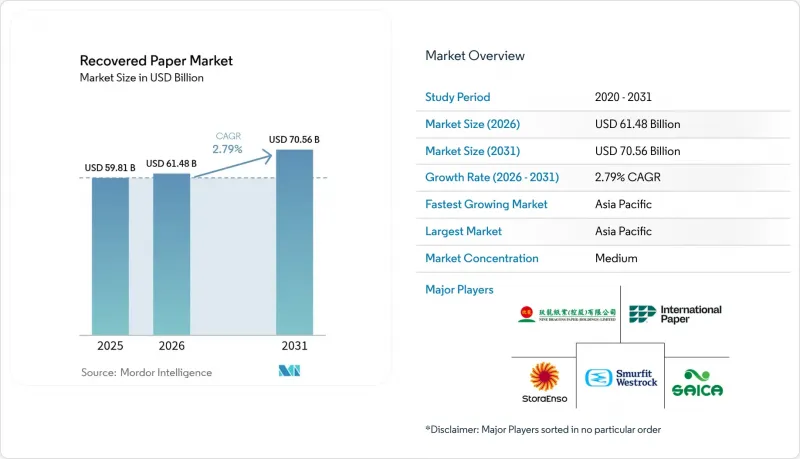
According to Mordor Intelligence, the recovered paper market size was valued at USD 59.81 billion in 2025 and estimated to grow from USD 61.48 billion in 2026 to reach USD 70.56 billion by 2031, at a CAGR of 2.79% during the forecast period (2026-2031).
This report is Segmented by Paper Grade (Old Corrugated Containers, Mixed Paper, and More), End-Use Industry (Packaging and Corrugated Boxes, Tissue and Sanitary, and More), Source of Collection (Residential, Commercial and Industrial, and More), Processing Technology (De-Inking Lines, Non-De-Inked Recycling, and More), and Geography. The Market Forecasts are Provided in Terms of Value (USD).
Global Recovered Paper Market Trends and Insights
E-commerce Surge Boosting Containerboard Demand
Global online retail fulfilled 15.3 billion parcels in 2024, up 12% year on year, and each shipment required at least one corrugated box that ultimately enters the recycling stream. High parcel density improves collection efficiency and strengthens the recovered paper market's feedstock security. Distribution centers now embed reverse-logistics docks that bale used boxes on-site, reducing contamination and trucking miles. Real-time sales analytics allow box converters to align run lengths with order volatility, minimizing trim waste and stabilizing fiber demand across seasons. Large retailers also fund take-back programs that gather corrugated packaging from customers at store entrances, widening the capture funnel beyond curbside pickups. These closed-loop practices anchor the recovered paper market by guaranteeing predictable OCC flows for mill re-feeds.
Regulatory Push for Recycled-Content Packaging
The European Union has adopted a binding target that 85% of corrugated cardboard and 75% of other paper packaging be recycled by 2030, while extended producer responsibility schemes make brand owners pay the full cost of collection and processing. Similar bills are advancing in several U.S. states. These obligations accelerate procurement of recycled fiber, underpinning mill expansion projects announced across Germany, Spain and the Midwest United States. Blockchain-based tracking offered by companies such as Amcor records fiber origin, bale weights and contamination scores, thus confirming regulatory compliance at item level. Mandated disclosures also bolster investor appetite for recycling infrastructure because revenue visibility improves under minimum-content rules.
Shrinking Newsprint and Office-Paper Supply Pool
Digital news platforms and paperless offices are eroding high-grade fiber availability. With many metropolitan dailies switching to weekend-only print runs, tonnage of old newsprint entering recovery circuits declined further in 2025. Cloud storage adoption equally trims office-paper waste, tightening supply of Sorted Office Paper that historically fed de-inked pulp used in premium tissue. Mills compensate by diverting lower-grade mixed paper, yet contamination elevates bleach and surfactant consumption, raising operating costs. Some plants add near-infrared pre-sorters to offset quality loss, but capital needs deter smaller operators, amplifying market consolidation pressure.
Other drivers and restraints analyzed in the detailed report include:
- AI-Enabled Optical Sorting Improving Yield
- Scope-3 Decarbonization Targets of Brand Owners
- Logistics-Driven Fiber-Price Volatility
For complete list of drivers and restraints, kindly check the Table Of Contents.
Segment Analysis
Old Corrugated Containers contributed 42.14% of 2025 revenue, confirming their centrality to the recovered paper market. High collection rates, low ink loads and uniform sheet structure allow efficient re-pulping, driving cost leadership in containerboard furnish. The recovered paper market size for OCC-sourced furnish is projected to rise in line with e-commerce parcel volumes, while smart balers installed at distribution hubs enhance bale density and lower freight spend. Brand programs that offer box-return credits further stabilize OCC availability across holiday peaks.
Sorted Office Paper represents the fastest-expanding grade with a 3.32% CAGR to 2031. Corporate archive digitization campaigns yield large purges of legacy files, temporarily boosting feedstock quality. De-inking plants prefer SOP because its long fibers and limited mechanical wear improve tensile strength in premium tissue. To capitalize, operators sign takeback contracts with records-management providers that guarantee fiber flow and lock in pricing. Mixed Paper faces quality variability; optical sort upgrades mitigate risk, yet margin dilution persists. Old Newsprint continues to contract, encouraging mills to pivot toward specialty uses such as cellulose insulation. Advanced pulping technologies like Georgia-Pacific's Juno system unlock higher value from difficult grades, demonstrating that innovation can extend usable fiber pools.
Packaging and corrugated boxes held 57.72% of the recovered paper market share in 2025, anchored by robust cartonboard demand from grocery delivery and omnichannel retail. Producers integrate recycling plants adjacent to box-making units, shaving transport cost and reducing carbon footprints. The recovered paper market size tied to packaging also benefits from design-for-recyclability guidelines that favor mono-fiber solutions over plastic composites.
Tissue and sanitary products, though smaller in base, register the highest 3.71% CAGR through 2031 as consumers favor eco-labeled toilet tissue and paper towels. De-inked pulp from SOP improves brightness and softness, allowing tissue brands to market premium recycled lines. Printing and writing uses continue to slide, yet high-security documents sustain a niche that commands price premiums. Non-paper applications such as fiber-reinforced panels for construction collect momentum, underpinned by LEED credits that reward recycled content.
Complete Report Scope:
- By Paper Grade
- Old Corrugated Containers (OCC)
- Mixed Paper (MWP)
- Old Newsprint (ONP)
- Sorted Office Paper (SOP)
- Other Paper Grades
- By End-use Industry
- Packaging and Corrugated Boxes
- Tissue and Sanitary
- Printing and Writing
- Newsprint and Publishing
- Other End-use Industries
- By Source of Collection
- Residential
- Commercial and Industrial
- Institutional
- Retail and E-commerce Returns
- By Processing Technology
- De-inking Lines
- Non-de-inked Recycling
- Advanced High-Consistency Pulping
- Chemical-assisted Recycling
- By Geography
- North America
- United States
- Canada
- Mexico
- South America
- Brazil
- Argentina
- Chile
- Rest of South America
- Europe
- United Kingdom
- Germany
- France
- Spain
- Italy
- Rest of Europe
- Asia-Pacific
- China
- India
- Japan
- Australia
- South Korea
- Vietnam
- Rest of Asia-Pacific
- Middle East and Africa
- Middle East
- Saudi Arabia
- United Arab Emirates
- Turkey
- Rest of Middle East
- Africa
- South Africa
- Nigeria
- Egypt
- Rest of Africa
- Middle East
- North America
Geography Analysis
North America anchors technology deployment, with the United States hosting the largest cluster of mill modernization projects. Irving Pulp and Paper's USD 810 million NextGen rebuild in New Brunswick adds advanced screening and closed-loop water treatment, reinforcing regional competitiveness. Stable collection programs and abundant warehouse space enable efficient bale aggregation, yet trucking shortages raise delivered-cost volatility. Canada leverages forestry expertise to supply bleached recycled pulp to tissue converters, whereas Mexico's near-shoring surge lifts containerboard demand and stimulates OCC recovery infrastructure.
Europe combines rigorous regulation with high consumer participation in recycling schemes, underpinning one of the world's highest recovery rates. Germany and the United Kingdom invest in AI-assisted MRFs that flag contaminants early and divert unsuitable material. Stora Enso's 2025 reorganization channels capital toward fiber-based packaging and away from declining paper segments, illustrating a strategic pivot to higher-margin niches. National Green Deal funding further subsidizes sorting upgrades and effluent-treatment retrofits. Regions in Southern Europe push to close collection gaps by adding deposit-return schemes for paper beverage cartons.
Asia-Pacific remains the volume heavyweight, driven by China's demand for containerboard used in export packaging. Import curbs pushed domestic mills to source fiber locally and to expand secondary processing hubs in Vietnam, Thailand and Malaysia. Q P Group's plant near Ho Chi Minh City demonstrates regional momentum, capturing mixed paper once re-exported to China. Japan continues to pioneer de-inking efficiencies, while Australia's state governments fund curbside upgrades to handle rising residential feedstock. Logistics costs across archipelagic nations and inland provinces remain a restraint, but digital freight platforms start to pool backhaul capacity, easing rate spikes.
- Nine Dragons Paper (Holdings) Limited
- Smurfit WestRock
- International Paper Company
- Stora Enso Oyj
- S.A. Industrias Celulosa Aragonesa S.A. (SAICA)
- Tay Paper Recycling Pte. Ltd.
- Visy Industries Holdings Pty Ltd.
- Oji Holdings Corporation
- Cascades Inc.
- Packaging Corporation of America
- Lee & Man Paper Manufacturing Limited
- Mondi plc
- Pratt Industries Inc.
- UPM-Kymmene Corporation
- Klabin S.A.
- Nippon Paper Industries Co., Ltd.
- Resolute Forest Products Inc.
- Georgia-Pacific LLC
Additional Benefits:
- The market estimate (ME) sheet in Excel format
- 3 months of analyst support
TABLE OF CONTENTS
1 INTRODUCTION
- 1.1 Study Assumptions and Market Definition
- 1.2 Scope of the Study
2 RESEARCH METHODOLOGY
3 EXECUTIVE SUMMARY
4 MARKET LANDSCAPE
- 4.1 Market Overview
- 4.2 Market Drivers
- 4.2.1 E-commerce surge boosting containerboard demand
- 4.2.2 Regulatory push for recycled-content packaging
- 4.2.3 Cost advantage versus virgin pulp
- 4.2.4 AI-enabled optical sorting improving yield
- 4.2.5 Scope-3 decarbonization targets of brand owners
- 4.2.6 Export curbs on wastepaper spurring local investment
- 4.3 Market Restraints
- 4.3.1 Shrinking newsprint and office-paper supply pool
- 4.3.2 Logistics-driven fiber-price volatility
- 4.3.3 Composite-packaging contaminants
- 4.3.4 Stricter de-inking effluent norms
- 4.4 Industry Value Chain Analysis
- 4.5 Regulatory Landscape
- 4.6 Technological Outlook
- 4.7 Porter's Five Forces Analysis
- 4.7.1 Bargaining Power of Suppliers
- 4.7.2 Bargaining Power of Buyers
- 4.7.3 Threat of New Entrants
- 4.7.4 Threat of Substitutes
- 4.7.5 Intensity of Competitive Rivalry
- 4.8 The Impact of Macroeconomic Factors on the Market
5 MARKET SIZE AND GROWTH FORECASTS (VALUE)
- 5.1 By Paper Grade
- 5.1.1 Old Corrugated Containers (OCC)
- 5.1.2 Mixed Paper (MWP)
- 5.1.3 Old Newsprint (ONP)
- 5.1.4 Sorted Office Paper (SOP)
- 5.1.5 Other Paper Grades
- 5.2 By End-use Industry
- 5.2.1 Packaging and Corrugated Boxes
- 5.2.2 Tissue and Sanitary
- 5.2.3 Printing and Writing
- 5.2.4 Newsprint and Publishing
- 5.2.5 Other End-use Industries
- 5.3 By Source of Collection
- 5.3.1 Residential
- 5.3.2 Commercial and Industrial
- 5.3.3 Institutional
- 5.3.4 Retail and E-commerce Returns
- 5.4 By Processing Technology
- 5.4.1 De-inking Lines
- 5.4.2 Non-de-inked Recycling
- 5.4.3 Advanced High-Consistency Pulping
- 5.4.4 Chemical-assisted Recycling
- 5.5 By Geography
- 5.5.1 North America
- 5.5.1.1 United States
- 5.5.1.2 Canada
- 5.5.1.3 Mexico
- 5.5.2 South America
- 5.5.2.1 Brazil
- 5.5.2.2 Argentina
- 5.5.2.3 Chile
- 5.5.2.4 Rest of South America
- 5.5.3 Europe
- 5.5.3.1 United Kingdom
- 5.5.3.2 Germany
- 5.5.3.3 France
- 5.5.3.4 Spain
- 5.5.3.5 Italy
- 5.5.3.6 Rest of Europe
- 5.5.4 Asia-Pacific
- 5.5.4.1 China
- 5.5.4.2 India
- 5.5.4.3 Japan
- 5.5.4.4 Australia
- 5.5.4.5 South Korea
- 5.5.4.6 Vietnam
- 5.5.4.7 Rest of Asia-Pacific
- 5.5.5 Middle East and Africa
- 5.5.5.1 Middle East
- 5.5.5.1.1 Saudi Arabia
- 5.5.5.1.2 United Arab Emirates
- 5.5.5.1.3 Turkey
- 5.5.5.1.4 Rest of Middle East
- 5.5.5.2 Africa
- 5.5.5.2.1 South Africa
- 5.5.5.2.2 Nigeria
- 5.5.5.2.3 Egypt
- 5.5.5.2.4 Rest of Africa
- 5.5.5.1 Middle East
- 5.5.1 North America
6 COMPETITIVE LANDSCAPE
- 6.1 Market Concentration
- 6.2 Strategic Moves
- 6.3 Market Share Analysis
- 6.4 Company Profiles (includes Global Level Overview, Market Level Overview, Core Segments, Financials as available, Strategic Information, Market Rank/Share for key companies, Products and Services, and Recent Developments)
- 6.4.1 Nine Dragons Paper (Holdings) Limited
- 6.4.2 Smurfit WestRock
- 6.4.3 International Paper Company
- 6.4.4 Stora Enso Oyj
- 6.4.5 S.A. Industrias Celulosa Aragonesa S.A. (SAICA)
- 6.4.6 Tay Paper Recycling Pte. Ltd.
- 6.4.7 Visy Industries Holdings Pty Ltd.
- 6.4.8 Oji Holdings Corporation
- 6.4.9 Cascades Inc.
- 6.4.10 Packaging Corporation of America
- 6.4.11 Lee & Man Paper Manufacturing Limited
- 6.4.12 Mondi plc
- 6.4.13 Pratt Industries Inc.
- 6.4.14 UPM-Kymmene Corporation
- 6.4.15 Klabin S.A.
- 6.4.16 Nippon Paper Industries Co., Ltd.
- 6.4.17 Resolute Forest Products Inc.
- 6.4.18 Georgia-Pacific LLC
7 MARKET OPPORTUNITIES AND FUTURE OUTLOOK
- 7.1 White-space and Unmet-need Assessment

