PUBLISHER: Mordor Intelligence | PRODUCT CODE: 2116037

PUBLISHER: Mordor Intelligence | PRODUCT CODE: 2116037
Motion Sensor - Market Share Analysis, Industry Trends & Statistics, Growth Forecasts (2026 - 2031)
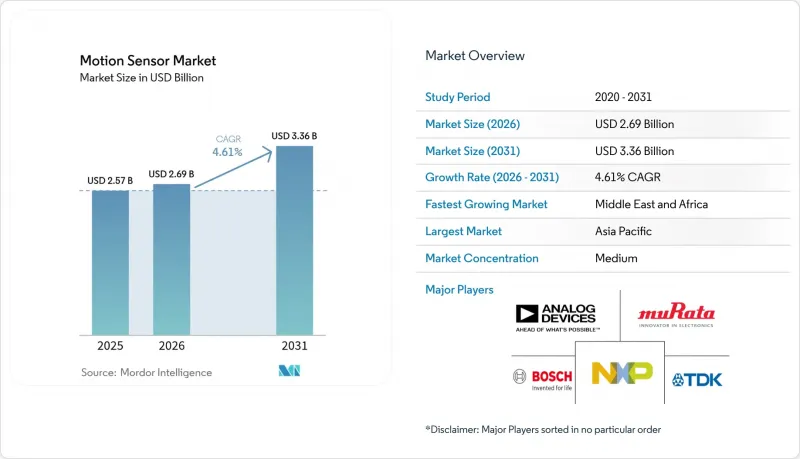
According to Mordor Intelligence, the motion sensor market size is expected to grow from USD 2.57 billion in 2025 to USD 2.69 billion in 2026 and is forecast to reach USD 3.36 billion by 2031 at 4.61% CAGR over 2026-2031.
This report is Segmented by Technology (Ultrasonic, Microwave, Infrared, and More), Functionality Level (Fully Automatic, and Semi-Automatic), Embedded Sensor Type (Accelerometer, Gyroscope, Magnetometer, and More), Application (Consumer Electronics, Automotive and Transportation, Healthcare and Medical Devices, Lighting Control and More), and Geography. The Market Forecasts are Provided in Terms of Value (USD).
Global Motion Sensor Market Trends and Insights
MEMS Penetration in Automotive and Mobile Devices
Regulators have locked in long-range roadmaps for advanced driver assistance functions, and each incremental feature requires added inertial sensing. The National Highway Traffic Safety Administration's 2024 decision to rate vehicles on blind-spot, lane-keeping, and pedestrian automatic braking incentives ensures that each new model refresh carries more motion sensing content.Smartphone vendors meanwhile embed multiple micro-electro-mechanical sensors to power augmented reality interfaces and gesture controls, creating overlapping demand cycles that cushion suppliers from sector-specific slowdowns. Vertically integrated chipmakers benefit most because they can shift foundry capacity between automotive and mobile runs without redesigning core sensor elements. Centralized vehicle compute architectures may temper total unit volumes later in the decade, yet higher per-device complexity should offset any volume erosion.
Surge in Motion-Enabled Gaming and AR/VR
Immersive gaming platforms need sub-millisecond tracking accuracy; a 2025 study showed that acoustic injection attacks can mislead inertial measurement units in leading headsets, distorting virtual content and inducing motion sickness These vulnerabilities spur demand for redundant sensor arrays and secure fusion algorithms that raise overall bill-of-materials value. Controller vendors, exemplified by haptic-rich console accessories, already combine accelerometers, gyroscopes, and capacitive touch to improve realism. As mixed-reality adoption spreads to enterprise training and field maintenance, the motion sensor market gains a diversified customer base that is less tied to consumer spending cycles.
High Cost of Advanced MEMS Alternatives
Photonic and quantum-scale motion sensors promise ten-fold precision gains but remain several cost curves away from high-volume deployment. Packaging complexity and lack of common test standards inflate per-unit pricing, deterring adoption in commodity smart-lighting and budget appliance lines. Research groups are pursuing machine-learning-based calibration schemes that reduce production tuning steps to under 10 seconds while maintaining accuracy. Widespread commercialization, however, depends on shared manufacturing infrastructure that can amortize capital outlays across multiple sensor families.
Other drivers and restraints analyzed in the detailed report include:
- Smart-Home and Building-Automation Rollout
- Edge-AI Ultra-Low-Power Sensor Innovations
- Semiconductor Supply-Chain Bottlenecks
For complete list of drivers and restraints, kindly check the Table Of Contents.
Segment Analysis
Passive infrared devices held 35.10% share of the motion sensor market size in 2025 due to low cost and proven reliability in lighting automation. Adoption of radar-based tomographic systems is growing at a 5.42% CAGR because millimeter-wave chips offer material penetration and object-classification advantages needed for advanced automotive safety.
Infrared shipments remain high for budget security installations, but multi-technology nodes that blend radar with PIR are emerging in premium residential kits. Laboratories are also refining segmented thermal calibration for MEMS gyroscopes, trimming drift across temperature swings and thereby widening usable ranges for high-end robotics. Photonic interference sensors under early trial could eventually disrupt both radar and infrared if packaging barriers fall.
Fully automatic systems commanded 55.70% share in 2025, reflecting buyer preference for "install-and-forget" devices that optimize lighting, HVAC, or driver assistance without human input. The segment's 4.95% CAGR rests on expanding smart-building retrofits where self-learning algorithms reduce commissioning labor.
Semi-automatic designs endure in industrial lines requiring manual overrides, yet the gradual rollout of AI-enabled auto-calibration trims their configuration time. Edge inference engines now embedded in sensors shrink latency from hundreds of milliseconds to single-digit milliseconds, meeting stricter safety thresholds for collaborative robots on factory floors.
Complete Report Scope:
- By Technology
- Ultrasonic
- Microwave
- Infrared (PIR)
- Dual/Hybrid
- Radar/Tomographic
- By Functionality Level
- Fully Automatic
- Semi-Automatic
- By Embedded Sensor Type
- Accelerometer
- Gyroscope
- Magnetometer
- Combo/IMU (6-axis, 9-axis)
- Pressure/Barometric
- By Application
- Consumer Electronics
- Automotive and Transportation
- Healthcare and Medical Devices
- Security and Surveillance
- Lighting Controls
- Smart Home and Building Automation
- Industrial and Robotics
- Gaming and Entertainment
- Other Applications
- By Geography
- North America
- United States
- Canada
- Mexico
- South America
- Brazil
- Argentina
- Rest of South America
- Europe
- Germany
- France
- United Kingdom
- Italy
- Spain
- Russia
- Rest of Europe
- Asia-Pacific
- China
- Japan
- South Korea
- India
- South East Asia
- Rest of Asia-Pacific
- Middle East and Africa
- GCC
- Turkey
- South Africa
- Rest of Middle East and Africa
- North America
Geography Analysis
Asia-Pacific generated 36.95% of motion sensor market revenue in 2025, enabled by dense electronics supply chains in China, Japan, and South Korea. Local fabs specialize in bulk CMOS and wafer-level chip-scale packaging, allowing regional OEMs to launch new sensor-rich mobile devices on compressed timelines. Regulatory pushes for advanced driver assistance systems in Japan and South Korea further reinforce baseline demand.
North America and Europe remain technology pace-setters rather than high-volume production centers. The U.S. New Car Assessment Program revisions obligate automakers to integrate blind-spot detection, lane-keeping, and pedestrian braking, guaranteeing a multi-year uplift for inertial combos and radar subsystems. Europe's General Safety Regulation II places similar requirements on new car models sold from mid-2024 onward, synchronizing demand across both mature markets.
The Middle East & Africa, though only a modest share contributor today, is projected to grow at 5.04% annually to 2031 as Gulf smart-city budgets prioritize intelligent lighting, security, and traffic-monitoring infrastructure. Broad-spectrum motion sensors suited to harsh desert climates gain traction in large-scale perimeter security installations and rapid-transit projects. Local assembly partnerships help circumvent import tariffs and align with regional content rules.
- Analog Devices Inc.
- NXP Semiconductors N.V.
- STMicroelectronics N.V.
- TE Connectivity Ltd.
- Panasonic Corp.
- Murata Manufacturing Co. Ltd.
- Honeywell International Inc.
- Bosch Sensortec GmbH
- TDK (InvenSense) Corp.
- KEMET Corp.
- Infineon Technologies AG
- Texas Instruments Inc.
- Sony Group Corp. (IMX sensors)
- Qualcomm Technologies Inc.
- Sensirion AG
- Alps Alpine Co. Ltd.
- MEMSIC Inc.
- Asahi Kasei Microdevices (AKM)
- ON Semiconductor Corp.
- Epson Toyo Yuden
Additional Benefits:
- The market estimate (ME) sheet in Excel format
- 3 months of analyst support
TABLE OF CONTENTS
1 INTRODUCTION
- 1.1 Study Assumptions and Market Definition
- 1.2 Scope of the Study
2 RESEARCH METHODOLOGY
3 EXECUTIVE SUMMARY
4 MARKET LANDSCAPE
- 4.1 Market Overview
- 4.2 Market Drivers
- 4.2.1 MEMS penetration in automotive and mobile devices
- 4.2.2 Surge in motion-enabled gaming and AR/VR
- 4.2.3 Smart-home and building-automation rollout
- 4.2.4 Wearable and IoT sensor fusion demand
- 4.2.5 Edge-AI ultra-low-power sensor innovations
- 4.2.6 ADAS-mandate-led demand for inertial combos
- 4.3 Market Restraints
- 4.3.1 High cost of advanced MEMS alternatives
- 4.3.2 Semiconductor supply-chain bottlenecks
- 4.3.3 Privacy backlash against ubiquitous sensing
- 4.3.4 Calibration drift in multi-axis combo IMUs
- 4.4 Industry Ecosystem Analysis
- 4.5 Technological Outlook
- 4.6 Porter's Five Forces Analysis
- 4.6.1 Threat of New Entrants
- 4.6.2 Bargaining Power of Buyers
- 4.6.3 Bargaining Power of Suppliers
- 4.6.4 Threat of Substitutes
- 4.6.5 Competitive Rivalry
5 MARKET SIZE AND GROWTH FORECASTS (VALUES)
- 5.1 By Technology
- 5.1.1 Ultrasonic
- 5.1.2 Microwave
- 5.1.3 Infrared (PIR)
- 5.1.4 Dual/Hybrid
- 5.1.5 Radar/Tomographic
- 5.2 By Functionality Level
- 5.2.1 Fully Automatic
- 5.2.2 Semi-Automatic
- 5.3 By Embedded Sensor Type
- 5.3.1 Accelerometer
- 5.3.2 Gyroscope
- 5.3.3 Magnetometer
- 5.3.4 Combo/IMU (6-axis, 9-axis)
- 5.3.5 Pressure/Barometric
- 5.4 By Application
- 5.4.1 Consumer Electronics
- 5.4.2 Automotive and Transportation
- 5.4.3 Healthcare and Medical Devices
- 5.4.4 Security and Surveillance
- 5.4.5 Lighting Controls
- 5.4.6 Smart Home and Building Automation
- 5.4.7 Industrial and Robotics
- 5.4.8 Gaming and Entertainment
- 5.4.9 Other Applications
- 5.5 By Geography
- 5.5.1 North America
- 5.5.1.1 United States
- 5.5.1.2 Canada
- 5.5.1.3 Mexico
- 5.5.2 South America
- 5.5.2.1 Brazil
- 5.5.2.2 Argentina
- 5.5.2.3 Rest of South America
- 5.5.3 Europe
- 5.5.3.1 Germany
- 5.5.3.2 France
- 5.5.3.3 United Kingdom
- 5.5.3.4 Italy
- 5.5.3.5 Spain
- 5.5.3.6 Russia
- 5.5.3.7 Rest of Europe
- 5.5.4 Asia-Pacific
- 5.5.4.1 China
- 5.5.4.2 Japan
- 5.5.4.3 South Korea
- 5.5.4.4 India
- 5.5.4.5 South East Asia
- 5.5.4.6 Rest of Asia-Pacific
- 5.5.5 Middle East and Africa
- 5.5.5.1 GCC
- 5.5.5.2 Turkey
- 5.5.5.3 South Africa
- 5.5.5.4 Rest of Middle East and Africa
- 5.5.1 North America
6 COMPETITIVE LANDSCAPE
- 6.1 Market Concentration
- 6.2 Strategic Moves
- 6.3 Market Share Analysis
- 6.4 Company Profiles (includes Global level Overview, Market level overview, Core Segments, Financials as available, Strategic Information, Market Rank/Share for key companies, Products and Services, and Recent Developments)
- 6.4.1 Analog Devices Inc.
- 6.4.2 NXP Semiconductors N.V.
- 6.4.3 STMicroelectronics N.V.
- 6.4.4 TE Connectivity Ltd.
- 6.4.5 Panasonic Corp.
- 6.4.6 Murata Manufacturing Co. Ltd.
- 6.4.7 Honeywell International Inc.
- 6.4.8 Bosch Sensortec GmbH
- 6.4.9 TDK (InvenSense) Corp.
- 6.4.10 KEMET Corp.
- 6.4.11 Infineon Technologies AG
- 6.4.12 Texas Instruments Inc.
- 6.4.13 Sony Group Corp. (IMX sensors)
- 6.4.14 Qualcomm Technologies Inc.
- 6.4.15 Sensirion AG
- 6.4.16 Alps Alpine Co. Ltd.
- 6.4.17 MEMSIC Inc.
- 6.4.18 Asahi Kasei Microdevices (AKM)
- 6.4.19 ON Semiconductor Corp.
- 6.4.20 Epson Toyo Yuden
7 MARKET OPPORTUNITIES AND FUTURE OUTLOOK
- 7.1 White-space and Unmet-need Assessment

