PUBLISHER: Mordor Intelligence | PRODUCT CODE: 2116040

PUBLISHER: Mordor Intelligence | PRODUCT CODE: 2116040
United States Mass Notification Systems - Market Share Analysis, Industry Trends & Statistics, Growth Forecasts (2026 - 2031)
According to Mordor Intelligence, United States mass notification systems market size in 2026 is estimated at USD 5.22 billion, growing from 2025 value of USD 4.40 billion with 2031 projections showing USD 12.27 billion, growing at 18.62% CAGR over 2026-2031.
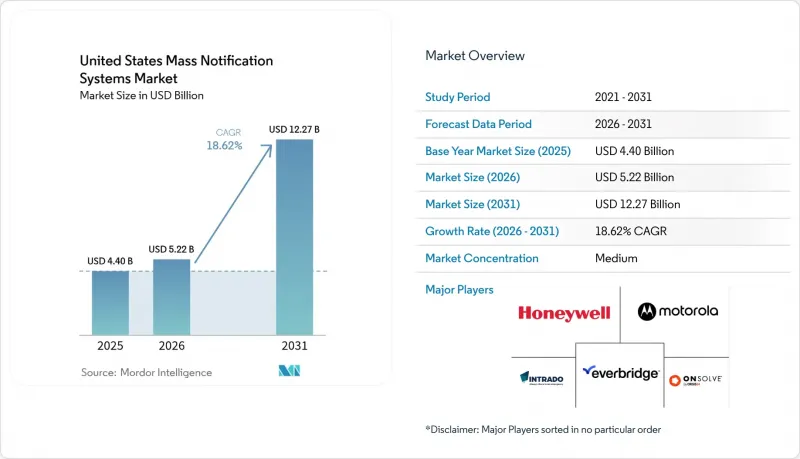
This report is Segmented by Component (Hardware, Software, and More), Deployment (On-Premise, Cloud, Hybrid), Application (In-Building, Wide-Area Outdoor, and More), Communication Channel (SMS/Cell Broadcast, Voice Call and VoIP, and More), End-User Vertical (Government and Public Safety, Education, and More). The Market Forecasts are Provided in Terms of Value (USD).
United States Mass Notification Systems Market Trends and Insights
Federal Expansion of IPAWS-Open 3.0 Accelerating Agency Deployments
IPAWS-Open 3.0 authorizations surpassed 1,800 alerting authorities in 2024, compelling upgrades across federal, state, local, tribal, and territorial jurisdictions. The FCC's December 2024 rule requiring IP-based Emergency Alert System transmissions intensified compliance timelines, catalyzing rapid contract awards for BlackBerry AtHoc-compatible solutions . Concurrently, a USD 136 million Corporation for Public Broadcasting grant accelerates infrastructure modernization for underserved rural and tribal broadcasters.
Clery-Act-Driven Campus Safety Mandates Fueling Higher-Ed Spend
The Department of Education can now levy USD 35,000 per violation for deficient campus alerts, compelling universities to adopt integrated platforms that bundle incident management with mass communication. Vanderbilt University's AlertVU upgrade illustrates the shift toward centralized command systems. Recent studies indicate more than 80% of higher-education safety professionals find these platforms effective in shaping real-time behavior.
Interoperability Gaps with Legacy P25 and 5G Networks
CISA's LMR/LTE best-practices guide underscores persistent technical hurdles in patching P25 talk groups to broadband channels. Santa Fe County's USD 8.1 million P25 overhaul-backed by just USD 425,000 in state aid-illustrates the fiscal weight of radio upgrades. The FCC's 2025 NG911 reliability docket may further widen the gap if existing radio networks cannot meet new standards.
Other drivers and restraints analyzed in the detailed report include:
- AI and ML to Revolutionize Security and Emergency Response
- Convergence of Federal Safety Mandates on Next-Generation Notification Systems
- Budget Shortfalls in Rural Municipalities
For complete list of drivers and restraints, kindly check the Table Of Contents.
Segment Analysis
The solutions segment accounted for 67.25% of the United States mass notification systems market in 2025, underscoring entrenched spending on core alerting platforms. Services revenue, however, is rising at a 18.95% CAGR as organizations rely on managed integrations to meet IPAWS-Open 3.0 and FedRAMP benchmarks. Professional-services providers benefit from growing demand for AI-enabled analytics configuration and 24/7 system monitoring.
Hardware margins are tightening as cloud architectures reduce on-premises footprint, yet specialized devices such as Alertus Beacons remain indispensable in hospitals and campuses requiring audible and visual redundancy. Subscription licensing aligns vendors and buyers to continuous-update roadmaps, while training services emerge to unlock machine-learning-based threat detection. As a result, services are positioned to capture a growing share of the United States mass notification systems market size, particularly among mid-tier municipalities lacking in-house expertise.
Cloud delivery dominated 71.80% of the United States mass notification systems market in 2025, but hybrid models-expanding at 20.05% CAGR-offer the preferred compromise between scalability and data-sovereignty requirements. Federal agencies with classified workloads demand on-premises storage paired with cloud distribution layers, a configuration reinforced by the FedRAMP High framework now supporting BlackBerry AtHoc deployments.
Healthcare providers adopt hybrid to safeguard electronic health information under HIPAA while retaining rapid alert dissemination to mobile caregivers. NG911 migration likewise pulls state PSAPs toward public-cloud resilience. As 5G expands, hybrid architectures are poised to capture a larger portion of the United States mass notification systems market share among enterprises integrating legacy P25 radios with broadband push-to-talk applications.
Complete Report Scope:
- By Component
- Hardware
- Software
- Professional Services
- Managed Services
- By Deployment
- On-Premise
- Cloud
- Hybrid
- By Application
- In-Building
- Wide-Area Outdoor
- Distributed Recipient / Personal Alerting
- By Communication Channel
- SMS / Cell Broadcast
- Voice Call and VoIP
- Email and Desktop Pop-Ups
- Public Address and Siren Systems
- Social Media and Web Feed
- IoT and Connected Device Notifications
- By End-User Vertical
- Government and Public Safety
- Education (K-12 and Higher-Ed)
- Healthcare Facilities
- Energy and Utilities
- Transportation and Logistics
- Industrial and Manufacturing
- Commercial and Corporate Enterprises
List of Companies Covered in this Report:
- Everbridge, Inc.
- Motorola Solutions, Inc.
- OnSolve, LLC
- Intrado Life & Safety (West Corp.)
- Blackboard Connect (Anthology Inc.)
- BlackBerry AtHoc
- Eaton Corporation plc
- Honeywell International Inc.
- Federal Signal Corporation
- Singlewire Software, LLC
- Alertus Technologies, LLC
- Omnilert, LLC
- Regroup Mass Notification
- Rave Mobile Safety
- AlertMedia, Inc.
- xMatters, Inc.
- Siemens AG
- Johnson Controls International plc
- ATI Systems (Acoustic Technology Inc.)
- Cisco Systems, Inc.
- Genasys Inc.
- Advanced Network Devices
Additional Benefits:
- The market estimate (ME) sheet in Excel format
- 3 months of analyst support
TABLE OF CONTENTS
1 INTRODUCTION
- 1.1 Study Assumptions and Market Definition
- 1.2 Scope of the Study
2 RESEARCH METHODOLOGY
3 EXECUTIVE SUMMARY
4 MARKET LANDSCAPE
- 4.1 Market Overview
- 4.2 Market Drivers
- 4.2.1 Federal Expansion of IPAWS-Open 3.0 Accelerating Agency Deployments
- 4.2.2 Clery-Act-Driven Campus Safety Mandates Fueling Higher-Ed Spend
- 4.2.3 Rising Technologies such as AI and ML to revolutionize security and emergence response capabilities
- 4.2.4 Convergence of Federal Safety Mandates on next-generation mass-notification systems
- 4.2.5 Cloud-Native Platforms Enabling Hybrid-Work Mass Alert Use-Cases
- 4.2.6 Next Generation 911 infrastructure modernization
- 4.3 Market Restraints
- 4.3.1 Interoperability Gaps with Legacy P25 and 5G Networks
- 4.3.2 Budget Shortfalls in Rural Municipalities
- 4.3.3 Alert-Fatigue and Public Trust Erosion Post False-Alarm Incidents
- 4.3.4 Data-Privacy and Liability Concerns Under State Breach Acts
- 4.4 Value / Supply-Chain Analysis
- 4.5 Regulatory and Technological Outlook
- 4.6 Porter's Five Forces
- 4.6.1 Threat of New Entrants
- 4.6.2 Bargaining Power of Buyers
- 4.6.3 Bargaining Power of Suppliers
- 4.6.4 Threat of Substitutes
- 4.6.5 Intensity of Competitive Rivalry
5 MARKET SIZE AND GROWTH FORECASTS (VALUE)
- 5.1 By Component
- 5.1.1 Hardware
- 5.1.2 Software
- 5.1.3 Professional Services
- 5.1.4 Managed Services
- 5.2 By Deployment
- 5.2.1 On-Premise
- 5.2.2 Cloud
- 5.2.3 Hybrid
- 5.3 By Application
- 5.3.1 In-Building
- 5.3.2 Wide-Area Outdoor
- 5.3.3 Distributed Recipient / Personal Alerting
- 5.4 By Communication Channel
- 5.4.1 SMS / Cell Broadcast
- 5.4.2 Voice Call and VoIP
- 5.4.3 Email and Desktop Pop-Ups
- 5.4.4 Public Address and Siren Systems
- 5.4.5 Social Media and Web Feed
- 5.4.6 IoT and Connected Device Notifications
- 5.5 By End-User Vertical
- 5.5.1 Government and Public Safety
- 5.5.2 Education (K-12 and Higher-Ed)
- 5.5.3 Healthcare Facilities
- 5.5.4 Energy and Utilities
- 5.5.5 Transportation and Logistics
- 5.5.6 Industrial and Manufacturing
- 5.5.7 Commercial and Corporate Enterprises
6 COMPETITIVE LANDSCAPE
- 6.1 Market Concentration
- 6.2 Strategic Moves
- 6.3 Market Share Analysis
- 6.4 Company Profiles (includes Global-level Overview, Market-level Overview, Core Segments, Financials as available, Strategic Information, Market Rank/Share, Products and Services, Recent Developments)
- 6.4.1 Everbridge, Inc.
- 6.4.2 Motorola Solutions, Inc.
- 6.4.3 OnSolve, LLC
- 6.4.4 Intrado Life & Safety (West Corp.)
- 6.4.5 Blackboard Connect (Anthology Inc.)
- 6.4.6 BlackBerry AtHoc
- 6.4.7 Eaton Corporation plc
- 6.4.8 Honeywell International Inc.
- 6.4.9 Federal Signal Corporation
- 6.4.10 Singlewire Software, LLC
- 6.4.11 Alertus Technologies, LLC
- 6.4.12 Omnilert, LLC
- 6.4.13 Regroup Mass Notification
- 6.4.14 Rave Mobile Safety
- 6.4.15 AlertMedia, Inc.
- 6.4.16 xMatters, Inc.
- 6.4.17 Siemens AG
- 6.4.18 Johnson Controls International plc
- 6.4.19 ATI Systems (Acoustic Technology Inc.)
- 6.4.20 Cisco Systems, Inc.
- 6.4.21 Genasys Inc.
- 6.4.22 Advanced Network Devices
7 MARKET OPPORTUNITIES AND FUTURE OUTLOOK
- 7.1 White-space and Unmet-Need Assessment
- 7.2 Integration of CAP-Compliant IoT Sensors
- 7.3 Convergence with 5G and CBRS for Public Warning

