PUBLISHER: Mordor Intelligence | PRODUCT CODE: 2116041

PUBLISHER: Mordor Intelligence | PRODUCT CODE: 2116041
Genomic Biomarkers - Market Share Analysis, Industry Trends & Statistics, Growth Forecasts (2026 - 2031)
According to Mordor Intelligence, the genomic biomarkers market size is projected to be USD 5.68 billion in 2025, USD 6.22 billion in 2026, and reach USD 9.82 billion by 2031, growing at a CAGR of 9.55% from 2026 to 2031.
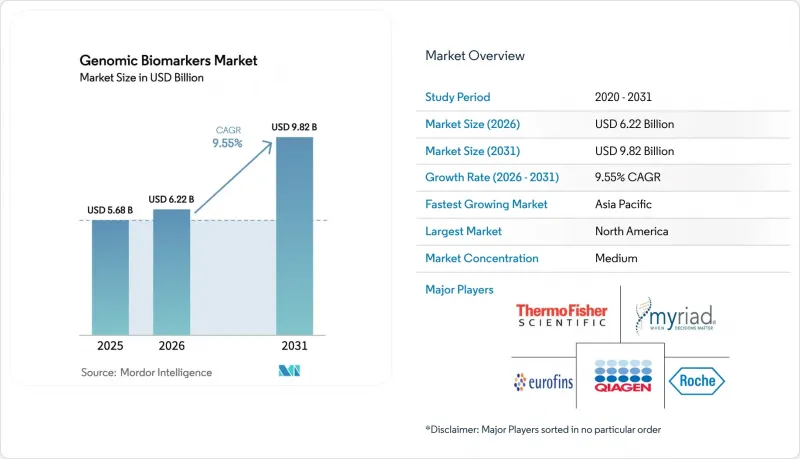
This report is Segmented by Indication (Cancer, Cardiovascular Disorders, Neurological Disorders, and More), End User (Diagnostic Laboratories, Hospitals, Pharmaceutical & Biotechnology Companies, Others), Technology Platform (Next-Generation Sequencing, PCR, Microarray, Others), Biomarker Type (Predictive, Prognostic), and Geography. Market Forecasts are Provided in Terms of Value (USD).
Global Genomic Biomarkers Market Trends and Insights
Rising Prevalence of Chronic and Lifestyle Diseases
Cancer, cardiovascular disorders, and metabolic syndromes collectively drive demand for earlier detection and individualized treatment planning. Noncommunicable diseases caused 74% of global deaths in 2024, with cancer responsible for nearly 10 million fatalities. The American Cancer Society projects more than 2 million new U.S. cancer diagnoses in 2026, reinforcing sustained need for tumor profiling and liquid biopsy monitoring. Polygenic risk scores now flag asymptomatic adults at elevated risk of coronary artery disease decades before onset, enabling preventive statin therapy and lifestyle modification. Widening use of such tools extends the genomic biomarkers market beyond specialty oncology into primary care and population health. As screening broadens, recurring surveillance tests replace one-off diagnostics, strengthening long-term revenue visibility for service providers.
Breakthroughs in NGS, Multi-Omics and AI Bioinformatics
Sequencing throughput has doubled every 18 months since 2020, and Illumina's NovaSeq X Plus now delivers 16 Tb per run at sub-USD 200 whole genome cost. Oxford Nanopore adaptive sampling reduces turnaround to under 12 hours in acute settings. Deep learning pipelines trained on diverse cohorts achieve 94% sensitivity and 98% specificity for pathogenic variant calls, 11 percentage points above legacy software. In 2025, the FDA cleared the first multi-omic assay that improved progression-free survival by 23% versus PD-L1 alone, signaling regulatory support for integrative biomarkers. Collectively, these advances compress analysis time, boost accuracy, and unlock clinically actionable signals that expand the genomic biomarkers market.
High Test Cost and Uncertain Third-Party Reimbursement
Comprehensive genomic profiling remains priced between USD 3,000 and USD 5,800, limiting access for uninsured patients and for public systems in low- and middle-income countries. Grail's USD 949 multi-cancer early detection test lacks Medicare coverage, confining sales to executive wellness packages that touch fewer than 2% of eligible U.S. adults. Private insurers deny roughly 18% of prior authorizations for serial liquid biopsy monitoring, pushing patients toward lengthy appeals or out-of-pocket payment. In emerging markets, absent reimbursement narrows adoption to major cancer centers, widening urban-rural inequities. Quarterly minimal residual disease tests can cost more than USD 20,000 over five years, a burden few payers will shoulder.
Other drivers and restraints analyzed in the detailed report include:
- Mainstreaming of Precision-Medicine Reimbursement Models
- National Population Genomic-Screening Programs
- Stringent and Fragmented Regulatory Approval Pathways
For complete list of drivers and restraints, kindly check the Table Of Contents.
Segment Analysis
Oncology generated 45.55% of 2025 revenue, underpinned by guideline-mandated genomic profiling that links EGFR, KRAS, and HER2 status to targeted therapy selection. Serial minimal residual disease liquid biopsies extend revenue per oncology patient over post-surgery surveillance windows. Cardiovascular applications, though starting from a smaller base, show the fastest momentum with a 13.85% CAGR as risk scores enter annual wellness visits.
Neurologic, renal, and autoimmune indications add diversification. Pharmacogenomic panels shorten the six-week trial-and-error cycle in depression management, while early genomic identification of polycystic kidney disease triggers ACE inhibitor therapy that delays renal decline. As these use cases mature, the genomic biomarkers market size for non-oncology diseases will outpace historical averages, although oncology should still anchor half of total demand through 2031.
Diagnostic laboratories held 38.53% of 2025 revenue, leveraging CLIA and CAP credentials and economies of scale that lower per-test costs by 30%. Hospitals, particularly academic centers, run rapid-turnaround assays for acute leukemia, meeting sub-72-hour decision windows.
Pharma and biotech represent the fastest-growing channel at 12.75% CAGR as 68% of 2024 FDA oncology drug approvals required biomarker-stratified enrollment. CROs extend testing to home-based clinical trial models, and community practices integrate result feeds directly into EHRs for real-world evidence capture. These dynamics fortify volume growth across multiple care settings, further broadening the genomic biomarkers market.
Complete Report Scope:
- By Indication
- Cancer
- Cardiovascular Disorders
- Neurological Disorders
- Renal Disorders
- Auto-Immune & Inflammatory Diseases
- Others
- By End User
- Diagnostic Laboratories
- Hospitals
- Pharmaceutical & Biotechnology Companies
- Others
- By Technology Platform
- Next-Generation Sequencing
- PCR
- Microarray
- Others
- By Biomarker Type
- Predictive Biomarker
- Prognostic Biomarker
- By Geography
- North America
- United States
- Canada
- Mexico
- Europe
- Germany
- United Kingdom
- France
- Italy
- Spain
- Rest of Europe
- Asia-Pacific
- China
- India
- Japan
- Australia
- South Korea
- Rest of Asia-Pacific
- Middle East and Africa
- GCC
- South Africa
- Rest of Middle East and Africa
- South America
- Brazil
- Argentina
- Rest of South America
- North America
Geography Analysis
North America accounted for 38.55% of 2025 revenue, anchored by more than 3,500 CLIA-certified molecular labs and early consumer normalization of genomic data through the All of Us portal. Public reimbursement for large gene panels and prolific private investment sustain the region's leadership. Canada's provincial cancer programs now reimburse comprehensive profiling for most metastatic cases, boosting national volumes.
Europe remains a substantial contributor, with Germany's EUR 500 million National Genome Strategy earmarking sequencing centers in all federal states. The NHS Genomic Medicine Service completes roughly 100,000 genomes annually, trimming rare-disease diagnostic time to under one year. Despite IVDR-related delays, France, Italy, and Spain continue to expand BRCA and hereditary cancer testing penetration.
Asia-Pacific is projected to post the fastest growth at 11.72% CAGR through 2031 as China's Precision Medicine Initiative deploys 50 sequencing hubs and integrates pharmacogenomics into the national formulary. India targets 1 million genomes by 2030, while Japan reimburses polygenic scores in annual health checks for 5 million citizens by 2028. Australia and South Korea add further momentum with national genome frameworks and population sequencing initiatives. Emerging programs in the UAE, Saudi Arabia, South Africa, and Brazil grow from a smaller base yet signal widespread global adoption, collectively enlarging genomic biomarkers market size across developing regions.
- 23andMe Holding Co.
- Adaptive Biotechnologies Corp.
- Agilent Technologies
- Almac Group Ltd.
- BGI Genomics Co. Ltd.
- Bio-Rad Laboratories
- Cancer Genetics
- Caris Life Sciences Inc.
- Element Biosciences Inc.
- Eurofins
- Exact Sciences Corp.
- Roche
- Foundation Medicine Inc.
- Grail LLC
- Guardant Health
- Illumina
- Invitae
- Myriad Genetics
- Natera
- NeoGenomics Laboratories
- Oxford Nanopore Technologies
- Pacific Bioscience
- QIAGEN
- Tempus Labs Inc.
- Thermo Fisher Scientific
Additional Benefits:
- The market estimate (ME) sheet in Excel format
- 3 months of analyst support
TABLE OF CONTENTS
1 Introduction
- 1.1 Study Assumptions & Market Definition
- 1.2 Scope of the Study
2 Research Methodology
3 Executive Summary
4 Market Landscape
- 4.1 Market Overview
- 4.2 Market Drivers
- 4.2.1 Rising prevalence of chronic & lifestyle diseases
- 4.2.2 Breakthroughs in NGS, multi-omics & AI bio-informatics
- 4.2.3 Mainstreaming of precision-medicine reimbursement models
- 4.2.4 National population genomic-screening programmes
- 4.2.5 Employer-sponsored genetic-benefit plans in self-insured firms
- 4.2.6 Federated cloud learning accelerating rare-disease biomarker discovery
- 4.3 Market Restraints
- 4.3.1 High test cost & uncertain third-party reimbursement
- 4.3.2 Stringent & fragmented regulatory approval pathways
- 4.3.3 Algorithmic bias in polygenic-risk scores for non-European populations
- 4.3.4 Scarcity of validated digital-plus-genomic composite biomarkers
- 4.4 Supply-Chain Analysis
- 4.5 Regulatory Landscape
- 4.6 Technological Outlook
- 4.7 Porter's Five Forces
- 4.7.1 Threat of New Entrants
- 4.7.2 Bargaining Power of Buyers
- 4.7.3 Bargaining Power of Suppliers
- 4.7.4 Threat of Substitutes
- 4.7.5 Competitive Rivalry
5 Market Size & Growth Forecasts (Value, USD)
- 5.1 By Indication
- 5.1.1 Cancer
- 5.1.2 Cardiovascular Disorders
- 5.1.3 Neurological Disorders
- 5.1.4 Renal Disorders
- 5.1.5 Auto-Immune & Inflammatory Diseases
- 5.1.6 Others
- 5.2 By End User
- 5.2.1 Diagnostic Laboratories
- 5.2.2 Hospitals
- 5.2.3 Pharmaceutical & Biotechnology Companies
- 5.2.4 Others
- 5.3 By Technology Platform
- 5.3.1 Next-Generation Sequencing
- 5.3.2 PCR
- 5.3.3 Microarray
- 5.3.4 Others
- 5.4 By Biomarker Type
- 5.4.1 Predictive Biomarker
- 5.4.2 Prognostic Biomarker
- 5.5 By Geography
- 5.5.1 North America
- 5.5.1.1 United States
- 5.5.1.2 Canada
- 5.5.1.3 Mexico
- 5.5.2 Europe
- 5.5.2.1 Germany
- 5.5.2.2 United Kingdom
- 5.5.2.3 France
- 5.5.2.4 Italy
- 5.5.2.5 Spain
- 5.5.2.6 Rest of Europe
- 5.5.3 Asia-Pacific
- 5.5.3.1 China
- 5.5.3.2 India
- 5.5.3.3 Japan
- 5.5.3.4 Australia
- 5.5.3.5 South Korea
- 5.5.3.6 Rest of Asia-Pacific
- 5.5.4 Middle East and Africa
- 5.5.4.1 GCC
- 5.5.4.2 South Africa
- 5.5.4.3 Rest of Middle East and Africa
- 5.5.5 South America
- 5.5.5.1 Brazil
- 5.5.5.2 Argentina
- 5.5.5.3 Rest of South America
- 5.5.1 North America
6 Competitive Landscape
- 6.1 Market Concentration
- 6.2 Market Share Analysis
- 6.3 Company Profiles (includes Global level Overview, Market level overview, Core Segments, Financials as available, Strategic Information, Market Rank/Share for key companies, Products & Services, and Recent Developments)
- 6.3.1 23andMe Holding Co.
- 6.3.2 Adaptive Biotechnologies Corp.
- 6.3.3 Agilent Technologies Inc.
- 6.3.4 Almac Group Ltd.
- 6.3.5 BGI Genomics Co. Ltd.
- 6.3.6 Bio-Rad Laboratories Inc.
- 6.3.7 Cancer Genetics Inc.
- 6.3.8 Caris Life Sciences Inc.
- 6.3.9 Element Biosciences Inc.
- 6.3.10 Eurofins Scientific SE
- 6.3.11 Exact Sciences Corp.
- 6.3.12 F. Hoffmann-La Roche AG
- 6.3.13 Foundation Medicine Inc.
- 6.3.14 Grail LLC
- 6.3.15 Guardant Health Inc.
- 6.3.16 Illumina Inc.
- 6.3.17 Invitae Corp.
- 6.3.18 Myriad Genetics Inc.
- 6.3.19 Natera Inc.
- 6.3.20 NeoGenomics Laboratories
- 6.3.21 Oxford Nanopore Technologies Ltd.
- 6.3.22 Pacific Biosciences of California Inc.
- 6.3.23 QIAGEN N.V.
- 6.3.24 Tempus Labs Inc.
- 6.3.25 Thermo Fisher Scientific Inc.
7 Market Opportunities & Future Outlook
- 7.1 White-space & Unmet-need Assessment

