PUBLISHER: Mordor Intelligence | PRODUCT CODE: 2116045

PUBLISHER: Mordor Intelligence | PRODUCT CODE: 2116045
North America Fire Sprinkler Systems - Market Share Analysis, Industry Trends & Statistics, Growth Forecasts (2026 - 2031)
According to Mordor Intelligence, the North America fire sprinkler systems market size is estimated at USD 2.81 billion in 2026, and is expected to reach USD 3.07 billion by 2031, at a CAGR of 1.79% during the forecast period (2026-2031).
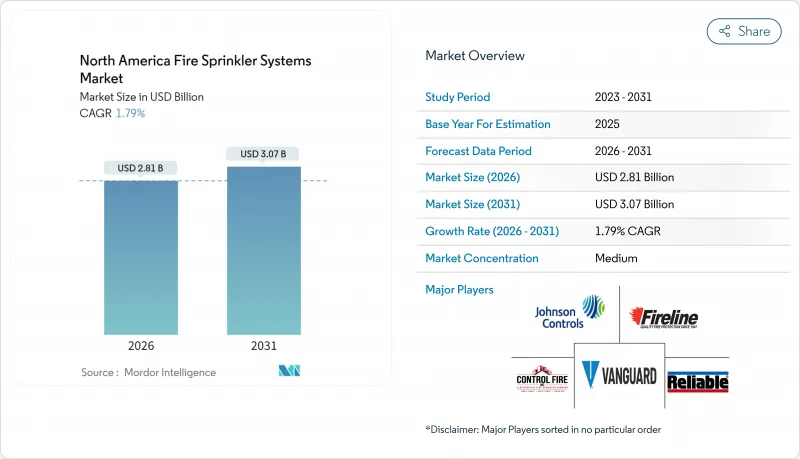
This report is Segmented by Solution (Systems Including Wet-Pipe, Dry-Pipe, Pre-Action, and More), Component (Sprinkler Heads, and More), End-User Vertical (Commercial, and More), Distribution Channel (Direct Sales, Distributor Sales, Online/Third-Party, and OEM Packaged Deals), and Geography (United States, Canada, and Mexico). The Market Forecasts are Provided in Terms of Value (USD).
North America Fire Sprinkler Systems Market Trends and Insights
Stringent Government Regulations And Mandates
The 2025 text of NFPA 13 tightened head spacing for quick-response and residential sprinklers, added seismic-bracing rules, and widened requirements for atriums and covered malls, causing owners to trigger retrofits each time a certificate of occupancy is renewed. Maryland's single-family mandate inspired California to extend sprinklers to all new houses in wildfire zones, while Ontario's 2025 Building Code now obliges retrofits in pre-1974 towers. Because each state or province layers amendments on the base standard, national integrators with multi-state engineering teams gain an execution edge. At the same time, NFPA 25 keeps retrofits lucrative by specifying quarterly valve checks, annual flow tests, and five-year internal inspections, effectively locking in decades of recurring service revenue. The International Code Council aligned its 2024 code with NFPA 13, shrinking the exemption for Group B occupancies and adding thousands of small offices and shops to the regulated universe.
Rising Commercial Construction Spending
United States non-residential construction reached USD 1.02 trillion in August 2025, a 4.2% year-over-year rise that dovetails directly with sprinkler installations in new hotels, hospitals, and offices. Nearshoring added 106 industrial parks to Mexico's 469 existing facilities, each required to meet FM Global specifications that favor deluge or pre-action systems in electronics assembly lines. Canadian warehouse projects around Toronto and Vancouver are embracing early-suppression fast-response (ESFR) heads to protect high-piled inventory, lifting per-project spend even as square footage remains. Mass-timber codes are expanding, but because wood is combustible, engineers specify closer head spacing, which increases the material count per building. Collectively, these factors convert macro-level construction dollars into unit sales of valves, pipe, and heads.
High Cost Of Retrofitting Existing Buildings
Upgrading a pre-1980 office tower can cost USD 3-7 per square foot, a figure that competes with HVAC and elevator modernization for landlords' limited capital budgets. Structural barriers, from missing vertical chases to asbestos abatement, can increase totals by 20-30%. Because tenant disruption is significant, owners must negotiate rent abatements or schedule night shifts, both of which erode project returns. Financing assistance is scarce, as most green-building incentives ignore fire-safety upgrades. Consequently, only a fraction of the retrofit opportunity moves forward each year, capping the incremental unit demand that could otherwise accelerate the North America fire sprinkler systems market.
Other drivers and restraints analyzed in the detailed report include:
- Insurance Premium Incentives For Sprinkler Installation
- Implementation Of NFPA 915 Remote Inspections Accelerating Renovations
- Supply-Chain Volatility For Piping Materials
For complete list of drivers and restraints, kindly check the Table Of Contents.
Segment Analysis
Wet-pipe systems accounted for 63.98% of 2025 revenue, securing the largest market share among all system configurations in the North America fire sprinkler systems market. Pre-action setups, favored in mission-critical environments such as hyperscale data centers and semiconductor fabs, are forecast to advance at a 3.57% CAGR through 2031, making them the fastest-growing solution subset. Dry-pipe networks remain common in unheated warehouses across the northern United States and Canada, but slower activation and compressor upkeep limit their expansion. Deluge systems fill high-hazard niches such as aircraft hangars and petrochemical racks, where blanket water deployment is mandated.
End users increasingly select technology by risk profile, which reinforces the practical segmentation of the North America fire sprinkler systems market. Codes now stipulate dual-interlock pre-action valves for spaces housing energized equipment, aligning capex priorities with uptime mandates. Manufacturers are responding by bundling quick-response heads, electronic release panels, and low-pressure switches as integrated kits, simplifying the design process for consulting engineers. As a result, the fire sprinkler systems market size for pre-action solutions is expected to widen by 2031, even though absolute dollars remain materially lower than wet-pipe revenue.
Sprinkler heads represented 31.42% of component revenue in 2025, fueled by the steady replacement of legacy fusible-link designs with quick-response models that activate at lower temperatures. Sensors and detectors, however, are growing at a 2.31% CAGR, outstripping the broader North America fire sprinkler systems market growth thanks to IoT gateway adoption that pushes real-time data to building-management dashboards. Pipes, valves, and fittings continue to dominate on a cost-basis, but innovation is minimal and pricing remains sensitive to raw-material indices.
Victaulic grooved couplings, which remove field welding, are lowering labor hours by up to 40% and are becoming standard in large commercial projects. RFID-tagged control valves now simplify NFPA 25 inspections by auto-populating serial numbers in digital checklists, a trend that folds predictive maintenance into the fire sprinkler systems industry roadmap. As smart components migrate downstream, the North America fire sprinkler systems market size for connected sensors will keep expanding, with aftermarket retrofits offering a secondary revenue stream when owners integrate legacy systems into cloud monitoring platforms.
Complete Report Scope:
- By Solution
- Systems
- Wet-Pipe Sprinkler System
- Dry-Pipe Sprinkler System
- Pre-Action Sprinkler System
- Deluge Sprinkler System
- Services
- Systems
- By Component
- Sprinkler Heads
- Pipes and Fittings
- Control Valves
- Alarm Valves
- Sensors and Detectors
- Accessories
- By End-User Vertical
- Commercial Buildings
- Industrial Buildings
- Residential Buildings
- By Pipe Material
- Steel
- CPVC
- Copper
- Other Pipe Materials
- By Distribution Channel
- Direct Sales
- Distributor Sales
- Online/Third-Party
- OEM Packaged Deals
List of Companies Covered in this Report:
- Johnson Controls International plc
- Carrier Global Corporation
- Potter Electric Signal Company LLC
- Minimax USA LLC
- Reliable Automatic Sprinkler Company Inc.
- The Viking Corporation
- Western States Fire Protection Company
- Victaulic Company
- Anvil International LLC
- Shurjoint, an Aalberts NV Company
- Globe Fire Sprinkler Corporation
- Tyco Fire Products LP
- Protegis Fire and Safety
- Summit Companies
- Guardian Fire Protection Services LLC
- Vanderbilt Industries
- Fireline Corporation
- Vanguard Fire and Security Systems
- Control Fire Inc.
- American Fire Protection Group Inc.
Additional Benefits:
- The market estimate (ME) sheet in Excel format
- 3 months of analyst support
TABLE OF CONTENTS
1 INTRODUCTION
- 1.1 Study Assumptions and Market Definition
- 1.2 Scope of the Study
2 RESEARCH METHODOLOGY
3 EXECUTIVE SUMMARY
4 MARKET LANDSCAPE
- 4.1 Market Overview
- 4.2 Market Drivers
- 4.2.1 Stringent Government Regulations and Mandates
- 4.2.2 Rising Commercial Construction Spending
- 4.2.3 Insurance Premium Incentives for Sprinkler Installation
- 4.2.4 Implementation of NFPA 915 Remote Inspections Accelerating Renovations
- 4.2.5 AI-based Predictive Maintenance Integration in Sprinkler Monitoring
- 4.2.6 Corporate ESG Reporting Pressures on Fire-Safety Metrics
- 4.3 Market Restraints
- 4.3.1 High Cost of Retrofitting Existing Buildings
- 4.3.2 Supply-Chain Volatility for Piping Materials
- 4.3.3 Skilled Labor Shortages in Sprinkler Fitters
- 4.3.4 Liability Concerns over Water Damage from False Activations
- 4.4 Industry Value Chain Analysis
- 4.5 Regulatory Landscape
- 4.6 Technological Outlook
- 4.7 Porter's Five Forces Analysis
- 4.7.1 Bargaining Power of Suppliers
- 4.7.2 Bargaining Power of Consumers
- 4.7.3 Threat of New Entrants
- 4.7.4 Threat of Substitute Products
- 4.7.5 Intensity of Competitive Rivalry
- 4.8 Impact of Macroeconomic Factors on the Market
5 MARKET SIZE AND GROWTH FORECASTS (VALUE, 2025-2031)
- 5.1 By Solution
- 5.1.1 Systems
- 5.1.1.1 Wet-Pipe Sprinkler System
- 5.1.1.2 Dry-Pipe Sprinkler System
- 5.1.1.3 Pre-Action Sprinkler System
- 5.1.1.4 Deluge Sprinkler System
- 5.1.2 Services
- 5.1.1 Systems
- 5.2 By Component
- 5.2.1 Sprinkler Heads
- 5.2.2 Pipes and Fittings
- 5.2.3 Control Valves
- 5.2.4 Alarm Valves
- 5.2.5 Sensors and Detectors
- 5.2.6 Accessories
- 5.3 By End-User Vertical
- 5.3.1 Commercial Buildings
- 5.3.2 Industrial Buildings
- 5.3.3 Residential Buildings
- 5.4 By Pipe Material
- 5.4.1 Steel
- 5.4.2 CPVC
- 5.4.3 Copper
- 5.4.4 Other Pipe Materials
- 5.5 By Distribution Channel
- 5.5.1 Direct Sales
- 5.5.2 Distributor Sales
- 5.5.3 Online/Third-Party
- 5.5.4 OEM Packaged Deals
6 COMPETITIVE LANDSCAPE
- 6.1 Market Concentration
- 6.2 Strategic Moves
- 6.3 Market Share Analysis
- 6.4 Company Profiles (includes Global Level Overview, Market Level Overview, Core Segments, Financials as Available, Strategic Information, Market Rank/Share for Key Companies, Products and Services, and Recent Developments)
- 6.4.1 Johnson Controls International plc
- 6.4.2 Carrier Global Corporation
- 6.4.3 Potter Electric Signal Company LLC
- 6.4.4 Minimax USA LLC
- 6.4.5 Reliable Automatic Sprinkler Company Inc.
- 6.4.6 The Viking Corporation
- 6.4.7 Western States Fire Protection Company
- 6.4.8 Victaulic Company
- 6.4.9 Anvil International LLC
- 6.4.10 Shurjoint, an Aalberts NV Company
- 6.4.11 Globe Fire Sprinkler Corporation
- 6.4.12 Tyco Fire Products LP
- 6.4.13 Protegis Fire and Safety
- 6.4.14 Summit Companies
- 6.4.15 Guardian Fire Protection Services LLC
- 6.4.16 Vanderbilt Industries
- 6.4.17 Fireline Corporation
- 6.4.18 Vanguard Fire and Security Systems
- 6.4.19 Control Fire Inc.
- 6.4.20 American Fire Protection Group Inc.
7 MARKET OPPORTUNITIES AND FUTURE OUTLOOK
- 7.1 White-Space and Unmet-Need Assessment

