PUBLISHER: Mordor Intelligence | PRODUCT CODE: 2116050

PUBLISHER: Mordor Intelligence | PRODUCT CODE: 2116050
E-Bike Battery Pack - Market Share Analysis, Industry Trends & Statistics, Growth Forecasts (2026 - 2031)
According to Mordor Intelligence, the e-bike battery pack market size in 2026 is estimated at USD 15.54 billion, growing from 2025 value of USD 13.72 billion with 2031 projections showing USD 28.86 billion, growing at 13.2% CAGR over 2026-2031.
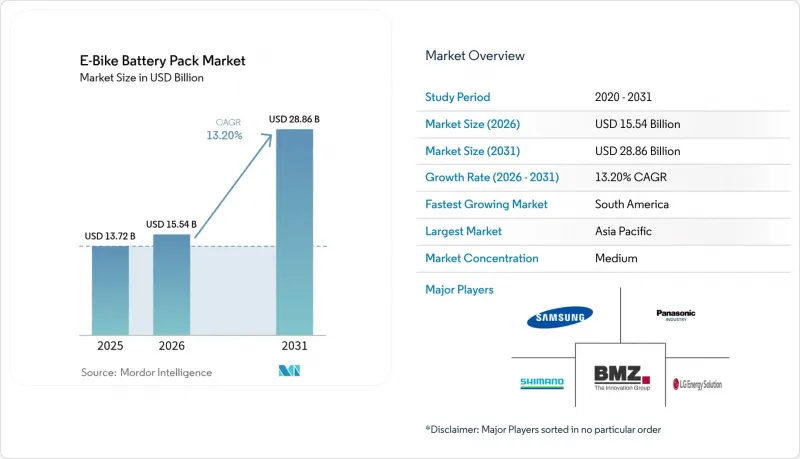
This report is Segmented by Battery Type (Lithium-Ion, Lead-Acid, and More), Battery Pack Position Type (Rear Carrier, Down Tube, and More), Voltage Class (Less Than/Equals 36V, and More), End-Use Application (Urban Commuter, Cargo/Delivery, and More), Distribution Channel (OEM-Fitted, Aftermarket Replacement), and Geography. The Market Forecasts are Provided in Terms of Value (USD) and Volume (kWh).
Global E-Bike Battery Pack Market Trends and Insights
Cost-Down Trend in Li-ion Cells
Lithium-ion pack prices fell 20% in 2024, reaching USD 115 per kWh at the pack level, while cell costs also slid. These declines stem from gigafactory scale economies, optimized NMC and LFP cathode chemistries, and streamlined logistics between cathode producers and pack assemblers. Lower pack prices let brands offer extended-range models without raising retail tags, drawing cost-sensitive buyers into the e-bike battery market. Vertical integration strategies from cell to module adopted by major Asian suppliers stabilize margins despite raw-material volatility. Western manufacturers instead differentiate via UL 2849 certifications and longer warranties, reflecting diverging competitive postures. Raw-material spikes or fresh tariffs could slow the deflationary curve, yet the structural cost advantage of larger plants remains intact.
Urban-Last-Mile Delivery Boom Fuels High-Cycle Packs
Commercial operators now demand packs that withstand more than 1,000 cycles each year, far exceeding the 50-100 cycles typical for leisure riders. UPS has deployed over 10,000 low-emission vehicles, including e-bikes worldwide, to cut downtown delivery emissions, pushing suppliers toward LFP chemistry valued for its cycle life . Food-delivery apps subsidize e-bike purchases for couriers, generating aggregated volumes that justify fit-for-purpose battery lines. High-cycle duty elevates the role of battery-management software capable of optimally throttling charge rates and monitoring cell temperatures. The e-bike battery market thus segments into consumer-range packs and commercial-grade solutions, each carrying distinct value propositions. Advanced telemetry further lowers lifetime cost per kilometer for fleet managers by predicting swap or service windows.
Small-Pack USD/kWh Premium vs. EV (Above 40%)
E-bike packs cost more than 40% per kWh above auto-grade batteries because each design must fit unique frame geometries and meet small-scale certification hurdles. Fixed costs for BMS hardware, enclosure tooling, and UN 38.3 transport testing weigh heavier when spread across modest watt-hour volumes. Suppliers respond with modular platforms that share cells and electronics across multiple models, yet the dilution effect remains limited. While the premium strains entry-level affordability, premium commuters absorb it in favor of lighter weight. Convergence with automotive cylindrical formats could narrow the gap, but only if e-bike frame makers align mounting standards and achieve higher lot sizes.
Other drivers and restraints analyzed in the detailed report include:
- Government Purchase Incentives in More Than 40 Countries
- Battery-as-a-Service (BaaS) Models for Shared Fleets
- Fire-Safety and Insurance Restrictions in Dense Cities
For complete list of drivers and restraints, kindly check the Table Of Contents.
Segment Analysis
Lithium-ion technology held 68.62% of e-bike battery market share in 2025. The segment is projected to grow at a 14.87% CAGR, supported by falling NMC and LFP costs that reinforce the overall e-bike battery market. Entry-level manufacturers keep lead-acid alive for its ultra-low sticker price, yet weight and cycle-life penalties confine its role to niche rural geographies. Sodium-ion's 2025 commercial release illustrates how lower-density chemistries can unlock fresh consumer layers without government subsidies. Over the forecast period, lithium-ion will remain the anchor of the e-bike battery industry, but cost-driven segments shift toward sodium-ion once pack volumes cross economic break-even thresholds.
Competitive dynamics differ by chemistry. CATL's TECTRANS lifetime-extension coating promises durability for LFP packs, a decisive advantage in high-cycle fleets. On the other hand, Yadea leverages sodium-ion's cold-weather resilience to broaden sales in northern China, Russia, and Scandinavia. Premium brands chase NMC811 cathodes for extended range, but commercial fleets increasingly adopt LFP to minimize replacement downtime. The coexistence of multiple chemistries supports a layered supply ecosystem, mitigating single-technology dependence risk within the e-bike battery market.
Down-tube packs commanded 70.45% of 2025 revenue, favored for balanced weight distribution and sleek aesthetics that mirror conventional bike silhouettes. Rear-carrier modules are set to expand 14.05% annually as cargo and family bikes require higher capacities that cannot fit within slender down tubes. Manufacturers of commercial delivery bikes choose rack-top positioning to enable quick swaps without dismantling frame covers, a feature that directly lowers courier downtime. Integrated in-frame cavities attract premium urban commuters who value theft resistance and weather sealing, even if servicing becomes more labor-intensive.
Regulatory changes that mandate battery removability for apartment storage complicate full integration strategies. Bosch's digital Battery Lock seeks to square the circle by allowing user-controlled unlock via a phone app when removal is required for indoor charging. Platform designers now offer modular rails that accept both down-tube and rear-carrier packs, granting OEMs flexibility to serve multiple customer personas while ordering common cells. The debate will ultimately center on maintenance convenience versus visual appeal, keeping both approaches relevant inside the e-bike battery market.
Complete Report Scope:
- By Battery Type
- Lithium-ion
- NMC
- LFP
- Lead-acid
- Other Chemistries (Ni-MH, Na-ion)
- Lithium-ion
- By Battery Pack Position Type
- Rear Carrier
- Down Tube
- In-Frame / Integrated
- By Voltage Class
- Less than/equals 36 V
- 37-48 V
- Above 48 V
- By End-use Application
- Urban Commuter
- Cargo / Delivery
- Mountain / Trekking
- Folding / Micro-mobility
- By Distribution Channel
- OEM-fitted
- Aftermarket Replacement
- By Geography
- North America
- United States
- Canada
- Mexico
- South America
- Brazil
- Argentina
- Rest of South America
- Europe
- United Kingdom
- Germany
- France
- Italy
- Rest of Europe
- Asia-Pacific
- China
- India
- Japan
- South Korea
- Rest of Asia-Pacific
- Middle East and Africa
- Saudi Arabia
- United Arab Emirates
- South Africa
- Egypt
- Rest of Middle East and Africa
- North America
Geography Analysis
Asia-Pacific held 56.60% of global 2025 revenue, with China exporting electric motorcycles and e-bikes exceeded 40 billion yuan (USD 5.5 billion) that year. Korea and Japan contribute advanced cell R&D that trickles into premium European brands, while India's e-two-wheeler unit sales in FY 2025 underscore latent demand in value-driven segments. Despite its dominance, the region's dependency on domestic lithium processing invites tariff risk, pushing some suppliers to establish satellite assembly in Vietnam and Hungary for tariff-neutral shipping into the West.
South America will clock a 16.55% CAGR through 2031. Bogota's CicloRUTA expansion, Sao Paulo's low-interest e-bike loans, and Brazilian tax rebates create fertile ground for both commuter and cargo models. Supply-chain gaps-chiefly in certified service centers and battery recycling-could temper adoption, prompting governments to court foreign direct investment in localized pack assembly. Regional growth accelerates once sodium-ion packs cut initial vehicle prices and mitigate range loss under tropical temperatures.
Europe and North America represent relatively mature arenas yet still promise mid-single-digit growth as policy measures intensify. France's cargo-bike grants and Germany's company-bike leasing encourage larger battery formats, prolonging replacement cycles yet raising aggregate watt-hour demand. The EU Battery Regulation will mandate digital passports by 2027, adding administrative overhead that larger suppliers can absorb more easily. In the United States, a federal tax credit plus California's voucher stack together to drive suburban uptake beyond core urban centers. Fire-safety rules tightening in New York and San Francisco may momentarily slow momentum, but improved certification compliance is expected to restore growth by 2026.
- Samsung SDI Co., Ltd.
- Panasonic Industry
- Shimano Inc.
- BMZ GmbH
- LG Energy Solution, Ltd.
- CATL
- Bafang Electric (Suzhou) Co., Ltd.
- Bosch eBike Systems
- Mahle GmbH
- Kingbo Power Technology Co., Ltd.
- Yoku Energy
- ENERdan GmbH
- Giant Manufacturing Co., Ltd.
- Accell Group
Additional Benefits:
- The market estimate (ME) sheet in Excel format
- 3 months of analyst support
TABLE OF CONTENTS
1 Introduction
- 1.1 Study Assumptions & Market Definition
- 1.2 Scope of the Study
2 Research Methodology
3 Executive Summary
4 Market Landscape
- 4.1 Market Overview
- 4.2 Market Drivers
- 4.2.1 Cost-Down Trend in Li-ion Cells
- 4.2.2 Urban-Last-Mile Delivery Boom Fuels High-Cycle Packs
- 4.2.3 Government Purchase Incentives in More Than 40 Countries
- 4.2.4 Battery-as-a-Service (BaaS) Models for Shared Fleets
- 4.2.5 Fast-Charge Capable Cylindrical Formats (21700/32140)
- 4.2.6 Sodium-Ion Pilot Lines Unlock Low-Cost Entry Bikes
- 4.3 Market Restraints
- 4.3.1 Small-Pack USD/kWh Premium vs. EV (Above 40%)
- 4.3.2 Fire-Safety and Insurance Restrictions in Dense Cities
- 4.3.3 China-Centric Cell Supply-Tariff and Geo-Risk Exposure
- 4.3.4 Sub-5 Year Warranty Gap Limits Total-Cost Parity
- 4.4 Value / Supply-Chain Analysis
- 4.5 Regulatory Landscape
- 4.6 Technological Outlook
- 4.7 Porter's Five Forces
- 4.7.1 Threat of New Entrants
- 4.7.2 Bargaining Power of Buyers
- 4.7.3 Bargaining Power of Suppliers
- 4.7.4 Threat of Substitutes
- 4.7.5 Intensity of Competitive Rivalry
5 Market Size & Growth Forecasts (Value (USD) and Volume (kWh))
- 5.1 By Battery Type
- 5.1.1 Lithium-ion
- 5.1.1.1 NMC
- 5.1.1.2 LFP
- 5.1.2 Lead-acid
- 5.1.3 Other Chemistries (Ni-MH, Na-ion)
- 5.1.1 Lithium-ion
- 5.2 By Battery Pack Position Type
- 5.2.1 Rear Carrier
- 5.2.2 Down Tube
- 5.2.3 In-Frame / Integrated
- 5.3 By Voltage Class
- 5.3.1 Less than/equals 36 V
- 5.3.2 37-48 V
- 5.3.3 Above 48 V
- 5.4 By End-use Application
- 5.4.1 Urban Commuter
- 5.4.2 Cargo / Delivery
- 5.4.3 Mountain / Trekking
- 5.4.4 Folding / Micro-mobility
- 5.5 By Distribution Channel
- 5.5.1 OEM-fitted
- 5.5.2 Aftermarket Replacement
- 5.6 By Geography
- 5.6.1 North America
- 5.6.1.1 United States
- 5.6.1.2 Canada
- 5.6.1.3 Mexico
- 5.6.2 South America
- 5.6.2.1 Brazil
- 5.6.2.2 Argentina
- 5.6.2.3 Rest of South America
- 5.6.3 Europe
- 5.6.3.1 United Kingdom
- 5.6.3.2 Germany
- 5.6.3.3 France
- 5.6.3.4 Italy
- 5.6.3.5 Rest of Europe
- 5.6.4 Asia-Pacific
- 5.6.4.1 China
- 5.6.4.2 India
- 5.6.4.3 Japan
- 5.6.4.4 South Korea
- 5.6.4.5 Rest of Asia-Pacific
- 5.6.5 Middle East and Africa
- 5.6.5.1 Saudi Arabia
- 5.6.5.2 United Arab Emirates
- 5.6.5.3 South Africa
- 5.6.5.4 Egypt
- 5.6.5.5 Rest of Middle East and Africa
- 5.6.1 North America
6 Competitive Landscape
- 6.1 Market Concentration
- 6.2 Strategic Moves
- 6.3 Market Share Analysis
- 6.4 Company Profiles (includes Global Level Overview, Market Level Overview, Core Segments, Financials as Available, Strategic Information, Market Rank/Share for Key Companies, Products and Services, SWOT Analysis, and Recent Developments)
- 6.4.1 Samsung SDI Co., Ltd.
- 6.4.2 Panasonic Industry
- 6.4.3 Shimano Inc.
- 6.4.4 BMZ GmbH
- 6.4.5 LG Energy Solution, Ltd.
- 6.4.6 CATL
- 6.4.7 Bafang Electric (Suzhou) Co., Ltd.
- 6.4.8 Bosch eBike Systems
- 6.4.9 Mahle GmbH
- 6.4.10 Kingbo Power Technology Co., Ltd.
- 6.4.11 Yoku Energy
- 6.4.12 ENERdan GmbH
- 6.4.13 Giant Manufacturing Co., Ltd.
- 6.4.14 Accell Group
7 Market Opportunities & Future Outlook
- 7.1 White-space & Unmet-Need Assessment

