PUBLISHER: Mordor Intelligence | PRODUCT CODE: 2116053

PUBLISHER: Mordor Intelligence | PRODUCT CODE: 2116053
United States And Europe LED Lighting - Market Share Analysis, Industry Trends & Statistics, Growth Forecasts (2026 - 2031)
According to Mordor Intelligence, the United States and Europe LED lighting market size in 2026 is estimated at USD 21.6 billion, growing from 2025 value of USD 20.55 billion with 2031 projections showing USD 27.68 billion, growing at 5.12% CAGR over 2026-2031.
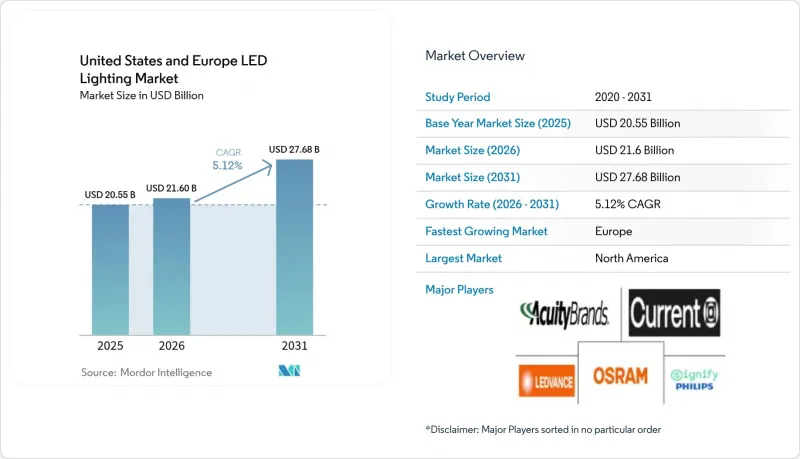
This report is Segmented by Application (Commercial Offices, Retail, Hospitality, and Industrial), Product Type (Lamps, and Luminaires), Installation Type (Retrofit, and New), Connectivity (Conventional/Standalone, and Connected/Smart), Distribution Channel (Direct Sales, Wholesale/Retail, and E-Commerce), and Geography. The Market Forecasts are Provided in Terms of Value (USD).
United States And Europe LED Lighting Market Trends and Insights
EU phase-out of fluorescent T5/T8 tubes accelerating commercial retrofits
The August 2023 EU ban on mercury-based T5 and T8 tubes produced an immediate replacement surge, as facility managers discovered that LED retrofits lower lighting energy use by 80% and pay back in three months. Demand strengthens into 2025 when the last exemptions expire, prompting manufacturers that pre-emptively ceased fluorescent production to channel capacity toward LED luminaires. Parallel UK restrictions extend the opportunity beyond EU borders, magnifying the LED lighting market's retrofit revenues.
United States DOE 120 lm/W rule catalyzing residential adoption
Finalized efficacy standards that raise the residential baseline from 45 lm/W to 120 lm/W by July 2028 erase compact fluorescent competition and guarantee a protected runway for LEDs. Annual consumer savings are projected at USD 1.6 billion, while utilities amplify rebates to accelerate compliance. Color-tunable and high-CRI products still face efficiency-performance trade-offs, creating design challenges that spur innovation in the LED lighting market.
LED chip supply-chain volatility extending OEM lead times
Semiconductor bottlenecks pushed delivery windows for specialty LED drivers from 12 weeks to as many as 24 weeks, forcing manufacturers to carry higher inventories and eroding margins. China's export restrictions on gallium and germanium intensified price pressure, while the forecast 67,000-engineer shortfall in the US semiconductor workforce threatens capacity expansions.
Other drivers and restraints analyzed in the detailed report include:
- Corporate net-zero commitments driving large-scale office relamping
- Electricity tariff surges shortening payback periods
- Stricter glare and blue-light ordinances delaying outdoor projects
For complete list of drivers and restraints, kindly check the Table Of Contents.
Segment Analysis
Hazardous-area installations captured only a modest slice of the LED lighting market in 2025 yet are expected to post a 8.92% CAGR, outpacing every other application category. Explosion-proof luminaires are gaining traction in chemical plants, oil refineries and grain silos, where a single fixture failure can trigger catastrophic downtime. Certification requirements such as ATEX and UL844 widen the moat for established suppliers, supporting premium pricing.
Commercial offices remain the volume leader at 27.70% LED lighting market share, buoyed by corporate sustainability programs that demand fast-payback energy retrofits. Retailers continue to shift toward tunable-white LEDs that enhance merchandise appeal and cut refrigeration loads. Hospitality conversions progress more slowly because rewiring historic buildings can inflate project costs, yet owners increasingly specify filament-style LED lamps that preserve heritage aesthetics. Hospitals and schools are adopting circadian-supportive lighting, with occupancy sensors further trimming operational expenses. Industrial logistics hubs are layering Li-Fi connectivity atop high-bay LED arrays to support asset tracking. Taken together, the application mix underscores the maturity of the LED lighting market while highlighting pockets of double-digit growth where safety and automation intersect.
Integrated luminaires accounted for 67.10% of 2025 revenues, reflecting buyers' preference for complete fixtures that merge optics, drivers and sensors into sealed systems. High-bay and low-bay models, driven by warehouse automation, represent the fastest-growing sub-segment with an 8.05% CAGR, underscoring how e-commerce reshapes lighting demand. The lamp category, although still significant for quick retrofits, faces commoditization pressures that squeeze margins. Troffers and downlights dominate ceiling-grid renovations because they drop into existing openings without rewiring, cutting labor costs by as much as 40%.
Street and area lighting demand is moving toward adaptive luminaires that dim automatically after midnight, extending service life and meeting dark-sky bylaws. Manufacturers increasingly bundle wireless drivers, photometric files and commissioning apps, pushing the LED lighting market further from component sales toward solution-oriented business models. Advanced optic designs now enable uniform vertical illuminance critical for automated picking robots, while upgraded thermal management extends rated life beyond 70,000 hours. As buyers prioritize lifecycle value over initial cost, luminaire-centric strategies reinforce leadership positions for integrated brands within the LED lighting market.
Complete Report Scope:
- By Application
- Commercial Offices
- Retail
- Hospitality
- Industrial
- Warehouses and Factories
- Hazardous Zones
- Other Industrial Applications
- Other Applications
- By Product Type
- Lamps
- Bulbs
- Tubes
- Other Lamps
- Luminaires
- Downlights
- Troffers/Panel Lights
- High-bay/Low-bay
- Street and Area Lights
- Lamps
- By Installation Type
- Retrofit
- New Installation
- By Connectivity
- Conventional/Standalone
- Connected/Smart
- By Distribution Channel
- Direct Sales
- Wholesale/Retail
- E-Commerce
- By End-user Industry
- Commercial
- Industrial
- Residential
- Public and Street Lighting
- Horticulture
- By Geography
- North America
- United States
- Canada
- Mexico
- Europe
- United Kingdom
- Germany
- France
- Spain
- Italy
- Nordics
- Benelux
- Rest of Europe
- North America
List of Companies Covered in this Report:
- Signify Holding (Philips Lighting)
- OSRAM GmbH
- Acuity Brands Inc.
- Eaton Corporation (Cooper Lighting)
- LEDVANCE GmbH (MLS Co Ltd)
- Current Lighting Solutions, LLC.
- Cree Inc.
- Nichia Corporation
- Sharp Corporation
- Dialight PLC
- Zumtobel Group AG
- Hubbell Incorporated
- Panasonic Corporation
- US LED Ltd.
- Legrand S.A.
- Feilo Sylvania (Shanghai Yaming)
- Lutron Electronics Co.
- Trilux GmbH and Co. KG
- Fagerhult AB
- Heliospectra AB
Additional Benefits:
- The market estimate (ME) sheet in Excel format
- 3 months of analyst support
TABLE OF CONTENTS
1 INTRODUCTION
- 1.1 Study Assumptions and Market Definition
- 1.2 Scope of the Study
2 RESEARCH METHODOLOGY
3 EXECUTIVE SUMMARY
4 MARKET LANDSCAPE
- 4.1 Market Overview
- 4.2 Market Drivers
- 4.2.1 EU Phase-out of Fluorescent T5/T8 Tubes Accelerating Commercial Retrofits
- 4.2.2 United States DOE 45 lm/W Rule Catalyzing Residential LED Adoption
- 4.2.3 Corporate Net-Zero Commitments Driving Large-Scale Office Relamping
- 4.2.4 Electricity Tariff Surges in DE, UK and CA Shortening Pay-back Period
- 4.2.5 EU Green Public Procurement Mandates for Municipal Lighting
- 4.2.6 Adoption of PoE and Bluetooth-Mesh LEDs in Smart-Building Retrofits
- 4.3 Market Restraints
- 4.3.1 LED Chip Supply-Chain Volatility Extending OEM Lead-times
- 4.3.2 High Re-wiring Costs in Historic Hospitality Facilities
- 4.3.3 Stricter Glare and Blue-Light Ordinances Delaying Outdoor Projects
- 4.3.4 Emergence of Laser-Phosphor High-Bay Luminaires
- 4.4 Industry Ecosystem Analysis
- 4.5 Technology Snapshot
- 4.6 Porter's Five Forces Analysis
- 4.6.1 Threat of New Entrants
- 4.6.2 Bargaining Power of Buyers
- 4.6.3 Bargaining Power of Suppliers
- 4.6.4 Threat of Substitutes
- 4.6.5 Competitive Rivalry
5 MARKET SIZE AND GROWTH FORECASTS (VALUES)
- 5.1 By Application
- 5.1.1 Commercial Offices
- 5.1.2 Retail
- 5.1.3 Hospitality
- 5.1.4 Industrial
- 5.1.4.1 Warehouses and Factories
- 5.1.4.2 Hazardous Zones
- 5.1.4.3 Other Industrial Applications
- 5.1.5 Other Applications
- 5.2 By Product Type
- 5.2.1 Lamps
- 5.2.1.1 Bulbs
- 5.2.1.2 Tubes
- 5.2.1.3 Other Lamps
- 5.2.2 Luminaires
- 5.2.2.1 Downlights
- 5.2.2.2 Troffers/Panel Lights
- 5.2.2.3 High-bay/Low-bay
- 5.2.2.4 Street and Area Lights
- 5.2.1 Lamps
- 5.3 By Installation Type
- 5.3.1 Retrofit
- 5.3.2 New Installation
- 5.4 By Connectivity
- 5.4.1 Conventional/Standalone
- 5.4.2 Connected/Smart
- 5.5 By Distribution Channel
- 5.5.1 Direct Sales
- 5.5.2 Wholesale/Retail
- 5.5.3 E-Commerce
- 5.6 By End-user Industry
- 5.6.1 Commercial
- 5.6.2 Industrial
- 5.6.3 Residential
- 5.6.4 Public and Street Lighting
- 5.6.5 Horticulture
- 5.7 By Geography
- 5.7.1 North America
- 5.7.1.1 United States
- 5.7.1.2 Canada
- 5.7.1.3 Mexico
- 5.7.2 Europe
- 5.7.2.1 United Kingdom
- 5.7.2.2 Germany
- 5.7.2.3 France
- 5.7.2.4 Spain
- 5.7.2.5 Italy
- 5.7.2.6 Nordics
- 5.7.2.7 Benelux
- 5.7.2.8 Rest of Europe
- 5.7.1 North America
6 COMPETITIVE LANDSCAPE
- 6.1 Market Concentration
- 6.2 Strategic Moves
- 6.3 Market Share Analysis
- 6.4 Company Profiles (includes Global Overview, Market Overview, Core Segments, Financials, Strategic Info, Market Share, Products and Services, Recent Developments)
- 6.4.1 Signify Holding (Philips Lighting)
- 6.4.2 OSRAM GmbH
- 6.4.3 Acuity Brands Inc.
- 6.4.4 Eaton Corporation (Cooper Lighting)
- 6.4.5 LEDVANCE GmbH (MLS Co Ltd)
- 6.4.6 Current Lighting Solutions, LLC.
- 6.4.7 Cree Inc.
- 6.4.8 Nichia Corporation
- 6.4.9 Sharp Corporation
- 6.4.10 Dialight PLC
- 6.4.11 Zumtobel Group AG
- 6.4.12 Hubbell Incorporated
- 6.4.13 Panasonic Corporation
- 6.4.14 US LED Ltd.
- 6.4.15 Legrand S.A.
- 6.4.16 Feilo Sylvania (Shanghai Yaming)
- 6.4.17 Lutron Electronics Co.
- 6.4.18 Trilux GmbH and Co. KG
- 6.4.19 Fagerhult AB
- 6.4.20 Heliospectra AB
7 MARKET OPPORTUNITIES AND FUTURE OUTLOOK
- 7.1 White-space and Unmet-need Assessment

