PUBLISHER: Mordor Intelligence | PRODUCT CODE: 2116071

PUBLISHER: Mordor Intelligence | PRODUCT CODE: 2116071
Transplant Box - Market Share Analysis, Industry Trends & Statistics, Growth Forecasts (2026 - 2031)
According to Mordor Intelligence, transplant box market size in 2026 is estimated at USD 193.25 million, growing from 2025 value of USD 179.52 million with 2031 projections showing USD 279.27 million, growing at 7.65% CAGR over 2026-2031.
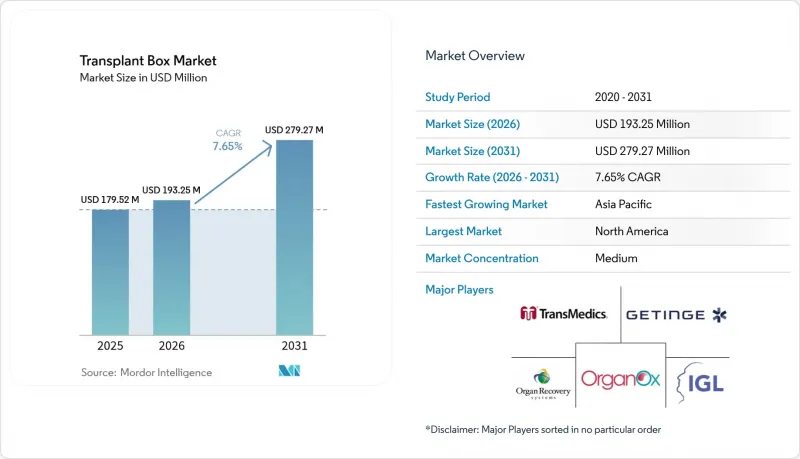
This report is Segmented by Organ Type (Heart, Liver, Lung, Kidney, Pancreas, and More), Preservation Technology (Static Cold Storage Boxes, Normothermic Machine Perfusion Devices, and More), End User (Hospitals & Transplant Centers, Organ Procurement Organisations, and More) and Geography (North America, Europe, Asia-Pacific, and More). The Market Forecasts are Provided in Terms of Value (USD).
Global Transplant Box Market Trends and Insights
Increasing Volume of Multi-Organ Transplants in Ageing and Diabetic Populations
Record organ recovery volumes in 2024 confirm that older and diabetic cohorts are driving sustained procedure growth. Higher prevalence of end-stage renal disease and cardiometabolic complications requires longer preservation windows that static cold storage cannot guarantee. Emerging economies mirrored this rise, highlighting untapped regional demand. Allocation systems now prioritize sicker patients, which often adds inter-state or cross-border travel to procurement logistics. These factors collectively elevate the clinical necessity for advanced devices across the transplant box market.
Government & NGO Programs Expanding Donor Registries
Legislative changes such as Ireland's opt-out Human Tissue Act 2024, in effect from June 2025, instantly enlarge donor pools. Japan's coordinator certification framework and India's expanded brain-death criteria similarly shorten consent cycles and raise utilization rates. The WHO strategy that calls for every member state to meet transplant demand by 2035 institutionalizes this momentum. Expanding donor availability directly lifts shipment volumes and places fresh emphasis on reliable, data-rich preservation hardware.
High Capital & Per-Use Cost of Advanced Transplant Boxes
Liver transplant expenses rose 10.9% after allocation policy revisions, underscoring the sensitivity of overall costs to logistics inputs. Incremental cost-effectiveness analyses frequently exceed USD 100,000 per quality-adjusted life year, stretching reimbursement thresholds. Consumable kits and single-use cartridges add recurring cost layers that impede broad deployment in mid-tier centers.
Other drivers and restraints analyzed in the detailed report include:
- Shift from Static Cold Storage to Portable Normothermic Perfusion Systems
- Hospital Demand for Real-Time Organ-Condition Analytics
- Complex Multi-Jurisdictional Regulatory Clearances
For complete list of drivers and restraints, kindly check the Table Of Contents.
Segment Analysis
Kidney devices contributed 37.80% of the transplant box market in 2025, benefiting from both deceased and living donor programs. Wider acceptance of ABO-incompatible procedures and record 8,200 kidney transplants performed by a single network in 2024 demonstrate deep installed demand. Conversely, lung preservation shows the fastest 11.88% CAGR as ex-vivo perfusion revives marginal grafts, a development that could lift the transplant box market size for pulmonary applications by mid-decade. Heart, liver, and pancreas boxes continue steady uptake, and early-stage work in intestinal and vascular-composite preservation hints at future expansion vectors.
The second growth driver is the widening perimeter of acceptable donor-recipient travel times. Normothermic lung and heart solutions allow 6-20 hour windows without raising ischemia-reperfusion risks, letting clinicians consider intercontinental matches and thereby stimulating regional volume. As transplant registries diversify, organ-specific demand patterns will continue to recalibrate production and R&D allocations across vendors operating in the transplant box market.
Complete Report Scope:
- By Organ Type
- Heart
- Liver
- Lung
- Kidney
- Pancreas
- Others
- By Preservation Technology
- Static Cold Storage Boxes
- Normothermic Machine Perfusion Devices
- Hypothermic Machine Perfusion Devices
- Others
- By End User
- Hospitals & Transplant Centers
- Organ Procurement Organisations (OPOs)
- Military & Emergency Medical Services
- Research Institutes
- Geography
- North America
- United States
- Canada
- Mexico
- Europe
- Germany
- United Kingdom
- France
- Italy
- Spain
- Rest of Europe
- Asia-Pacific
- China
- Japan
- India
- South Korea
- Australia
- Rest of Asia-Pacific
- Middle East and Africa
- GCC
- South Africa
- Rest of Middle East and Africa
- South America
- Brazil
- Argentina
- Rest of South America
- North America
Geography Analysis
North America retains leadership with 37.20% of global revenue in 2025 owing to robust healthcare infrastructure and rigorous yet navigable regulatory pathways. The United States accounts for the majority of regional sales, supported by sustained double-digit revenue growth reported by leading vendors. Cross-border agreements with Canada and Mexico facilitate broader organ sharing and strengthen procurement logistics, thereby maintaining high device utilization.
Europe follows with sophisticated transplant networks and progressive regulations. The new SoHO rules harmonize technical standards, positioning the bloc for accelerated adoption of dynamic perfusion devices. Countries such as Germany, France, and Spain show notable investment in donor-care units, which increase yields and reduce total costs, thus enhancing device ROI.
Asia-Pacific is the fastest-growing territory, recording a 10.42% CAGR through to 2031. China's voluntary donation system, Japan's coordinator certifications, and India's record transplant volumes collectively generate an expanding customer base. Governments are also funding new transplant centers and procurement hubs, prerequisites for large-scale device deployment. South America, the Middle East, and Africa hold significant latent demand, but limited reimbursement and logistical challenges constrain immediate scale. Gradual infrastructure improvements are likely to unlock incremental opportunities over the second half of the forecast period, incrementally lifting overall transplant box market growth.
- TransMedics Inc.
- Organ Recovery Systems
- Getinge (Paragonix Technologies, Inc.)
- Institut Georges Lopez (IGL)
- OrganOx Ltd.
- Xvivo Perfusion
- Bridge to Life Ltd.
- Hibernicor
- Northwestern Medicine
- Waters Medical Systems
- Preservation Solutions Inc.
- Ebers Medical Technology SL
- CryoLife
- Lifeline Scientific
- Medtronic
- W. L. Gore & Associates
- Terumo
- Shenzhen Lifotronic Technology Co.
- Avive Biomedical
- OCS Logistics LLC
Additional Benefits:
- The market estimate (ME) sheet in Excel format
- 3 months of analyst support
TABLE OF CONTENTS
1 Introduction
- 1.1 Study Assumptions & Market Definition
- 1.2 Scope of the Study
2 Research Methodology
3 Executive Summary
4 Market Landscape
- 4.1 Market Overview
- 4.2 Market Drivers
- 4.2.1 Increasing Volume Of Multi-Organ Transplants In Ageing And Diabetic Populations
- 4.2.2 Government & NGO Programmes Expanding Donor Registries
- 4.2.3 Shift From Static Cold Storage To Portable Normothermic Perfusion Systems
- 4.2.4 Hospital Demand For Real-Time Organ-Condition Analytics
- 4.2.5 Military-Funded R&D On Battlefield-Ready Organ Transport Solutions
- 4.3 Market Restraints
- 4.3.1 High Capital & Per-Use Cost Of Advanced Transplant Boxes
- 4.3.2 Complex Multi-Jurisdictional Regulatory Clearances
- 4.3.3 Global Shortage Of Qualified Cold-Chain Logistics Personnel
- 4.4 Porter's Five Forces
- 4.4.1 Threat of New Entrants
- 4.4.2 Bargaining Power of Buyers
- 4.4.3 Bargaining Power of Suppliers
- 4.4.4 Threat of Substitute Products
- 4.4.5 Intensity of Competitive Rivalry
5 Market Size & Growth Forecasts (Value, USD)
- 5.1 By Organ Type
- 5.1.1 Heart
- 5.1.2 Liver
- 5.1.3 Lung
- 5.1.4 Kidney
- 5.1.5 Pancreas
- 5.1.6 Others
- 5.2 By Preservation Technology
- 5.2.1 Static Cold Storage Boxes
- 5.2.2 Normothermic Machine Perfusion Devices
- 5.2.3 Hypothermic Machine Perfusion Devices
- 5.2.4 Others
- 5.3 By End User
- 5.3.1 Hospitals & Transplant Centers
- 5.3.2 Organ Procurement Organisations (OPOs)
- 5.3.3 Military & Emergency Medical Services
- 5.3.4 Research Institutes
- 5.4 Geography
- 5.4.1 North America
- 5.4.1.1 United States
- 5.4.1.2 Canada
- 5.4.1.3 Mexico
- 5.4.2 Europe
- 5.4.2.1 Germany
- 5.4.2.2 United Kingdom
- 5.4.2.3 France
- 5.4.2.4 Italy
- 5.4.2.5 Spain
- 5.4.2.6 Rest of Europe
- 5.4.3 Asia-Pacific
- 5.4.3.1 China
- 5.4.3.2 Japan
- 5.4.3.3 India
- 5.4.3.4 South Korea
- 5.4.3.5 Australia
- 5.4.3.6 Rest of Asia-Pacific
- 5.4.4 Middle East and Africa
- 5.4.4.1 GCC
- 5.4.4.2 South Africa
- 5.4.4.3 Rest of Middle East and Africa
- 5.4.5 South America
- 5.4.5.1 Brazil
- 5.4.5.2 Argentina
- 5.4.5.3 Rest of South America
- 5.4.1 North America
6 Competitive Landscape
- 6.1 Market Concentration
- 6.2 Market Share Analysis
- 6.3 Company Profiles (includes Global level Overview, Market level overview, Core Segments, Financials as available, Strategic Information, Market Rank/Share for key companies, Products & Services, and Recent Developments)
- 6.3.1 TransMedics Inc.
- 6.3.2 Organ Recovery Systems Inc.
- 6.3.3 Getinge (Paragonix Technologies, Inc.)
- 6.3.4 Institut Georges Lopez (IGL)
- 6.3.5 OrganOx Ltd.
- 6.3.6 XVIVO Perfusion AB
- 6.3.7 Bridge to Life Ltd.
- 6.3.8 Hibernicor
- 6.3.9 Northwestern Medicine
- 6.3.10 Waters Medical Systems
- 6.3.11 Preservation Solutions Inc.
- 6.3.12 Ebers Medical Technology SL
- 6.3.13 CryoLife Inc.
- 6.3.14 Lifeline Scientific Inc.
- 6.3.15 Medtronic plc
- 6.3.16 W. L. Gore & Associates
- 6.3.17 Terumo Corporation
- 6.3.18 Shenzhen Lifotronic Technology Co.
- 6.3.19 Avive Biomedical
- 6.3.20 OCS Logistics LLC
7 Market Opportunities & Future Outlook
- 7.1 White-space & Unmet-Need Assessment

