PUBLISHER: Mordor Intelligence | PRODUCT CODE: 2116072

PUBLISHER: Mordor Intelligence | PRODUCT CODE: 2116072
Eye Health Supplement - Market Share Analysis, Industry Trends & Statistics, Growth Forecasts (2026 - 2031)
According to Mordor Intelligence, the eye health supplement market size was valued at USD 2.72 billion in 2025 and is estimated to grow from USD 2.93 billion in 2026 to reach USD 4.23 billion by 2031, at a CAGR of 7.62% during the forecast period (2026-2031).
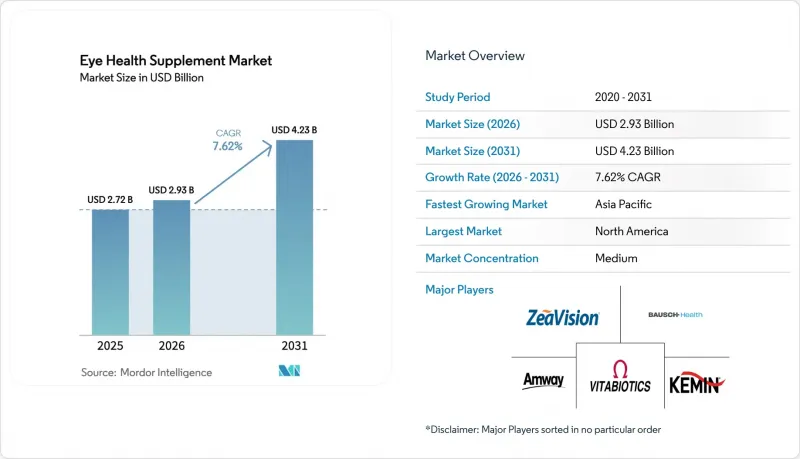
This report is Segmented by Ingredient Type (Carotenoids, Antioxidant Vitamins, and More), Form (Softgel Capsules, Tablets, and More), Indication (AMD, Cataract, Dry Eye, Diabetic Retinopathy, and More), Distribution Channel (OTC Pharmacy, Online Retail & DTC, Others), Age Group (Pediatric, Adults, Geriatric), and Geography (North America and More). Market Forecasts are Provided in Terms of Value (USD).
Global Eye Health Supplement Market Trends and Insights
Increasing Prevalence of Ocular Diseases Linked to Metabolic Syndrome
Diabetic retinopathy incidence tracks hemoglobin A1c levels above 7.5%, a threshold exceeded by 58% of diagnosed diabetics in the United States in 2024. India's urban prevalence reached 17.6%, translating to 14.2 million affected individuals who often lack access to laser treatment, leaving supplementation as an interim measure. Combination products blending omega-3s and coenzyme Q10 grew 34% in 2024-2025 because metabolic syndrome comorbidities intensify retinal oxidative stress. The American Diabetes Association's 2025 care standards call for yearly retinal screening at diagnosis, indirectly endorsing early supplement uptake. Supplement demand therefore escalates in tier-2 cities where ophthalmologist density remains below one per 100,000 residents, filling a glaring care gap.
Adoption of Preventative-Health Mindset Among Gen Z and Millennials
Consumers aged 25-40 made up 41% of purchases in 2025 as daily screen exposure averaged 11 hours during remote work. Ingredient transparency matters; 68% will pay a 25% premium for NSF-verified labels. Social media amplified demand-TikTok eye-health hashtags amassed 2.3 billion views in 2024, and influencer content drove 29% of first-time buys. Gummies captured 18% of this cohort's spending against 9% for baby boomers, demonstrating taste preferences that shape product formats. Early lutein and zeaxanthin adoption before symptom onset differentiates this demographic from older groups that initiate supplementation only after diagnosis.
Scientific Controversy Over Supplement Efficacy and Lack of Reimbursement
A 2024 Cochrane review of 19 trials reported no significant benefit from lutein or zeaxanthin against cataract progression, reducing clinician endorsement. Medicare Part D continued to exclude eye supplements from formularies in 2025, classifying them as wellness products. Out-of-pocket costs deterred 34% of AMD patients from starting supplementation, according to an American Academy of Ophthalmology survey. Ophthalmologists cite permissive FDA structure-function rules as misleading because products can claim eye support without pre-market efficacy proof. Without payer backing, pharmaceutical firms avoid prescription-grade pathways, limiting innovation beyond over-the-counter formulas.
Other drivers and restraints analyzed in the detailed report include:
- Surge in Self-Directed Eye-Care via E-Commerce Nutraceuticals
- Clinical Validation of Carotenoid + Omega-3 Synergistic Formulations
- Price Volatility of Marine-Sourced Omega-3 Inputs
For complete list of drivers and restraints, kindly check the Table Of Contents.
Segment Analysis
Omega-3 fatty acids commanded 29.55% revenue in 2025, but carotenoids are forecast to deliver the fastest 9.85% CAGR because rising macular pigment scores link directly with 0.12 logMAR visual-acuity gains in early AMD cases. High-purity lutein pricing-USD 180 per kilogram in 2025-helps private labels compete while still funding quality testing. Antioxidant vitamins face falling margins as commoditized ascorbic acid prices declined 14% since 2023. Minerals such as zinc and copper keep stable volume but reformulate into chelated formats after 22% of users reported gastrointestinal discomfort at standard zinc dosages.
Botanical and polyphenol innovation is advancing category differentiation. Bilberry extract at 25% anthocyanins improved night-vision adaptation by 18% among Italian military pilots. Astaxanthin attracted mainstream attention in 2025, with 12 mg daily reducing accommodative decline by 0.8 diopters among presbyopic adults. Multi-ingredient blends accounted for 68% of 2024 launches, as brands layer carotenoids, omega-3s, and botanicals to command premiums. The United States Pharmacopeia's 2024 monographs for lutein and zeaxanthin raised compliance costs but also enabled trust-building label claims.
Softgel capsules retained 45.53% revenue in 2025 by safeguarding shelf life up to 36 months. Yet gummies and chews posted a 10.75% CAGR due to pectin matrices that mask fishy aftertaste while delivering 87% bioequivalence to softgels. The format appeals to dysphagia patients and children, with pediatric gummies capturing 31% of under-12 spending in 2025.
Tablets are retreating as slow disintegration undermines lipophilic payloads, although effervescents are gaining traction in Europe for faster dissolution. Powders attract fitness consumers seeking custom blends, while liquids represent a premium niche at under 5% share but 40% higher price points. Capsule makers have introduced chewable softgels, though broad acceptance remains untested.
Complete Report Scope:
- By Ingredient Type
- Carotenoids
- Antioxidant Vitamins
- Omega-3 Fatty Acids
- Minerals
- Botanicals & Polyphenols
- Multi-ingredient Blends
- By Form
- Softgel Capsules
- Tablets
- Gummies & Chews
- Powders & Sachets
- Liquid Drops & Shots
- By Indication
- Age-Related Macular Degeneration (AMD)
- Cataract
- Dry Eye Syndrome
- Diabetic Retinopathy
- Glaucoma & Ocular Hypertension
- Myopia Progression
- Others
- By Distribution Channel
- OTC Pharmacy & Drug Stores
- Online Retail & Direct-to-Consumer Brands
- Other Disctribution Channels
- By Age Group
- Pediatric
- Adults
- Geriatric
- By Geography
- North America
- United States
- Canada
- Mexico
- Europe
- Germany
- United Kingdom
- France
- Italy
- Spain
- Rest of Europe
- Asia-Pacific
- China
- India
- Japan
- Australia
- South Korea
- Rest of Asia-Pacific
- Middle East and Africa
- GCC
- South Africa
- Rest of Middle East and Africa
- South America
- Brazil
- Argentina
- Rest of South America
- North America
Geography Analysis
North America captured 36.62% of 2025 revenue on the back of established clinician recommendations and high per-capita spending, yet penetration among diagnosed AMD patients already stands at 67%, slowing organic growth. Private-label SKUs and generic AREDS2 formulas appeal to cost-conscious seniors, while younger buyers migrate to DTC subscriptions that combine eye supplements with wellness bundles.
Asia-Pacific is projected to expand at an 8.72% CAGR through 2031 as China's myopia crisis drives pediatric uptake and India's diabetic retinopathy prevalence surges. Japan's super-aged population allocates USD 47 per capita annually, second only to the United States, creating steady baseline demand. South Korea's 2024 school-based screening program now subsidizes lutein products, trimming retail prices by 40% and accelerating adoption.
Europe and other mature markets grow modestly under strict novel-food regulations that delayed high-dose astaxanthin until 2024. Middle East demand clusters in Gulf nations where diabetes prevalence exceeds 20%, supporting premium SKUs sold through private hospitals. South American consumption is rising in Brazil and Argentina as smartphone use raises digital-eye-strain awareness, while Africa remains nascent due to low public-sector access and limited ophthalmology capacity.
- Amway (Nutrilite)
- BASF Nutrition & Health
- Basic Brands
- Bausch + Lomb
- Blackmores
- Carlson Laboratories
- Garden of Life
- Herbalife Nutrition
- Jamieson Vitamins
- Kemin Industries
- Life Extension
- Nature's Bounty
- Nordic Naturals
- Nutrivein
- Nuzena
- OmniActive Health Technologies
- Performance Lab
- Pharmavite (Nature Made)
- Vitabiotics
- Viteyes (Vitamin Health)
- ZeaVision (EyePromise)
- Zenith Labs
Additional Benefits:
- The market estimate (ME) sheet in Excel format
- 3 months of analyst support
TABLE OF CONTENTS
1 Introduction
- 1.1 Study Assumptions & Market Definition
- 1.2 Scope of the Study
2 Research Methodology
3 Executive Summary
4 Market Landscape
- 4.1 Market Overview
- 4.2 Market Drivers
- 4.2.1 Increasing prevalence of ocular diseases linked to metabolic syndrome
- 4.2.2 Adoption of preventative-health mindset among Gen Z & Millennials
- 4.2.3 Surge in self-directed eye-care via e-commerce nutraceuticals
- 4.2.4 Clinical validation of carotenoid + omega-3 synergistic formulations
- 4.2.5 Micro-algae DHA/EPA cost breakthroughs enabling mass-market pricing
- 4.2.6 Patent expiries spurring fortified eye-vitamin line extensions
- 4.3 Market Restraints
- 4.3.1 Scientific controversy over supplement efficacy & lack of reimbursement
- 4.3.2 Price volatility of key marine-sourced omega-3 inputs
- 4.3.3 Counterfeit & adulterated products eroding consumer trust
- 4.3.4 Stringent cross-border novel-food rules for high-dose carotenoids
- 4.4 Supply-Chain Analysis
- 4.5 Technological Outlook
- 4.6 Regulatory Landscape
- 4.7 Porter's Five Forces
- 4.7.1 Threat of New Entrants
- 4.7.2 Bargaining Power of Buyers/Consumers
- 4.7.3 Bargaining Power of Suppliers
- 4.7.4 Threat of Substitute Products
- 4.7.5 Intensity of Competitive Rivalry
5 Market Size & Growth Forecasts (Value, USD)
- 5.1 By Ingredient Type
- 5.1.1 Carotenoids
- 5.1.2 Antioxidant Vitamins
- 5.1.3 Omega-3 Fatty Acids
- 5.1.4 Minerals
- 5.1.5 Botanicals & Polyphenols
- 5.1.6 Multi-ingredient Blends
- 5.2 By Form
- 5.2.1 Softgel Capsules
- 5.2.2 Tablets
- 5.2.3 Gummies & Chews
- 5.2.4 Powders & Sachets
- 5.2.5 Liquid Drops & Shots
- 5.3 By Indication
- 5.3.1 Age-Related Macular Degeneration (AMD)
- 5.3.2 Cataract
- 5.3.3 Dry Eye Syndrome
- 5.3.4 Diabetic Retinopathy
- 5.3.5 Glaucoma & Ocular Hypertension
- 5.3.6 Myopia Progression
- 5.3.7 Others
- 5.4 By Distribution Channel
- 5.4.1 OTC Pharmacy & Drug Stores
- 5.4.2 Online Retail & Direct-to-Consumer Brands
- 5.4.3 Other Disctribution Channels
- 5.5 By Age Group
- 5.5.1 Pediatric
- 5.5.2 Adults
- 5.5.3 Geriatric
- 5.6 By Geography
- 5.6.1 North America
- 5.6.1.1 United States
- 5.6.1.2 Canada
- 5.6.1.3 Mexico
- 5.6.2 Europe
- 5.6.2.1 Germany
- 5.6.2.2 United Kingdom
- 5.6.2.3 France
- 5.6.2.4 Italy
- 5.6.2.5 Spain
- 5.6.2.6 Rest of Europe
- 5.6.3 Asia-Pacific
- 5.6.3.1 China
- 5.6.3.2 India
- 5.6.3.3 Japan
- 5.6.3.4 Australia
- 5.6.3.5 South Korea
- 5.6.3.6 Rest of Asia-Pacific
- 5.6.4 Middle East and Africa
- 5.6.4.1 GCC
- 5.6.4.2 South Africa
- 5.6.4.3 Rest of Middle East and Africa
- 5.6.5 South America
- 5.6.5.1 Brazil
- 5.6.5.2 Argentina
- 5.6.5.3 Rest of South America
- 5.6.1 North America
6 Competitive Landscape
- 6.1 Market Concentration
- 6.2 Market Share Analysis
- 6.3 Company Profiles (includes Global level Overview, Market level overview, Core Segments, Financials as available, Strategic Information, Market Rank/Share for key companies, Products & Services, and Recent Developments)
- 6.3.1 Amway (Nutrilite)
- 6.3.2 BASF Nutrition & Health
- 6.3.3 Basic Brands
- 6.3.4 Bausch + Lomb
- 6.3.5 Blackmores
- 6.3.6 Carlson Laboratories
- 6.3.7 Garden of Life
- 6.3.8 Herbalife Nutrition
- 6.3.9 Jamieson Vitamins
- 6.3.10 Kemin Industries
- 6.3.11 Life Extension
- 6.3.12 Nature's Bounty
- 6.3.13 Nordic Naturals
- 6.3.14 Nutrivein
- 6.3.15 Nuzena
- 6.3.16 OmniActive Health Technologies
- 6.3.17 Performance Lab
- 6.3.18 Pharmavite (Nature Made)
- 6.3.19 Vitabiotics
- 6.3.20 Viteyes (Vitamin Health)
- 6.3.21 ZeaVision (EyePromise)
- 6.3.22 Zenith Labs
7 Market Opportunities & Future Outlook
- 7.1 White-space & Unmet-Need Assessment

