PUBLISHER: Mordor Intelligence | PRODUCT CODE: 2116074

PUBLISHER: Mordor Intelligence | PRODUCT CODE: 2116074
Pruritus Therapeutics - Market Share Analysis, Industry Trends & Statistics, Growth Forecasts (2026 - 2031)
According to Mordor Intelligence, pruritus therapeutics market size in 2026 is estimated at USD 10.39 billion, growing from 2025 value of USD 9.97 billion with 2031 projections showing USD 12.74 billion, growing at 4.17% CAGR over 2026-2031.
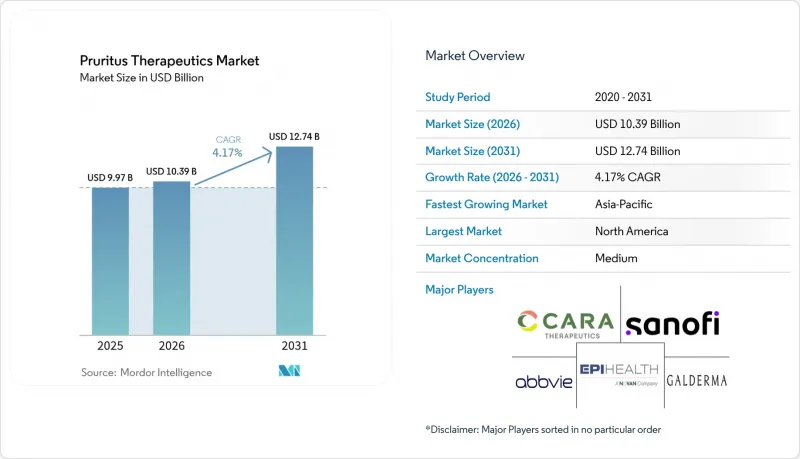
This report Segments the Industry by Product Type (Corticosteroids, Antihistamines, Local Anesthetics, Counterirritants, Immunosuppressants, Calcineurin Inhibitors, and More), Disease Type (Atopic Dermatitis, Allergic Contact Dermatitis, and More), and Geography (North America, Europe, Asia-Pacific, Middle East and Africa, South America). The Market Forecasts are Provided in Terms of Value (USD).
Global Pruritus Therapeutics Market Trends and Insights
Increasing Prevalence of Dermatological Disorders
Global itch prevalence is outpacing overall population growth; 14.2% of older adults report chronic pruritus compared with 1% among younger cohorts. Climate-linked allergen exposure and urban pollution raise atopic dermatitis incidence, especially in rapidly developing economies. Better diagnostics now classify several orphan pruritic conditions, which expands the treated population. Health systems increasingly assign specific reimbursement codes to chronic itch, lifting access to advanced therapies. As neurologists and oncologists incorporate pruritus management into routine care, the pruritus therapeutic market gains multidisciplinary visibility.
Aging Population with Chronic Inflammatory Skin Diseases
Longer life expectancy raises the pool of patients with recalcitrant eczema, prurigo nodularis, and lichen simplex; regional data show Northern Europe and North America carry the heaviest burden. Physicians prefer targeted biologics over systemic steroids in polypharmacy settings to avoid drug interactions. Universal health-coverage expansion enlarges diagnosis and treatment volumes in Asia-Pacific. Together, these demographic and policy shifts generate a durable demand base for the pruritus therapeutic market.
Limited Understanding of Pruritus Pathophysiology
Neuropathic itch still lacks an FDA-approved therapy; consensus diagnostic criteria only crystallized recently. Complex receptor pathways spanning TRPV1, TRPA1, and IL-31 complicate target validation. Chronic pruritus of unknown origin often affects elderly patients without reliable biomarkers, delaying drug development. Regulators remain cautious about unvalidated digital endpoints, extending clinical-trial timelines and raising costs across the pruritus therapeutic market.
Other drivers and restraints analyzed in the detailed report include:
- Commercial Launch of Biologics & JAK Inhibitors
- Rapid Uptake of Tele-Dermatology & E-Prescription Platforms
- Safety Concerns Over Long-Term Immunosuppressant Usage
For complete list of drivers and restraints, kindly check the Table Of Contents.
Segment Analysis
Corticosteroids retained a 34.98% revenue share in 2025, yet cumulative safety concerns and tachyphylaxis curb repeat prescriptions. JAK inhibitors contributed a modest share in 2025 but are projected to grow fastest at 5.59% CAGR, buoyed by 19.9% complete clearance rates shown by upadacitinib against dupilumab in head-to-head data. The pruritus therapeutic market size for JAK inhibitors could reach USD 2.49 billion by 2031 if label expansions continue. Antihistamines remain first-line for acute flare control, whereas calcineurin inhibitors occupy pediatric niches thanks to favorable safety in thin skin.
Nanofiber transdermal films enhance the delivery of counter-irritants and local anesthetics, raising adherence in mild cases. PDE-4 inhibitors are moving from psoriasis into atopic dermatitis, diversifying topical portfolios. Opioid receptor antagonists now feature in late-stage trials for cholestatic itch, while TRPM8 agonists explore cold-receptor modulation. Combination therapy and precision dosing are emerging norms, further fragmenting the pruritus therapeutic market.
Complete Report Scope:
- By Product Type
- Corticosteroids
- Antihistamines
- Local Anesthetics
- Counterirritants
- Immunosuppressants
- Calcineurin Inhibitors
- Opioid Receptor Antagonists
- Antidepressants
- PDE-4 Inhibitors
- JAK Inhibitors
- By Disease Type
- Atopic Dermatitis
- Allergic Contact Dermatitis
- Urticaria
- Cholestatic Pruritus
- Hematologic Pruritus
- Neuropathic Pruritus
- Oncologic Pruritus
- Other Disease Type
- By Geography
- North America
- United States
- Canada
- Mexico
- Europe
- Germany
- United Kingdom
- France
- Italy
- Spain
- Rest of Europe
- Asia-Pacific
- China
- Japan
- India
- Australia
- South Korea
- Rest of Asia-Pacific
- Middle East & Africa
- GCC
- South Africa
- Rest of Middle East & Africa
- South America
- Brazil
- Argentina
- Rest of South America
- North America
Geography Analysis
North America held 37.12% of 2025 revenue owing to early biologic access; yet, biosimilar competition and tighter PBM formularies are slowing incremental growth. Medicare fee cuts of 46% (inflation-adjusted) on dermatology procedures between 2007 and 2024 are nudging providers toward cost-optimized regimens. Large PBMs have already removed certain high-price biologics to favor low-cost adalimumab biosimilars. Even so, clinical-trial density and swift FDA review times retain the region's influence on global launch sequencing within the pruritus therapeutic market.
Asia-Pacific is on track for an 8.18% CAGR, benefiting from synchronized adoption of ICH guidelines and middle-class insurance expansion. China approved 228 new drugs in 2024, with accelerated pathways covering 71 molecules. Japan continues to deliver world-first dermatology approvals, including chronic spontaneous urticaria coverage for dupilumab, and facilitates topical roflumilast commercialization through co-development alliances. India's clearance of abrocitinib underscores regulatory convergence trends, while nationwide telehealth platforms extend specialty care to tier-2 cities.
Europe exhibits steady but moderated growth as biosimilar price competition intensifies. EMA cardiovascular warnings on JAK inhibitors influence physician choice, especially for older adults. Brexit-driven regulatory divergence adds filing complexity, although ICH efforts maintain broad alignment. Long-term opportunities lie in the Middle East, Africa, and South America, where improving infrastructure and NGO-backed access programs broaden the addressable base for the pruritus therapeutic market.
- Abbvie
- Pfizer
- Sanofi
- Galderma
- Cara Therapeutics
- Actavis (Teva)
- Astellas Pharma
- Trevi Therapeutics
- Epi Health
- Johnson & Johnson
- Eli Lilly and Company
- Bayer
- GlaxoSmithKline
- Novartis
- Regeneron Pharmaceuticals
- Incyte
- Leo Pharma
- Maruho Co., Ltd.
- Amgen
- Ocera Therapeutics
Additional Benefits:
- The market estimate (ME) sheet in Excel format
- 3 months of analyst support
TABLE OF CONTENTS
1 Introduction
- 1.1 Study Assumptions & Market Definition
- 1.2 Scope of the Study
2 Research Methodology
3 Executive Summary
4 Market Landscape
- 4.1 Market Overview
- 4.2 Market Drivers
- 4.2.1 Increasing Prevalence of Dermatological Disorders
- 4.2.2 Presence of High Unmet Medical Needs
- 4.2.3 Aging Population with Chronic Inflammatory Skin Diseases
- 4.2.4 Commercial Launch of Biologics & JAK Inhibitors
- 4.2.5 Rapid Uptake of Tele-Dermatology & E-Prescription Platforms
- 4.2.6 Innovative R&D Advancements in Neurogenic Itch Mechanisms
- 4.3 Market Restraints
- 4.3.1 Limited Understanding of Pruritus Pathophysiology
- 4.3.2 Safety Concerns Over Long-Term Immunosuppressant Usage
- 4.3.3 Availability of Symptomatic Non-Prescription Alternatives
- 4.3.4 Fragmented Reimbursement for Novel Biologics
- 4.4 Regulatory Landscape
- 4.5 Porter's Five Forces Analysis
- 4.5.1 Threat of New Entrants
- 4.5.2 Bargaining Power of Buyers
- 4.5.3 Bargaining Power of Suppliers
- 4.5.4 Threat of Substitute Products
- 4.5.5 Intensity of Competitive Rivalry
5 Market Size & Growth Forecasts (Value in USD)
- 5.1 By Product Type
- 5.1.1 Corticosteroids
- 5.1.2 Antihistamines
- 5.1.3 Local Anesthetics
- 5.1.4 Counterirritants
- 5.1.5 Immunosuppressants
- 5.1.6 Calcineurin Inhibitors
- 5.1.7 Opioid Receptor Antagonists
- 5.1.8 Antidepressants
- 5.1.9 PDE-4 Inhibitors
- 5.1.10 JAK Inhibitors
- 5.2 By Disease Type
- 5.2.1 Atopic Dermatitis
- 5.2.2 Allergic Contact Dermatitis
- 5.2.3 Urticaria
- 5.2.4 Cholestatic Pruritus
- 5.2.5 Hematologic Pruritus
- 5.2.6 Neuropathic Pruritus
- 5.2.7 Oncologic Pruritus
- 5.2.8 Other Disease Type
- 5.3 By Geography
- 5.3.1 North America
- 5.3.1.1 United States
- 5.3.1.2 Canada
- 5.3.1.3 Mexico
- 5.3.2 Europe
- 5.3.2.1 Germany
- 5.3.2.2 United Kingdom
- 5.3.2.3 France
- 5.3.2.4 Italy
- 5.3.2.5 Spain
- 5.3.2.6 Rest of Europe
- 5.3.3 Asia-Pacific
- 5.3.3.1 China
- 5.3.3.2 Japan
- 5.3.3.3 India
- 5.3.3.4 Australia
- 5.3.3.5 South Korea
- 5.3.3.6 Rest of Asia-Pacific
- 5.3.4 Middle East & Africa
- 5.3.4.1 GCC
- 5.3.4.2 South Africa
- 5.3.4.3 Rest of Middle East & Africa
- 5.3.5 South America
- 5.3.5.1 Brazil
- 5.3.5.2 Argentina
- 5.3.5.3 Rest of South America
- 5.3.1 North America
6 Competitive Landscape
- 6.1 Market Concentration
- 6.2 Market Share Analysis
- 6.3 Company Profiles (includes Global level Overview, Market level overview, Core Segments, Financials as available, Strategic Information, Market Rank/Share for key companies, Products & Services, and Recent Developments)
- 6.3.1 AbbVie Inc.
- 6.3.2 Pfizer Inc.
- 6.3.3 Sanofi
- 6.3.4 Galderma S.A.
- 6.3.5 Cara Therapeutics
- 6.3.6 Actavis (Teva)
- 6.3.7 Astellas Pharma Inc.
- 6.3.8 Trevi Therapeutics
- 6.3.9 EPI Health LLC
- 6.3.10 Johnson & Johnson
- 6.3.11 Eli Lilly & Co.
- 6.3.12 Bayer AG
- 6.3.13 GlaxoSmithKline plc
- 6.3.14 Novartis AG
- 6.3.15 Regeneron Pharmaceuticals
- 6.3.16 Incyte Corporation
- 6.3.17 LEO Pharma
- 6.3.18 Maruho Co., Ltd.
- 6.3.19 Amgen Inc.
- 6.3.20 Ocera Therapeutics
7 Market Opportunities & Future Outlook
- 7.1 White-space & Unmet-need Assessment

