PUBLISHER: Mordor Intelligence | PRODUCT CODE: 2116081

PUBLISHER: Mordor Intelligence | PRODUCT CODE: 2116081
Blood Pressure Monitoring Devices - Market Share Analysis, Industry Trends & Statistics, Growth Forecasts (2026 - 2031)
According to Mordor Intelligence, blood pressure monitoring devices market size in 2026 is estimated at USD 5.93 billion, growing from 2025 value of USD 5.38 billion with 2031 projections showing USD 9.61 billion, growing at 10.15% CAGR over 2026-2031.
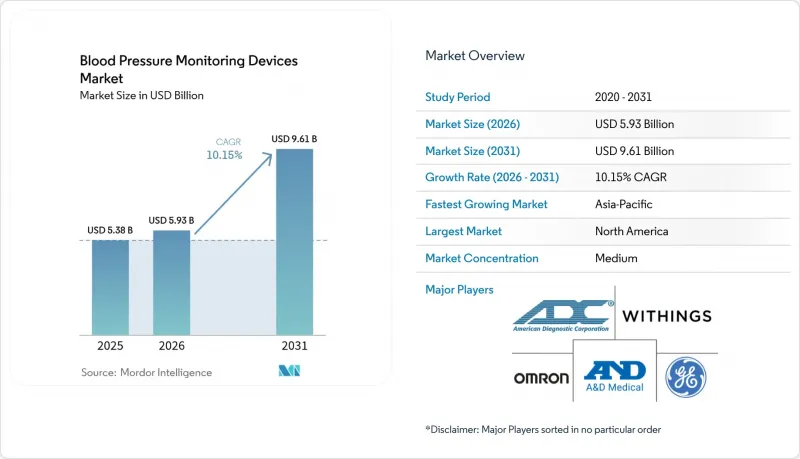
This report Segments the Industry Into by Product Type (Upper Arm Monitors, Wrist Monitors, Ambulatory BP Monitors, Cuffless Wearables, and Accessories), End User (Hospitals, Ambulatory Surgical Centers, and More), and Geography (North America, Europe, Asia-Pacific, Middle East and Africa, and South America). The Market Forecasts are Provided in Terms of Value (USD).
Global Blood Pressure Monitoring Devices Market Trends and Insights
Rising Prevalence of Hypertension and Cardiovascular Diseases
Hypertension affects more than 1 billion people worldwide, and deaths attributable to elevated systolic pressure have continued to climb in absolute terms despite falling age-standardized rates. Screening programs inside large employers found that 17.6% of staff with no prior diagnosis register hypertensive readings, uncovering extensive silent disease pools. Health-system analyses show that early workplace detection boosted new hypertension diagnoses by 81% and raised antihypertensive prescriptions by 127%, confirming direct therapeutic value for continuous monitoring. These findings intensify procurement of scalable devices that work beyond clinics and drive the blood pressure monitoring devices market toward integrated solutions. They also reinforce payer interest in preventive benefits that offset future cardiovascular treatment costs.
Technological Advancements in Cuffless Monitoring
Cuffless blood pressure monitoring now sets the pace in product innovation. Nanowear's SimpleSense-BP received FDA 510(k) clearance in 2024 as the first non-invasive continuous system, validating nanotechnology and AI analytics in routine hypertension care. Apple secured a patent for liquid-filled sensors that could bring medical-grade accuracy to future Apple Watch models, signaling Big-Tech entry into regulated cardiovascular wearables. Academic teams at Caltech introduced resonance sonomanometry, which uses sound waves plus ultrasound to generate full waveform readings without arterial lines. Each breakthrough raises expectations for real-time trend analysis, data portability, and patient comfort, fueling premium demand inside the blood pressure monitoring devices market.
Regulatory Approval Complexities for Innovative Devices
Validation protocols for cuffless devices remain in flux. The FDA recognized IEEE 1708-2014 but flagged certain observer-training clauses as incompatible with automated workflows, creating partial guidance only. Multicenter trials revealed that some optical wearables under-perform against ambulatory monitors, particularly after medication titrations, which slows payer adoption. Pediatric use requires separate 3-to-12-year trials, adding cost layers that deter smaller innovators. As a result, time-to-market elongates and compliance expenditure rises, applying a brake to the blood pressure monitoring devices market.
Other drivers and restraints analyzed in the detailed report include:
- Increasing Adoption of Remote Patient Monitoring
- Growing Awareness of Home Healthcare Benefits
- High Costs of Advanced Monitoring Technologies
For complete list of drivers and restraints, kindly check the Table Of Contents.
Segment Analysis
The upper-arm monitors category controlled 59.10% of the blood pressure monitoring devices market share in 2025, reflecting entrenched clinical confidence in oscillometric cuffs. Nevertheless, cuffless wearables are advancing at a 12.07% CAGR through 2031, translating into a fast-rising portion of the blood pressure monitoring devices market size for this segment. Hospitals and insurers are increasingly recognizing the importance of continuous waveform capture for managing nocturnal hypertension, which favors optoelectronic patches and smartwatches. Nanowear's FDA-cleared SimpleSense-BP underscored this pivot by demonstrating real-world accuracy without inflation cycles, while Apple's patent pipeline illustrates mainstream consumer potential.
Demand for ambulatory monitors also persists as clinicians prescribe 24-hour profiles to confirm white-coat or masked hypertension. SunTech Medical's takeover of Meditech consolidated expertise that targets this niche, adding software that automates reporting into electronic records. Meanwhile, aneroid sphygmomanometers retreat as facilities modernize. Digital wrist cuffs benefit from comfort-driven upgrades though remain secondary in most guidelines. The overall competitive dynamic therefore hinges on balancing physicians' insistence on validation with patients' desire for unobtrusive wear, a balance that shapes long-run volume in the blood pressure monitoring devices market.
Complete Report Scope:
- By Product Type
- Upper Arm Monitors
- Wrist Monitors
- Ambulatory BP Monitors
- Cuffless Wearables
- Accessories (Cuffs & Others)
- By End User
- Hospitals
- Ambulatory Surgical Centers & Clinics
- Home Healthcare Settings
- Other End Users
- By Geography
- North America
- United States
- Canada
- Mexico
- Europe
- Germany
- United Kingdom
- France
- Italy
- Spain
- Rest of Europe
- Asia-Pacific
- China
- Japan
- India
- South Korea
- Australia
- Rest of Asia-Pacific
- Middle East and Africa
- GCC
- South Africa
- Rest of Middle East and Africa
- South America
- Brazil
- Argentina
- Rest of South America
- North America
Geography Analysis
North America accounted for 35.20% of 2025 revenues, supported by advanced infrastructure and well-defined billing codes that facilitate remote monitoring. The region nonetheless examines supply resilience after tariffs disrupted 70% of inbound medical device volumes, prompting buyers to certify supplier origin and consider near-shoring options. Canada and Mexico boost regional momentum through e-health funding and cross-border regulatory alignment that shortens clearance timelines. These conditions sustain the blood pressure monitoring devices market, but they also promote investment in dual-sourced components.
The Asia-Pacific region delivers the swiftest growth at a 12.02% CAGR to 2031, reflecting demographic aging, hypertension prevalence, and an active policy that accelerates device approvals. China's National Medical Products Administration cleared 61 innovative medical devices in 2023, representing an 11% year-over-year increase, under an accelerated pathway that prioritizes high-impact technologies. India projects its medical device sector to grow from USD 5.2 billion to USD 50 billion by 2030, driven by production-linked incentives and a single-window approval system. These reforms, together with local manufacturing grants, expand domestic supply and lower pricing, thereby broadening the regional market for blood pressure monitoring devices.
Europe benefits from entrenched universal healthcare that values validated accuracy. Adoption spreads as country panels harmonize cuffless performance requirements across notified bodies, giving innovators a predictable dossier route. Brazil, through ANVISA, now accepts FDA or TGA approvals to streamline entry, exemplifying regulatory convergence that also influences other Latin American markets. Additionally, the Pan American Health Organization's HEARTS program mandates the exclusive use of validated monitors in primary care by 2025, fostering quality benchmarks across South America. Middle Eastern and African nations are allocating increasing capital to chronic disease management, installing telehealth hubs that integrate validated blood pressure monitoring modules. Across these varied geographies, policy alignment and disease burden continue to underpin the global expansion of the blood pressure monitoring devices market.
- OMRON
- A&D Medical
- Koninklijke Philips
- Microlife
- Withings
- Beurer
- Welch Allyn / Hillrom
- GE Healthcare
- Smiths Group
- SunTech Medical
- Yuwell Jiangsu Yuyue
- Rossmax
- iHealth Labs
- Qardio Inc.
- ForaCare AG
- Braun (Healthcare)
- Panasonic Healthcare
- Greater Goods
- Veridian Healthcare
- American Diagnostic
Additional Benefits:
- The market estimate (ME) sheet in Excel format
- 3 months of analyst support
TABLE OF CONTENTS
1 Introduction
- 1.1 Study Assumptions & Market Definition
- 1.2 Scope of the Study
2 Research Methodology
3 Executive Summary
4 Market Landscape
- 4.1 Market Overview
- 4.2 Market Drivers
- 4.2.1 Rising Prevalence of Hypertension and Cardiovascular Diseases
- 4.2.2 Technological Advancements in Cuffless Monitoring
- 4.2.3 Increasing Adoption of Remote Patient Monitoring
- 4.2.4 Growing Awareness of Home Healthcare Benefits
- 4.2.5 Aging Population Demographics
- 4.2.6 Government Initiatives for Preventive Healthcare
- 4.3 Market Restraints
- 4.3.1 Regulatory Approval Complexities for Innovative Devices
- 4.3.2 High Costs of Advanced Monitoring Technologies
- 4.3.3 Accuracy Concerns with Cuffless Devices
- 4.3.4 Data Privacy and Security Concerns
- 4.4 Value / Supply-Chain Analysis
- 4.5 Regulatory Landscape
- 4.6 Technological Outlook
- 4.7 Porter's Five Forces Analysis
- 4.7.1 Buyer Power
- 4.7.2 Supplier Power
- 4.7.3 Threat of New Entrants
- 4.7.4 Threat of Substitutes
- 4.7.5 Competitive Rivalry
5 Market Size & Growth Forecasts
- 5.1 By Product Type
- 5.1.1 Upper Arm Monitors
- 5.1.2 Wrist Monitors
- 5.1.3 Ambulatory BP Monitors
- 5.1.4 Cuffless Wearables
- 5.1.5 Accessories (Cuffs & Others)
- 5.2 By End User
- 5.2.1 Hospitals
- 5.2.2 Ambulatory Surgical Centers & Clinics
- 5.2.3 Home Healthcare Settings
- 5.2.4 Other End Users
- 5.3 By Geography
- 5.3.1 North America
- 5.3.1.1 United States
- 5.3.1.2 Canada
- 5.3.1.3 Mexico
- 5.3.2 Europe
- 5.3.2.1 Germany
- 5.3.2.2 United Kingdom
- 5.3.2.3 France
- 5.3.2.4 Italy
- 5.3.2.5 Spain
- 5.3.2.6 Rest of Europe
- 5.3.3 Asia-Pacific
- 5.3.3.1 China
- 5.3.3.2 Japan
- 5.3.3.3 India
- 5.3.3.4 South Korea
- 5.3.3.5 Australia
- 5.3.3.6 Rest of Asia-Pacific
- 5.3.4 Middle East and Africa
- 5.3.4.1 GCC
- 5.3.4.2 South Africa
- 5.3.4.3 Rest of Middle East and Africa
- 5.3.5 South America
- 5.3.5.1 Brazil
- 5.3.5.2 Argentina
- 5.3.5.3 Rest of South America
- 5.3.1 North America
6 Competitive Landscape
- 6.1 Market Concentration
- 6.2 Market Share Analysis
- 6.3 Company Profiles (includes Global level Overview, Market Level Overview, Core Segments, Financials as Available, Strategic Information, Market Rank/Share for Key Companies, Products & Services, and Recent Developments)
- 6.3.1 Omron Healthcare
- 6.3.2 A&D Medical
- 6.3.3 Philips Healthcare
- 6.3.4 Microlife Corporation
- 6.3.5 Withings
- 6.3.6 Beurer GmbH
- 6.3.7 Welch Allyn / Hillrom
- 6.3.8 GE Healthcare
- 6.3.9 Smiths Medical
- 6.3.10 SunTech Medical
- 6.3.11 Yuwell Jiangsu Yuyue
- 6.3.12 Rossmax International
- 6.3.13 iHealth Labs
- 6.3.14 Qardio Inc.
- 6.3.15 ForaCare AG
- 6.3.16 Braun (Healthcare)
- 6.3.17 Panasonic Healthcare
- 6.3.18 Greater Goods
- 6.3.19 Veridian Healthcare
- 6.3.20 American Diagnostics Corporation
7 Market Opportunities & Future Outlook
- 7.1 White-space & Unmet-need Assessment

