PUBLISHER: Mordor Intelligence | PRODUCT CODE: 2116085

PUBLISHER: Mordor Intelligence | PRODUCT CODE: 2116085
Pork Meat - Market Share Analysis, Industry Trends & Statistics, Growth Forecasts (2026 - 2031)
According to Mordor Intelligence, the global pork meat market size was valued at USD 406.76 billion in 2025 and estimated to grow from USD 416.12 billion in 2026 to reach USD 466.13 billion by 2031, at a CAGR of 2.30% during the forecast period (2026-2031).
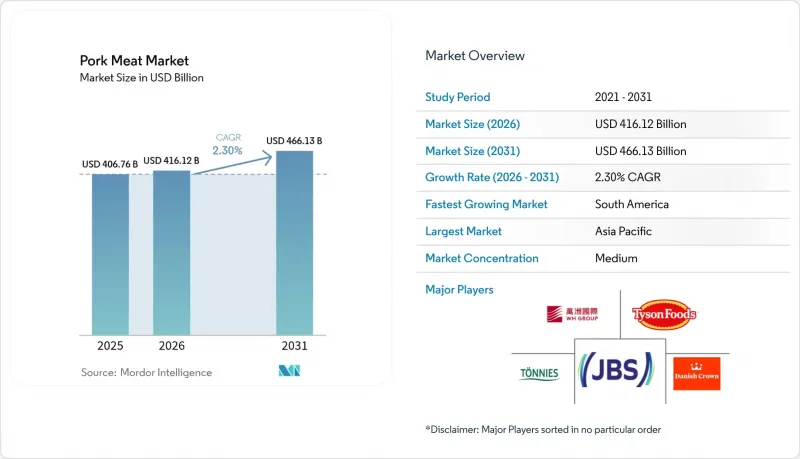
This report is Segmented by Meat Form(Fresh/Chilled, Frozen, and More), Nature (Conventional and Organic), Cut Type (Ham, Ribs and Others), Distribution Channel (Off-Trade and On-Trade), and Geography (North America, Europe, and More). The Market Forecasts are Provided in Terms of Value (USD) and Volume (Tonnes).
Global Pork Meat Market Trends and Insights
Rising Consumer Preference for Protein-rich Diets Drives Market Growth
The increasing consumer awareness about protein-rich diets is driving the growth of the global pork meat market. Pork meat, being rich in high-quality protein, B-complex vitamins, and essential minerals such as zinc and iron, aligns with the growing consumer focus on nutritional value. Health-conscious consumers actively seek high-protein food options, recognizing proteins' role in muscle development, weight management, and overall health. The rising fitness culture and adoption of dietary patterns like keto and paleo diets have further increased the demand for protein-rich meat products. The availability of portion-controlled frozen pork products helps consumers manage their protein consumption while offering longer shelf life compared to fresh alternatives. According to the Food and Agriculture Organization (FAO), the global undernourishment rate was 9.1% in 2023, indicating the potential for pork meat to serve as an affordable protein source to improve dietary nutrition. These factors collectively contribute to the sustained demand for pork meat products in the global market.
Expansion of Cold Chain Infrastructure Facilitates Wider Distribution and Freshness
The expansion of cold chain infrastructure is significantly driving the global pork meat market by enabling efficient transportation and storage of pork products across longer distances while maintaining product quality. Modern cold chain facilities incorporate technologies like IoT sensors and automated temperature monitoring systems to ensure consistent temperature control during storage and transportation. According to the UN Environment Programme, developing countries experience approximately 40% of food loss during production to retail due to incomplete cold chains, highlighting the importance of robust cold chain networks . Recent innovations in temperature management, on raising frozen meat storage temperatures from -18°C to -12°C, demonstrate potential for reducing carbon emissions and energy costs while maintaining product quality according to the Australian Meat Processor Corporation . The development of temperature-controlled warehouses, refrigerated trucks, and advanced packaging solutions helps preserve the freshness and safety of pork meat throughout the supply chain, reduces food waste by extending shelf life, and enables retailers and distributors to maintain larger inventories to respond effectively to market demand fluctuations.
Environmental and Animal Welfare Issues Raise Regulatory and Consumer Challenges
The pork meat market faces significant constraints due to growing environmental and animal welfare concerns. Stringent regulations regarding livestock farming practices, waste management, and animal housing conditions increase operational costs for producers. Consumer awareness about sustainable farming practices and animal welfare has led to increased demand for ethically sourced pork products, requiring producers to implement costly certification programs. Additionally, environmental regulations targeting greenhouse gas emissions from pig farms and waste management systems create compliance challenges for farmers. The industry also faces pressure to reduce its water consumption and implement proper manure management systems, which requires substantial capital investment. These environmental and welfare requirements, combined with varying regional regulations, create operational complexities and impact profit margins across the global pork supply chain.
Other drivers and restraints analyzed in the detailed report include:
- Growth in the Foodservice and Hospitality Industry (On-Trade) Supports Market Demand.
- Increasing Demand for Processed and Convenient Pork Products Boosts Sales
- Competition from Alternative Proteins such as Plant-based and Poultry Products Restrains Growth
For complete list of drivers and restraints, kindly check the Table Of Contents.
Segment Analysis
Fresh/chilled pork dominates the market with a 62.95% share in 2025, as consumers consistently choose these products for their perceived superior quality and versatility in cooking applications. This segment maintains its market leadership position through established distribution networks and strong consumer trust in traditional meat purchasing habits. The preference for fresh pork is particularly evident in Asian markets, where daily shopping for fresh meat remains a cultural norm. Additionally, retail chains and butcher shops continue to expand their fresh pork offerings, supported by improvements in cold chain logistics and storage facilities.
The frozen pork segment exhibits significant growth potential with a projected CAGR of 6.55% during 2026-2031, supported by advancing preservation technologies and increasing consumer demand for convenient meal solutions. While canned and preserved pork products occupy a smaller market share, they maintain steady demand through emergency preparedness markets and regions where cold chain infrastructure remains limited. The frozen segment benefits from extended shelf life and bulk purchasing options, making it attractive to food service operators and cost-conscious consumers. Modern quick-freezing techniques have also improved the quality perception of frozen pork, contributing to its growing acceptance in both developed and emerging markets.
The conventional segment commands a dominant 80.62% market share in 2025, supported by well-established supply chains and cost advantages that resonate with price-sensitive consumers. This segment benefits from economies of scale, standardized production processes, and widespread distribution networks that enable competitive pricing and consistent availability across global markets. The conventional pork industry's robust infrastructure and efficient production methods continue to meet the high-volume demands of processors and retailers. Additionally, established quality control measures and regulatory compliance frameworks ensure consistent product quality while maintaining cost-effectiveness.
While conventional pork maintains its market leadership, the organic segment is experiencing rapid growth with a projected CAGR of 7.09% during 2026-2031. This growth is primarily fueled by increasing health consciousness among consumers and their willingness to pay premium prices for organic pork products. However, the acceptance of premium-priced organic and traceable pork products shows notable regional variations, reflecting differences in consumer preferences and purchasing power across markets. The organic pork segment is also benefiting from increasing transparency in production methods and stricter certification standards. Furthermore, growing awareness about animal welfare and environmental sustainability is strengthening consumer trust in organic pork products.
Complete Report Scope:
- By Meat Form
- Fresh/Chilled
- Frozen
- Canned/Preserved
- By Nature
- Conventional
- Organic
- By Cut Type
- Ham
- Ribs
- Others
- By Distribution Channel
- Off-Trade
- Supermarkets/Hypermarkets
- Convinience Stores
- Specialty Stores
- Online Retail Stores
- Other Distribution Channels
- On-Trade
- Off-Trade
- By Geography
- North America
- United States
- Canada
- Mexico
- Rest of North America
- Europe
- Germany
- France
- United Kingdom
- Spain
- Netherlands
- Italy
- Sweden
- Poland
- Belgium
- Rest of Europe
- Asia-Pacific
- China
- India
- Japan
- Australia
- South Korea
- Indonesia
- Thailand
- Singapore
- Rest of Asia-Pacific
- South America
- Brazil
- Argentina
- Chile
- Colombia
- Peru
- Rest of South America
- Middle East and Africa
- United Arab Emirates
- South Africa
- Nigeria
- Egypt
- Turkey
- Rest of Middle East and Africa
- North America
Geography Analysis
In 2025, Asia-Pacific commands a dominant 57.54% share of the market, but growth patterns tell a nuanced story. While China's mature market edges toward saturation, Southeast Asian nations are experiencing a surge in demand, driven by a shift from plant-based to animal proteins. Notably, many countries still see per capita pork consumption lagging behind dietary recommendations, hinting at potential growth. This demand is bolstered by urbanization, rising incomes, and the increasing footprint of modern food retail and services.
South America emerges as the global pork market's fastest-growing contender, eyeing a robust 15.05% CAGR from 2026 to 2031. Brazil stands at the forefront, enhancing production efficiency and diversifying its export markets. Bolstered by government policies promoting agricultural growth and modern farming, Brazil's competitiveness is further amplified by advancements in processing infrastructure and cold chain capabilities, ensuring exports meet global quality standards.
North America and Europe, both seasoned players in the pork market, chart a course of steady, moderate growth. These regions are pivoting towards value-added products and sustainability to sharpen their competitive edge. They navigate rising regulatory challenges and competition from alternative proteins, all while aligning with shifting consumer tastes. A commitment to animal welfare and environmental sustainability is evident, with both regions adopting cutting-edge technologies for waste management and carbon footprint reduction. Additionally, they're at the helm of crafting innovative packaging and convenience products, resonating with the evolving lifestyles and preferences of consumers.
- JBS SA
- Tyson Foods Inc
- Vion Food Group
- Cooperl Arc Atlantique
- Hormel Foods Corporation
- Danish Crown A/S
- Charoen Pokphand Group
- Premium Food Group
- WH Group Ltd.
- BRF S.A.
- Yurun Holding Group
- Seaboard Corporation
- NH Foods Ltd.
- Frimesa Cooperativa Central
- Grupo Vall Companys
- Marfrig Global Foods Brazil
- Tonnies Holding GmbH & Co. KG
- Arthur's Food Company Pvt. Ltd.,
- Dawn Meats Group
- The Campofrio Food Group S.A.U
Additional Benefits:
- The market estimate (ME) sheet in Excel format
- 3 months of analyst support
TABLE OF CONTENTS
1 INTRODUCTION
- 1.1 Study Assumptions and Market Definition
- 1.2 Scope of the Study
2 RESEARCH METHODOLOGY
3 EXECUTIVE SUMMARY
4 MARKET LANDSCAPE
- 4.1 Market Overview
- 4.2 Market Drivers
- 4.2.1 Rising consumer preference for protein-rich diets drives market growth
- 4.2.2 Expansion of cold chain infrastructure facilitates wider distribution and freshness
- 4.2.3 Growth in the foodservice and hospitality industry (on-trade) supports market demand
- 4.2.4 Increasing demand for processed and convenient pork products boosts sales
- 4.2.5 Advances in livestock farming and breeding techniques enhance production efficiency
- 4.2.6 Increasing adoption of western dietary habits in developing countries contributes to higher pork consumption
- 4.3 Market Restraints
- 4.3.1 Environmental and animal welfare issues raise regulatory and consumer challenges
- 4.3.2 Competition from alternative proteins such as plant-based and poultry products restrains growth
- 4.3.3 Volatility in feed prices increases production costs and affects profitability
- 4.3.4 Religious and cultural restrictions in various regions limit pork consumption and market growth
- 4.4 Value and Supply-Chain Analysis
- 4.5 Regulatory Outlook
- 4.6 Technological Outlook
- 4.7 Porter's Five Forces
- 4.7.1 Threat of New Entrants
- 4.7.2 Bargaining Power of Buyers
- 4.7.3 Bargaining Power of Suppliers
- 4.7.4 Threat of Substitutes
- 4.7.5 Intensity of Competitive Rivalry
5 MARKET SIZE AND GROWTH FORECASTS (VALUE,VOLUME)
- 5.1 By Meat Form
- 5.1.1 Fresh/Chilled
- 5.1.2 Frozen
- 5.1.3 Canned/Preserved
- 5.2 By Nature
- 5.2.1 Conventional
- 5.2.2 Organic
- 5.3 By Cut Type
- 5.3.1 Ham
- 5.3.2 Ribs
- 5.3.3 Others
- 5.4 By Distribution Channel
- 5.4.1 Off-Trade
- 5.4.1.1 Supermarkets/Hypermarkets
- 5.4.1.2 Convinience Stores
- 5.4.1.3 Specialty Stores
- 5.4.1.4 Online Retail Stores
- 5.4.1.5 Other Distribution Channels
- 5.4.2 On-Trade
- 5.4.1 Off-Trade
- 5.5 By Geography
- 5.5.1 North America
- 5.5.1.1 United States
- 5.5.1.2 Canada
- 5.5.1.3 Mexico
- 5.5.1.4 Rest of North America
- 5.5.2 Europe
- 5.5.2.1 Germany
- 5.5.2.2 France
- 5.5.2.3 United Kingdom
- 5.5.2.4 Spain
- 5.5.2.5 Netherlands
- 5.5.2.6 Italy
- 5.5.2.7 Sweden
- 5.5.2.8 Poland
- 5.5.2.9 Belgium
- 5.5.2.10 Rest of Europe
- 5.5.3 Asia-Pacific
- 5.5.3.1 China
- 5.5.3.2 India
- 5.5.3.3 Japan
- 5.5.3.4 Australia
- 5.5.3.5 South Korea
- 5.5.3.6 Indonesia
- 5.5.3.7 Thailand
- 5.5.3.8 Singapore
- 5.5.3.9 Rest of Asia-Pacific
- 5.5.4 South America
- 5.5.4.1 Brazil
- 5.5.4.2 Argentina
- 5.5.4.3 Chile
- 5.5.4.4 Colombia
- 5.5.4.5 Peru
- 5.5.4.6 Rest of South America
- 5.5.5 Middle East and Africa
- 5.5.5.1 United Arab Emirates
- 5.5.5.2 South Africa
- 5.5.5.3 Nigeria
- 5.5.5.4 Egypt
- 5.5.5.5 Turkey
- 5.5.5.6 Rest of Middle East and Africa
- 5.5.1 North America
6 COMPETITIVE LANDSCAPE
- 6.1 Market Concentration
- 6.2 Strategic Moves
- 6.3 Market Share Analysis
- 6.4 Company Profiles (includes Global level Overview, Market level overview, Core Segments, Financials as available, Strategic Information, Market Rank/Share, Products and Services, Recent Developments)
- 6.4.1 JBS SA
- 6.4.2 Tyson Foods Inc
- 6.4.3 Vion Food Group
- 6.4.4 Cooperl Arc Atlantique
- 6.4.5 Hormel Foods Corporation
- 6.4.6 Danish Crown A/S
- 6.4.7 Charoen Pokphand Group
- 6.4.8 Premium Food Group
- 6.4.9 WH Group Ltd.
- 6.4.10 BRF S.A.
- 6.4.11 Yurun Holding Group
- 6.4.12 Seaboard Corporation
- 6.4.13 NH Foods Ltd.
- 6.4.14 Frimesa Cooperativa Central
- 6.4.15 Grupo Vall Companys
- 6.4.16 Marfrig Global Foods Brazil
- 6.4.17 Tonnies Holding GmbH & Co. KG
- 6.4.18 Arthur's Food Company Pvt. Ltd.,
- 6.4.19 Dawn Meats Group
- 6.4.20 The Campofrio Food Group S.A.U
7 MARKET OPPORTUNITIES AND FUTURE OUTLOOK

