PUBLISHER: Mordor Intelligence | PRODUCT CODE: 2116087

PUBLISHER: Mordor Intelligence | PRODUCT CODE: 2116087
Textured Soy Protein - Market Share Analysis, Industry Trends & Statistics, Growth Forecasts (2026 - 2031)
According to Mordor Intelligence, the textured soy protein market, valued at USD 1.37 billion in 2026, is projected to reach USD 1.87 billion by 2031, growing at a CAGR of 6.37%.
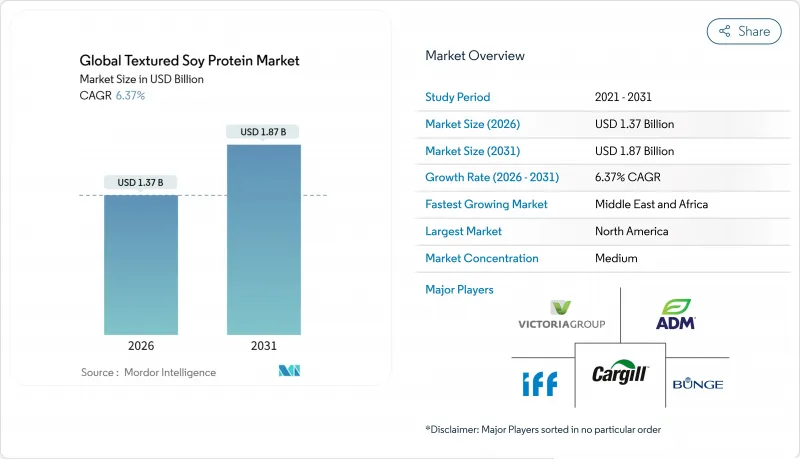
This report is Segmented by Type (Conventional, Organic), Application (Food and Beverages, Animal Feed), and Geography (North America, Europe, Asia-Pacific, South America, Middle East and Africa). The Market Forecasts are Provided in Terms of Value (USD).
Global Textured Soy Protein Market Trends and Insights
Awareness of Obesity and Chronic Diseases Drives Soy Protein Demand
By 2050, the Lancet Global Burden of Disease study predicts that over 1 billion people globally will grapple with obesity. This trend is steering protein consumption towards lower-fat, plant-based alternatives. Textured soy protein, boasting a protein content of 50% to 70% and minimal saturated fat, is carving a niche as a functional ingredient in processed foods aimed at weight management and heart health. This trend is especially evident in North America and Europe, where public health initiatives and front-of-pack nutrition labels heighten consumer awareness of ingredient choices. The U.S. Department of Agriculture's Dietary Guidelines for Americans advocate for plant protein consumption, subtly endorsing soy-based products in school meals and institutional catering. Moreover, corporate wellness initiatives are embracing plant-centric menus, paving a B2B avenue for textured soy protein in office cafeterias. This suggests that the rising demand isn't just confined to retail but is also making inroads into foodservice and institutional sectors, offering processors a chance for stable revenue through volume contracts.
Clean-Label and Allergen-Managed Proteins Boost Textured Soy Protein's Appeal
The Food and Drug Administration enforces the Food Allergen Labeling and Consumer Protection Act, requiring soy to be clearly labeled as one of the nine major allergens. This regulation enhances transparency and builds trust among consumers managing dietary restrictions. In response, manufacturers are increasingly sourcing identity-preserved soybeans and obtaining third-party certifications like the Non-GMO Project Verified label, which commands a 20% to 30% retail price premium over conventional options. Additionally, the United States Department of Agriculture's National Organic Program standards have created a niche for organic textured soy protein, appealing to consumers who value pesticide-free farming and regenerative agriculture. This regulatory framework has led to a two-tiered market, where conventional products compete on price, while certified offerings target premium segments. To succeed in clean-label positioning, companies must invest in upstream traceability, from seed selection to processing. Those unable to meet these requirements risk margin compression as retailers increasingly demand detailed documentation.
Perception as Processed "Fake Meat" Reduces Appeal for Flexitarians
Flexitarians, who cut back on meat but don't completely forgo it, are increasingly favoring whole-food ingredients over their highly processed counterparts. This shift in preference poses challenges for textured soy protein formulations, which are often viewed as overly industrial. The label "fake meat" has taken on a negative tone, a sentiment heightened by media discussions linking ultra-processed foods to metabolic disorders. This perception is especially pronounced in North America and Europe, regions where clean-eating advocates champion ingredient transparency and minimalism. In response, manufacturers are streamlining ingredient lists and emphasizing protein density and allergen management on packaging. Despite these efforts, a stigma remains, with many consumers associating processing with a decline in nutritional value. Strategically, this means that product positioning should not only highlight functional benefits like cost-effectiveness and shelf life but also focus on sensory and nutritional qualities that appeal to discerning consumers. Brands that mismanage this balance may find themselves losing ground to less-processed options, such as whole beans, tempeh, or lightly processed legume flours.
Other drivers and restraints analyzed in the detailed report include:
- Broad Application in Food Processing, from Ground Meat Extenders to Ready-to-Eat Meals and Snacks
- Extrusion Technology Improves Soy-Based Analogue Textures
- Supply Chain Issues in Soybean Sourcing Disrupt Production and Quality
For complete list of drivers and restraints, kindly check the Table Of Contents.
Segment Analysis
In 2025, conventional textured soy protein dominated the market with an 86.71% share, driven by decades of infrastructure investments in North America's Corn Belt and Asia-Pacific's soybean processing hubs. Archer Daniels Midland Company's USD 300 million expansion in Decatur, Illinois, doubled soy protein concentrate capacity, showcasing economies of scale achieved through vertical integration. Conventional variants benefit from established supply chains, consistent agronomic inputs, and regulatory familiarity, enabling processors to deliver quality at 20% to 30% lower costs than organic equivalents. This cost advantage makes them ideal for price-sensitive applications like ground meat extenders and institutional foodservice. Bunge's USD 550 million soy protein concentrate facility in Indiana, operational since mid-2025 and processing 4.5 million bushels annually, highlights the capital investments reinforcing the segment's structural advantages.
Meanwhile, organic textured soy protein, though smaller in share, is projected to grow at a 7.81% CAGR through 2031, driven by USDA organic standards requiring pesticide-free cultivation, non-GMO seeds, and three-year land transitions. Despite 20% to 30% price premiums due to higher input costs and lower yields, health-conscious consumers and premium brands support its growth for clean-label positioning. Retailers like Whole Foods prioritize organic certifications, giving processors with identity-preserved supply chains and third-party audits a distribution edge. While organic textured soy protein remains a niche segment emphasizing value over volume, processors must manage the complexities of dual-track systems to prevent cross-contamination between conventional and organic streams.
Complete Report Scope:
- Type
- Conventional
- Organic
- Application
- Food and Beverages
- Meat Substitutes
- Dairy Alternatives
- Infant Nutrition
- Bakery Products
- Cereal and Snacks
- Other Food Applications
- Animal Feed
- Food and Beverages
- Geography
- North America
- United States
- Canada
- Mexico
- Rest of North America
- Europe
- Germany
- United Kingdom
- Italy
- France
- Rest of Europe
- Asia-Pacific
- China
- India
- Japan
- Australia
- Rest of Asia-Pacific
- South America
- Brazil
- Argentina
- Colombia
- Rest of South America
- Middle East and Africa
- South Africa
- Saudi Arabia
- United Arab Emirates
- Rest of Middle East and Africa
- North America
Geography Analysis
In 2025, North America held a 36.33% market share, driven by vertically integrated processors, favorable soybean agronomics, and mature distribution networks. Key developments included Bunge's USD 550 million soy protein concentrate facility in Indiana, processing 4.5 million bushels annually, and Archer Daniels Midland Company's USD 300 million expansion in Decatur, Illinois, which doubled production capacity. The U.S., with the world's largest soybean harvest averaging 120 million metric tonnes annually, benefits from clear regulatory frameworks like FDA allergen labeling and USDA organic standards. Canada is emerging as an export-oriented hub, supported by Protein Industries Canada's CA 23.9 million investment in Ontario's soy processing infrastructure. However, drought in 2024 caused an 8% to 10% decline in soybean output, raising input costs and limiting margins.
Europe and Asia-Pacific are growing steadily, with China's urbanization boosting protein consumption and India's vegetarian population driving demand for affordable meat alternatives. China's 14th Five-Year Plan promotes alternative proteins to reduce pork imports, while India's National Mission on Sustainable Agriculture supports soybeans as climate-resilient crops. Japan's aging population is shifting demand toward plant-based proteins, with companies like DAIZ launching textured soy protein products. Europe's Farm to Fork Strategy, with EUR 10 billion for sustainable food systems, supports plant proteins, though fragmented supply chains and low soybean production limit self-sufficiency. South America, led by Brazil and Argentina, remains a major soybean exporter but lacks significant value-added processing capacity.
The Middle East and Africa are projected to grow at a 7.50% CAGR through 2031, driven by halal-certified plant proteins in Saudi Arabia and the UAE. Saudi Arabia's Vision 2030 emphasizes domestic protein production, while the UAE attracts multinational investments targeting local and re-export markets. Halal certification adds a unique compliance factor, and South Africa's nascent plant-based sector is growing as urban consumers adopt flexitarian diets. Early movers with halal-certified production and distribution partnerships can capture market share, though infrastructure gaps and reliance on imported feedstock pose challenges.
- Archer-Daniels-Midland Company
- Cargill, Incorporated
- Wilmar International Limited
- Bunge Global SA
- CHS Inc.
- Crown Soya Protein Group
- Sonic Biochem
- Victoria Group
- Bremil Group
- International Flavors & Fragrances Inc.
- Shandong Yuxin Biotechnology
- Sojaprotein Novi Sad
- Gushen Biological Technology
- Fuji Oil Co., Ltd.
- Shandong Sanwei Soy Protein
- Beneo (Germany)
- Top Agri Group
- Wonderful Industrial Group
- The Scoular Company
- Kansas Protein Foods
- Foodchem International Corp.
- Axiom Foods Inc.
Additional Benefits:
- The market estimate (ME) sheet in Excel format
- 3 months of analyst support
TABLE OF CONTENTS
1 INTRODUCTION
- 1.1 Study Assumptions and Market Definition
- 1.2 Scope of the Study
2 RESEARCH METHODOLOGY
3 EXECUTIVE SUMMARY
4 MARKET LANDSCAPE
- 4.1 Market Overview
- 4.2 Market Drivers
- 4.2.1 Awareness of obesity and chronic diseases drives soy protein demand
- 4.2.2 Clean-label and allergen-managed proteins boost textured soy protein's appeal
- 4.2.3 Broad application in food processing, from ground meat extenders to ready-to-eat meals and snacks
- 4.2.4 Extrusion technology improves soy-based analogue textures
- 4.2.5 Environmental concerns favor sustainable plant proteins like soy
- 4.2.6 Governments promote alternative proteins for sustainability
- 4.3 Market Restraints
- 4.3.1 Perception as processed "fake meat" reduces appeal for flexitarians
- 4.3.2 Supply chain issues in soybean sourcing disrupt production and quality
- 4.3.3 Texture differences from real meat deter traditional meat eaters
- 4.3.4 Specialized equipment creates production and scalability challenges
- 4.4 Supply Chain Analysis
- 4.5 Regulatory Landscape
- 4.6 Technological Outlook
- 4.7 Porter's Five Forces Analysis
- 4.7.1 Threat of New Entrants
- 4.7.2 Bargaining Power of Buyers
- 4.7.3 Bargaining Power of Suppliers
- 4.7.4 Threat of Substitutes
- 4.7.5 Intensity of Competitive Rivalry
5 MARKET SIZE AND GROWTH FORECASTS (VALUE)
- 5.1 Type
- 5.1.1 Conventional
- 5.1.2 Organic
- 5.2 Application
- 5.2.1 Food and Beverages
- 5.2.1.1 Meat Substitutes
- 5.2.1.2 Dairy Alternatives
- 5.2.1.3 Infant Nutrition
- 5.2.1.4 Bakery Products
- 5.2.1.5 Cereal and Snacks
- 5.2.1.6 Other Food Applications
- 5.2.2 Animal Feed
- 5.2.1 Food and Beverages
- 5.3 Geography
- 5.3.1 North America
- 5.3.1.1 United States
- 5.3.1.2 Canada
- 5.3.1.3 Mexico
- 5.3.1.4 Rest of North America
- 5.3.2 Europe
- 5.3.2.1 Germany
- 5.3.2.2 United Kingdom
- 5.3.2.3 Italy
- 5.3.2.4 France
- 5.3.2.5 Rest of Europe
- 5.3.3 Asia-Pacific
- 5.3.3.1 China
- 5.3.3.2 India
- 5.3.3.3 Japan
- 5.3.3.4 Australia
- 5.3.3.5 Rest of Asia-Pacific
- 5.3.4 South America
- 5.3.4.1 Brazil
- 5.3.4.2 Argentina
- 5.3.4.3 Colombia
- 5.3.4.4 Rest of South America
- 5.3.5 Middle East and Africa
- 5.3.5.1 South Africa
- 5.3.5.2 Saudi Arabia
- 5.3.5.3 United Arab Emirates
- 5.3.5.4 Rest of Middle East and Africa
- 5.3.1 North America
6 COMPETITIVE LANDSCAPE
- 6.1 Market Concentration
- 6.2 Strategic Moves
- 6.3 Market Positioning Analysis
- 6.4 Company Profiles (includes Global level Overview, Market level overview, Core Segments, Financials as available, Strategic Information, Market Rank/Share for key companies, Products and Services, and Recent Developments)
- 6.4.1 Archer-Daniels-Midland Company
- 6.4.2 Cargill, Incorporated
- 6.4.3 Wilmar International Limited
- 6.4.4 Bunge Global SA
- 6.4.5 CHS Inc.
- 6.4.6 Crown Soya Protein Group
- 6.4.7 Sonic Biochem
- 6.4.8 Victoria Group
- 6.4.9 Bremil Group
- 6.4.10 International Flavors & Fragrances Inc.
- 6.4.11 Shandong Yuxin Biotechnology
- 6.4.12 Sojaprotein Novi Sad
- 6.4.13 Gushen Biological Technology
- 6.4.14 Fuji Oil Co., Ltd.
- 6.4.15 Shandong Sanwei Soy Protein
- 6.4.16 Beneo (Germany)
- 6.4.17 Top Agri Group
- 6.4.18 Wonderful Industrial Group
- 6.4.19 The Scoular Company
- 6.4.20 Kansas Protein Foods
- 6.4.21 Foodchem International Corp.
- 6.4.22 Axiom Foods Inc.
7 MARKET OPPORTUNITIES AND FUTURE OUTLOOK

