PUBLISHER: Mordor Intelligence | PRODUCT CODE: 2116088

PUBLISHER: Mordor Intelligence | PRODUCT CODE: 2116088
Soy Milk - Market Share Analysis, Industry Trends & Statistics, Growth Forecasts (2026 - 2031)
According to Mordor Intelligence, the soymilk market size in 2026 is estimated at USD 12.28 billion, growing from 2025 value of USD 11.50 billion with 2031 projections showing USD 17.07 billion, growing at 6.8% CAGR over 2026-2031.
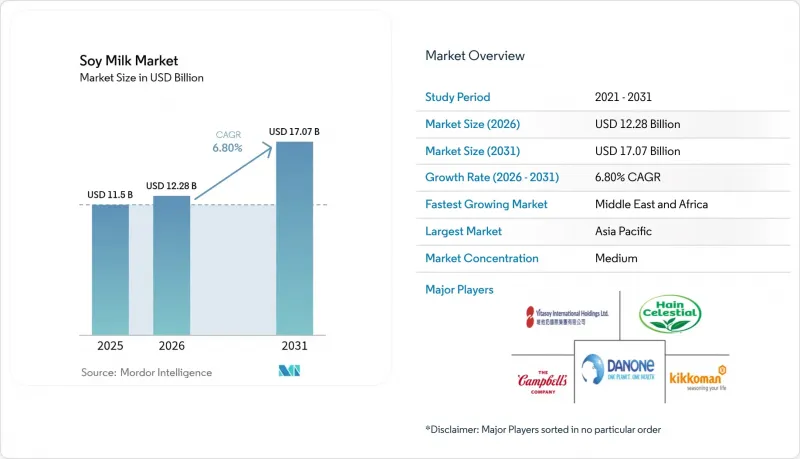
This report is Segmented by Product Type (Unflavored Soy Milk and Flavored Soy Milk), Form (Ready-To-Drink and Powder), Packaging Type (Aseptic Cartons, PET and Glass Bottles, Flexible Pouches, and Others), Distribution Channel (On-Trade and Off-Trade), and Geography (North America, Europe, Asia-Pacific, South America, and Middle East and Africa). The Market Forecasts are Provided in Terms of Value (USD).
Global Soy Milk Market Trends and Insights
Adoption of Soy Milk in Foodservice Channels
The foodservice industry's adoption of soy milk is driving market growth, as institutional buyers select plant-based alternatives to meet dietary requirements and manage costs. Foodservice operators choose soy milk for its high protein content and operational efficiency in large-scale food preparation. Among plant-based alternatives, soy milk's protein composition is most similar to dairy milk, making it suitable for institutional nutrition programs. The demand for specialized barista formulations is increasing, particularly from coffee chains and restaurants that require products that maintain foam stability and prevent curdling in hot beverages. The removal of additional charges for non-dairy milk options by Starbucks in October 2024 demonstrates the growing institutional acceptance and demand for plant-based alternatives, including soy milk. The foodservice sector values soy milk's consistent supply and standardized nutritional content over alternatives like almond or oat milk, which face greater raw material price and availability fluctuations. This widespread adoption in foodservice establishments supports sustained market growth beyond retail consumer trends, establishing soy milk as an essential component of the food industry.
Increasing Adoption of Vegan and Vegetarian Diets
The global soy milk market is experiencing substantial growth due to the increasing adoption of vegan and vegetarian diets, primarily driven by health consciousness, environmental sustainability concerns, ethical considerations, and economic factors. Consumer preferences are shifting towards plant-based alternatives due to rising awareness of lactose intolerance, concerns about cholesterol levels, and the environmental impact of traditional dairy farming. The market growth is further propelled by technological advancements in processing methods, enhanced product formulations, and significant investments in research and development. According to World Population Review, India and Mexico's vegan population reached 9% in 2025, particularly supported by the rapid expansion of modern retail formats, increasing urbanization, rising disposable incomes, and growing awareness of plant-based nutrition benefits . This shift is further accelerated by the expansion of retail distribution networks, product innovations in taste and nutritional content, and increasing investments in plant-based protein technologies across the food and beverage industry.
Allergen-Labelling Tightening for Soy Milk
The implementation of increasingly stringent allergen-labeling regulations for soy milk represents a substantial market restraint, as regulatory authorities worldwide strengthen their oversight measures to protect consumers with food allergies. The Food and Drug Administration (FDA) categorizes soybeans as one of the nine major food allergens, along with milk, eggs, fish, crustacean shellfish, tree nuts, peanuts, wheat, and sesame, necessitating a comprehensive declaration on all packaged food labels. In January 2025, the Food and Drug Administration (FDA) issued revised guidance emphasizing explicit allergen labeling, mandating manufacturers to specify soy and other major allergens in both the ingredient list and a contains statement. These regulatory requirements, while fundamental for consumer safety and transparency, impose substantial compliance burdens on soy milk producers, particularly in critical areas of ingredient sourcing documentation, manufacturing process validation, and cross-contamination prevention protocols.
Other drivers and restraints analyzed in the detailed report include:
- Product Innovations and Diverse Flavors Expand Market Reach
- Nutritional Benefits Propels Market Growth
- Soybean Price Volatility Hinders Market Growth
For complete list of drivers and restraints, kindly check the Table Of Contents.
Segment Analysis
Aseptic cartons maintain market leadership in the soy milk packaging segment, commanding a 46.78% share in 2025. This market position is attributed to their demonstrated capabilities in product preservation, ambient temperature shelf life extension, and stringent safety standards maintenance. The format has established substantial market penetration and consumer acceptance across international markets, positioning it as the primary packaging solution for residential consumption and portable applications. Aseptic cartons demonstrate full compliance with the European Union's Packaging and Packaging Waste Regulation, which mandates comprehensive packaging recyclability and establishes a 5% reduction target in packaging waste. This regulatory adherence enhances their environmental sustainability credentials and compels industry stakeholders to implement this packaging format to address regulatory requirements and evolving consumer environmental preferences.
Flexible pouches demonstrate significant market momentum as the fastest-expanding packaging segment, exhibiting a compound annual growth rate of 12.18% through 2031. This growth trajectory is attributed to their material efficiency, optimized logistics costs, and reduced storage requirements, complemented by a compact structural design that resonates with environmentally conscious consumer segments. The format delivers operational advantages through integrated resealable mechanisms and enhanced portability characteristics, particularly resonating with younger demographic segments and household consumers. Moreover, PET and glass bottles maintain a consistent market presence in premium product categories, where packaging aesthetics and perceived quality metrics significantly influence consumer purchasing behavior. Other packaging formats, including bag-in-box and bulk containers, serve specialized applications in foodservice and industrial markets.
Unflavored soy milk maintains a substantial 77.68% market share in 2025, primarily attributed to its extensive utilization in traditional consumption patterns and institutional applications requiring neutral taste profiles. The segment's market dominance is reinforced by its fundamental role in food preparation processes and significant acceptance across multiple cultural demographics, particularly in Asian markets where consumer preferences align with neutral plant-based beverages. The production methodology of unflavored variants demonstrates operational efficiency through streamlined manufacturing processes and reduced ingredient requirements, facilitating competitive price points that drive market expansion in price-sensitive regions.
The flavored soy milk segment demonstrates robust growth prospects with a projected 7.01% CAGR through 2031, attributed to increasing consumer demand for enhanced taste profiles and strategic market expansion initiatives by manufacturers. Within this category, vanilla and chocolate variants maintain prominent positions, with vanilla products serving dual purposes in direct consumption and culinary applications, while chocolate variants specifically target youth demographics and dessert substitute markets. The segment encompasses additional flavor variations, including seasonal and regional formulations, which present opportunities for premium market positioning, although these subcategories currently maintain limited distribution networks and market penetration.
Complete Report Scope:
- By Product Type
- Unflavored Soy Milk
- Flavored Soy Milk
- Vanilla
- Chocolate
- Others
- By Form
- Ready-to-Drink (RTD)
- Powder
- By Packaging Type
- Aseptic Cartons
- PET and Glass Bottles
- Flexible Pouches
- Others
- By Distribution Channel
- On-Trade
- Off-Trade
- Supermarkets/Hypermarkets
- Convenience Stores
- Online Retailers
- Other Off-Trade Channels
- By Geography
- North America
- United States
- Canada
- Mexico
- Rest of North America
- Europe
- Germany
- United Kingdom
- Italy
- France
- Spain
- Netherlands
- Poland
- Belgium
- Sweden
- Rest of Europe
- Asia-Pacific
- China
- India
- Japan
- Australia
- Indonesia
- South Korea
- Thailand
- Singapore
- Rest of Asia-Pacific
- South America
- Brazil
- Argentina
- Colombia
- Chile
- Peru
- Rest of South America
- Middle East and Africa
- South Africa
- Saudi Arabia
- United Arab Emirates
- Nigeria
- Egypt
- Morocco
- Turkey
- Rest of Middle East and Africa
- North America
Geography Analysis
Asia-Pacific holds 66.88% market share in 2025, driven by the deep cultural integration of soy-based beverages and robust manufacturing infrastructure in China, Japan, and South Korea. The region's growth is supported by expanding middle-class populations, rising health consciousness, and government policies promoting plant-based protein for food security. China's regulatory changes requiring sterilized milk production from raw milk create market opportunities for plant-based alternatives. The region's manufacturing capabilities and supply chain networks serve both domestic consumption and global export markets.
The Middle East and Africa region projects 11.34% CAGR through 2031, supported by increasing disposable incomes, health awareness, and government food security initiatives. The United Arab Emirates (UAE) position as a regional food distribution hub facilitates market entry for international brands. In 2023, the United States' exports of agricultural and related products to the United Arab Emirates reached USD 1.33 billion, with consumer-oriented goods accounting for over 75% of the increase . Moreover, the Food Innovation Laboratory at the University of the Free State (UFS) in South Africa launched affordable, protein-rich soy-based dairy alternatives in June 2024, addressing regional nutritional needs and food security concerns.
North America and Europe maintain steady market growth through health awareness, environmental concerns, and supportive regulations for sustainable food systems. European markets benefit from carbon footprint labeling requirements and sustainability directives that advantage soy milk over dairy alternatives. North American manufacturers focus on processing capacity expansion and product development to meet consumer demand. South America leverages its soybean production advantage for cost-effective manufacturing, though market growth faces distribution and consumer awareness challenges.
- Danone S.A.
- Vitasoy International Holdings Ltd
- The Hain Celestial Group Inc.
- Campbell Soup Company
- Kikkoman Corporation
- SunOpta Inc. (West Life)
- Eden Foods Inc.
- Fraser and Neave, Limited (F&N NutriSoy)
- The Hershey Company (Sofit)
- Samyuk Foods
- Earth's Own Food Company Inc.
- Dr. Chung's Food Co. Ltd.
- Granarolo S.p.A.
- Maeil Dairy Ind. Co. Ltd.
- Yeo Hiap Seng Ltd
- Yili Group
- Alt Co.
- Green Spot Co. Ltd
- Sanitarium Health and Wellbeing Company
- VV Food & Beverage Co. Ltd.
Additional Benefits:
- The market estimate (ME) sheet in Excel format
- 3 months of analyst support
TABLE OF CONTENTS
1 INTRODUCTION
- 1.1 Study Assumptions and Market Definition
- 1.2 Scope of the Study
2 RESEARCH METHODOLOGY
3 EXECUTIVE SUMMARY
4 MARKET LANDSCAPE
- 4.1 Market Overview
- 4.2 Market Drivers
- 4.2.1 Adoption of Soy Milk in Foodservice Channels
- 4.2.2 Increasing Adoption of Vegan and Vegetarian Diets
- 4.2.3 Product Innovations and Diverse Flavors Expand Market Reach
- 4.2.4 Nutritional Benefits Propels Market Growth
- 4.2.5 EU Carbon-footprint Labelling Favouring Soy Beverages
- 4.2.6 E-commerce Milk-subscription Boom
- 4.3 Market Restraints
- 4.3.1 Allergen-labelling Tightening for Soy Milk
- 4.3.2 Soybean Price Volatility Hinders Market Growth
- 4.3.3 Shelf-life Limitations in Rural or Underdeveloped Areas
- 4.3.4 Competition from Other Plant-Based Milks
- 4.4 Value/Supply-Chain Analysis
- 4.5 Regulatory or Technological Outlook
- 4.6 Porter's Five Forces Analysis
- 4.6.1 Threat of New Entrants
- 4.6.2 Bargaining Power of Buyers/Consumers
- 4.6.3 Bargaining Power of Suppliers
- 4.6.4 Threat of Substitute Products
- 4.6.5 Intensity of Competitive Rivalry
5 MARKET SIZE AND GROWTH FORECASTS (VALUE)
- 5.1 By Product Type
- 5.1.1 Unflavored Soy Milk
- 5.1.2 Flavored Soy Milk
- 5.1.2.1 Vanilla
- 5.1.2.2 Chocolate
- 5.1.2.3 Others
- 5.2 By Form
- 5.2.1 Ready-to-Drink (RTD)
- 5.2.2 Powder
- 5.3 By Packaging Type
- 5.3.1 Aseptic Cartons
- 5.3.2 PET and Glass Bottles
- 5.3.3 Flexible Pouches
- 5.3.4 Others
- 5.4 By Distribution Channel
- 5.4.1 On-Trade
- 5.4.2 Off-Trade
- 5.4.2.1 Supermarkets/Hypermarkets
- 5.4.2.2 Convenience Stores
- 5.4.2.3 Online Retailers
- 5.4.2.4 Other Off-Trade Channels
- 5.5 By Geography
- 5.5.1 North America
- 5.5.1.1 United States
- 5.5.1.2 Canada
- 5.5.1.3 Mexico
- 5.5.1.4 Rest of North America
- 5.5.2 Europe
- 5.5.2.1 Germany
- 5.5.2.2 United Kingdom
- 5.5.2.3 Italy
- 5.5.2.4 France
- 5.5.2.5 Spain
- 5.5.2.6 Netherlands
- 5.5.2.7 Poland
- 5.5.2.8 Belgium
- 5.5.2.9 Sweden
- 5.5.2.10 Rest of Europe
- 5.5.3 Asia-Pacific
- 5.5.3.1 China
- 5.5.3.2 India
- 5.5.3.3 Japan
- 5.5.3.4 Australia
- 5.5.3.5 Indonesia
- 5.5.3.6 South Korea
- 5.5.3.7 Thailand
- 5.5.3.8 Singapore
- 5.5.3.9 Rest of Asia-Pacific
- 5.5.4 South America
- 5.5.4.1 Brazil
- 5.5.4.2 Argentina
- 5.5.4.3 Colombia
- 5.5.4.4 Chile
- 5.5.4.5 Peru
- 5.5.4.6 Rest of South America
- 5.5.5 Middle East and Africa
- 5.5.5.1 South Africa
- 5.5.5.2 Saudi Arabia
- 5.5.5.3 United Arab Emirates
- 5.5.5.4 Nigeria
- 5.5.5.5 Egypt
- 5.5.5.6 Morocco
- 5.5.5.7 Turkey
- 5.5.5.8 Rest of Middle East and Africa
- 5.5.1 North America
6 COMPETITIVE LANDSCAPE
- 6.1 Market Concentration
- 6.2 Strategic Moves
- 6.3 Market Share Analysis
- 6.4 Company Profiles {(includes Global level Overview, Market level overview, Core Segments, Financials as available, Strategic Information, Market Rank/Share for key companies, Products and Services, and Recent Developments)}
- 6.4.1 Danone S.A.
- 6.4.2 Vitasoy International Holdings Ltd
- 6.4.3 The Hain Celestial Group Inc.
- 6.4.4 Campbell Soup Company
- 6.4.5 Kikkoman Corporation
- 6.4.6 SunOpta Inc. (West Life)
- 6.4.7 Eden Foods Inc.
- 6.4.8 Fraser and Neave, Limited (F&N NutriSoy)
- 6.4.9 The Hershey Company (Sofit)
- 6.4.10 Samyuk Foods
- 6.4.11 Earth's Own Food Company Inc.
- 6.4.12 Dr. Chung's Food Co. Ltd.
- 6.4.13 Granarolo S.p.A.
- 6.4.14 Maeil Dairy Ind. Co. Ltd.
- 6.4.15 Yeo Hiap Seng Ltd
- 6.4.16 Yili Group
- 6.4.17 Alt Co.
- 6.4.18 Green Spot Co. Ltd
- 6.4.19 Sanitarium Health and Wellbeing Company
- 6.4.20 VV Food & Beverage Co. Ltd.
7 MARKET OPPORTUNITIES AND FUTURE OUTLOOK

