PUBLISHER: Mordor Intelligence | PRODUCT CODE: 2116093

PUBLISHER: Mordor Intelligence | PRODUCT CODE: 2116093
Hardwood Flooring - Market Share Analysis, Industry Trends & Statistics, Growth Forecasts (2026 - 2031)
According to Mordor Intelligence, the hardwood flooring market size is expected to grow from USD 52.38 billion in 2025 to USD 55.46 billion in 2026 and is forecast to reach USD 73.79 billion by 2031 at 5.88% CAGR over 2026-2031.
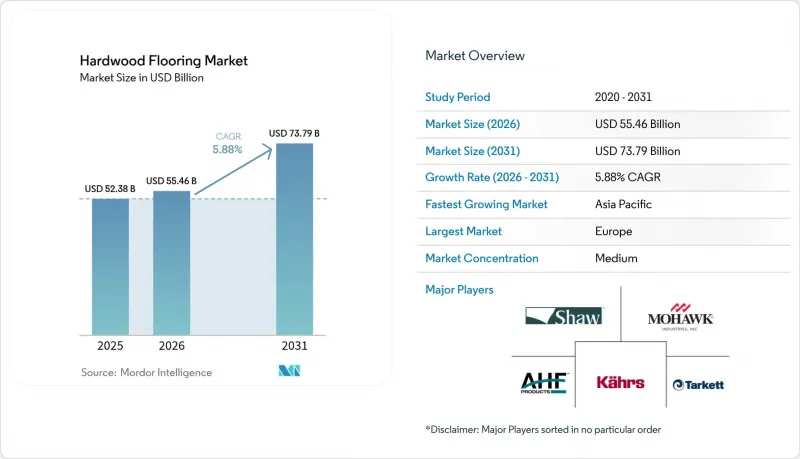
This report is Segmented by Product Type (Solid Wood, Engineered Wood), End-User Type (Residential, Commercial), Distribution Channel (Offline Stores, Online Stores), and Geography (North America, South America, Europe, Asia-Pacific, Middle East, and Africa). The Market Forecasts are Provided in Terms of Value (USD).
Global Hardwood Flooring Market Trends and Insights
Surging Home-Renovation Spending in Developed Economies
Elevated mortgage costs encourage households to remodel rather than relocate, fueling steady hardwood flooring upgrades in North America and Europe. Market research shows flooring projects deliver high resale value and tangible lifestyle benefits, making premium hardwood a favored investment even during macro uncertainty. The trend smooths revenue cyclicality by trying to increase demand for an aging housing stock rather than to volatile newly built pipelines. Manufacturers leverage the replacement cycle by bundling design services and extended-warranty packages that lift margins. Retailers benefit from predictable traffic and higher ticket values as consumers prioritize living-space enhancements over discretionary goods. Growth momentum is therefore embedded in renovation budgets that remain resilient despite shifting economic sentiment.
Expansion of Engineered-Wood Click-Lock Technologies
Proprietary locking mechanisms such as Uniclic and Valinge 5G fold-down profiles enable floating installations that cut labor time by up to 60%, expanding the hardwood flooring market among DIY enthusiasts and light-commercial specifiers. Moisture-resistant cores mitigate cupping concerns, allowing kitchens and basements to adopt engineered planks historically reserved for vinyl. Patent protection around locking systems creates pricing power and licensing revenue streams for technology owners, while driving industry-wide R&D is aimed at slimmer, more dimensionally stable constructions. This efficiency gains lower total project costs, making engineered hardwood a feasible upgrade path when budgets might otherwise tilt to resilient flooring. As a result, click-lock innovation acts as a structural demand driver with long-tail global relevance.
High Upfront Cost Versus Vinyl & Laminate Alternatives
Luxury vinyl tile replicates wood visuals at a fraction of the material and labor costs, siphoning entry-level demand away from hardwood. Inflation-driven lumber price spikes widen the gap, amplifying consumer price sensitivity. DIY-friendly resilient planks require no sanding or finishing, saving an additional 30-50% on installation labor. Commercial specifiers balancing budget and durability perceive limited ROI in hardwood for back-of-house or moisture-exposed zones. Manufacturers counter by amplifying value propositions around refinishing longevity and end-of-life recyclability yet cost parity remains elusive in price-driven bids.
Other drivers and restraints analyzed in the detailed report include:
- Growing Preference for Biophilic Interior Aesthetics
- Rising Residential Construction in Emerging Asia
- Stricter Sustainability & Deforestation Regulations
For complete list of drivers and restraints, kindly check the Table Of Contents.
Segment Analysis
Engineered planks captured 71.98% of the hardwood flooring market share in 2025 and are forecast to maintain a 6.05% CAGR to 2031, underscoring their dominance in both scale and momentum. This leadership stems from multilayer cores that curb seasonal movement and accept factory-applied finishes, translating into lower call-backs and higher installer productivity. Engineered wood in the hardwood flooring market is anticipated to witness significant growth by 2031, highlighting its importance in both residential renovations and expansive commercial projects.
Solid wood maintains relevance among heritage restorations and premium custom homes, where the capability to sand multiple times supports century-long lifespans. Red and white oak species command pricing premiums due to grain uniformity and domestic availability, while maple earns niche demand in sports flooring for its hardness. Yet, scalable product innovation skews toward engineered formats: Valinge's Woodura surface densification triples dent resistance and unlocks thinner wear layers that optimize raw-material yield. Producers also integrate recycled wood fibers into core layers, elevating sustainability credentials without compromising stability. These advances consolidate engineered wood's status as the hardwood flooring market's technology bellwether.
Complete Report Scope:
- By Product Type
- Solid Wood
- Red Oak
- White Oak
- Maple
- Other Solid Woods
- Engineered Wood
- Solid Wood
- By End-User Type
- Residential
- Commercial
- By Distribution Channel (Value)
- Offline Stores
- Online Stores
- By Geography
- North America
- Canada
- United States
- Mexico
- South America
- Brazil
- Peru
- Chile
- Argentina
- Rest of South America
- Europe
- United Kingdom
- Germany
- France
- Spain
- Italy
- BENELUX (Belgium, Netherlands, Luxembourg)
- NORDICS (Denmark, Finland, Iceland, Norway, Sweden)
- Rest of Europe
- Asia-Pacific
- India
- China
- Japan
- Australia
- South Korea
- South East Asia (Singapore, Malaysia, Thailand, Indonesia, Vietnam, Philippines)
- Rest of Asia-Pacific
- Middle East And Africa
- United Arab Emirates
- Saudi Arabia
- South Africa
- Nigeria
- Rest of Middle East And Africa
- North America
Geography Analysis
Europe retained a 33.05% share of the hardwood flooring market in 2025, underpinned by stringent eco-labeling norms and a renovation-oriented building stock. Nordic design preferences favor light-tone engineered oak finished with natural oils, a look that permeates German and Dutch markets. The pending EUDR compliance deadline incentivizes domestic mills to secure chain-of-custody certifications, reinforcing regional supply security. France's MaPrimeRenov' subsidy boosts residential retrofits, while commercial upgrades linked to the Paris 2024 legacy program elevate demand in hospitality and mixed-use venues.
Asia-Pacific registers the fastest momentum with a 7.48% CAGR, adding millions of square feet of new apartments annually. China's coastal provinces allocate higher finish budgets in response to up-market consumer shifts, while tier-two cities introduce local subsidies that reward low-formaldehyde flooring. India's Pradhan Mantri Awas Yojana projects and Jakarta's TOD schemes include green-building clauses that lift engineered-wood inclusion rates. Regional sawmills integrate kiln-drying and UV finishing lines to serve export markets facing anti-dumping duties, bolstering intra-Asia value addition.
North America sustains a mature, yet sizeable demand base anchored by renovation spending. Lumber tariffs and phytosanitary checks create periodic supply volatility, yet abundant FSC-certified Appalachian oak stabilizes input costs for domestic producers. U.S. builders increasingly specify thermally modified species for decking and three-season rooms, cross-selling indoor planks for design continuity. Canadian installers capitalize on favorable currency dynamics when sourcing from European mills, diversifying supply. While growth lags Asia, stable replacement demand ensures North America remains core to multinationals' revenue mix.
- Armstrong Flooring
- Mohawk Industries
- Shaw Industries Group
- AHF Products (Bruce Hardwood)
- Tarkett S.A.
- Mannington Mills
- Somerset Hardwood Flooring
- Kahrs Group
- Bauwerk Group
- Boral Timber
- Haro (Hamberger Flooring)
- Swiss Krono Group
- Quick-Step (Unilin)
- Balterio
- Mirage (Boa-Franc)
- Dinesen
- Floor & Decor Holdings
- LL Flooring (Lumber Liquidators)
- Greenply Industries
- Nature Home Holding
Additional Benefits:
- The market estimate (ME) sheet in Excel format
- 3 months of analyst support
TABLE OF CONTENTS
1 Introduction
- 1.1 Study Assumptions & Market Definition
- 1.2 Scope of the Study
2 Research Methodology
3 Executive Summary
4 Market Landscape
- 4.1 Market Overview
- 4.2 Market Drivers
- 4.2.1 Surging home-renovation spending in developed economies
- 4.2.2 Expansion of engineered-wood click-lock technologies
- 4.2.3 Growing preference for biophilic interior aesthetics
- 4.2.4 Rising residential construction in emerging Asia
- 4.2.5 Commercial adoption of thermally-modified hardwood floors
- 4.2.6 Uptake of reclaimed & recycled hardwood within circular-economy projects
- 4.3 Market Restraints
- 4.3.1 High upfront cost versus vinyl & laminate alternatives
- 4.3.2 Stricter sustainability & deforestation regulations
- 4.3.3 Supply-chain disruptions from phytosanitary import checks
- 4.3.4 Volatility in bio-based adhesive resin pricing
- 4.4 Value / Supply-Chain Analysis
- 4.5 Regulatory Landscape
- 4.6 Technological Outlook
- 4.7 Porter's Five Forces Analysis
- 4.7.1 Threat of New Entrants
- 4.7.2 Bargaining Power of Suppliers
- 4.7.3 Bargaining Power of Buyers
- 4.7.4 Threat of Substitutes
- 4.7.5 Competitive Rivalry
5 Market Size & Growth Forecasts
- 5.1 By Product Type
- 5.1.1 Solid Wood
- 5.1.1.1 Red Oak
- 5.1.1.2 White Oak
- 5.1.1.3 Maple
- 5.1.1.4 Other Solid Woods
- 5.1.2 Engineered Wood
- 5.1.1 Solid Wood
- 5.2 By End-User Type
- 5.2.1 Residential
- 5.2.2 Commercial
- 5.3 By Distribution Channel (Value)
- 5.3.1 Offline Stores
- 5.3.2 Online Stores
- 5.4 By Geography
- 5.4.1 North America
- 5.4.1.1 Canada
- 5.4.1.2 United States
- 5.4.1.3 Mexico
- 5.4.2 South America
- 5.4.2.1 Brazil
- 5.4.2.2 Peru
- 5.4.2.3 Chile
- 5.4.2.4 Argentina
- 5.4.2.5 Rest of South America
- 5.4.3 Europe
- 5.4.3.1 United Kingdom
- 5.4.3.2 Germany
- 5.4.3.3 France
- 5.4.3.4 Spain
- 5.4.3.5 Italy
- 5.4.3.6 BENELUX (Belgium, Netherlands, Luxembourg)
- 5.4.3.7 NORDICS (Denmark, Finland, Iceland, Norway, Sweden)
- 5.4.3.8 Rest of Europe
- 5.4.4 Asia-Pacific
- 5.4.4.1 India
- 5.4.4.2 China
- 5.4.4.3 Japan
- 5.4.4.4 Australia
- 5.4.4.5 South Korea
- 5.4.4.6 South East Asia (Singapore, Malaysia, Thailand, Indonesia, Vietnam, Philippines)
- 5.4.4.7 Rest of Asia-Pacific
- 5.4.5 Middle East And Africa
- 5.4.5.1 United Arab Emirates
- 5.4.5.2 Saudi Arabia
- 5.4.5.3 South Africa
- 5.4.5.4 Nigeria
- 5.4.5.5 Rest of Middle East And Africa
- 5.4.1 North America
6 Competitive Landscape
- 6.1 Market Concentration
- 6.2 Strategic Moves
- 6.3 Market Share Analysis
- 6.4 Company Profiles (includes Global level Overview, Market level overview, Core Segments, Financials as available, Strategic Information, Market Rank/Share for key companies, Products & Services, and Recent Developments)
- 6.4.1 Armstrong Flooring
- 6.4.2 Mohawk Industries
- 6.4.3 Shaw Industries Group
- 6.4.4 AHF Products (Bruce Hardwood)
- 6.4.5 Tarkett S.A.
- 6.4.6 Mannington Mills
- 6.4.7 Somerset Hardwood Flooring
- 6.4.8 Kahrs Group
- 6.4.9 Bauwerk Group
- 6.4.10 Boral Timber
- 6.4.11 Haro (Hamberger Flooring)
- 6.4.12 Swiss Krono Group
- 6.4.13 Quick-Step (Unilin)
- 6.4.14 Balterio
- 6.4.15 Mirage (Boa-Franc)
- 6.4.16 Dinesen
- 6.4.17 Floor & Decor Holdings
- 6.4.18 LL Flooring (Lumber Liquidators)
- 6.4.19 Greenply Industries
- 6.4.20 Nature Home Holding
7 Market Opportunities & Future Outlook
- 7.1 Carbon-neutral, FSC-certified hardwood product lines
- 7.2 AI-enabled customization & virtual design tools for consumers

