PUBLISHER: Mordor Intelligence | PRODUCT CODE: 2116105

PUBLISHER: Mordor Intelligence | PRODUCT CODE: 2116105
Ambulance Stretchers - Market Share Analysis, Industry Trends & Statistics, Growth Forecasts (2026 - 2031)
According to Mordor Intelligence, ambulance stretchers market size in 2026 is estimated at USD 2.38 billion, growing from 2025 value of USD 2.30 billion with 2031 projections showing USD 2.79 billion, growing at 3.27% CAGR over 2026-2031.
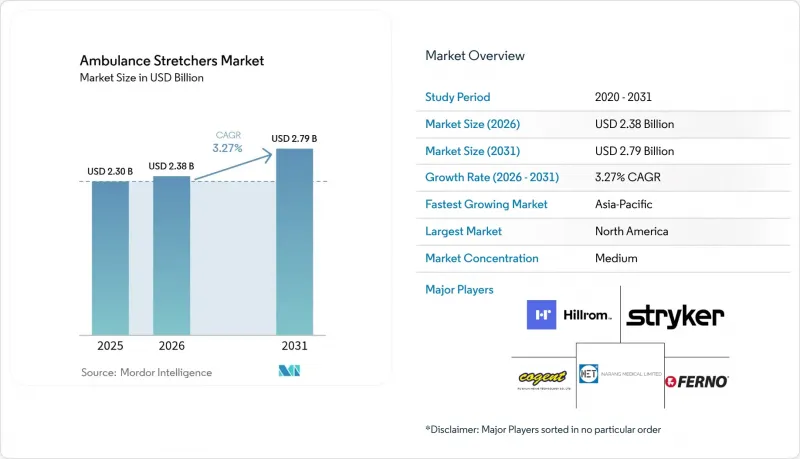
This report is Segmented by Product (Transport Stretchers, Emergency Stretchers, Bariatric Stretchers, and More), Technology (Manual, Electric-Powered, Hydraulic/Pneumatic, and More), End-User (Hospitals and Trauma Centers, EMS Providers, Military and Disaster Relief Agencies, Others), and Geography (North America, Europe, Asia Pacific, and More). The Market Forecasts are Provided in Terms of Value (USD).
Global Ambulance Stretchers Market Trends and Insights
Aging-Linked Chronic Disease Burden
One in five U.S. residents will be at least 65 years old by 2030, intensifying demand for stretchers with multi-position functions, wider frames, and enhanced pressure-relief surfaces. Healthcare providers facing physician shortages are adopting ergonomic equipment to transfer complex cases safely with fewer staff, making stretcher design a workforce-retention lever rather than a routine purchase. Bariatric devices now double as mobility platforms inside emergency departments, shortening handoff times and lowering fall risk. Procurement teams increasingly specify weight ratings above 300 kg and integrated monitoring rails as baseline requirements. These shifts collectively amplify premium-segment revenue and expand the addressable pool for electric power-lift models.
Road-Traffic Trauma Growth in EMs & LMICs
Road accidents account for 37.3% of trauma cases in Addis Ababa and similar shares across sub-Saharan hubs, yet only 13.6% of victims receive adequate stabilization before hospital transfer in countries like Tanzania. This mismatch drives demand for durable stretchers able to perform both extraction and transport functions under resource constraints. International donor programs now bundle stretcher purchases with ambulance grants, accelerating first-generation upgrades in provincial fleets. Manufacturers responding with cost-down versions that still meet EN1789 and FDA class I requirements widen their reach without compromising safety. As governments adopt WHO trauma-system guidelines, spending on transport and scoop stretchers is shifting from sporadic tenders to multiyear budgets, lifting baseline volumes across Africa and South Asia.
Device-Related Musculoskeletal Injuries to EMS Staff
EMS personnel register injury rates surpassing construction workers, with manual cot lifting singled out as a primary cause. University of Waterloo research found a 78% drop in paramedic injuries after powered stretcher deployment. Despite clear ROI from reduced compensation claims, some municipal services defer upgrades due to procurement cycles and union negotiations. Worker-safety advocacy groups now lobby regulators to set mandatory force-exertion thresholds, potentially accelerating electric adoption but raising near-term compliance costs. Persistent staffing shortages magnify the operational impact of each injury, incentivizing fleets to accelerate replacement timetables once financing aligns.
Other drivers and restraints analyzed in the detailed report include:
- Worldwide Upgrade to Type III & Modular Ambulances
- EMS Reimbursement Expansion in APAC
- Capital-Intensive Power-Lift Systems for Low-Income Fleets
For complete list of drivers and restraints, kindly check the Table Of Contents.
Segment Analysis
Transport stretchers generated the most significant revenue slice, accounting for 45.74% of the ambulance stretchers market size in 2025. Their ubiquity across emergency fleets ensures predictable replacement cycles, but commoditization pressures margins as specifications standardize. Bariatric models, by contrast, are climbing at 9.1% CAGR as obesity prevalence rises in developed economies. Scoop and basket stretchers continue to serve confined-space rescues, yet remain niche. Neonatal variants see steady demand tied to hospital birthing volumes, while trauma-specific designs face moderate growth as modular ambulance interiors assume more tasks.
Demand for bariatric equipment is reinforced by regulations that stipulate minimum safe-working loads above 300 kg and require four-point harnesses for larger patients. These standards drive the procurement of stretchers with more expansive decks and motorized height adjustment. In turn, manufacturers integrate antimicrobial coatings and quick-swap mattress systems to minimize turnaround time in high-occupancy departments. As a result, the bariatric line is transitioning from optional inventory to essential stock in tertiary-care facilities, expanding its revenue contribution in the broader ambulance stretchers market.
Complete Report Scope:
- By Product
- Transport Stretchers
- Emergency Stretchers
- Bariatric Stretchers
- Neonatal & Paediatric Stretchers
- Scoop & Basket Stretchers
- By Technology
- Manual
- Electric-Powered
- Hydraulic/Pneumatic
- Automated Loading Systems
- By End-User
- Hospitals & Trauma Centers
- EMS Providers
- Military & Disaster-Relief Agencies
- Others
- By Geography
- North America
- United States
- Canada
- Mexico
- Europe
- Germany
- United Kingdom
- France
- Italy
- Spain
- Rest of Europe
- Asia Pacific
- China
- Japan
- India
- South Korea
- Australia
- Rest of Asia Pacific
- Middle East & Africa
- GCC
- South Africa
- Rest of Middle East & Africa
- South America
- Brazil
- Argentina
- Rest of South America
- North America
Geography Analysis
North America holds a 35.34% revenue share and sets the pace for regulatory and technology trends. Occupational-safety statutes and high labor costs favor powered systems, sustaining premium pricing. The U.S. CARES Act capital allocations enabled county EMS agencies to refresh fleets post-pandemic, while Canadian provinces adopted similar stimulus frameworks. The ongoing alignment of the FDA Quality System Regulation with ISO 13485 raises compliance costs while stabilizing product quality, reinforcing the market position of well-capitalized incumbents.
The Middle East and Africa region delivers the fastest CAGR at 7.33% by 2031. Governments channel oil revenues into tertiary hospitals and trauma centers, with Saudi Arabia alone budgeting USD 50.4 billion for health-sector development in 2023. Private operators building medical-tourism hubs in the Gulf import U.S. and European stretcher brands to meet Joint Commission International accreditation. Simultaneously, African Union programs subsidize basic EMS fleets, opening doors for value-engineered models. This two-tier demand landscape encourages multinational vendors to localize assembly to sidestep import duties and qualify for public tenders.
Asia Pacific is the most diverse territory. Japan and Singapore mandate advanced safety features, fostering early adoption of motorized stretchers and telematics. Conversely, populous nations such as Indonesia focus on scaling fleet numbers with robust manual units. Domestic manufacturing incentives under schemes like India's Production-Linked Incentive encourage joint ventures, facilitating technology transfer while containing costs. As digital health funding rises, hospitals in South Korea and Australia pilot stretchers with integrated RFID to streamline asset tracking, setting precedents that the wider region may emulate.
- Stryker
- Ferno-Washington
- Hill-Rom
- Medline Industries
- Arjo AB
- GF Health Products
- Spencer Italia S.r.l.
- Dragon Industry (ZJG) Co. Ltd.
- Fu Shun Hsing Technology Co. Ltd.
- Jiangsu Rixin Medical Equipment Co. Ltd.
- ROYAX s.r.o.
- Narang Medical Ltd.
- Zhangjiagang New Fellow Med Co. Ltd.
- Allied Healthcare Products
- Dragerwerk
- Promeba SL
- MeBer s.r.l.
- EMSRUN Technology Co. Ltd.
- Junkin Safety Appliance Co.
- Laerdal Medical AS
- Ambulanz Mobile GmbH
Additional Benefits:
- The market estimate (ME) sheet in Excel format
- 3 months of analyst support
TABLE OF CONTENTS
1 Introduction
- 1.1 Study Assumptions & Market Definition
- 1.2 Scope of the Study
2 Research Methodology
3 Executive Summary
4 Market Landscape
- 4.1 Market Overview
- 4.2 Market Drivers
- 4.2.1 Aging-Linked Chronic Disease Burden
- 4.2.2 Road-Traffic Trauma Growth In EMs & LMICs
- 4.2.3 Worldwide Upgrade To Type III & Modular Ambulances
- 4.2.4 EMS Reimbursement Expansion In APAC
- 4.2.5 Extreme-Temperature Response-Ready Composite Stretchers
- 4.2.6 OEM-Agnostic IoT Sensor Retrofits Driving Aftermarket
- 4.3 Market Restraints
- 4.3.1 Device-Related Musculoskeletal Injuries To EMS Staff
- 4.3.2 Capital-Intensive Power-Lift Systems For Low-Income Fleets
- 4.3.3 Stricter Biocontamination Norms Lengthen Approval Cycles
- 4.3.4 Raw-Material Price Volatility
- 4.4 Supply Chain Analysis
- 4.5 Regulatory Landscape
- 4.6 Technological Outlook
- 4.7 Porter's Five Forces Analysis
- 4.7.1 Bargaining Power of Buyers
- 4.7.2 Bargaining Power of Suppliers
- 4.7.3 Threat of New Entrants
- 4.7.4 Threat of Substitutes
- 4.7.5 Competitive Rivalry
5 Market Size & Growth Forecasts (Value)
- 5.1 By Product
- 5.1.1 Transport Stretchers
- 5.1.2 Emergency Stretchers
- 5.1.3 Bariatric Stretchers
- 5.1.4 Neonatal & Paediatric Stretchers
- 5.1.5 Scoop & Basket Stretchers
- 5.2 By Technology
- 5.2.1 Manual
- 5.2.2 Electric-Powered
- 5.2.3 Hydraulic/Pneumatic
- 5.2.4 Automated Loading Systems
- 5.3 By End-User
- 5.3.1 Hospitals & Trauma Centers
- 5.3.2 EMS Providers
- 5.3.3 Military & Disaster-Relief Agencies
- 5.3.4 Others
- 5.4 By Geography
- 5.4.1 North America
- 5.4.1.1 United States
- 5.4.1.2 Canada
- 5.4.1.3 Mexico
- 5.4.2 Europe
- 5.4.2.1 Germany
- 5.4.2.2 United Kingdom
- 5.4.2.3 France
- 5.4.2.4 Italy
- 5.4.2.5 Spain
- 5.4.2.6 Rest of Europe
- 5.4.3 Asia Pacific
- 5.4.3.1 China
- 5.4.3.2 Japan
- 5.4.3.3 India
- 5.4.3.4 South Korea
- 5.4.3.5 Australia
- 5.4.3.6 Rest of Asia Pacific
- 5.4.4 Middle East & Africa
- 5.4.4.1 GCC
- 5.4.4.2 South Africa
- 5.4.4.3 Rest of Middle East & Africa
- 5.4.5 South America
- 5.4.5.1 Brazil
- 5.4.5.2 Argentina
- 5.4.5.3 Rest of South America
- 5.4.1 North America
6 Competitive Landscape
- 6.1 Market Concentration
- 6.2 Market Share Analysis
- 6.3 Company Profiles (includes Global level Overview, Market level overview, Core Segments, Financials, Strategic Information, Market Rank/Share, Products & Services, Recent Developments)
- 6.3.1 Stryker Corporation
- 6.3.2 Ferno-Washington Inc.
- 6.3.3 Hill-Rom Services Inc. (Baxter)
- 6.3.4 Medline Industries LP
- 6.3.5 Arjo AB
- 6.3.6 GF Health Products Inc.
- 6.3.7 Spencer Italia S.r.l.
- 6.3.8 Dragon Industry (ZJG) Co. Ltd.
- 6.3.9 Fu Shun Hsing Technology Co. Ltd.
- 6.3.10 Jiangsu Rixin Medical Equipment Co. Ltd.
- 6.3.11 ROYAX s.r.o.
- 6.3.12 Narang Medical Ltd.
- 6.3.13 Zhangjiagang New Fellow Med Co. Ltd.
- 6.3.14 Allied Healthcare Products Inc.
- 6.3.15 Dragerwerk AG & Co. KGaA
- 6.3.16 Promeba SL
- 6.3.17 MeBer s.r.l.
- 6.3.18 EMSRUN Technology Co. Ltd.
- 6.3.19 Junkin Safety Appliance Co.
- 6.3.20 Laerdal Medical AS
- 6.3.21 Ambulanz Mobile GmbH
7 Market Opportunities & Future Outlook

