PUBLISHER: Mordor Intelligence | PRODUCT CODE: 2116111

PUBLISHER: Mordor Intelligence | PRODUCT CODE: 2116111
North America UPVC Doors And Windows - Market Share Analysis, Industry Trends & Statistics, Growth Forecasts (2026 - 2031)
According to Mordor Intelligence, the North America UPVC doors and windows market size is expected to grow from USD 11.84 billion in 2025 to USD 12.25 billion in 2026 and is forecast to reach USD 14.86 billion by 2031 at 3.44% CAGR over 2026-2031.
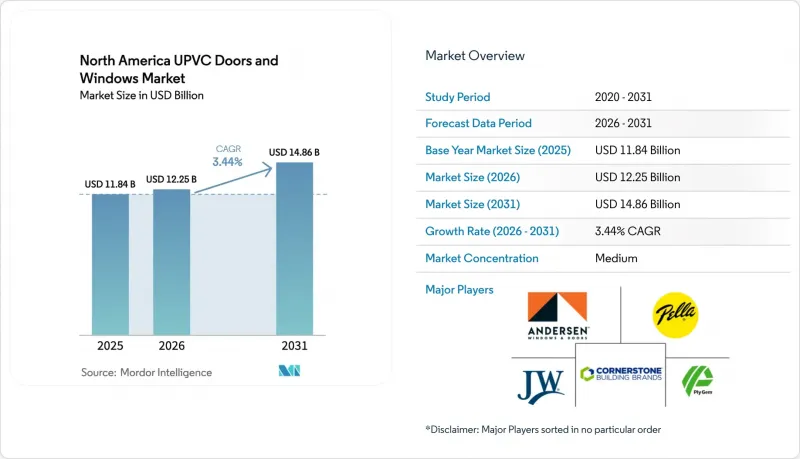
This report is Segmented by Product Type (uPVC Doors, UPVC Windows), End User (Residential, Commercial, Industrial & Institutional), Installation (New Construction, Renovation & Replacement), Distribution Channel (Direct Sales Manufacturers, Distributor Dealer Network, Retail & Online), and Geography (United States, Canada, Mexico). The Market Forecasts are Provided in Terms of Value USD.
North America UPVC Doors And Windows Market Trends and Insights
Stringent Energy-Efficiency Regulations & Incentives
Energy-efficiency criteria continue to tighten across the region, with ENERGY STAR Version 7.0 pushing U-factors lower and raising SHGC expectations for high-performance fenestration, which effectively steers many premium residential lines toward triple-pane options in northern zones. Federal support bolsters local adoption through programs and grants that help jurisdictions move to more efficient model codes, which in turn nudge builders and remodelers toward low U-factor windows that meet the prescriptive path or earn credits under performance paths within the 2024 IECC. DOE guidance and the Energy Saver framework document how low-e and advanced glazing reduce heating and cooling loads, and those savings tie into incentive programs and homeowner tax credits that improve ROI on fenestration upgrades. NFRC's 2023 technical updates to U-factor and SHGC procedures strengthen the linkage between product testing and real-world label values, which helps mitigate warranty disputes and supports compliance across code jurisdictions. California's Title 24 Part 6 2025 update moves the state toward tighter envelope baselines and heat pump norms, and it often raises the performance bar for windows and doors in ways that cascade into product development and stocking strategies across national portfolios.
Renovation-Led Demand Surge
Replacement momentum remains a defining growth axis for the North America uPVC doors and windows market as aging housing and energy-bill sensitivity prioritize envelope improvements that deliver measurable comfort and utility-bill outcomes. Code updates and available credits make it easier for homeowners to pick compliant products, claim tax benefits through standardized forms, and move forward with multi-opening projects that would otherwise be delayed. Utility programs and local initiatives add stackable rebates that further compress the payback period, keeping replacement activity resilient during phases of higher interest rates and constrained new-home supply. National associations and rating councils have standardized rating protocols for U-factor and Solar Heat Gain Coefficient (SHGC), which simplifies specifying and comparing windows and doors across brands, and this reduces friction in the sales process for replacement decisions. Manufacturers have introduced installation systems that allow faster, cleaner replacements from the interior, which lowers project disruption and labour hours, raising throughput per crew and helping alleviate skilled installer bottlenecks.
Competition from Thermally Broken Aluminum
Thermally broken aluminum continues to improve U-factors and assembly techniques to meet stricter code thresholds, which narrows uPVC's thermal advantage in certain commercial and high-end residential specifications. In cold climate zones under 2024 IECC and ASHRAE 90.1, aluminum systems that integrate thermal breaks, warm-edge spacers, and triple glazing can achieve performance levels that satisfy prescriptive paths, and architects often prefer the slimmer sightlines and span capacity for larger openings. Code adoption trends elevate minimums for fixed and operable fenestration, and these thresholds open pathways for aluminum products to qualify while maintaining aesthetic and structural preferences in commercial use cases. In coastal markets, corrosion-resistant finishes and impact-rated configurations are widely available for aluminum, which, when combined with code compliance, present credible alternatives to uPVC where project design requires tall or wide spans. Even with higher installed costs, aluminum's durability and form factor can justify specifications where lifecycle considerations, facade design, and project budgets align under strict code constraints.
Other drivers and restraints analyzed in the detailed report include:
- Material Cost-Advantage vs. Wood & Aluminum
- Smart-Sensor-Ready Profile Adoption
- Skilled Installer Shortage
For complete list of drivers and restraints, kindly check the Table Of Contents.
Segment Analysis
uPVC windows captured 65.83% of the 2025 North America uPVC doors and windows market share, and are set to grow at a 4.13% CAGR through 2031. Intensifying ENERGY STAR criteria and IECC updates elevate the required performance for residential and light commercial fenestration, which in practice keeps window specifications front and centre due to their contribution to envelope U-factors and Solar Heat Gain Coefficient (SHGC) targets across climate zones. Products that meet ENERGY STAR Most Efficient thresholds or comply with stretch codes gain an advantage by simplifying rebate and tax credit documentation for homeowners and builders. Labelling and performance verification through the National Fenestration Rating Council's updated procedures further streamlines code inspections and aligns expectations for delivered U-factor and SHGC, which reduces rework and warranty claims. For owners and facility managers, the lifecycle equation pairs thermal performance with installed cost and maintenance profile, which supports the use of uPVC across a wide span of typical openings in residential and smaller commercial projects in the North America uPVC doors and windows market.
uPVC doors maintain growth parity because code and insurance requirements for impact-rated entries remain prominent in coastal states, and because insulated uPVC door systems can reach attractive R-values while keeping installed costs accessible for replacement projects. As jurisdictional energy standards move toward higher envelope baselines in 2026, manufacturers have focused on improved cores and glazing options to meet U-factor targets for half-light and full-light door designs where daylighting is desired. The NFRC framework helps buyers compare door and window performance on a uniform basis, and this transparency supports broader adoption of performance-tiered uPVC offerings. Installation tools and knockdown frame options introduced by leading brands shorten install times, which raises throughput per crew and lowers total cost of ownership for time-sensitive remodelling projects. Over the forecast period, product development targeting thermal bridging, hardware integration, and smart-ready features keeps both windows and doors aligned with evolving code and user-experience expectations across the North America uPVC doors and windows market.
The residential segment remained the largest by volume with 58.14% share in 2025, benefiting from an entrenched replacement cycle and tax credits that promote whole-home upgrades, while the commercial segment is the fastest growing with a 3.92% CAGR on specifications tied to ASHRAE 90.1 and performance-led code paths. Energy modelling for performance-based compliance and evolving municipal standards push commercial owners to evaluate envelope improvements that reduce whole-building loads, which can tilt specifications toward higher-performing fenestration configurations. Utility programs and public-sector procurement standards encourage the selection of products with clear performance documentation, environmental transparency, and durability, which aligns with uPVC offerings that meet certified thresholds at competitive cost. Institutional buyers often weigh lifecycle and warranty support heavily, an area where manufacturer-direct installation and service programs have grown to ensure product performance and compliance alignment. Residential momentum remains resilient as households leverage tax credits, while installers rely on standardized documentation like Qualified Manufacturer Identification Numbers to simplify claims.
Commercial buyers also benefit from code consistency and labelling assurance across multi-jurisdiction portfolios, which reduces compliance risk when deploying retrofit programs at scale in the North America uPVC doors and windows market. For institutional facilities and light industrial buildings, budgets and maintenance practicalities favour materials that deliver reliable thermal performance and cost control under frequent use, which positions uPVC for non-structural, standard-size openings. In office-to-residential conversions and adaptive reuse, uPVC's thermal and acoustic characteristics are often sufficient when paired with appropriate glazing and spacer technologies to meet code and comfort goals. Public incentives, where available, add further support when projects can document code or performance gains for envelope upgrades as part of whole-building energy plans. This demand profile underscores why commercial growth can edge ahead of residential, even as residential retains the larger share in the North America uPVC doors and windows market.
Complete Report Scope:
- By Product Type
- uPVC Doors
- Sliding Doors
- Casement Doors
- Tilt & Turn Doors
- French Doors
- Others
- uPVC Windows
- Sliding Windows
- Casement Windows
- Tilt & Turn Windows
- Others (Picture / Fixed Windows,Awning Windows)
- uPVC Doors
- By End User
- Residential
- Commercial
- Industrial & Institutional
- By Installation
- New Construction
- Renovation & Replacement
- By Distribution Channel
- Direct Sales (Manufacturers)
- Distributor / Dealer Network
- Retail & Online
- By Country
- United States
- Canada
- Mexico
List of Companies Covered in this Report:
- Andersen Corporation
- Pella Corporation
- JELD-WEN Holding Inc.
- Cornerstone Building Brands (MI Windows)
- Ply Gem
- Marvin Windows & Doors
- Milgard Manufacturing
- Harvey Building Products
- Atrium Windows & Doors
- Viwinco
- Simonton Windows & Doors
- Soft-Lite LLC
- YKK AP America
- Crystal Window & Door Systems
- REHAU
- VEKA AG
- Deceuninck NV
- Profine Group (Kommerling)
- Aluplast GmbH
- Eurocell plc
Additional Benefits:
- The market estimate (ME) sheet in Excel format
- 3 months of analyst support
TABLE OF CONTENTS
1 Introduction
- 1.1 Study Assumptions & Market Definition
- 1.2 Scope of the Study
2 Research Methodology
3 Executive Summary
4 Market Landscape
- 4.1 Market Overview
- 4.2 Market Drivers
- 4.2.1 Stringent energy-efficiency regulations & incentives
- 4.2.2 Renovation-led demand surge
- 4.2.3 Material cost-advantage vs. wood & aluminum
- 4.2.4 Insurance-driven uptake of hurricane-rated uPVC
- 4.2.5 Recycled-content extrusion capacity expansion
- 4.2.6 Smart-sensor-ready profile adoption
- 4.3 Market Restraints
- 4.3.1 PVC resin price volatility
- 4.3.2 Competition from thermally-broken aluminum
- 4.3.3 ESG limits on virgin PVC
- 4.3.4 Skilled installer shortage
- 4.4 Industry Value Chain Analysis
- 4.5 Regulatory Landscape
- 4.6 Porter's Five Forces Analysis
- 4.6.1 Bargaining Power of Suppliers
- 4.6.2 Bargaining Power of Buyers
- 4.6.3 Threat of New Entrants
- 4.6.4 Threat of Substitutes
- 4.6.5 Competitive Rivalry
- 4.7 Insights into the Latest Trends and Innovations in the Market
- 4.8 Insights into Recent Developments (New Product Launches, Strategic Initiatives, Investments, Partnerships, JVs, Expansion, M&As, etc.) in the Market
5 Market Size & Growth Forecasts
- 5.1 By Product Type
- 5.1.1 uPVC Doors
- 5.1.1.1 Sliding Doors
- 5.1.1.2 Casement Doors
- 5.1.1.3 Tilt & Turn Doors
- 5.1.1.4 French Doors
- 5.1.1.5 Others
- 5.1.2 uPVC Windows
- 5.1.2.1 Sliding Windows
- 5.1.2.2 Casement Windows
- 5.1.2.3 Tilt & Turn Windows
- 5.1.2.4 Others (Picture / Fixed Windows,Awning Windows)
- 5.1.1 uPVC Doors
- 5.2 By End User
- 5.2.1 Residential
- 5.2.2 Commercial
- 5.2.3 Industrial & Institutional
- 5.3 By Installation
- 5.3.1 New Construction
- 5.3.2 Renovation & Replacement
- 5.4 By Distribution Channel
- 5.4.1 Direct Sales (Manufacturers)
- 5.4.2 Distributor / Dealer Network
- 5.4.3 Retail & Online
- 5.5 By Country
- 5.5.1 United States
- 5.5.2 Canada
- 5.5.3 Mexico
6 Competitive Landscape
- 6.1 Market Concentration
- 6.2 Strategic Moves
- 6.3 Market Share Analysis
- 6.4 Company Profiles {(includes Global level Overview, Market level overview, Core Segments, Financials as available, Strategic Information, Market Rank/Share for key companies, Products & Services, and Recent Developments)}
- 6.4.1 Andersen Corporation
- 6.4.2 Pella Corporation
- 6.4.3 JELD-WEN Holding Inc.
- 6.4.4 Cornerstone Building Brands (MI Windows)
- 6.4.5 Ply Gem
- 6.4.6 Marvin Windows & Doors
- 6.4.7 Milgard Manufacturing
- 6.4.8 Harvey Building Products
- 6.4.9 Atrium Windows & Doors
- 6.4.10 Viwinco
- 6.4.11 Simonton Windows & Doors
- 6.4.12 Soft-Lite LLC
- 6.4.13 YKK AP America
- 6.4.14 Crystal Window & Door Systems
- 6.4.15 REHAU
- 6.4.16 VEKA AG
- 6.4.17 Deceuninck NV
- 6.4.18 Profine Group (Kommerling)
- 6.4.19 Aluplast GmbH
- 6.4.20 Eurocell plc
7 Market Opportunities & Future Outlook
- 7.1 Closed-Loop Recycling & Reprocessed uPVC Feedstock
- 7.2 Smart-Ready Retrofit Systems

