PUBLISHER: Mordor Intelligence | PRODUCT CODE: 2116121

PUBLISHER: Mordor Intelligence | PRODUCT CODE: 2116121
Automotive Glow Plugs - Market Share Analysis, Industry Trends & Statistics, Growth Forecasts (2026 - 2031)
According to Mordor Intelligence, the automotive glow plugs market size is expected to grow from USD 4.23 billion in 2025 to USD 4.36 billion in 2026 and is forecast to reach USD 5.07 billion by 2031 at 3.07% CAGR over 2026-2031.
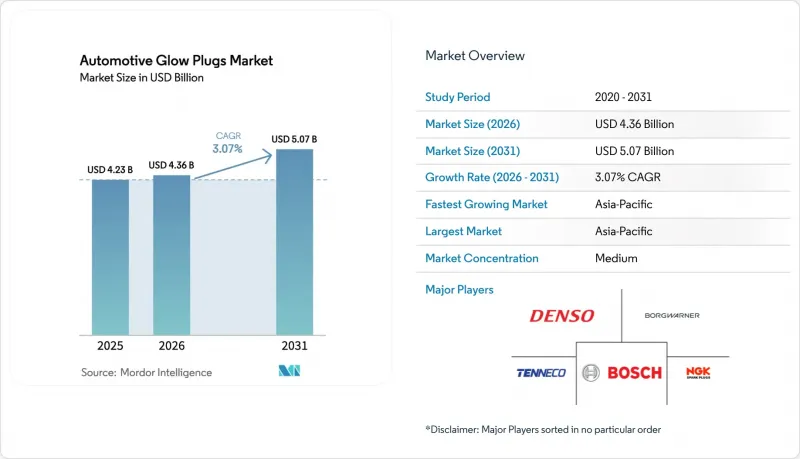
This report is Segmented by Product Type (Metal Glow Plug and Ceramic Glow Plug), Vehicle Type (Passenger Cars and Commercial Vehicles), Sales Channel (OEM and Aftermarket), Heating Technology (Single-Coil, Dual-Coil / Instant-Heat, and More), and Geography. The Market Forecasts are Provided in Terms of Value (USD) and Volume (Units).
Global Automotive Glow Plugs Market Trends and Insights
Tightening Euro 7 & U.S. EPA diesel cold-start norms
Euro 7 rules, effective November 2026, require continuous cold-start monitoring rather than static lab tests, forcing glow plugs to achieve peak temperature in under two seconds. Ceramic elements meet this threshold at 1,300 °C, giving them a clear edge over metal peers. Parallel EPA 2027 limits trim heavy-duty NOx to 35 mg/hp-hr, obliging OEMs to sustain aftertreatment temperatures even in sub-zero starts. The trans-Atlantic harmonization removes regional design deviations, letting suppliers amortize R&D over larger production runs and accelerating global uptake of instant-heat dual-coil and pressure-sensor glow plugs.
Global medium-duty diesel-truck production rebound
Medium-duty truck output is rising due to infrastructure spending and e-commerce distribution. The Inflation Reduction Act stimulates Class 5 utility trucks, segments that cannot yet be electrified because of duty cycle demands. Every new diesel truck contains at least four glow plugs, and large-bore engines amplify replacement revenues in the aftermarket. OEMs prioritize commercial applications to compensate for shrinking passenger-diesel lines, reinforcing component demand.
Stricter OBD-III in-cylinder temperature-sensing mandates
OBD-III turns glow plugs into active diagnostic nodes by demanding real-time fault detection. Pressure-sensor and catalyst-coated variants, holding 23.10% 2024 share, embed miniature thermocouples that feed data to engine control units, generating premium margins. California's 2022 amendments already extend the requirement to light-duty diesels, while the EPA's 40 CFR 86.010-18 brings heavy-duty engines into scope. Predictive maintenance enabled by sensor data curbs fleet downtime and rapidly becomes a differentiator for OEM procurement teams.
Other drivers and restraints analyzed in the detailed report include:
- Growth of 48 V mild-hybrid diesel architectures
- ICE rationalization (Less than 15% diesel mix in new-EU cars)
- Counterfeit glow-plug proliferation is harming OEM brands
For complete list of drivers and restraints, kindly check the Table Of Contents.
Segment Analysis
Metal designs retained the bulk of 2025 shipments, capturing 65.21% market share in 2025, yet ceramic variants generated the swiftest top-line gains with a 3.78% CAGR outlook.Ceramic heating elements hit 1,300 °C in under two seconds, satisfying Euro 7 durability cycles and cutting white smoke by 70%. They also survive up to 200,000 thermal cycles, double that of metal equivalents, trimming warranty claims for OEMs.
Adoption widens as commercial fleets chase uptime and cleaner exhaust gas, especially in temperature-sensitive refrigerated transport. DENSO and Bosch capitalize by co-developing alumina-silicate formulations that minimise brittleness. While metal plugs stay relevant for cost-driven retrofits, their share will erode as regulations bite. Suppliers are shifting line capacity toward ceramic sintering, which demands high capital yet offers stickier margins once certified, underpinning long-term revenue visibility.
Commercial vehicles held 59.42% revenue in 2025 and are expected to grow at a CAGR of 3.18% through 2031, reflecting diesel's 76% fleet prevalence. Within this pool, the automotive glow plugs market share is expected to reach around three fifth of the share by 2031 as medium-duty manufacturing rebounds. Fleet buyers prefer premium glow plugs that assure sub-zero starts without external heaters, improving duty-cycle efficiency. Government infrastructure spending and last-mile delivery growth further elevate unit demand.
Passenger-car diesel retreat narrows volumes yet nudges the segment toward upscale plug configurations embedded with temperature sensors. Despite shrinking volumes, suppliers still court OEMs for high-margin specialty variants used in light-duty pickups and SUVs. The bifurcated landscape reinforces commercial-vehicle centric R&D agendas, catalysing more robust testing protocols that trickle down to passenger models once cost curves mature.
Complete Report Scope:
- By Product Type
- Metal Glow Plug
- Ceramic Glow Plug
- By Vehicle Type
- Passenger Cars
- Commercial Vehicles
- By Sales Channel
- OEM
- Aftermarket
- By Heating Technology
- Single-Coil
- Dual-Coil / Instant-Heat
- Pressure-Sensor
- Catalyst-Coated
- By Geography
- North America
- United States
- Canada
- Rest of North America
- South America
- Brazil
- Argentina
- Rest of South America
- Europe
- Germany
- United Kingdom
- France
- Italy
- Spain
- Russia
- Rest of Europe
- Asia-Pacific
- China
- Japan
- South Korea
- India
- Rest of Asia-Pacific
- Middle East and Africa
- Saudi Arabia
- United Arab Emirates
- Turkey
- South Africa
- Egypt
- Rest of Middle East and Africa
- North America
Geography Analysis
Asia-Pacific headed the 2025 leaderboard with 36.08% revenue and a 3.35% CAGR outlook. China's reinstated truck subsidies and India's Bharat Stage VI/VII enforcement stimulate OEM demand for ceramic and pressure-sensor plugs. Local manufacturers partner with global leaders for technology licensing deals, speeding homologation timelines. Cross-border e-commerce also facilitates aftermarket penetration into Southeast Asian right-hand-drive markets where diesel pickups dominate.
Europe followed despite passenger-car diesel attrition. Euro 7 engines rolling out in 2026 require integrated diagnostics, compelling aftermarket replacements for older vehicles to meet periodic inspection standards. Germany hosts BorgWarner's BERU plant, anchoring regional supply and supporting 95% OE coverage for diesel cars. Retrofit requirements for off-road machinery under Stage V further buoy plug demand in the agriculture and construction segments.
North America riding a medium-duty truck upswing driven by infrastructure spending and e-commerce parcel growth. EPA 2027 rules hasten migration to instant-heat plugs, while California's proposed Tier 5 mandates unlock retrofit demand in non-road engines. The North American aftermarket automotive glow plugs market size is projected to grow as fleets tighten compliance cycles. OEMs mmins incorporate software-updatable glow-plug controllers, marrying hardware and digital ecosystems.
- BorgWarner Inc.
- NGK Spark Plug Co. Ltd
- Robert Bosch GmbH
- Denso Corporation
- Valeo SA
- Tenneco Inc.
- Autolite
- ACDelco
- Hidria d.o.o.
- Delphi Technologies
- Magneti Marelli
- Weichai Power Co.
- Hyundai Mobis
Additional Benefits:
- The market estimate (ME) sheet in Excel format
- 3 months of analyst support
TABLE OF CONTENTS
1 Introduction
- 1.1 Study Assumptions & Market Definition
- 1.2 Scope of the Study
2 Research Methodology
3 Executive Summary
4 Market Landscape
- 4.1 Market Overview
- 4.2 Market Drivers
- 4.2.1 Tightening Euro 7 & U.S. EPA diesel cold-start norms
- 4.2.2 Global medium-duty diesel-truck production rebound
- 4.2.3 Growth of 48 V mild-hybrid diesel architectures
- 4.2.4 Stricter OBD-III in-cylinder temperature-sensing mandates
- 4.2.5 Rise of direct-to-consumer e-commerce channels for aftermarket plugs (under-the-radar)
- 4.2.6 Off-road retrofit programs for Tier 5/Stage V compliance (under-the-radar)
- 4.3 Market Restraints
- 4.3.1 ICE rationalisation (Less than 15 % diesel mix in new-EU cars)
- 4.3.2 Platinum-alloy coil price volatility
- 4.3.3 Counterfeit glow-plug proliferation harming OEM brands (under-the-radar)
- 4.3.4 Accelerated electrification targets for heavy-duty fleets in China & EU
- 4.4 Value/Supply-Chain Analysis
- 4.5 Regulatory Landscape
- 4.6 Technological Outlook
- 4.7 Porter's Five Forces Analysis
- 4.7.1 Bargaining Power of Buyers/Consumers
- 4.7.2 Bargaining Power of Suppliers
- 4.7.3 Threat of New Entrants
- 4.7.4 Threat of Substitute Products
- 4.7.5 Intensity of Competitive Rivalry
5 Market Size & Growth Forecasts (Value (USD) and Volume (Units))
- 5.1 By Product Type
- 5.1.1 Metal Glow Plug
- 5.1.2 Ceramic Glow Plug
- 5.2 By Vehicle Type
- 5.2.1 Passenger Cars
- 5.2.2 Commercial Vehicles
- 5.3 By Sales Channel
- 5.3.1 OEM
- 5.3.2 Aftermarket
- 5.4 By Heating Technology
- 5.4.1 Single-Coil
- 5.4.2 Dual-Coil / Instant-Heat
- 5.4.3 Pressure-Sensor
- 5.4.4 Catalyst-Coated
- 5.5 By Geography
- 5.5.1 North America
- 5.5.1.1 United States
- 5.5.1.2 Canada
- 5.5.1.3 Rest of North America
- 5.5.2 South America
- 5.5.2.1 Brazil
- 5.5.2.2 Argentina
- 5.5.2.3 Rest of South America
- 5.5.3 Europe
- 5.5.3.1 Germany
- 5.5.3.2 United Kingdom
- 5.5.3.3 France
- 5.5.3.4 Italy
- 5.5.3.5 Spain
- 5.5.3.6 Russia
- 5.5.3.7 Rest of Europe
- 5.5.4 Asia-Pacific
- 5.5.4.1 China
- 5.5.4.2 Japan
- 5.5.4.3 South Korea
- 5.5.4.4 India
- 5.5.4.5 Rest of Asia-Pacific
- 5.5.5 Middle East and Africa
- 5.5.5.1 Saudi Arabia
- 5.5.5.2 United Arab Emirates
- 5.5.5.3 Turkey
- 5.5.5.4 South Africa
- 5.5.5.5 Egypt
- 5.5.5.6 Rest of Middle East and Africa
- 5.5.1 North America
6 Competitive Landscape
- 6.1 Market Concentration
- 6.2 Strategic Moves
- 6.3 Market Share Analysis
- 6.4 Company Profiles (Includes Global Level Overview, Market Level Overview, Core Segments, Financials as Available, Strategic Information, Market Rank/Share for Key Companies, Products and Services, SWOT Analysis, and Recent Developments)
- 6.4.1 BorgWarner Inc.
- 6.4.2 NGK Spark Plug Co. Ltd
- 6.4.3 Robert Bosch GmbH
- 6.4.4 Denso Corporation
- 6.4.5 Valeo SA
- 6.4.6 Tenneco Inc.
- 6.4.7 Autolite
- 6.4.8 ACDelco
- 6.4.9 Hidria d.o.o.
- 6.4.10 Delphi Technologies
- 6.4.11 Magneti Marelli
- 6.4.12 Weichai Power Co.
- 6.4.13 Hyundai Mobis
7 Market Opportunities & Future Outlook
- 7.1 Electrically heated catalyst-glow-plug integration for Euro 8
- 7.2 3-D printed ceramic heating elements enabling custom shapes
- 7.3 Emerging retrofit mandates for diesel gensets in data-centre backup

