PUBLISHER: Mordor Intelligence | PRODUCT CODE: 2116135

PUBLISHER: Mordor Intelligence | PRODUCT CODE: 2116135
Virtual Clinical Trials - Market Share Analysis, Industry Trends & Statistics, Growth Forecasts (2026 - 2031)
According to Mordor Intelligence, the virtual clinical trials market size in 2026 is estimated at USD 10.32 billion, growing from 2025 value of USD 9.77 billion with 2031 projections showing USD 13.56 billion, growing at 5.62% CAGR over 2026-2031.
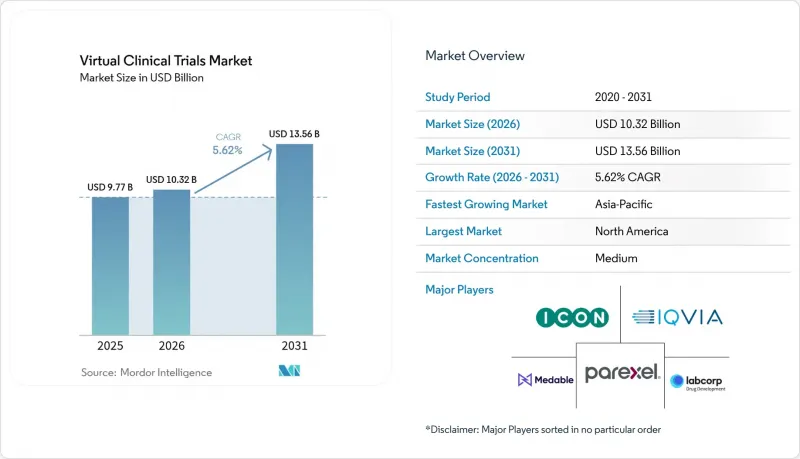
This report is Segmented by Study Design (Interventional, and More), Phase (Phase I, and More), Component (Software Platforms and Services), Delivery Mode (Web-Based, and More), End User (Medical-Device Manufacturers, and More), Indication (Oncology, and More), Geography (North America, Europe, Asia-Pacific, and More). The Market Forecasts are Provided in Terms of Value (USD).
Global Virtual Clinical Trials Market Trends and Insights
Escalating Cost & Complexity of Site-Based Trials
Traditional trial budgets continue to rise faster than R&D headcounts, pushing sponsors to search for structural savings. Medable reported 50% cost reduction and 200% faster enrollment across more than 300 trials when virtual techniques replaced physical sites. The Tufts Center calculated returns of USD 10 million for Phase II and USD 39 million for Phase III when decentralization cuts one year from timelines, largely by removing facility overhead and staff coordination. Sponsors now benchmark feasibility plans against those savings, so virtual deployment gains board-level attention. Cost sensitivity especially influences early-stage biotech firms that run multiple small cohorts concurrently. This economic driver is set to lift adoption until productivity gaps between virtual and physical execution narrow.
Post-Pandemic Regulatory Endorsement of Decentralized Models
The FDA's September 2024 final guidance confirmed telehealth visits, local laboratory use, and digital health data capture as fully acceptable within the same regulatory standards applied to site-based trials. One month later, the European Medicines Agency aligned via ICH E6(R3), effective July 2025, embedding decentralized quality-by-design principles. These endorsements neutralized prior compliance fears and opened the path for cross-border protocols with consistent monitoring rules. As a result, global sponsors can now budget virtual designs as default options rather than pilot programs. Harmonization likewise encourages mid-size firms to place multi-country oncology or rare-disease studies under a single remote governance model, accelerating the virtual clinical trials market.
Data-Privacy & Cybersecurity Risks Across Digital Endpoints
Large breaches at Oracle Health and Worldwide Clinical Trials exposed sensitive datasets, shaking sponsor confidence. Virtual designs multiply attack surfaces through home devices, Wi-Fi networks, and interconnected cloud APIs. GDPR imposes strict consent and transfer rules, adding encryption and audit trail costs. Sponsors draft layered vendor assessments and cyber liability policies before green-lighting virtual proposals, which can slow kick-off by several weeks. While no systemic regulatory halt occurred, the risk premium marginally tempers the CAGR contribution.
Other drivers and restraints analyzed in the detailed report include:
- Global Rollout of High-Speed Connectivity & Consumer Health Devices
- Rising Demand for Patient-Centric and Inclusive Participation
- Fragmented Global Regulatory & Ethics-Committee Requirements
For complete list of drivers and restraints, kindly check the Table Of Contents.
Segment Analysis
Interventional models contributed 77.20% revenue in 2025, underscoring sponsors' reliance on controlled dosing and safety oversight. This leadership anchors the virtual clinical trials market size for core drug development programs. Regulatory acceptance of remote drug administration, electronic diaries, and home nursing visits sustains share through 2031 even as new designs arise. Interventional protocols recorded a 4.08% annual growth between 2019 and 2025.
Observational studies enjoy a 7.65% forecast CAGR under mandates for real-world evidence in approval dossiers. ICH E6(R3) and FDA guidance validate passive data capture from connected devices, boosting confidence in longitudinal outcome measurement. Sponsors channel funds into prospective registry platforms and claims-linked analytics that operate in routine care settings. As that investment scales, the overall virtual clinical trials market benefits from diversified evidence streams that extend beyond investigational products.
Phase III captured 48.60% of expenditure in 2025, reflecting large patient cohorts and long follow-up periods that profit most from remote engagement. Wide geographic reach trims screen-fail attrition and retention losses, cementing the phase's contribution to the virtual clinical trials market size through 2031.
Phase I registers the quickest 8.74% growth as biotechs exploit home-based telemetry and virtual safety reviews to shorten dose escalation windows. The National Cancer Institute established a Virtual Clinical Trials Office in 2024 to escalate early oncology enrollment, signaling institutional commitment. Mid-stage Phase II protocols adapt selectively, balancing decentralized convenience with site-based imaging or biopsies when complex endpoints demand specialized facilities.
Complete Report Scope:
- By Study Design
- Interventional
- Observational
- Expanded Access
- By Phase
- Phase I
- Phase II
- Phase III
- Phase IV
- By Component
- Software Platforms
- Services
- By Delivery Mode
- Web-Based
- Cloud-Based
- On-Premise
- By End-User
- Pharmaceutical & Biopharma Companies
- Medical-Device Manufacturers
- Contract Research Organizations (CROs)
- Academic & Research Institutes
- By Indication
- Oncology
- Cardiovascular Diseases
- Neurology
- Endocrine & Metabolic
- Rare-Disease / Orphan
- Other Indications
- Geography
- North America
- United States
- Canada
- Mexico
- Europe
- Germany
- United Kingdom
- France
- Italy
- Spain
- Rest of Europe
- Asia-Pacific
- China
- Japan
- India
- Australia
- South Korea
- Rest of Asia-Pacific
- Middle East & Africa
- GCC
- South Africa
- Rest of Middle East & Africa
- South America
- Brazil
- Argentina
- Rest of South America
- North America
Geography Analysis
North America contributed 58.75% of 2025 revenue, driven by FDA clarity and robust broadband coverage that underpin high recruitment velocity. Vendors such as IQVIA, ICON, and Parexel operate turnkey hybrid models, and Palantir analytics within Parexel shave weeks from interim analyses by automating data reconciliation. Despite leadership, rising site costs and talent shortages prompt sponsors to diversify toward lower-cost regions, tempering North American share growth yet preserving absolute revenue gains for the virtual clinical trials market.
Asia-Pacific holds the highest 6.71% CAGR through 2031. Singapore's Health Sciences Authority and Australia's Therapeutic Goods Administration introduced expedited decentralized approval pathways, cutting review to roughly 90 days. Novotech's regional hubs utilize multilingual coordinators and telehealth networks reaching urban and rural sites, increasing patient diversity. Japan's Ministry of Health funds app-based adherence pilots, while China's 57% surge in trial volume underscores the region's capacity to host global pivotal studies even amid complex ethics frameworks.
Europe posts steady gains as ICH E6(R3) aligns member state expectations. GDPR adds compliance layers, yet its maturity provides clear operational playbooks for data controllers. The EU Clinical Trials Information System centralizes submissions, removing country-by-country portals that previously slowed start-up. The UK operates separate yet parallel guidance after Brexit, which still supports virtual protocols. Overall, transparent oversight outweighs the administrative load, ensuring European contribution grows in the virtual clinical trials market albeit at a moderate pace.
- IQVIA
- ICON
- Parexel International Corp.
- Labcorp (Covance)
- Oracle Health Sciences
- Medable
- Dassault Systmes (Medidata)
- Signant Health
- Science 37 Inc.
- THREAD Research
- Syneos Health
- WuXi App Tec
- Novotech CRO
- ObvioHealth
- YPrime
- Castor EDC
- Veeva Systems (Clinical Vault)
- Alira Health
- ClinOne
- MedPace
Additional Benefits:
- The market estimate (ME) sheet in Excel format
- 3 months of analyst support
TABLE OF CONTENTS
1 Introduction
- 1.1 Study Assumptions & Market Definition
- 1.2 Scope of the Study
2 Research Methodology
3 Executive Summary
4 Market Landscape
- 4.1 Market Overview
- 4.2 Market Drivers
- 4.2.1 Escalating Cost & Complexity of Site-Based Trials
- 4.2.2 Post-Pandemic Regulatory Endorsement of Decentralized Models
- 4.2.3 Global Rollout of High-Speed Connectivity & Consumer Health Devices
- 4.2.4 Rising Demand for Patient-Centric and Inclusive Participation
- 4.2.5 Oncology & Rare-Disease Pipeline Expansion Requiring Remote Access
- 4.2.6 Sponsor/CRO Investment Surge in Digital-Trial Efficiency Tools
- 4.3 Market Restraints
- 4.3.1 Data-Privacy & Cybersecurity Risks Across Digital Endpoints
- 4.3.2 Fragmented Global Regulatory & Ethics-Committee Requirements
- 4.3.3 Digital Literacy & Broadband-Access Gaps in Patient Populations
- 4.3.4 Integration Hurdles with Legacy Clinical Systems & Esource Silos
- 4.4 Regulatory Landscape
- 4.5 Porter's Five Forces Analysis
- 4.5.1 Threat of New Entrants
- 4.5.2 Bargaining Power of Suppliers
- 4.5.3 Bargaining Power of Buyers
- 4.5.4 Threat of Substitutes
- 4.5.5 Competitive Rivalry
5 Market Size & Growth Forecasts (Value, USD)
- 5.1 By Study Design
- 5.1.1 Interventional
- 5.1.2 Observational
- 5.1.3 Expanded Access
- 5.2 By Phase
- 5.2.1 Phase I
- 5.2.2 Phase II
- 5.2.3 Phase III
- 5.2.4 Phase IV
- 5.3 By Component
- 5.3.1 Software Platforms
- 5.3.2 Services
- 5.4 By Delivery Mode
- 5.4.1 Web-Based
- 5.4.2 Cloud-Based
- 5.4.3 On-Premise
- 5.5 By End-User
- 5.5.1 Pharmaceutical & Biopharma Companies
- 5.5.2 Medical-Device Manufacturers
- 5.5.3 Contract Research Organizations (CROs)
- 5.5.4 Academic & Research Institutes
- 5.6 By Indication
- 5.6.1 Oncology
- 5.6.2 Cardiovascular Diseases
- 5.6.3 Neurology
- 5.6.4 Endocrine & Metabolic
- 5.6.5 Rare-Disease / Orphan
- 5.6.6 Other Indications
- 5.7 Geography
- 5.7.1 North America
- 5.7.1.1 United States
- 5.7.1.2 Canada
- 5.7.1.3 Mexico
- 5.7.2 Europe
- 5.7.2.1 Germany
- 5.7.2.2 United Kingdom
- 5.7.2.3 France
- 5.7.2.4 Italy
- 5.7.2.5 Spain
- 5.7.2.6 Rest of Europe
- 5.7.3 Asia-Pacific
- 5.7.3.1 China
- 5.7.3.2 Japan
- 5.7.3.3 India
- 5.7.3.4 Australia
- 5.7.3.5 South Korea
- 5.7.3.6 Rest of Asia-Pacific
- 5.7.4 Middle East & Africa
- 5.7.4.1 GCC
- 5.7.4.2 South Africa
- 5.7.4.3 Rest of Middle East & Africa
- 5.7.5 South America
- 5.7.5.1 Brazil
- 5.7.5.2 Argentina
- 5.7.5.3 Rest of South America
- 5.7.1 North America
6 Competitive Landscape
- 6.1 Market Concentration
- 6.2 Market Share Analysis
- 6.3 Company Profiles (includes Global level Overview, Market level overview, Core Business Segments, Financials, Headcount, Key Information, Market Rank, Market Share, Products and Services, and analysis of Recent Developments)
- 6.3.1 IQVIA Inc.
- 6.3.2 ICON plc
- 6.3.3 Parexel International Corp.
- 6.3.4 Labcorp (Covance)
- 6.3.5 Oracle Health Sciences
- 6.3.6 Medable Inc.
- 6.3.7 Dassault Systmes (Medidata)
- 6.3.8 Signant Health
- 6.3.9 Science 37 Inc.
- 6.3.10 THREAD Research
- 6.3.11 Syneos Health
- 6.3.12 Wuxi AppTec
- 6.3.13 Novotech CRO
- 6.3.14 ObvioHealth
- 6.3.15 YPrime
- 6.3.16 Castor EDC
- 6.3.17 Veeva Systems (Clinical Vault)
- 6.3.18 Alira Health
- 6.3.19 ClinOne
- 6.3.20 Medpace Holdings Inc.
7 Market Opportunities & Future Outlook
- 7.1 White-Space & Unmet-Need Assessment

