PUBLISHER: Mordor Intelligence | PRODUCT CODE: 2116136

PUBLISHER: Mordor Intelligence | PRODUCT CODE: 2116136
Fetal Heart Rate Monitoring Device - Market Share Analysis, Industry Trends & Statistics, Growth Forecasts (2026 - 2031)
According to Mordor Intelligence, the fetal heart rate monitoring devices market size was valued at USD 0.95 billion in 2025 and estimated to grow from USD 0.99 billion in 2026 to reach USD 1.21 billion by 2031, at a CAGR of 4.05% during the forecast period (2026-2031).
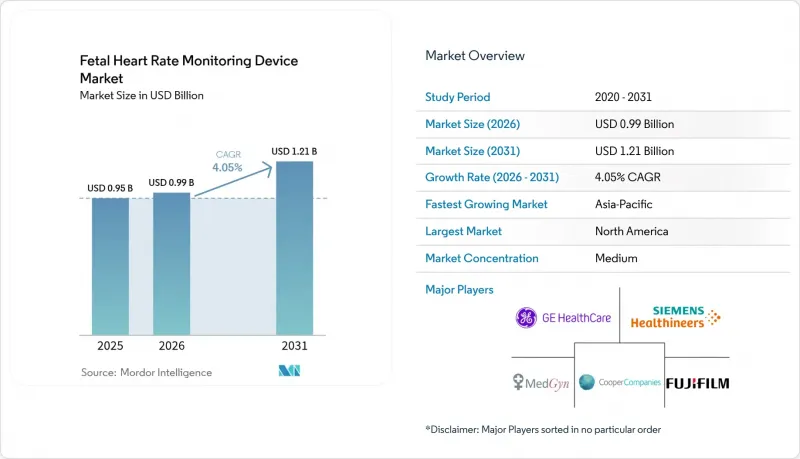
This report is Segmented by Product Type (Internal FHR Monitoring Devices, and More), Technology Type (Doppler Ultrasound Devices and Electronic Fetal Monitoring, and More), Portability (Portable and Non-Portable), Method (Non-Invasive and Invasive), End User (Hospitals, and More), and Geography (North America, Europe, and More). The Market Forecasts are Provided in Terms of Value (USD).
Global Fetal Heart Rate Monitoring Device Market Trends and Insights
Technological Breakthroughs in Wireless & Wearable Monitors
Wireless patch monitors allow continuous tracking without restricting maternal mobility. GE HealthCare's Novii+ waterproof patch captures fetal heart rate, maternal heart rate, and uterine activity from 34 weeks gestation, maintaining signal integrity across body-mass indices. Philips' Avalon CL system, rapidly cleared during the COVID-19 emergency, accelerated hospital adoption of cordless pods that reduce nurse repositioning time. Hospitals report higher patient comfort scores and shorter admission-to-delivery intervals, reinforcing reimbursement incentives tied to satisfaction metrics. Remote data streaming to electronic medical records aligns with value-based care models that reward timely clinical decisions. The trend also supports the shift toward decentralized labor suites configured for family-centered birthing experiences.
Rising Global Birth-Rate & Pre-Term Deliveries
Asia-Pacific facilities face increasing institutional deliveries as urban families choose hospital births. China's 26,000-facility maternal network guarantees 90% of households a clinic within 15 minutes, boosting equipment installations. Roughly 15 million annual pre-term births need continuous fetal surveillance, lifting demand for high-acuity monitors. A University of Helsinki study of 214,000 births linked external monitoring plus maternal pulse recording to lower neonatal encephalopathy incidence. Evidence-based guidelines consequently broaden monitoring protocols in secondary hospitals across India and Indonesia, supporting further device uptake.
Stringent Multi-Region Device Approvals
Divergent regulatory regimes raise development costs and prolong time-to-market. The EU Medical Device Regulation imposes rigorous clinical evidence and post-market surveillance, while the FDA's 2024 Quality System Regulation amendments align with ISO 13485 yet introduce new documentation layers. Japan demands domestic clinical datasets, straining foreign entrants. User fees that reach USD 365,657 for premarket approvals weigh heavily on start-ups, limiting diversity in the fetal heart rate monitoring devices market.
Other drivers and restraints analyzed in the detailed report include:
- Government & NGO Maternal-Health Programs
- AI-Driven Signal Cleaning Reduces False Positives
- High Capex & Patchy Reimbursement
For complete list of drivers and restraints, kindly check the Table Of Contents.
Segment Analysis
External devices generated 63.68% of 2025 revenues, underscoring entrenched clinician confidence in belt-based Doppler and CTG systems. The fetal heart rate monitoring devices market size for external monitors is poised to rise at a conservative 3.32% CAGR as replacement demand follows typical seven-year capital cycles. Wearable patches, though niche in absolute dollars, log an 10.62% CAGR as midwives embrace cable-free mobility that shortens labor-room turnovers. Masimo's over-the-counter Stork monitor illustrates regulatory momentum toward consumer-friendly prenatal tracking. Hospitals integrate patches into hybrid workflows-initial triage on belts followed by patches to maintain surveillance during ambulation. Internal scalp electrodes conserve a small share for complicated labors requiring direct R-wave acquisition.
User comfort and workflow efficiency drive preference shifts. Wearables eliminate gel reapplication and belt adjustments, reducing nurse workload during peak delivery periods. INVU's cloud platform lets physicians review live traces from remote clinics, widening access in obstetric deserts. Academic prototypes such as Electric Potential Sensing promise gel-free external ECG, signaling a longer-term pathway for non-adhesive wearables. As reimbursement codes coalesce around home monitoring, suppliers position subscription models bundling hardware, analytics, and teleconsulting.
Doppler ultrasound retained 50.94% share in 2025, benefiting from well-established training curricula and ubiquitous repair networks. Nonetheless, the fetal electrocardiography (FECG) segment records an 11.18% CAGR through 2031 as objective waveform analysis addresses observer variability fears. The fetal heart rate monitoring devices market share held by Doppler is expected to dip marginally as tertiary centers pilot multichannel FECG combined with AI prediction modules. Huntleigh's 2025 CTG Analysis clearance demonstrates continued Doppler software refinement rather than hardware displacement.
Clinical evidence fuels FECG momentum. Literature reviews highlight reduced false alarms and clearer arrhythmia detection compared with Doppler. Yet upfront costs and learning curves confine adoption to high-risk units. Magnetocardiography remains restricted to research owing to shielded facility requirements and multimillion-dollar price tags. CTG stays routine for twin gestations where dual fetal heart tracing is necessary, and newer algorithms now auto-segregate signals even with overlapping heart rates.
Complete Report Scope:
- By Product Type
- Internal FHR Monitoring Devices
- External FHR Monitoring Devices
- Wearable Patch-based Monitors
- Remote/Home-use Doppler Monitors
- By Technology Type
- Doppler Ultrasound Devices
- Electronic Fetal Monitoring (CTG)
- Fetal Electrocardiography (FECG)
- Magnetocardiography
- By Portability
- Portable Devices
- Non-portable Devices
- By Method
- Non-invasive Monitoring
- Invasive Monitoring
- By End User
- Hospitals
- Specialty Maternity Clinics
- Home-care Settings
- Geography
- North America
- United States
- Canada
- Mexico
- Europe
- Germany
- United Kingdom
- France
- Italy
- Spain
- Rest of Europe
- Asia-Pacific
- China
- Japan
- India
- South Korea
- Australia
- Rest of Asia-Pacific
- Middle East and Africa
- GCC
- South Africa
- Rest of Middle East and Africa
- South America
- Brazil
- Argentina
- Rest of South America
- North America
Geography Analysis
North America accounted for 42.10% of 2025 revenue due to comprehensive Medicare and private-payer coverage policies that absorb capital costs for next-generation monitors. High malpractice awards, exemplified by a USD 120 million verdict over delayed cesarean, keep hospitals vigilant about trace quality and documentation. Federal initiatives to reduce maternal deaths incentivize procurement of AI-enhanced systems, while tightened HIPAA provisions bolster confidence in cloud storage. Vendor service contracts prioritizing uptime protect against ransomware incidents flagged by the proposed Security Rule revisions.
Asia-Pacific is the fastest-growing region with a 8.71% CAGR through 2031, propelled by demographic pressures and large-scale public health investments. China's maternal network ensures near-universal physical access, and hospital accreditation upgrades require modern fetal monitors. India's Ayushman Arogya Mandirs integrate fetal monitoring into primary care, supported by National Health Mission funding. Regional start-ups leverage low-cost mobile CTG to serve rural clinics without mains electricity, broadening the addressable customer base. Nonetheless, varied device approval timelines and fragmented reimbursement slow uniform adoption.
Europe maintains moderate expansion as MDR compliance lengthens product refresh cycles. Hospitals weigh investment in AI-equipped monitors against budget constraints imposed by national health systems. GDPR influences system design: suppliers incorporate on-premise servers or EU-hosted clouds to meet data-sovereignty rules. Scandinavian pilot projects such as Norway's Mum-Care smartphone app illustrate the region's embrace of digital prenatal support, yet commercialization hinges on multicountry reimbursement alignment. Middle-East and Africa see pockets of innovation; Jordan's digital reproductive health registry shows data-driven service planning, while Ugandan midwives apply AI ultrasound to offset specialist shortages.
- Koninklijke Philips
- GE Healthcare
- Siemens Healthineers
- The Cooper Companies
- MedGyn Products
- Edan Instruments Inc.
- Bionet America
- Trismed Co. Ltd.
- Mindray
- Fujifilm Holdings Corp.
- Natus Medical
- Masimo
- Huntleigh Healthcare (Arjo)
- Atom Medical Corp.
- Analogic
- Spacelabs Healthcare
- Neoventa Medical AB
- Viatom Technology Ltd.
- Monica Healthcare
- Shenzhen Heal Force Bio-Medical
Additional Benefits:
- The market estimate (ME) sheet in Excel format
- 3 months of analyst support
TABLE OF CONTENTS
1 Introduction
- 1.1 Study Assumptions & Market Definition
- 1.2 Scope of the Study
2 Research Methodology
3 Executive Summary
4 Market Landscape
- 4.1 Market Overview
- 4.2 Market Drivers
- 4.2.1 Technological Breakthroughs In Wireless & Wearable Monitors
- 4.2.2 Rising Global Birth-Rate & Pre-Term Deliveries
- 4.2.3 Government & NGO Maternal-Health Programs
- 4.2.4 Surge In Home-Use Doppler Adoption
- 4.2.5 AI-Driven Signal-Cleaning Cuts False Positives
- 4.2.6 Tele-Obstetric Reimbursement Expansion
- 4.3 Market Restraints
- 4.3.1 Stringent Multi-Region Device Approvals
- 4.3.2 High Capex & Patchy Reimbursement
- 4.3.3 Litigation Risk From CTG-Linked C-Sections
- 4.3.4 Data-Privacy Concerns In Cloud Platforms
- 4.4 Porter's Five Forces
- 4.4.1 Bargaining Power of Buyers/Consumers
- 4.4.2 Bargaining Power of Suppliers
- 4.4.3 Threat of New Entrants
- 4.4.4 Threat of Substitute Products
- 4.4.5 Intensity of Competitive Rivalry
5 Market Size & Growth Forecasts (Value, USD)
- 5.1 By Product Type
- 5.1.1 Internal FHR Monitoring Devices
- 5.1.2 External FHR Monitoring Devices
- 5.1.3 Wearable Patch-based Monitors
- 5.1.4 Remote/Home-use Doppler Monitors
- 5.2 By Technology Type
- 5.2.1 Doppler Ultrasound Devices
- 5.2.2 Electronic Fetal Monitoring (CTG)
- 5.2.3 Fetal Electrocardiography (FECG)
- 5.2.4 Magnetocardiography
- 5.3 By Portability
- 5.3.1 Portable Devices
- 5.3.2 Non-portable Devices
- 5.4 By Method
- 5.4.1 Non-invasive Monitoring
- 5.4.2 Invasive Monitoring
- 5.5 By End User
- 5.5.1 Hospitals
- 5.5.2 Specialty Maternity Clinics
- 5.5.3 Home-care Settings
- 5.6 Geography
- 5.6.1 North America
- 5.6.1.1 United States
- 5.6.1.2 Canada
- 5.6.1.3 Mexico
- 5.6.2 Europe
- 5.6.2.1 Germany
- 5.6.2.2 United Kingdom
- 5.6.2.3 France
- 5.6.2.4 Italy
- 5.6.2.5 Spain
- 5.6.2.6 Rest of Europe
- 5.6.3 Asia-Pacific
- 5.6.3.1 China
- 5.6.3.2 Japan
- 5.6.3.3 India
- 5.6.3.4 South Korea
- 5.6.3.5 Australia
- 5.6.3.6 Rest of Asia-Pacific
- 5.6.4 Middle East and Africa
- 5.6.4.1 GCC
- 5.6.4.2 South Africa
- 5.6.4.3 Rest of Middle East and Africa
- 5.6.5 South America
- 5.6.5.1 Brazil
- 5.6.5.2 Argentina
- 5.6.5.3 Rest of South America
- 5.6.1 North America
6 Competitive Landscape
- 6.1 Market Concentration
- 6.2 Market Share Analysis
- 6.3 Company Profiles (includes Global level Overview, Market level overview, Core Segments, Financials as available, Strategic Information, Market Rank/Share for key companies, Products & Services, and Recent Developments)
- 6.3.1 Koninklijke Philips N.V.
- 6.3.2 GE Healthcare
- 6.3.3 Siemens Healthineers
- 6.3.4 Cooper Companies Inc.
- 6.3.5 MedGyn Products Inc.
- 6.3.6 Edan Instruments Inc.
- 6.3.7 Bionet America
- 6.3.8 Trismed Co. Ltd.
- 6.3.9 Mindray Medical International Ltd.
- 6.3.10 Fujifilm Holdings Corp.
- 6.3.11 Natus Medical Inc.
- 6.3.12 Masimo Corporation
- 6.3.13 Huntleigh Healthcare (Arjo)
- 6.3.14 Atom Medical Corp.
- 6.3.15 Analogic Corporation
- 6.3.16 Spacelabs Healthcare
- 6.3.17 Neoventa Medical AB
- 6.3.18 Viatom Technology Ltd.
- 6.3.19 Monica Healthcare
- 6.3.20 Shenzhen Heal Force Bio-Medical
7 Market Opportunities & Future Outlook
- 7.1 White-space & Unmet-Need Assessment

