PUBLISHER: Mordor Intelligence | PRODUCT CODE: 2116140

PUBLISHER: Mordor Intelligence | PRODUCT CODE: 2116140
Regulatory Reporting And Compliance - Market Share Analysis, Industry Trends & Statistics, Growth Forecasts (2026 - 2031)
According to Mordor Intelligence, the regulatory reporting and compliance market size in 2026 is estimated at USD 4.70 billion, growing from 2025 value of USD 4.31 billion with 2031 projections showing USD 7.24 billion, growing at 9.03% CAGR over 2026-2031.
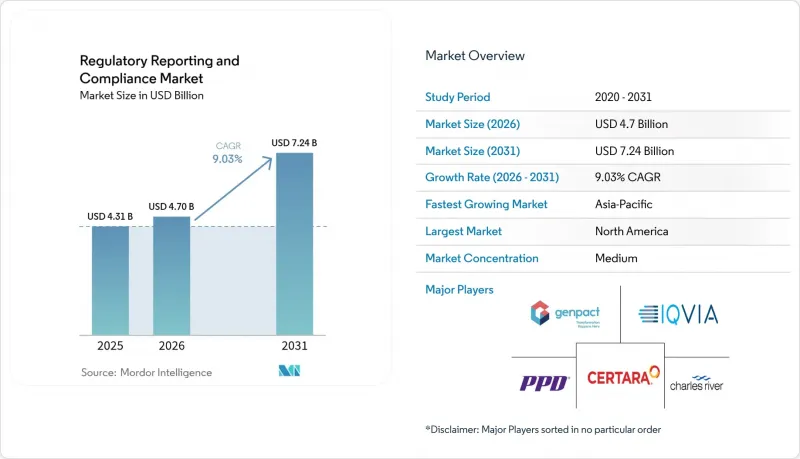
This report is Segmented by Service Type (Regulatory Consulting, Product Registration & Clinical Trial Applications, and More), Service Provider Type (In-House and Outsourcing), End User (Pharmaceutical Companies, Medical Device Companies, and Biotechnology Companies), and Geography (North America, Europe, and More). The Market Forecasts are Provided in Terms of Value (USD).
Global Regulatory Reporting And Compliance Market Trends and Insights
Growing Demand for Faster Approval Process
Breakthrough therapy designation halves FDA review timelines, creating premium demand for advisory services that compress submissions without compromising rigor. Specialized regulatory writers now command 40% price premiums for expedited dossiers. Real-world evidence (RWE) guidelines, updated in 2024, open new acceleration avenues yet require advanced analytics unavailable in most in-house teams. As sponsors harness RWE, external partners with robust data-science capabilities help navigate evolving evidence standards. This emphasis on speed sustains above-market fee structures and cements deep vendor-client collaboration. Competitive pressure to reduce launch gaps reinforces the regulatory reporting and compliance market's strategic value proposition.
Continuously Changing Regulatory Landscape
In 2024, regulators issued more than 200 substantive guideline updates, forcing companies to maintain continuous surveillance. China's National Medical Products Administration released 15 new technical guidelines, reshaping dossier formats and safety-reporting thresholds. Timely interpretation of overlapping national and ICH frameworks now exceeds the capacity of many internal teams. Hybrid models blend core expertise with specialized consultants for jurisdiction-specific compliance, enabling flexible resource allocation. While global harmonization holds long-term promise, near-term complexity keeps external advisory services indispensable. Companies allocating higher budgets for horizon-scanning tools illustrate the regulatory reporting and compliance market's resilience.
Lack of Technologically Advanced Infrastructure in Developing Nations
Paper-based processes persist in India, Brazil, and parts of Africa, forcing multinational sponsors to run parallel paper and electronic workflows, inflating compliance costs by up to 30%. Government-funded upgrades progress unevenly, leaving implementation gaps that hamper cloud-based submissions. Vendors address the divide through hybrid solutions combining low-bandwidth portals with on-site scanning hubs. Nonetheless, slow modernization tempers adoption of advanced AI-driven tools, moderating the regulatory reporting and compliance market's broader CAGR.
Other drivers and restraints analyzed in the detailed report include:
- Digitalization of Regulatory Processes
- Increasing Complexity of Multi-Region Clinical Trials
- Shortage of Skilled Regulatory-Affairs Professionals
For complete list of drivers and restraints, kindly check the Table Of Contents.
Segment Analysis
Consulting captured 28.10% of the regulatory reporting and compliance market share in 2025 on the strength of expertise in navigating complex submission pathways. Regulatory writing and publishing is accelerating at an 11.10% CAGR, supported by the FDA's enhanced eCTD and the EMA's structured-data mandates. This rise in automation, artificial-intelligence content generation, and cloud-enabled template libraries reshapes resource allocation, prompting consultants to integrate technology partnerships. As sponsors prioritize speed, specialized writing teams deliver machine-readable dossiers that satisfy global agencies' evolving technical standards. Meanwhile, legal-representation services grow steadily due to increased FDA warning-letter activity, and pharmacovigilance consulting gains momentum amid expanded post-market safety requirements.
Digitization casts consulting firms as technology orchestrators rather than pure advisory bodies. To protect margins, incumbents embed proprietary natural-language processing engines that auto-populate Module 3 and 5 components. This integration repositions human experts toward high-value strategic content. Consulting's incumbency remains resilient, yet providers without technology roadmaps risk commoditization. Over the forecast period, the regulatory reporting and compliance market will witness convergence between content generation, data-engineering, and strategic advisory as clients demand unified, technology-enabled service suites.
Complete Report Scope:
- By Service Type
- Regulatory Consulting
- Product Registration & Clinical Trial Applications
- Legal Representation
- Regulatory Writing & Publishing
- Other Regulatory Services
- By Service Provider Type
- In-House
- Outsourcing
- By End User
- Pharmaceutical Companies
- Medical Device Companies
- Biotechnology Companies
- Geography
- North America
- United States
- Canada
- Mexico
- Europe
- Germany
- United Kingdom
- France
- Italy
- Spain
- Rest of Europe
- Asia-Pacific
- China
- Japan
- India
- Australia
- South Korea
- Rest of Asia-Pacific
- Middle East & Africa
- GCC
- South Africa
- Rest of Middle East & Africa
- South America
- Brazil
- Argentina
- Rest of South America
- Brazil
- Argentina
- Rest of South America
- North America
Geography Analysis
North America controlled 41.10% of the regulatory reporting and compliance market size in 2025, anchored by stringent FDA standards and a high concentration of large pharmaceutical sponsors. The agency's adoption of AI-assisted review tools elevates technical-compliance requirements, channeling demand toward consultants adept in machine-readable submissions. Canada's participation in Project Orbis and alignment with FDA oncology frameworks further sparks cross-border advisory engagements. Intellectual-property protection and strong venture funding amplify the region's outsourcing budgets, sustaining above-average service pricing.
Asia-Pacific is the fastest-growing region at a 10.15% CAGR through 2031, powered by China's regulatory reform agenda, Japan's PMDA consultation enhancements, and India's digital-submission pilot programs. Diversity of regulatory maturity creates fragmented demand patterns: global firms need local partners to interpret country-specific rules, while indigenous manufacturers seek expertise to meet FDA and EMA export requirements. Vendors that establish regional centers with bilingual teams and real-time intelligence platforms capture early-mover advantages in the regulatory reporting and compliance market.
Europe remains a mature but evolving arena. EMA's ongoing digital-transformation roadmap and the UK MHRA's post-Brexit divergence introduce complexity that bolsters advisory fees. Sustainability-related disclosure obligations broaden the compliance remit, creating opportunities for ESG-focused consultants. Northern and Western Europe lead digital adoption, whereas Central and Eastern sub-regions lag, opening niche engagements for infrastructure modernization. Elsewhere, Latin America, the Middle East, and Africa register slower uptake due to limited technical infrastructure but represent long-term opportunities as multinationals expand trials and manufacturing footprints. Targeted capacity-building initiatives by global health agencies gradually unlock new consulting revenue streams.
- Accenture
- AmerisourceBergen / Cencora
- Celegence
- Certara
- Charles River
- Clinilabs
- Freyr Solutions
- Genpact
- ICON
- Indegene
- IQVIA
- LabCorp
- MED-EL
- Navitas Life Sciences
- Parexel International
- PharmaLex GmbH
- PPD
- ProPharma Group
- Syneos Health
- WuXi App Tec
Additional Benefits:
- The market estimate (ME) sheet in Excel format
- 3 months of analyst support
TABLE OF CONTENTS
1 Introduction
- 1.1 Study Assumptions & Market Definition
- 1.2 Scope of the Study
2 Research Methodology
3 Executive Summary
4 Market Landscape
- 4.1 Market Overview
- 4.2 Market Drivers
- 4.2.1 Growing Demand For Faster Approval Process
- 4.2.2 Continuously Changing Regulatory Landscape
- 4.2.3 Digitalization of Regulatory Processes
- 4.2.4 Increasing Complexity of Multi-Region Clinical Trials
- 4.2.5 AI-Enabled Regulatory-Intelligence Platforms Shorten Dossier Cycles
- 4.2.6 ESG-Driven Disclosure Mandates Expand Compliance Scope
- 4.3 Market Restraints
- 4.3.1 Lack of Technologically Advanced Infrastructure in Developing Nations
- 4.3.2 Complicated Local and Global Regulatory Norms
- 4.3.3 Shortage of Skilled Regulatory-Affairs Professionals
- 4.3.4 Cyber-Security & Data-Residency Hurdles for Cloud Compliance Tools
- 4.4 Value / Supply-Chain Analysis
- 4.5 Regulatory Landscape
- 4.6 Technological Outlook
- 4.7 Porter's Five Forces Analysis
- 4.7.1 Threat of New Entrants
- 4.7.2 Bargaining Power of Buyers
- 4.7.3 Bargaining Power of Suppliers
- 4.7.4 Threat of Substitutes
- 4.7.5 Intensity of Competitive Rivalry
5 Market Size & Growth Forecasts (Value, USD)
- 5.1 By Service Type
- 5.1.1 Regulatory Consulting
- 5.1.2 Product Registration & Clinical Trial Applications
- 5.1.3 Legal Representation
- 5.1.4 Regulatory Writing & Publishing
- 5.1.5 Other Regulatory Services
- 5.2 By Service Provider Type
- 5.2.1 In-House
- 5.2.2 Outsourcing
- 5.3 By End User
- 5.3.1 Pharmaceutical Companies
- 5.3.2 Medical Device Companies
- 5.3.3 Biotechnology Companies
- 5.4 Geography
- 5.4.1 North America
- 5.4.1.1 United States
- 5.4.1.2 Canada
- 5.4.1.3 Mexico
- 5.4.2 Europe
- 5.4.2.1 Germany
- 5.4.2.2 United Kingdom
- 5.4.2.3 France
- 5.4.2.4 Italy
- 5.4.2.5 Spain
- 5.4.2.6 Rest of Europe
- 5.4.3 Asia-Pacific
- 5.4.3.1 China
- 5.4.3.2 Japan
- 5.4.3.3 India
- 5.4.3.4 Australia
- 5.4.3.5 South Korea
- 5.4.3.6 Rest of Asia-Pacific
- 5.4.4 Middle East & Africa
- 5.4.4.1 GCC
- 5.4.4.2 South Africa
- 5.4.4.3 Rest of Middle East & Africa
- 5.4.5 South America
- 5.4.5.1 Brazil
- 5.4.5.2 Argentina
- 5.4.5.3 Rest of South America
- 5.4.5.4 Brazil
- 5.4.5.5 Argentina
- 5.4.5.6 Rest of South America
- 5.4.1 North America
6 Competitive Landscape
- 6.1 Market Concentration
- 6.2 Market Share Analysis
- 6.3 Company Profiles (includes Global level Overview, Market level overview, Core Segments, Financials as available, Strategic Information, Market Rank/Share for key companies, Products & Services, and Recent Developments)
- 6.3.1 Accenture
- 6.3.2 AmerisourceBergen / Cencora
- 6.3.3 Celegence LLC
- 6.3.4 Certara LP
- 6.3.5 Charles River Laboratories International Inc.
- 6.3.6 Clinilabs Inc.
- 6.3.7 Freyr Solutions
- 6.3.8 Genpact Ltd
- 6.3.9 ICON PLC
- 6.3.10 Indegene
- 6.3.11 IQVIA Holdings Inc.
- 6.3.12 Labcorp Drug Development
- 6.3.13 Medelis Inc.
- 6.3.14 Navitas Life Sciences
- 6.3.15 Parexel International Corporation
- 6.3.16 PharmaLex GmbH
- 6.3.17 Pharmaceutical Product Development LLC (PPD)
- 6.3.18 ProPharma Group
- 6.3.19 Syneos Health
- 6.3.20 WuXi AppTec
7 Market Opportunities & Future Outlook
- 7.1 White-space & Unmet-Need Assessment

