PUBLISHER: Mordor Intelligence | PRODUCT CODE: 2116145

PUBLISHER: Mordor Intelligence | PRODUCT CODE: 2116145
PCR Molecular Diagnostics - Market Share Analysis, Industry Trends & Statistics, Growth Forecasts (2026 - 2031)
According to Mordor Intelligence, the PCR molecular diagnostics market size was valued at USD 9.74 billion in 2025 and estimated to grow from USD 10.26 billion in 2026 to reach USD 13.31 billion by 2031, at a CAGR of 5.36% during the forecast period (2026-2031).
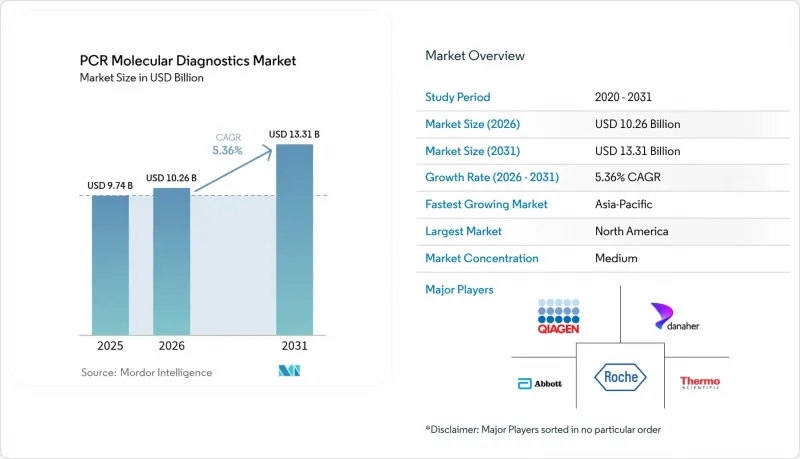
This report is Segmented by Product Type (Instrument, Reagents and Consumables and Software), Application (Infectious Disease Testing, Oncology Testing, Other Applications), End User (Hospitals, Diagnostic & Reference Laboratories, and More), and Geography (North America, Europe, Asia-Pacific, Middle East and Africa, and South America). The Market Forecasts are Provided in Terms of Value (USD).
Global PCR Molecular Diagnostics Market Trends and Insights
Rising Infectious-Disease and Cancer Incidence
Escalating global disease burdens anchor demand for molecular assays across the PCR molecular diagnostics market. The American Cancer Society anticipates 2,041,910 new cancer diagnoses and 618,000 deaths in the United States during 2025, heightening the urgency for early detection strategies. Concurrently, paediatric hospitalisations linked to human metapneumovirus rose 17% versus 2023 across the United States and China, underscoring the need for rapid respiratory-virus differentiation. PCR offers attomolar sensitivity, enabling clinicians to guide antivirals, isolate patients more precisely and monitor minimal residual disease after therapy. Because 40% of new cancer cases are considered preventable through earlier detection, payers and policymakers increasingly treat molecular diagnostics as cost-saving rather than discretionary. The result is sustained throughput growth across centralised and near-patient laboratories within the PCR molecular diagnostics market.
Technological Innovation in PCR Chemistry & Instrumentation
Rapid-cycle enzymes, microfluidics and digitisation are rewriting performance benchmarks within the PCR molecular diagnostics market. Extreme-PCR protocols now compress complete thermocycles into 15 seconds, raising hourly sample capacity without raising instrument footprints. Digital PCR partitions reaction volumes into thousands of nanodroplets, reaching 0.01% variant calls that were once the sole province of next-generation sequencing. AI is becoming integral to quality control; Seegene is co-developing a Digitalized Development System with Microsoft that automates primer design and detects signal anomalies in real time. These advances collectively elevate sensitivity, shorten turn-around-time and lower operator variability, thereby expanding oncology monitoring, transplant surveillance and wastewater-based epidemiology within the PCR molecular diagnostics market.
High Capital and Consumable Costs
Cutting-edge digital PCR instruments can exceed USD 250,000 per unit, a barrier for district hospitals that operate under tight capital budgets. Ongoing reagent outlays compound the burden because chemistry often represents 55-65% of lifetime testing expenses. Liquid-biopsy panels cost USD 500-3,000 each, limiting routine oncology follow-up outside high-income markets. Although manufacturing scale and open-channel chemistries are nudging prices downward, the near-term reality is a two-tier diagnostic ecosystem where sophisticated assays cluster in major medical centres. Smaller laboratories therefore outsource samples, extending turn-around-times and tempering volume growth in parts of the PCR molecular diagnostics market.
Other drivers and restraints analyzed in the detailed report include:
- Adoption of Syndromic and Multiplex Panels
- Decentralised and Point-of-Care Molecular Testing
- Regulatory Complexity and Reimbursement Uncertainty
For complete list of drivers and restraints, kindly check the Table Of Contents.
Segment Analysis
Reagents and consumables produced the largest slice of 2025 revenue at 54.72% because every test run mandates fresh primers, probes and buffers, creating a predictable annuity business model inside the PCR molecular diagnostics market. Digital PCR instruments, though currently a minority in installed base, logged the quickest adoption pace due to absolute quantification and orders-of-magnitude gains in analytical sensitivity. For example, Bio-Rad's droplet partitioning routinely detects rare alleles down to 0.01%, enabling detection of circulating tumour DNA in a standard blood draw. Standard thermocyclers still populate many regional hospitals thanks to lower acquisition costs, whereas real-time systems occupy a middle tier by offering quantitation without the capital intensity of digital.
Software and analytical services are emerging revenue streams as laboratories wrestle with data lakes generated by high-throughput systems. Roche's LightCycler PRO integrates automatic calibration and robotics to lift walk-away time, and QIAGEN plans more than 100 new QIAcuity assays by 2028 after obtaining CE mark for its syndromic respiratory menu in late 2024. These developments highlight how engineering and bioinformatics advances continue to extend the value proposition of each instrument generation within the PCR molecular diagnostics market.
Complete Report Scope:
- By Product
- Instrument
- Standard PCR Systems
- Real-time PCR Systems
- Digital PCR Systems
- Reagents & Consumables
- Software & Services
- Instrument
- By Application
- Infectious Disease Testing
- Oncology Testing
- Other Applications
- By End User
- Hospitals
- Diagnostic & Reference Laboratories
- Academic & Research Institutes
- Other End Users
- Geography
- North America
- United States
- Canada
- Mexico
- Europe
- Germany
- United Kingdom
- France
- Italy
- Spain
- Rest of Europe
- Asia-Pacific
- China
- Japan
- India
- South Korea
- Australia
- Rest of Asia-Pacific
- Middle-East and Africa
- GCC
- South Africa
- Rest of Middle East and Africa
- South America
- Brazil
- Argentina
- Rest of South America
- North America
Geography Analysis
North America generated 41.62% of global revenue in 2025. Federal funding streams reinforce this leadership position; the U.S. Defense Health Program's FY 2025 budget allocates substantial outlays for precision-medicine and genomic-surveillance projects. Large hospital networks frequently run dual platforms-high-throughput core-lab thermocyclers for routine testing and mobile units for operating rooms-creating layered demand across the PCR molecular diagnostics market size. FDA regulatory tightening is expected to spur lab consolidation but also encourage standardisation, possibly elevating U.S. export competitiveness for cleared kits.
Asia-Pacific is forecast to record a 6.27% CAGR through 2031, the fastest worldwide. Governments in China, India and South Korea earmark expanding precision-medicine budgets, while private laboratories race to meet oncology-panel demand. Japan currently leads regional adoption in oncology-focused testing, holding roughly 41% share of that application niche during 2023. Public-health authorities in Southeast Asia embrace point-of-care PCR for dengue and respiratory outbreaks to compensate for central-lab shortages. This multifaceted growth portfolio positions the region as the most dynamic frontier for the PCR molecular diagnostics market.
Europe maintains robust share on the back of universal-health-coverage frameworks and strong academic-industry R&D consortia. Implementation of the In Vitro Diagnostic Regulation is prompting earlier engagement between manufacturers and notified bodies, lengthening approval timelines yet raising device quality and post-market surveillance. In contrast, Latin America, Middle East and Africa constitute nascent but high-potential territories where decentralised platforms circumvent infrastructural deficits. Pilots deploying GeneXpert units in remote clinics illustrate the impact of real-time tuberculosis confirmation on treatment initiation and antibiotic stewardship, gradually stitching these regions into the global PCR molecular diagnostics market value chain.
- Roche
- Thermo Fisher Scientific
- Danaher
- QIAGEN
- Abbott Laboratories
- Bio-Rad Laboratories
- Agilent Technologies
- Beckton Dickinson
- Takara Bio
- Promega
- LGC Ltd. (Biosearch Technologies)
- PerkinElmer Inc. (Revvity)
- Standard BioTools Inc. (Fluidigm)
- Seegene
- Analytik Jena GmbH
- BGI Genomics Co. Ltd.
- Sysmex Inostics GmbH
- QuantuMDx Group
- DiaSorin
- Hologic
- Luminex
Additional Benefits:
- The market estimate (ME) sheet in Excel format
- 3 months of analyst support
TABLE OF CONTENTS
1 Introduction
- 1.1 Study Assumptions & Market Definition
- 1.2 Scope of the Study
2 Research Methodology
3 Executive Summary
4 Market Landscape
- 4.1 Market Overview
- 4.2 Market Drivers
- 4.2.1 Growing Global Incidence of Infectious Diseases and Cancer
- 4.2.2 Continuous Technological Innovations in PCR Instrumentation & Chemistry
- 4.2.3 Increasing Adoption of Syndromic and Multiplex PCR Panels for Rapid Diagnosis
- 4.2.4 Expansion of Decentralised & Point-of-Care Molecular Testing Platforms
- 4.2.5 Government Screening Programs & Public-Health Funding for Molecular Diagnostics
- 4.2.6 Rising Demand for Precision Medicine & Companion Diagnostics in Oncology
- 4.3 Market Restraints
- 4.3.1 High Capital Investment and Consumable Costs of Advanced PCR Systems
- 4.3.2 Complex Regulatory Approval Pathways and Reimbursement Uncertainties
- 4.3.3 Limited Availability of Skilled Molecular Laboratory Workforce
- 4.3.4 Growing Competition from Isothermal Amplification and CRISPR-based Diagnostics
- 4.4 Regulatory Outlook
- 4.5 Porter's Five Forces Analysis
- 4.5.1 Threat of New Entrants
- 4.5.2 Bargaining Power of Buyers
- 4.5.3 Bargaining Power of Suppliers
- 4.5.4 Threat of Substitutes
- 4.5.5 Intensity of Competitive Rivalry
5 Market Size & Growth Forecasts (Value, USD)
- 5.1 By Product
- 5.1.1 Instrument
- 5.1.1.1 Standard PCR Systems
- 5.1.1.2 Real-time PCR Systems
- 5.1.1.3 Digital PCR Systems
- 5.1.2 Reagents & Consumables
- 5.1.3 Software & Services
- 5.1.1 Instrument
- 5.2 By Application
- 5.2.1 Infectious Disease Testing
- 5.2.2 Oncology Testing
- 5.2.3 Other Applications
- 5.3 By End User
- 5.3.1 Hospitals
- 5.3.2 Diagnostic & Reference Laboratories
- 5.3.3 Academic & Research Institutes
- 5.3.4 Other End Users
- 5.4 Geography
- 5.4.1 North America
- 5.4.1.1 United States
- 5.4.1.2 Canada
- 5.4.1.3 Mexico
- 5.4.2 Europe
- 5.4.2.1 Germany
- 5.4.2.2 United Kingdom
- 5.4.2.3 France
- 5.4.2.4 Italy
- 5.4.2.5 Spain
- 5.4.2.6 Rest of Europe
- 5.4.3 Asia-Pacific
- 5.4.3.1 China
- 5.4.3.2 Japan
- 5.4.3.3 India
- 5.4.3.4 South Korea
- 5.4.3.5 Australia
- 5.4.3.6 Rest of Asia-Pacific
- 5.4.4 Middle-East and Africa
- 5.4.4.1 GCC
- 5.4.4.2 South Africa
- 5.4.4.3 Rest of Middle East and Africa
- 5.4.5 South America
- 5.4.5.1 Brazil
- 5.4.5.2 Argentina
- 5.4.5.3 Rest of South America
- 5.4.1 North America
6 Competitive Landscape
- 6.1 Market Concentration
- 6.2 Strategic Moves
- 6.3 Market Share Analysis
- 6.4 Company Profiles (includes Global level Overview, Market level overview, Core Business Segments, Financials, Headcount, Key Information, Market Rank, Market Share, Products and Services, and analysis of Recent Developments)
- 6.4.1 F. Hoffmann-La Roche Ltd.
- 6.4.2 Thermo Fisher Scientific Inc.
- 6.4.3 Danaher
- 6.4.4 QIAGEN N.V.
- 6.4.5 Abbott Laboratories
- 6.4.6 Bio-Rad Laboratories Inc.
- 6.4.7 Agilent Technologies Inc.
- 6.4.8 Becton Dickinson and Company
- 6.4.9 Takara Bio Inc.
- 6.4.10 Promega Corporation
- 6.4.11 LGC Ltd. (Biosearch Technologies)
- 6.4.12 PerkinElmer Inc. (Revvity)
- 6.4.13 Standard BioTools Inc. (Fluidigm)
- 6.4.14 Seegene Inc.
- 6.4.15 Analytik Jena GmbH
- 6.4.16 BGI Genomics Co. Ltd.
- 6.4.17 Sysmex Inostics GmbH
- 6.4.18 QuantuMDx Group Ltd.
- 6.4.19 DiaSorin S.p.A.
- 6.4.20 Hologic Inc.
- 6.4.21 Luminex Corporation
7 Market Opportunities & Future Outlook
- 7.1 White-Space & Unmet-Need Assessment

